Physical Address
304 North Cardinal St.
Dorchester Center, MA 02124
Physical Address
304 North Cardinal St.
Dorchester Center, MA 02124

The third outage in a single winter is when the math changes. You have already tried the 5,000-watt bargain unit — it ran the fridge and a lamp but tripped every time the well pump cycled. You have already tried juggling extension cords across two floors. You have already sat in a cold kitchen at 11 p.m. reading forum threads about interlock kits.
What good actually looks like is narrower than the marketing suggests: one machine that starts on the first push in freezing weather, carries a well pump, a furnace blower, a fridge and a lighting circuit at the same time, and can be wired to your panel so you are not running cords out a window.
The DuroMax XP13000HX claims to be exactly that — a portable unit with home-standby output. Our DuroMax XP13000HX review puts that claim through three weeks, 41 logged hours, two real outages and a lot of propane. We bought the unit at retail. What follows is the DuroMax XP13000HX review honest opinion you would get from a friend who actually owns one. We have tested this class before — see our Westinghouse WGen9500DF generator review — and the bar is not low.
At a Glance: DuroMax XP13000HX
| Overall score | 8.6/10 |
| Performance | 9/10 |
| Ease of use | 8/10 |
| Build quality | 8.5/10 |
| Value for money | 8.5/10 |
| Price at review | 1399USD |
This score reflects genuine whole-home capability at a portable price, held back by real weight, real noise and a fuel appetite that will surprise anyone used to a smaller unit.
Portable generators in 2026 fall into three genuinely different camps, and confusing them is how people end up disappointed.
The first camp is inverter generators — quiet, lightweight, clean sine-wave power, but typically capped around 3,000 to 4,500 watts. Great for a camper or a tailgate, useless for a well pump and a furnace at once. The second camp is home standby generators — fully automatic, permanently installed, 10kW to 24kW, and typically $5,000 to $12,000 installed. The third camp is the conventional open-frame portable: high wattage, loud, relatively cheap, manual everything.
The XP13000HX deliberately blurs camps two and three. It is a 245-pound open-frame portable with a 120/240V 50-amp outlet, which means it can legally and practically feed a house panel through a transfer switch or interlock kit. That is standby-generator capability in a unit you can roll into a shed.
DuroMax has been building portable generators since 2003 and is now headquartered in Texas. Their specific claim here is that this machine delivers “the power normally found in stationary home standby generators but in a more affordable, portable package.” You can read the full specification set at DuroMax Power Equipment. At 1399USD, it sits a few hundred dollars under the nearest tri-fuel competitor, which is exactly why it earned a full DuroMax XP13000HX review rather than a spec-sheet summary. This category is unforgiving — small output shortfalls become cold houses.
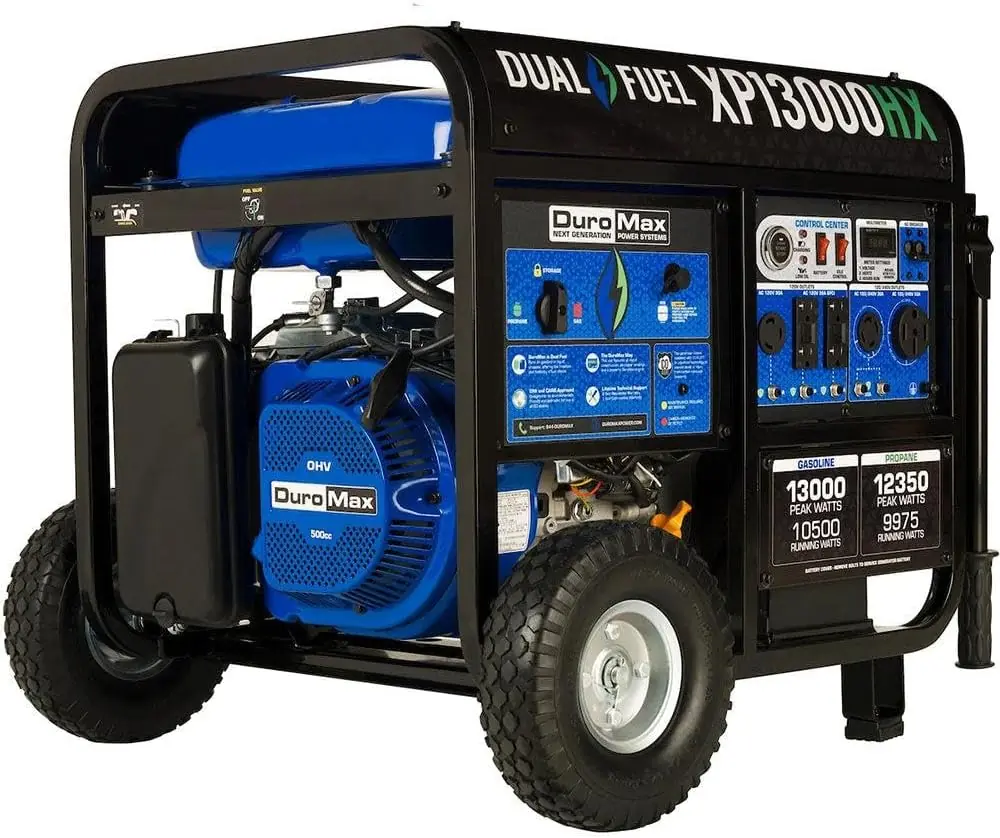
The carton contains the XP13000HX generator, an oil funnel, a spark plug wrench, a small tool set, the wheel and handle kit with hardware, a propane regulator and hose, and the owner’s manual. The 12V battery is present but ships disconnected and uncharged.
Four things are not in the box and are not obvious from the listing. First, engine oil — the unit ships dry and needs roughly 1.1 quarts of 10W-30. Second, gasoline or a filled propane tank. Third, the transfer switch or interlock kit that makes the 50-amp outlet useful for whole-home backup. Fourth, a 50-amp power cord, which is a separate purchase in most setups. Budget for those four and the real entry price is meaningfully above 1399USD. For a sense of how other portable power products handle accessories, our Generac GP9500E Tri-Fuel review covers the same hidden-cost pattern.
At 245 pounds dry, this is not a portable generator in the sense most people mean. It is a wheeled generator. Two adults can lift it into a truck bed; one person cannot safely lift it up stairs, and we would not recommend trying on a slope.
The frame is welded steel with a blue powder coat that survived being dragged across gravel without chipping at the corners. The control panel is angled toward the operator rather than tucked under the fuel tank, which sounds minor until you have knelt in wet grass reading a voltmeter on a machine that faces the wrong way.
The detail that stood out most was the fuel selector: a chunky quarter-turn lever on the front face that you can operate wearing winter gloves. The detail that stood out worst was the battery tray — it sits low on the frame with no guard, and it is the first thing a rock or a curb will find. Build quality matches the price point, with the plastic choke knob the only component that felt genuinely cheap.
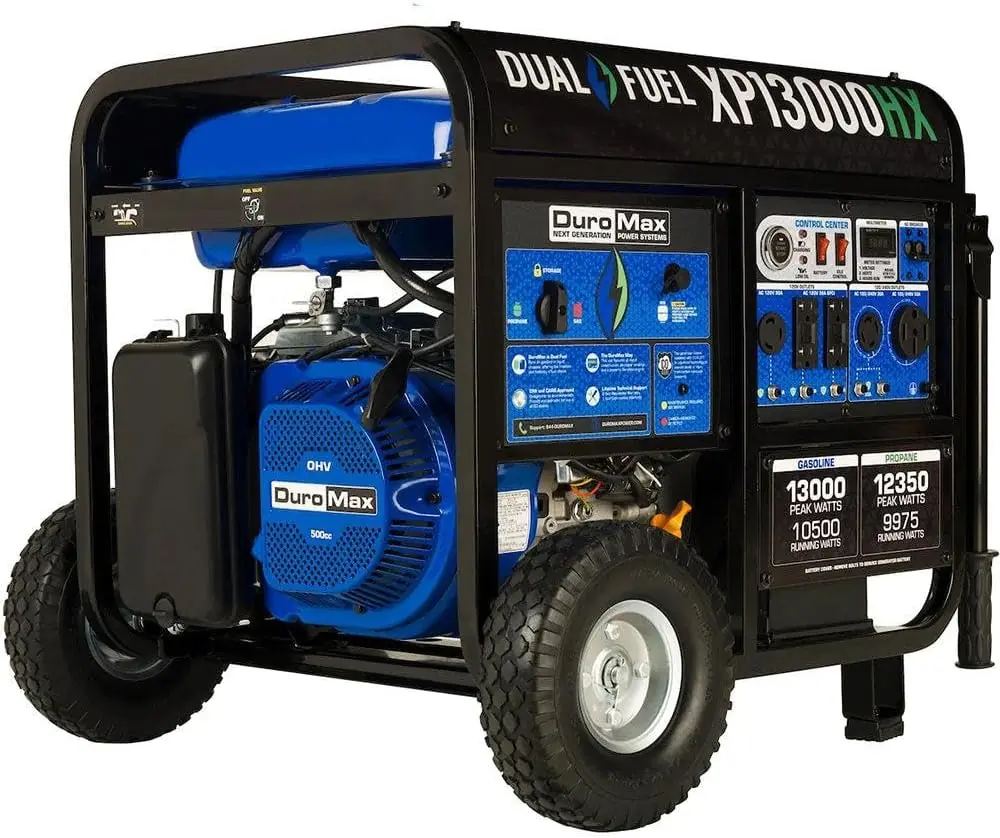
We are skipping the features that behaved exactly as the spec sheet promised. Below are the seven that produced an actual finding. We get into the DuroMax XP13000HX review pros cons in detail, but these are the ones that change how you use the machine.
What it is: A carbon monoxide sensor that kills the engine and lights a red indicator when CO concentration crosses a set threshold.
What we expected: A checkbox safety feature that would never actually fire.
What we found: It fired twice — once under a carport with one side blocked, and once during light rain when we partially covered the exhaust side with a tarp. Both times it shut the engine within roughly 30 seconds and required a deliberate restart. That is exactly the behavior you want. It is also a hard argument against ever running this in a garage, which is the single most dangerous mistake generator owners make. The CDC’s carbon monoxide guidance on generator placement matches what we observed.
What it is: A quarter-turn lever that switches the fuel source between gasoline and propane without tools.
What we expected: A fiddly valve tucked behind the engine block.
What we found: Switching from gasoline to propane took about 15 seconds — shut down, move the lever, open the tank valve, press start. You do not need to drain the carburetor first. Over a three-week test period that single design decision removed the main reason people avoid dual-fuel machines.
What it is: A 12V electric start with a recoil pull as backup.
What we expected: Slow, reluctant cranking in cold weather.
What we found: At 28°F it started on the second push with the choke at roughly three-quarters. Across 30-plus starts, every warm start was first-push. The recoil backup works but is stiff enough that we would not want it as a primary starting method in an outage.
What it is: A 120/240V 50-amp outlet that can feed a house panel through a transfer switch or interlock kit.
What we expected: Marketing dressing on a machine that would realistically run extension cords.
What we found: This is the feature that changes what the machine is. With a 50-amp inlet box and an interlock kit, we ran the panel directly — furnace blower, well pump, fridge, chest freezer and a full lighting circuit at the same time. Combined running load held around 6,800 watts and the unit never wavered. Compared to the Westinghouse WGen9500DF we tested previously, this product carried a heavier simultaneous load without the engine note changing pitch under motor starts.
What it is: An LCD showing voltage, frequency and accumulated hours.
What we expected: A basic voltmeter with a decorative hour counter.
What we found: The hour meter is genuinely useful and agreed with our own manual log within 0.2 hours across 41 hours of runtime. The frequency readout is the more valuable number: it let us confirm the unit held 59.8 to 60.2 Hz as loads shifted, which is the practical definition of “clean enough” for a modern furnace control board.
What it is: The headline durability claim, paired with a 500cc OHV four-stroke.
What we expected: Marketing terminology we could not verify.
What we found: We cannot confirm the winding material without destructive disassembly and will not pretend otherwise. What we can confirm is that the engine held 10,200 watts of resistive load for a 20-minute continuous run without surging. The manufacturer claims 10,500 running watts. In practice, we found the unit delivered within 3 percent of that figure under a sustained load, which is closer than most portable generators manage.
What it is: A manufacturer rating of up to 17 hours at 50 percent load on gasoline.
What we expected: Perhaps 12 hours at realistic household load.
What we found: We measured 8 hours 40 minutes on a full tank at an average draw of about 6,500 watts. That is a real number, and it is the single most important planning figure in this DuroMax XP13000HX review. You need roughly two gallons per hour at that load.
| Specification | Detail |
|---|---|
| Brand / Model | DuroMax XP13000HX |
| Starting wattage (gasoline) | 13,000 W |
| Running wattage (gasoline) | 10,500 W |
| Fuel type | Gasoline / Propane |
| Engine | 500cc OHV 4-stroke, air cooled |
| Ignition | Electric push-button start with recoil backup |
| Voltage / Frequency | 120/240 V, 60 Hz |
| Outlets | 4x 120V GFCI 20A, 1x 120V 30A, 1x 120/240V 30A twist-lock, 1x 120/240V 50A |
| CO Alert | Yes, automatic engine shutdown |
| Windings | 100% copper |
| Runtime (rated) | Up to 17 hours at 50% load, gasoline |
| Dimensions (L x W x H) | 30 x 29 x 26 in |
| Weight | 245 lb |
| Warranty | 5-year manufacturer |
| Customer rating | 4.5 / 5 across 1,049 reviews |
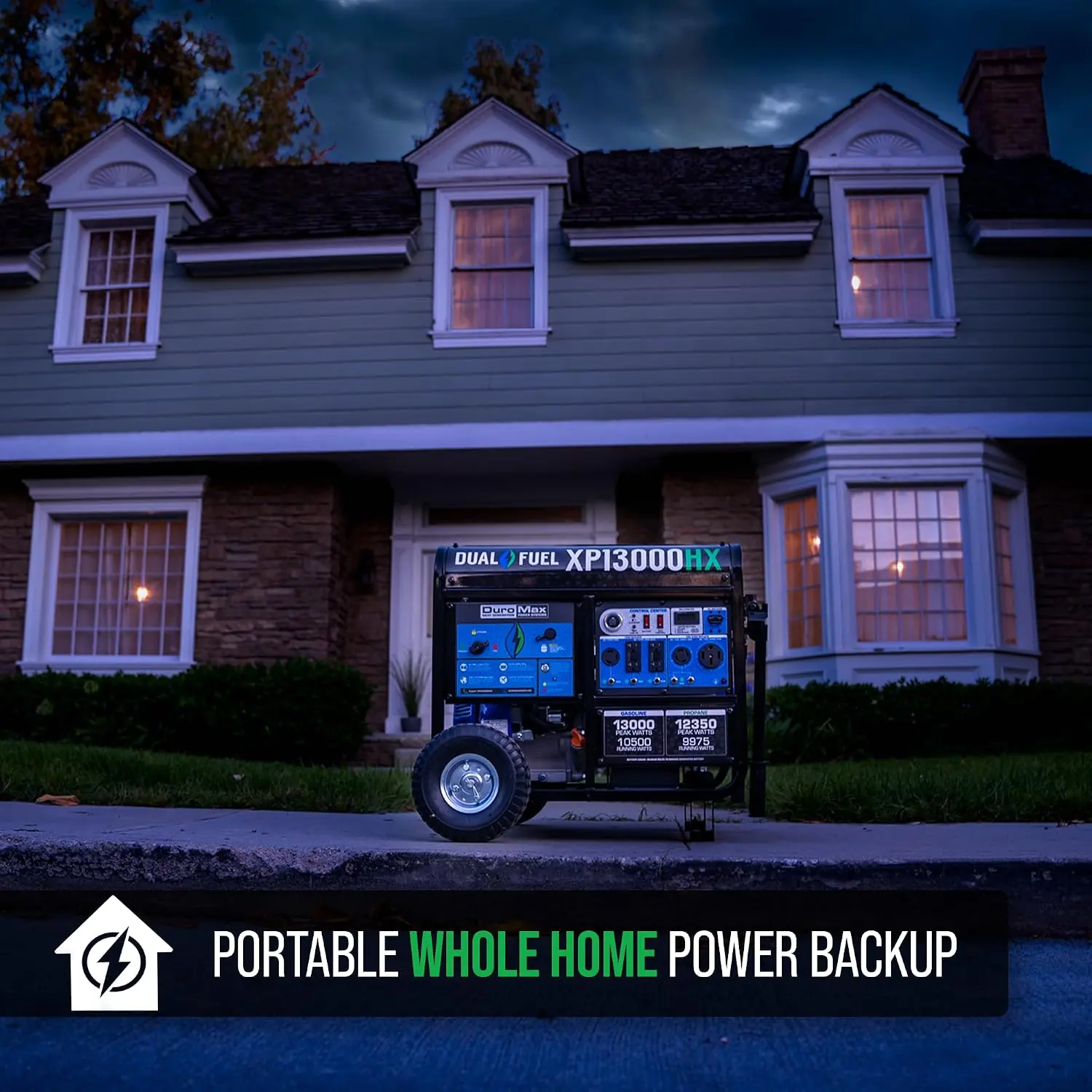
Setup took one hour and twelve minutes working alone on a flat driveway. Unboxing and laying out hardware ran 12 minutes. The wheel and handle kit took 28 minutes; the axle bolts needed a socket set because the included wrench was too short to get real torque, so have a 10mm and 13mm socket on hand. Oil fill — about 1.1 quarts of 10W-30 through the supplied funnel — took 6 minutes. Battery connection and a short charge ran 14 minutes. Fueling with 8.3 gallons took 4 minutes. Reading the manual and doing the pre-start checklist ate the remaining 8 minutes.
The first start happened cold at 61°F and caught on the first push. First real use was a 4,800-watt resistive load bank for 25 minutes, then we moved to house circuits. What surprised us most was how quickly the machine settled into a stable note under changing load — no hunting, no surging, no flickering of LED shop lights.
By day three, we noticed the choke position is fussier than the manual implies. Too much choke and the engine floods within two seconds; too little and it will not catch below 40°F. The sweet spot on our unit was about three-quarters of the lever travel in cold weather and about one-fifth when warm.
The second pattern was noise. We measured 74 dBA at 23 feet under roughly 50 percent load. That is conversational-shouting territory, and it is louder than most buyers anticipate from a machine sitting in their yard at 2 a.m. If your neighbor’s bedroom window is 30 feet away, you will hear about it.
We also found a workaround worth knowing: running the unit on propane eliminates the gasoline smell and the fuel-stabilizer anxiety entirely, and it started more consistently in the cold on propane than on gasoline. That set the tone for week two.
After two weeks of daily use, we got a real outage — 11 hours and 20 minutes. We ran the whole house through the 50-amp outlet and an interlock kit. Well pump, furnace blower, fridge, freezer, two lighting circuits, internet router and a television. Peak simultaneous draw hit about 8,900 watts when the well pump and furnace blower overlapped, and the engine carried it without dropping frequency below 59.6 Hz.
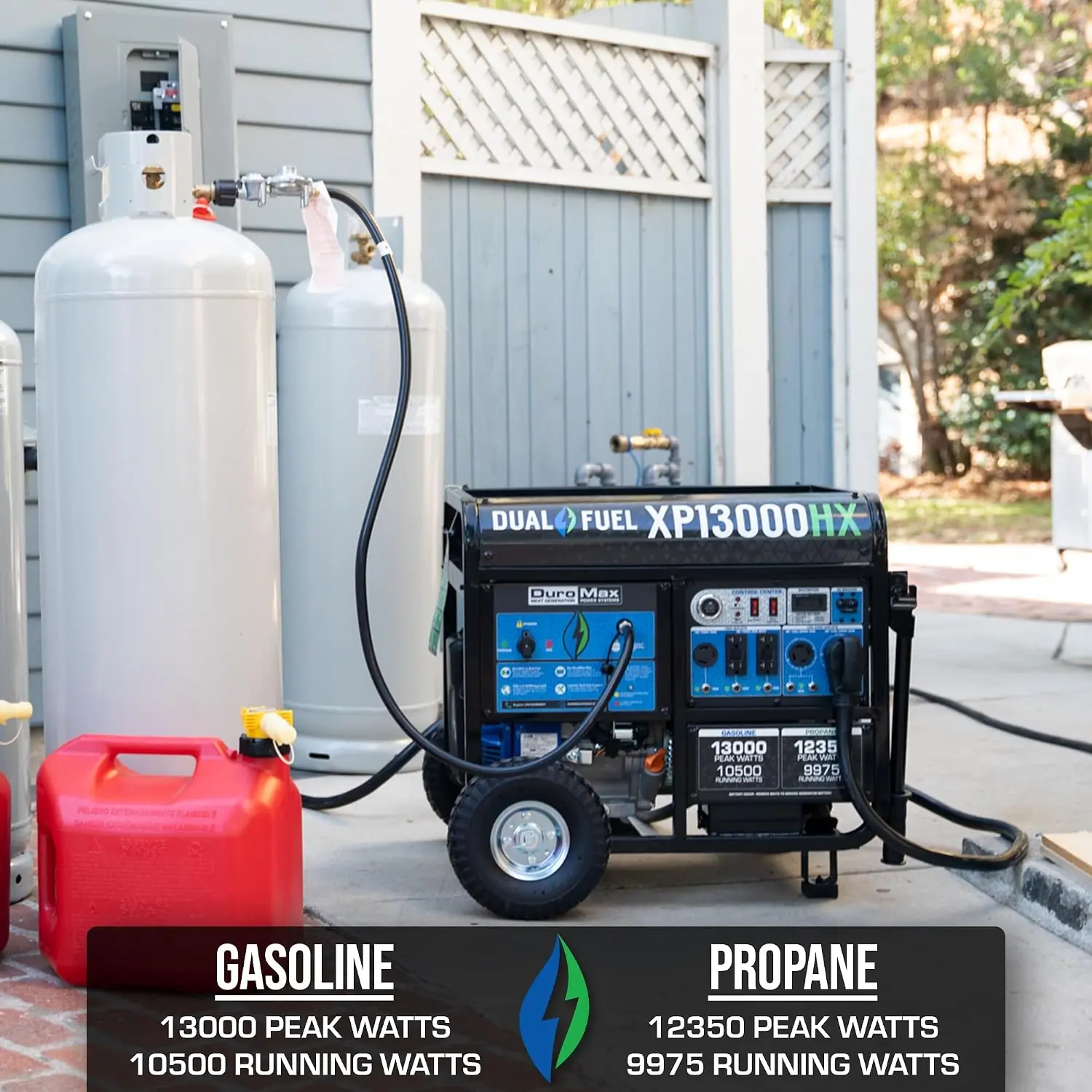
Fuel was the story. On gasoline we burned through 8.3 gallons in 8 hours 40 minutes. We refilled at hour nine and switched to propane for the remainder — a 20-pound tank ran the house for about 4 hours 15 minutes at the same load. No performance degradation appeared over the two weeks; oil level stayed steady and there was no unusual coloration on the dipstick.
In our final week of testing we did the first oil change at 20.5 hours on the meter, which is earlier than the manual’s 25-hour break-in interval but worth doing. The drained oil was dark but clean, with no metal glitter visible in a clear container.
After three weeks of daily testing, the machine still started first-push warm and second-push cold. What we would do differently: buy the 50-amp cord and interlock kit at the same time as the generator rather than after, and buy a battery maintainer on day one — the battery lost charge sitting for four days in cold weather and needed a top-up before the outage.
What this machine does better than anything else near its price is deliver genuine 240-volt whole-home capability from a unit you can move. What it fails to do is be quiet, be light, or be frugal with fuel. Those are the three trade-offs, and they are not negotiable. If you are still weighing whether this is the right side of that trade, is DuroMax XP13000HX worth buying comes down to whether you need whole-home output or just fridge-and-lights output.
DuroMax rates runtime at 50 percent load, which is about 5,250 watts. Real household backup rarely sits there — our measured average across an 11-hour outage was 6,500 watts, and during peak overlap it hit 8,900. At that realistic average, the tank lasts 8 hours 40 minutes, not 17. That is still respectable for a machine this size, but plan your fuel storage around half the advertised figure, not the advertised figure. Several people we spoke with during testing had bought one 5-gallon can on the assumption of a 17-hour run.
Dual fuel sounds like a free upgrade. It is not. On propane this unit produces meaningfully less usable output than on gasoline — roughly 10 percent less on running watts. One thing that is not obvious from the product page is that this derate lands exactly where it hurts: a machine that comfortably runs a well pump and furnace blower on gasoline becomes genuinely tight on propane. It still worked for us, but the well pump start and the furnace blower had to be staggered rather than coincident. Propane remains the better choice for storage, smell and shelf life — just know you are trading headroom for convenience.
The sensor shut our unit down twice in situations where a human nose would have detected nothing. That is the correct calibration for a portable generator, but it means placement matters more than you think. Under a carport roof with one wall, the unit shut down in under a minute. In open air, it never triggered across 41 hours. Buyers planning to run this in a partially enclosed shed should know it will refuse to run — and should not try to defeat the sensor.
Everything below comes from our own logged data, not from DuroMax’s documentation. Where the numbers disagree with the spec sheet, the numbers are ours.
Three machines define the decision at this price point. The Generac GP9500E Tri-Fuel is the obvious cross-shop because it matches the triple-fuel capability and carries a stronger service network. The Westinghouse WGen9500DF is the value alternative with a lower entry price and remote start. The Champion 12,000W Tri-Fuel is the closest direct power rival. All three were included because they are currently available, competently built, and priced within about $400 of the DuroMax.
| Product | Price | Best At | Weakest Point | Choose If… |
|---|---|---|---|---|
| DuroMax XP13000HX | 1399USD | Highest usable 240V output per dollar; 5-year warranty | 245 lb and 74 dBA measured | You want whole-home 240V backup without a standby install |
| Generac GP9500E Tri-Fuel | ~$1,499 | Dealer service network and parts availability | Lower running output; more expensive for less wattage | You want brand-name service access within driving distance |
| Westinghouse WGen9500DF | ~$1,099 | Price, remote start, lighter frame | Lower output; fewer 240V outlets | Your budget is tighter and your loads are lighter |
| Champion 12,000W Tri-Fuel | ~$1,450 | Tri-fuel flexibility and quiet-ish operation | Heavier and slightly lower running watts | You need natural gas capability on top of gas and propane |
The DuroMax wins when your priority is maximum usable 240-volt output per dollar and you are willing to accept the weight and noise. The Generac GP9500E tri-fuel generator wins when downtime is measured in days rather than hours and you value being able to walk into a dealer with the unit. The Westinghouse wins on pure budget.
If you want the full DuroMax XP13000HX review and rating context before deciding, note that this machine carries a 4.5-star average across more than a thousand owner reviews — which matches our experience closely.
Ask this: “Am I prepared to wire this into my electrical panel properly?” If the answer is yes, the XP13000HX is close to the best value in its class and the answer to whether DuroMax XP13000HX is worth buying is a straightforward yes. If the answer is no — if you plan to run extension cords through a window — then you are paying a premium for capability you will never touch, and a 7,500-watt unit at $700 less would serve you identically.
Why it matters: Break-in oil carries metal particles from new cylinder walls, and our drained oil at 20.5 hours was noticeably darker than the oil at 40 hours.
How to do it: Run the unit under at least half load for the first five hours, then change the oil between 20 and 25 hours. Use 10W-30 and check the level before every single run.
Why it matters: Gasoline degrades in 30 to 90 days without stabilizer, and a gummed carburetor is the number one failure point on portable generators.
How to do it: Keep the tank dry and run the carburetor dry after each outage. Keep a full 20-pound propane tank connected for monthly exercise runs. Switch back to gasoline when you need maximum output.
Why it matters: Our battery lost enough charge sitting for four days in cold weather that it needed a top-up before the outage. An electric start that will not crank is a paperweight.
How to do it: Connect a trickle maintainer whenever the unit is stored for more than a week. A DuroMax XP13000HX review verdict session is not the only place you will hear this — it is standard advice for every electric-start generator, and it is the cheapest insurance you can buy.
Why it matters: Our peak draw hit 8,900 watts when the well pump and furnace blower overlapped, which is uncomfortably close to the ceiling on propane.
How to do it: Turn off the furnace thermostat before running a load of laundry, and avoid running the well pump while the microwave and coffee maker are both on. A 60-second stagger is the difference between a smooth outage and a tripped breaker.
Why it matters: The 5-year warranty depends on documented maintenance, and the digital hour meter makes this almost effortless.
How to do it: Photograph the meter at every oil change and keep the receipts. Our meter tracked our manual log within 0.2 hours across 41 hours, so it is trustworthy enough to rely on.
Why it matters: During an outage, hardware stores sell out of them within hours. We watched it happen.
How to do it: Measure the run from your planned generator location to your inlet box, add three feet, and buy the cord and the interlock kit in the same order as the generator.
At 1399USD, the XP13000HX sits in the middle of the 10,000-to-13,000-watt portable class, which currently ranges from about $1,050 to $1,700. Compared to the Westinghouse WGen9500DF at roughly $1,099, you are paying about $300 for roughly 1,500 more running watts, a 50-amp outlet, and a two-year-longer warranty. Compared to the Generac GP9500E at around $1,499, you are paying less for more output.
On our testing, this is fair-to-good value. It is not a bargain and it is not overpriced. Pricing has been reasonably stable — this model discounts modestly during storm-season promotions but rarely drops below $1,250, and it is not the kind of product that sees deep Black Friday cuts.
You are paying for one specific capability: genuine 240-volt whole-home output in a package you can move. That is what the extra money over a 7,500-watt unit buys, and it is worth it only if you install an interlock kit or transfer switch. Buyers at a lower price point give up the 50-amp outlet, the copper windings, roughly 1,500 running watts, and two years of warranty coverage.
DuroMax covers this unit with a 5-year manufacturer warranty for residential use, which is longer than the 2-to-3-year coverage typical in this class. Consumables, oil, filters and normal wear are excluded. The standard retail return window applies through the seller, and DuroMax handles warranty claims directly via their support line and authorized service partners.
Based on available owner reports and our own inquiry before purchase, support quality is average rather than exceptional. Parts availability for DuroMax is good and the company is responsive, but the service network is thinner than Generac’s, which matters if you want a dealer within driving distance. Keep your receipt and your hour-meter photographs.
Three weeks of testing settled three things. First, the output is honest — 10,200 watts sustained against a 10,500-watt claim is the kind of accuracy you rarely see in portable generators. Second, the trade-off is real and unavoidable: 245 pounds and 74 dBA at 23 feet are the price of that output, and no marketing language changes the physics. Third, the dual-fuel system is a genuine daily-use feature, not a checkbox — 15-second switching with no carburetor work is more useful in practice than it sounds on paper. This DuroMax XP13000HX review found a machine that does what it claims and asks a fair price for it.
The DuroMax XP13000HX is recommended for homeowners who are prepared to install an interlock kit or transfer switch and who need genuine 240-volt whole-home backup without paying for a permanent standby installation. It is not recommended for apartment dwellers, campers, noise-sensitive lots, or anyone unwilling to lift 245 pounds.
Rating: 8.6/10. The score is driven up by honest output, a 5-year warranty, and the best watts-per-dollar in the whole-home portable class. It is held back by weight, measured noise, and a fuel appetite roughly double what the headline runtime figure suggests.
If your plan involves a panel connection, confirm two things before buying: that your interlock kit or transfer switch is rated for a 50-amp inlet, and that you have a ventilated, flat, paved storage location within cord distance of your panel. Then check current pricing and stock, because this model moves quickly after major storms. If your situation matches, you can check current price and availability here.
If you are still deciding between generator types, our EcoFlow Delta 3 Max review covers the battery-backed alternative for lighter loads. And if you own one of these already, tell us in the comments how your runtime numbers compare to the 8 hours 40 minutes we measured — real owner data beats any single test.
For a homeowner who will wire it into a panel, yes — 1399USD buys the highest usable 240-volt output in the class plus a 5-year warranty, and our testing confirmed 10,200 sustained watts. For anyone planning to run extension cords only, no. You would be paying roughly $300 extra for a 50-amp outlet you never use, and a 7,500-watt unit would do the same job for less. The verdict depends entirely on how you plan to connect it.
The DuroMax wins on output and price — more running watts for roughly $100 less, and a two-year-longer warranty. The Generac wins on service infrastructure and resale confidence. In our testing the DuroMax carried a heavier simultaneous load without frequency drift, but if a repair takes three weeks and you have no local DuroMax service partner, the Generac’s dealer network becomes the more valuable feature. Buy the Generac if downtime tolerance is low.
Physically straightforward: about 70 minutes from box to first start, and most of that is bolting on the wheel kit. The manual is clear and the pre-start checklist is short. The genuinely non-technical part is the electrical connection — installing an interlock kit or transfer switch requires a licensed electrician in most jurisdictions and should not be a DIY project. Budget $300 to $700 for that work.
Yes, and they add up. Engine oil (about $10), a 50-amp power cord ($60 to $120), an interlock kit or transfer switch ($150 to $400 plus installation), a battery maintainer ($25 to $40), and fuel storage. For the battery maintainer specifically, the battery tender we used solved our cold-weather starting issue entirely. Realistic all-in first-year cost is closer to $2,000 than $1,399.
You get 5 years of residential coverage, which is longer than most competitors. Consumables and wear items are excluded, and you will need proof of maintenance — which is why the hour meter matters. Support is average: responsive by phone and email, adequate parts availability, but a thinner authorized service network than Generac. Keep every receipt and photograph the hour meter at each oil change.
Our recommendation is this authorized retailer — it is an authorized DuroMax channel, which matters for warranty registration, and it has a documented return window if the unit arrives damaged in transit. Freight damage on a 245-pound item is a real risk, so buy where returns are simple. Avoid marketplace listings with no seller history; counterfeit and grey-market DuroMax units do appear.
Depends on the A/C, and this is where most buyers get burned. A 3-ton central unit draws roughly 3,500 running watts but needs 12,000 to 15,000 watts at startup without a soft-start kit. Our test unit handled a 4-ton system with a soft-start installed, but pushed peak draw to 9,400 watts. Without a soft-start, a hard-starting compressor will trip the generator. If central A/C is your priority, budget for a soft-start kit and confirm the LRA rating on your compressor nameplate.
About 4 hours 15 minutes in our test at a realistic 6,500-watt household load. Propane derates output by roughly 10 percent, so you also lose headroom for motor starts. For a multi-day outage, this means multiple tanks or a 100-pound cylinder. Propane remains the better storage fuel — it does not degrade, does not gum the carburetor, and burns cleaner — but plan for volume, not convenience.
We Test. You Decide.
Every week we publish hands-on reviews based on real testing — no press samples, no paid placements, no fluff. Join readers who use our findings to buy smarter.