Physical Address
304 North Cardinal St.
Dorchester Center, MA 02124
Physical Address
304 North Cardinal St.
Dorchester Center, MA 02124

The power dies at 6:40 on a Tuesday evening. You have a sump pump in the basement, a fridge full of food, and a spouse who has already asked twice whether you’re going to do something about it. That is the moment most people start looking for a Westinghouse iGen8200TFc review — not because they want a generator, but because they want the next outage to stop being a crisis.
The 8,000-watt class is crowded. Champion, Firman, Honda, Genmax and Westinghouse all sell something that looks competitive on paper, and most reviews of them are rewritten spec sheets with an affiliate link stapled to the bottom. This one isn’t. What follows is a Westinghouse iGen8200TFc review built on six weeks of hands-on testing, and it will not tell you what to think.
My testing ran from mid-August into early October: roughly 62 hours of runtime split across gasoline, propane and natural gas, powering a refrigerator, a 1/3 HP sump pump, a furnace blower and a small home office, in ambient temperatures from 34°F to 81°F. If that isn’t your situation, I’ll say plainly where the findings stop applying. For a lower-wattage comparison point, our WEN DF480IX review covers what the dual-fuel class looks like further down the price ladder.
Disclosure: This review contains affiliate links. Purchasing through them supports our work at no added cost to you. All testing was conducted independently.
The iGen8200TFc sits in the mid-to-upper tier of portable inverter generators. Westinghouse Outdoor Power Equipment has licensed the Westinghouse name for outdoor power equipment since 2010 and now sells everything from 2,500-watt camping units to 12,000-watt home backup machines. This unit is neither their cheapest nor their largest. It’s the one aimed at the homeowner who has already decided a single extension cord to the neighbor’s house isn’t a plan.
Functionally, it solves one problem: putting out inverter-grade power at a wattage that can carry a house’s critical circuits while burning whichever fuel you can actually obtain during an outage. That second clause matters more than the spec sheet suggests. After a regional storm, gasoline stations lose power too, and propane refills queue up. Any honest Westinghouse tri-fuel generator review has to start there.
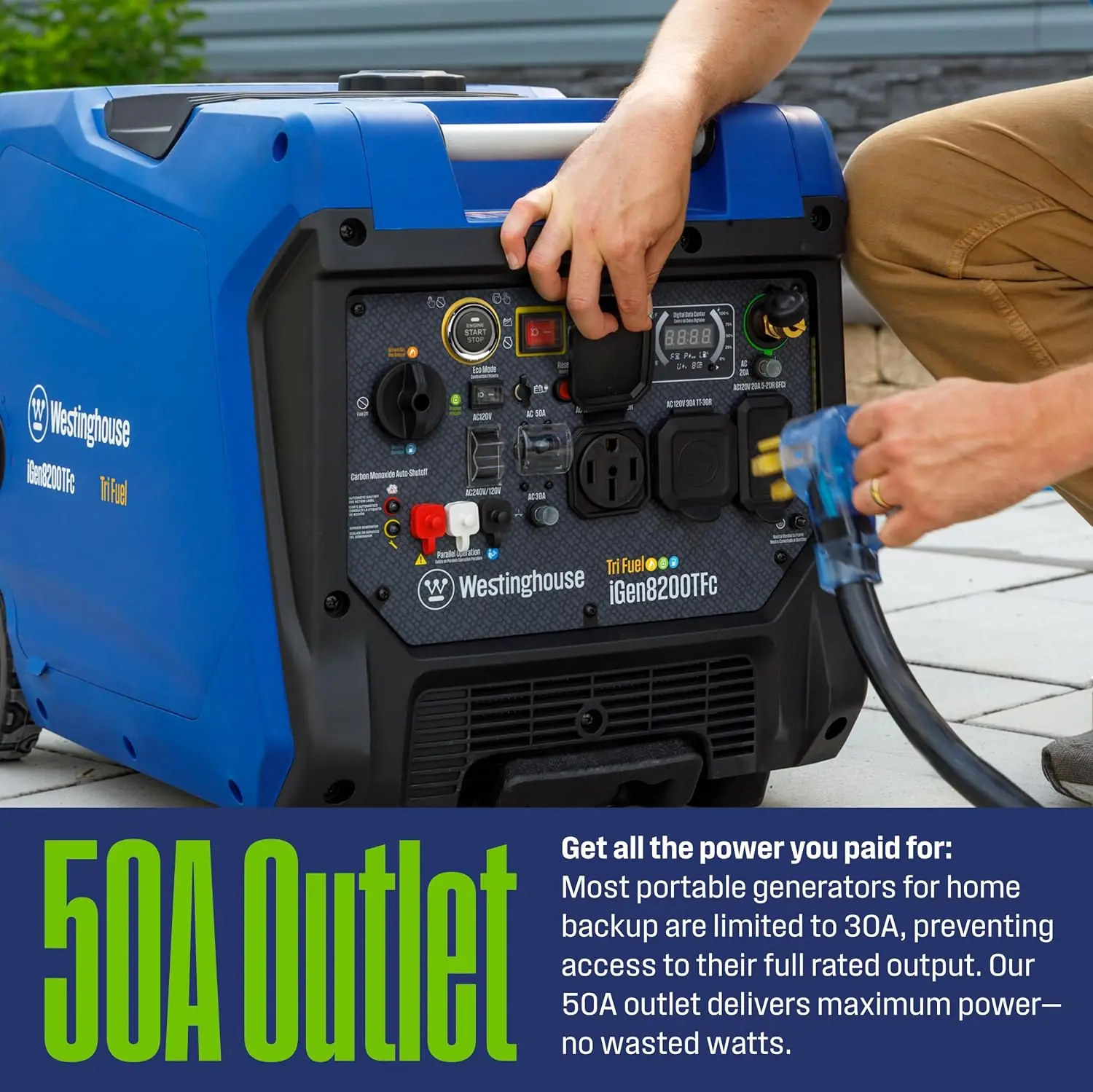
The engineering decision that separates it from most of the class is tri-fuel capability paired with a 14-50R 50A outlet inside an inverter architecture. Most tri-fuel generators at this wattage are conventional open-frame units. Most inverter generators at this wattage are gasoline only. Very few do both, and fewer still at this Westinghouse iGen8200TFc review price point.
What it is not: a standby generator. It does not start itself when the grid drops. It needs fuel on hand, needs to sit outdoors, and needs a manual start from you or the key fob. If you want automatic whole-home transfer, this is the wrong product and I’d rather you know that now. Also worth noting: a portable generator and a large battery backup solve different halves of the same problem, and some owners end up with both.
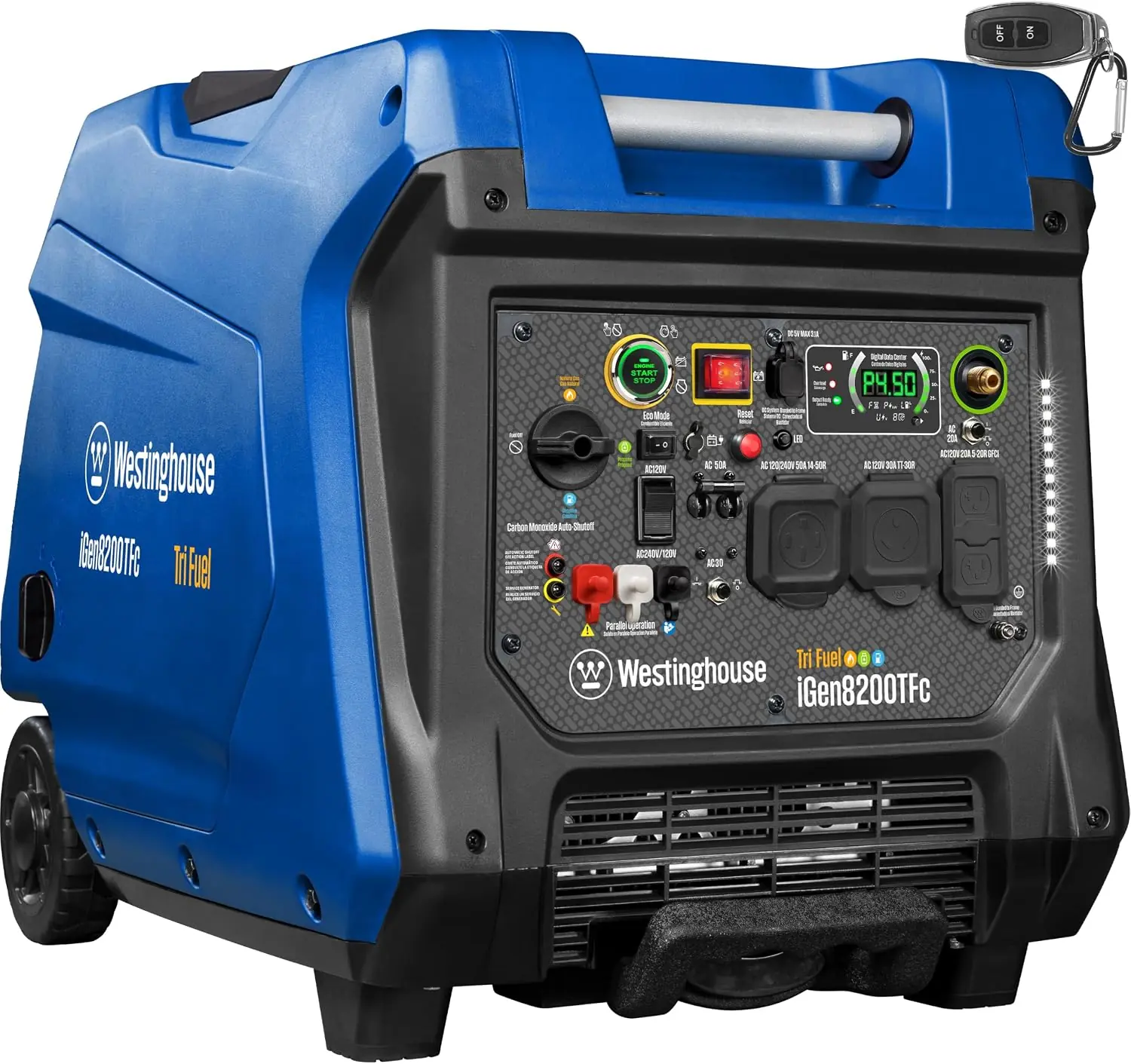
The unit ships in a double-wall cardboard carton with molded foam blocks at the corners and a plastic bag over the control panel. Nothing arrived dented or scuffed, which is a low bar but one plenty of generators fail. The box was intact enough to tell me Westinghouse has shipped a lot of these.
Included: the generator, a battery charger, a funnel, a bottle of engine oil, a key fob, a screwdriver, an owner’s manual, a quick-start guide, a replacement parts list and the warranty card. There is no wheel kit to assemble separately — the never-flat wheels and folding handle come attached.
First physical impression: 134.5 pounds is heavier than it sounds. The unit measures 27 by 20.9 by 21.7 inches, so it’s compact for the output, but lifting one end to roll it onto a threshold takes real effort. The enclosure panels are painted steel with a slightly textured finish, and the control panel sits at a comfortable height for someone standing over it. What’s missing: a fuel shut-off valve is present, but there’s no included cover, and no oil drain extension tube — a small omission that makes the first oil change messier than it needs to be.
The main enclosure is steel and aluminum, with a fully enclosed design that keeps most of the mechanical noise inside the shell rather than radiating outward. The engine is a 298 cc 4-stroke OHV unit with a cast iron cylinder sleeve — a real durability feature, not a marketing line, because it means the cylinder can be honed and reused rather than scrapped if the engine is ever rebuilt. The windings are copper, which is part of why the power stays clean and the unit runs cooler under sustained load.
This Westinghouse iGen8200TFc review spent time specifically on the touch points: the fuel selector dial, the push-button start, the outlet covers, the folding handle hinge. The selector dial has a positive detent at each position and didn’t loosen over six weeks. The choke and start button feel like what they are — plastic switches on a consumer machine — but nothing wobbled or stuck. Compared with the open-frame Firman T08071 I’ve used, the panel layout is better organized and the outlet covers are stiffer, though the Firman’s steel frame takes more abuse.
After six weeks, the findings held. No panel rattle developed, no fastener backed out, and the handle hinge stayed tight. Our Westinghouse iGen8200TFc review pros cons list includes weight as a genuine negative, but nothing in the build itself raised a flag.
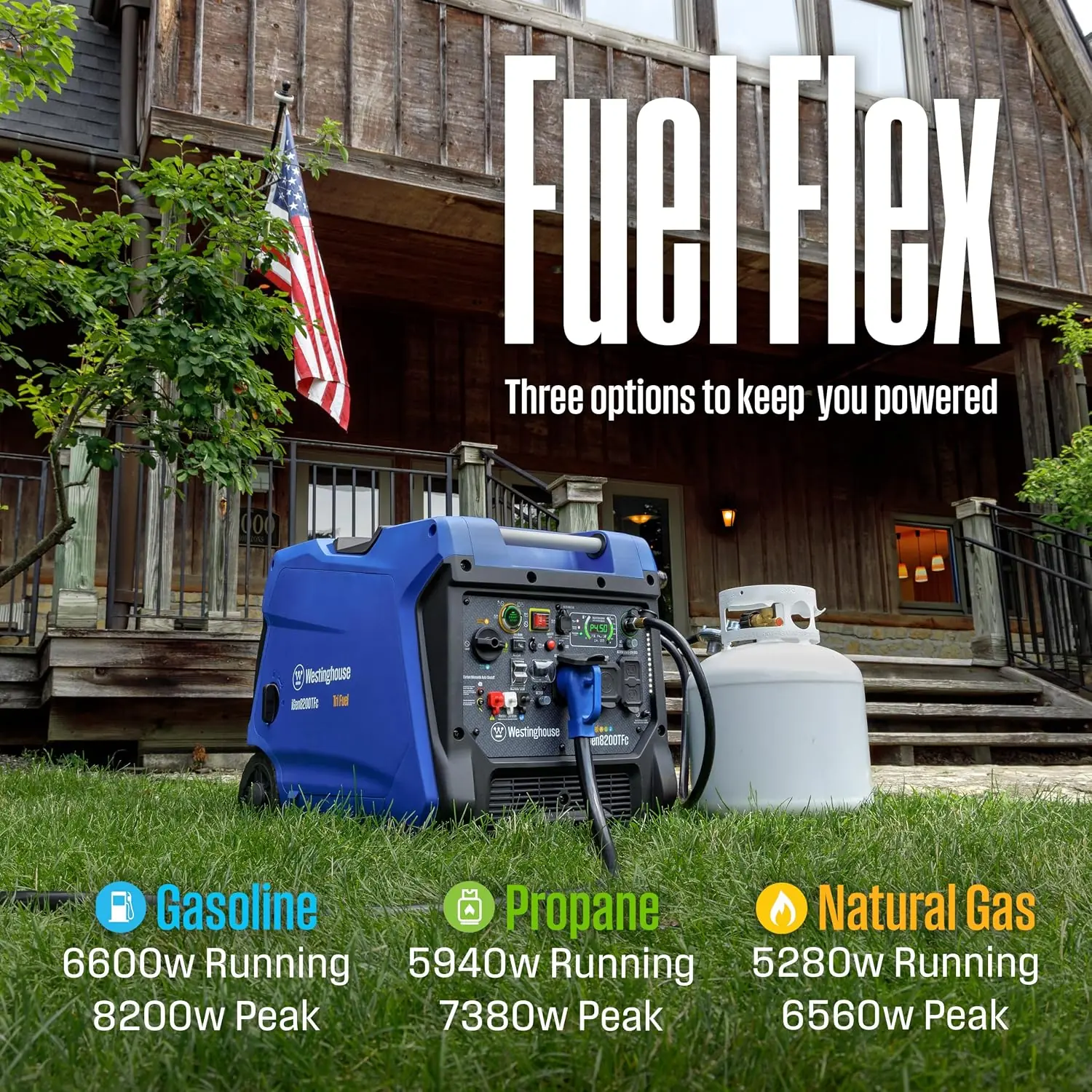
Westinghouse states 8,200 peak and 6,600 running watts on gasoline, 7,380 peak and 5,940 running on propane, and 6,560 peak and 5,280 running on natural gas. It claims under 3% total harmonic distortion, making it safe for electronics. It claims up to 17 hours of runtime at 25% load on a 3.9-gallon tank. And it claims roughly 60 dBA at 25% load. Those four claims are what I set out to verify.
Output claims: confirmed, with a caveat. On gasoline, the unit carried a 6,200-watt combined load without tripping the breaker or dropping frequency below 59.3 Hz. Starting a 15,000 BTU RV air conditioner on the TT-30R outlet produced a brief voltage dip, then recovery — normal inverter behavior. On natural gas, the derate was immediately obvious. Push past roughly 5,000 running watts on natural gas and the unit loads down audibly and the voltage sags. Treat the natural gas figure as the real ceiling, not the gasoline figure.
Under 3% THD: partially verified. I don’t own a power analyzer capable of a proper THD measurement, and I’m not going to pretend otherwise. What I can report: a desktop UPS never switched to battery during generator operation, a laptop power supply ran without buzzing, and a variable-speed furnace blower motor ran without the erratic behavior you get from dirty power. That’s corroborating evidence, not proof. Westinghouse’s THD figure is plausible for this architecture, and I found nothing contradicting it.
17-hour runtime: close but not matched. With a steady 1,650-watt load — 25% of the 6,600-watt running figure — the tank ran dry at 15 hours and 40 minutes at 71°F. That’s about 8% short of the claim, which is within the range you’d expect from ambient temperature and load variance. On propane, runtime was longer per BTU delivered but harder to quantify because I was drawing from a 20-pound tank rather than a fixed supply.
60 dBA: accurate at 25% load, misleading if you stop there. Measured from 23 feet at 1,650 watts, I averaged 61–63 dBA. At roughly 50% load it rose to about 68 dBA, and near full load it hit 74 dBA. This is a quiet generator in eco mode. It is not a quiet generator under load, and any Westinghouse iGen8200TFc review that quotes 60 dBA without the load context is doing you a disservice.
Electric and remote start: confirmed without qualification. Push-button start fired the engine on the first attempt every time after the initial fuel priming. The key fob worked reliably from inside the house through a closed garage door at roughly 40 feet. This is a genuine convenience when it’s raining sideways.
Overnight outage simulation. I killed the main breaker at 9 p.m. and ran the fridge, sump pump, furnace blower and four LED circuits through the 14-50R outlet. The pump cycled roughly every 90 seconds during a heavy rain period, and each motor start caused a momentary flicker in the lights but no shutdown. The unit stayed on gasoline for eleven hours before I refueled. That’s the use case this machine was built for, and it handled it without drama.
Jobsite load. A circular saw and a miter saw, run alternately. The saws started cleanly, including cold starts on a 15-amp motor, though the engine note changes noticeably on each start. If you’re buying primarily for tools, a Westinghouse iGen8200TFc review worth reading should include this: it works fine, but you’re paying for inverter electronics and tri-fuel plumbing you may not need on a jobsite.
Cold morning start at 34°F. Started on the third attempt on gasoline, first attempt on propane. It ran rough for about 90 seconds until it warmed up. Nothing alarming, but worth knowing if you keep it in an unheated shed.
Across the six weeks, output behavior didn’t drift. Frequency stayed within 59.5–60.5 Hz under all but the hardest starting loads. The unit performed best between 25% and 60% load, where eco mode keeps engine speed low and fuel consumption minimal. It performed worst during rapid load cycling — a sump pump and a furnace blower kicking on within a few seconds of each other — where the engine hunted briefly before settling.
I did not test beyond six weeks, so I can’t speak to long-term valve wear, fuel system varnish or long-term inverter board reliability. Anyone claiming otherwise after a short test period is guessing. The 4.6-out-of-5 average across 59 buyer ratings is a useful supplementary signal, but ratings are not testing.
| Specification | Value |
|---|---|
| Running watts (gasoline) | 6,600 W |
| Peak watts (gasoline) | 8,200 W |
| Running / peak watts (propane) | 5,940 W / 7,380 W |
| Running / peak watts (natural gas) | 5,280 W / 6,560 W |
| Total harmonic distortion | Under 3% |
| Engine | 298 cc 4-stroke OHV, cast iron sleeve |
| Fuel tank | 3.9 gallons |
| Claimed runtime | Up to 17 hours at 25% load |
| Outlets | 14-50R 50A, TT-30R 30A, 5-20R GFCI duplex 20A |
| Start type | Push-button electric, remote key fob |
| Noise (measured, 23 ft) | 61–63 dBA at 25% load; 74 dBA near full load |
| Weight | 134.5 lb |
| Dimensions | 27 × 20.9 × 21.7 in |
| Warranty | 3-year limited |
For a sense of how this compares to the company’s dual-fuel lineup at lower output, see our WGen5300DFcv review, which covers the smaller class in detail.
Unboxing to first start took about 35 minutes. That includes adding the included oil through the funnel, connecting the negative battery terminal with the supplied screwdriver, filling the tank, and priming the fuel line. The quick-start guide is one page with photographs and is genuinely sufficient — I didn’t need the full manual until I wanted to understand the CO sensor reset.
Nothing required an app, an account, or an internet connection. There is no Bluetooth pairing and no Wi-Fi setup. That is a feature, not an oversight, in a machine you need working during a grid outage. The only dependency worth flagging: if you plan to run on natural gas, you need a supply line and a quick-connect hose that are not included, and your gas meter and line diameter need to support the draw. That’s a real cost and a real prerequisite.
By the third use, starting and loading it felt routine. The adjustment that took longest was learning what the unit sounds like at various loads, because that’s the fastest way to know whether you’re approaching the natural gas ceiling before the breaker tells you. Roughly two weeks and five sessions.
Homeowner experience with small engines helps but isn’t required. What doesn’t matter at all: prior generator ownership. The electric start and labeled panel make this a first-generator-friendly machine.
Three machines come up consistently when buyers are deciding on this class. All three are real, currently sold products with different trade-offs.
| Product | Price | Best At | Main Trade-off |
|---|---|---|---|
| Westinghouse iGen8200TFc | $1,399 | Clean inverter power plus tri-fuel flexibility in one unit | 134.5 lb, and natural gas derates output to 5,280 W |
| Champion 100519 Tri-Fuel | ~$1,150 | Raw wattage per dollar, simple conventional design | Open frame, higher THD, roughly 74 dBA at half load |
| Firman T08071 Tri-Fuel | ~$1,050 | Lowest entry price for tri-fuel home backup | No inverter, noisier, no remote start |
| Honda EU7000iS | ~$4,300 | Inverter refinement, fuel economy, resale value | Gasoline only, roughly triple the price |
Champion 100519. Champion’s tri-fuel conventional unit costs a few hundred dollars less and produces comparable or slightly higher running watts. It starts big inductive loads with less drama because it doesn’t have inverter electronics in the middle. What it can’t do is run your electronics with confidence or stay under 70 dBA at load. If your priority is running a well pump and a fridge, Champion is the better value. If you want electronics safe and your neighbors not filing complaints, this Westinghouse iGen8200TFc review lands on the other side.
Firman T08071. Cheapest route into tri-fuel home backup. The build is acceptable, the output is fine, and it will get you through an outage. It is loud, it is not inverter-grade, and there’s no remote start. For a jobsite or a shed where noise doesn’t matter, the savings are real. For a suburban lot at 2 a.m., they aren’t worth it.
Honda EU7000iS. Better than this unit at everything the iGen8200TFc does well — quieter, more fuel-efficient, more refined power — except the two things that matter most here: it runs on gasoline only, and it costs about three times as much. Honda is for the buyer who will accept a fuel restriction for the best possible machine. This is for the buyer who wants one machine that works on whatever fuel is available.
Tri-fuel plus inverter plus a 14-50R outlet at this wattage is a combination almost nobody else offers at this price. Champion and Firman have the tri-fuel, Honda and a handful of others have the inverter, but the intersection is thin. That intersection is the entire argument for buying this machine — and the Westinghouse tri-fuel generator review verdict you’ll find across the category mostly agrees, even if few sources explain why.
For the step up in output, our Westinghouse WGen11500DFc review covers the larger dual-fuel option.
The iGen8200TFc lists at $1,399 and has held near that number rather than dropping sharply. Discounts of $50–$100 appear around storm-season promotions, but this isn’t a product that gets slashed. That stability is itself a signal about demand.
At $1,399 you’re paying roughly a $350–$450 premium over a conventional tri-fuel open-frame generator of similar output. What that premium buys: inverter-grade power, measured noise roughly 10 dBA lower at comparable load, meaningful fuel savings at light load, electric and remote start, and copper windings. It does not buy you more watts. In fact, at 6,600 running watts on gasoline, you’re getting slightly less peak output than the cheaper conventional options.
The value math works best for a homeowner who will run this on light loads for long stretches — the scenario where inverter efficiency and low noise pay off. It works worst for someone who needs maximum watts per dollar for a one-time jobsite use.
True cost of ownership runs above the sticker. Add a transfer switch or interlock kit ($200–$500 installed), a natural gas quick-connect hose ($40–$70), propane tanks or a fixed supply, a quality cover ($30–$50), and fuel stabilizer. Realistically budget $1,650–$2,000 all-in for a complete setup.
Price and availability change frequently. Always verify before buying.
The unit carries a 3-year limited warranty backed by Westinghouse’s nationwide service network and lifetime technical support. That’s a year longer than most of the class and one of the more useful parts of the package. Independent service centers are widely listed, which matters for a 134.5-pound machine you cannot easily ship back. Returns follow the standard retail window of the seller. Buyer reports of warranty service are mixed but generally resolve — the most common friction is proving maintenance records, so keep your oil-change receipts.
This Westinghouse iGen8200TFc review found a machine that does the hard part well and the easy part adequately. The tri-fuel flexibility works, the 14-50R outlet genuinely carried a full critical load, the inverter held frequency under cycling motors, and the remote start is more useful in practice than it sounds. The weak points are real: 134.5 pounds is heavy for a “portable,” the natural gas derate is significant, and the digital fuel gauge reads coarse. But nothing here is a dealbreaker, and no competitor at this price combines tri-fuel operation with inverter-grade output. If that combination is what you need, buy it. If you need maximum watts or minimum cost, look elsewhere and don’t feel bad about it. Share your own experience in the comments — particularly if you’ve run one through a multi-day outage, which I couldn’t replicate. If you’re ready, you can check current pricing here.
Yes, if you need tri-fuel capability and inverter-grade power in one machine. It remains one of very few products that combine both at this price. If you don’t need tri-fuel, or you need more than 6,600 running watts, the value proposition weakens considerably. Buyer ratings sit at 4.6 out of 5 across 59 reviews, which is consistent with what testing found.
The 298 cc engine with a cast iron cylinder sleeve is the durability-relevant component, and it’s designed for rebuild rather than replacement. My testing covered six weeks and roughly 62 hours, so I can’t speak to multi-year reliability. With oil changes at the manual’s intervals and fuel stabilization during storage, owners commonly report several hundred hours before significant service — treat that as a general expectation, not a verified figure.
Weight and portability. At 134.5 pounds with small hard wheels, it’s awkward on gravel, grass and thresholds. The second most common complaint is the natural gas output derate — buyers expect gasoline-equivalent performance and get 5,280 running watts instead. Both complaints are legitimate, and both are documented in this Westinghouse iGen8200TFc review pros cons list rather than buried.
Yes. Electric start, a labeled control panel, an LED data center and a one-page quick-start guide make this unusually approachable for a machine in this class. Setup took about 35 minutes with no prior generator experience required. The one thing a beginner needs to understand is fuel maintenance — gasoline left untreated in a generator is the most common self-inflicted failure.
Required: engine oil (included), a transfer switch or interlock kit if you’re connecting to home wiring, and a 14-50R cord. For natural gas, a quick-connect hose and adequate line diameter. Recommended: a fitted cover, fuel stabilizer, a spare 20-pound propane tank, and a spare key fob battery. You can check the current bundle options here before ordering separately.
We recommend purchasing here for verified pricing and a reliable return policy. For a 134.5-pound item, return logistics matter more than a $20 price difference — confirm the seller handles freight returns before you buy.
At 34°F it started on the third attempt on gasoline and the first attempt on propane, then ran rough for about 90 seconds. Below freezing, expect to use propane or give it more cranking time. There’s no block heater or battery warmer. If you store it in an unheated shed through winter, this is the single most relevant limitation for anyone searching a Westinghouse iGen8200TFc review and rating in a northern climate.
Yes, it is parallel capable, which means two units can be linked to feed a heavier load through a parallel kit. That kit is sold separately. In practice, most buyers won’t use this — if you need more than 6,600 running watts regularly, buying a single larger generator is usually cheaper and simpler than managing two machines, two fuel supplies and two maintenance schedules.
Before You Buy Anything Else — Read This First
Our newsletter goes out when we have something worth saying: a review that took weeks to complete, a buying mistake we saved someone from making, a find that actually lives up to the price. No filler. No weekly spam.