Physical Address
304 North Cardinal St.
Dorchester Center, MA 02124
Physical Address
304 North Cardinal St.
Dorchester Center, MA 02124

Three days without grid power in late October is what finally pushed me off the fence. A windstorm took out the transformer at the end of our road on a Thursday night, and by Friday morning I was staring at a chest freezer full of meat, a sump pit filling faster than the rain was falling, and a gas generator I refused to run at 2 a.m. because it sits eight feet from my neighbor’s bedroom window.
That week is why this EcoFlow DELTA 3 Max review exists. I bought the unit as an experiment rather than a recommendation. I wanted to know whether 2,048Wh of battery could carry the parts of a house that actually matter during an outage without the noise, the fumes, or the fuel runs. I had already put a smaller Anker station through a shorter version of the same test last spring, so I had a baseline to measure against.
If you are here only to find out is EcoFlow DELTA 3 Max worth buying at today’s price, that link goes straight to the listing. Otherwise, the long version follows — including the parts I did not like.
Disclosure: Some links in this article are affiliate links. We may earn a commission if you buy through them. This does not influence our findings or recommendations.
The short answer on the EcoFlow DELTA 3 Max
| Tested for | Four months of near-daily use, one three-day grid outage in October, and two weekend camping trips |
| Best suited to | Homeowners who want quiet, fume-free backup for a fridge, a sump pump, a router and a few lights — and who will actually cycle the unit between outages instead of leaving it in a closet |
| Not suited to | Anyone who needs to run central air, a well pump, or an electric range for days at a stretch, or who wants to power a whole panel without adding a transfer switch |
| Price at review | 879USD |
| Would I buy it again | Yes — but I would add the expansion battery before I bought a second station, because 2kWh buys you an evening, not a week |
Full reasoning below. Or check the current price here if you have already decided.
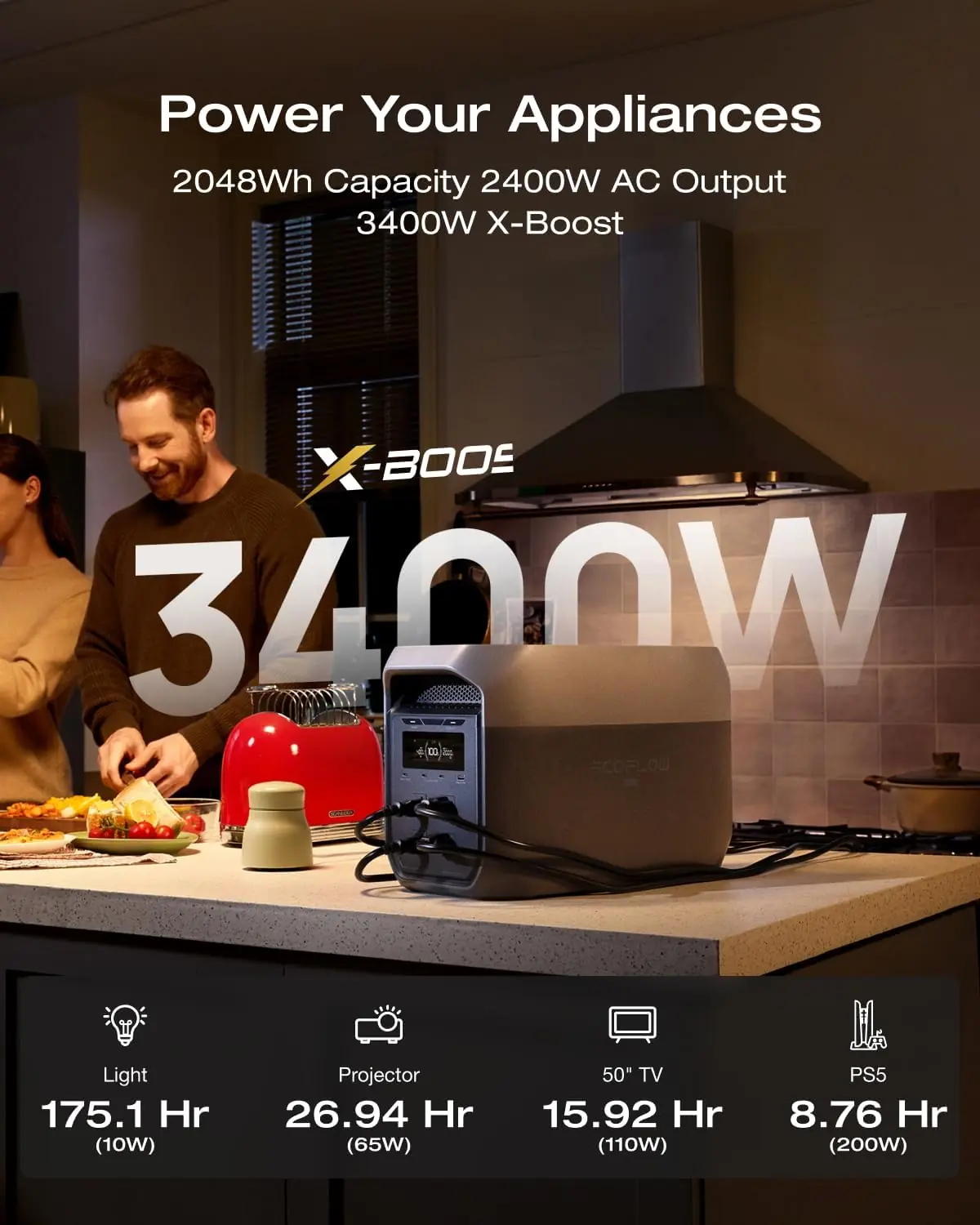
The DELTA 3 Max is a portable power station: a battery, an inverter and a charge controller in one box. EcoFlow rates it at 2,048Wh of LiFePO4 capacity and 2,400W of continuous AC output, with a 3,400W X-Boost mode that pushes past that ceiling by trimming voltage. That is the category. Understanding what it is not will save you money.
It is not a standby generator. It will not carry central air, a well pump, an electric water heater or an electric range for any useful length of time, and you cannot refuel it in ten minutes. It is not a whole-home UPS either — the sub-10ms transfer protects whatever is plugged into it, not your panel, unless you add a transfer switch. And it is not a solar generator in the literal sense, because the panels ship separately and cost extra.
EcoFlow manufactures it. The company has been shipping portable power since 2017, and its product line is deep enough that expansion batteries and spare parts tend to stay available. In an EcoFlow DELTA 3 Max review, that matters for one practical reason: you can grow into the ecosystem instead of replacing it.
Market position is upper-mid. It is neither the cheapest 2kWh LFP station nor the most expandable one. It sits in the middle, priced aggressively for the hardware inside it.
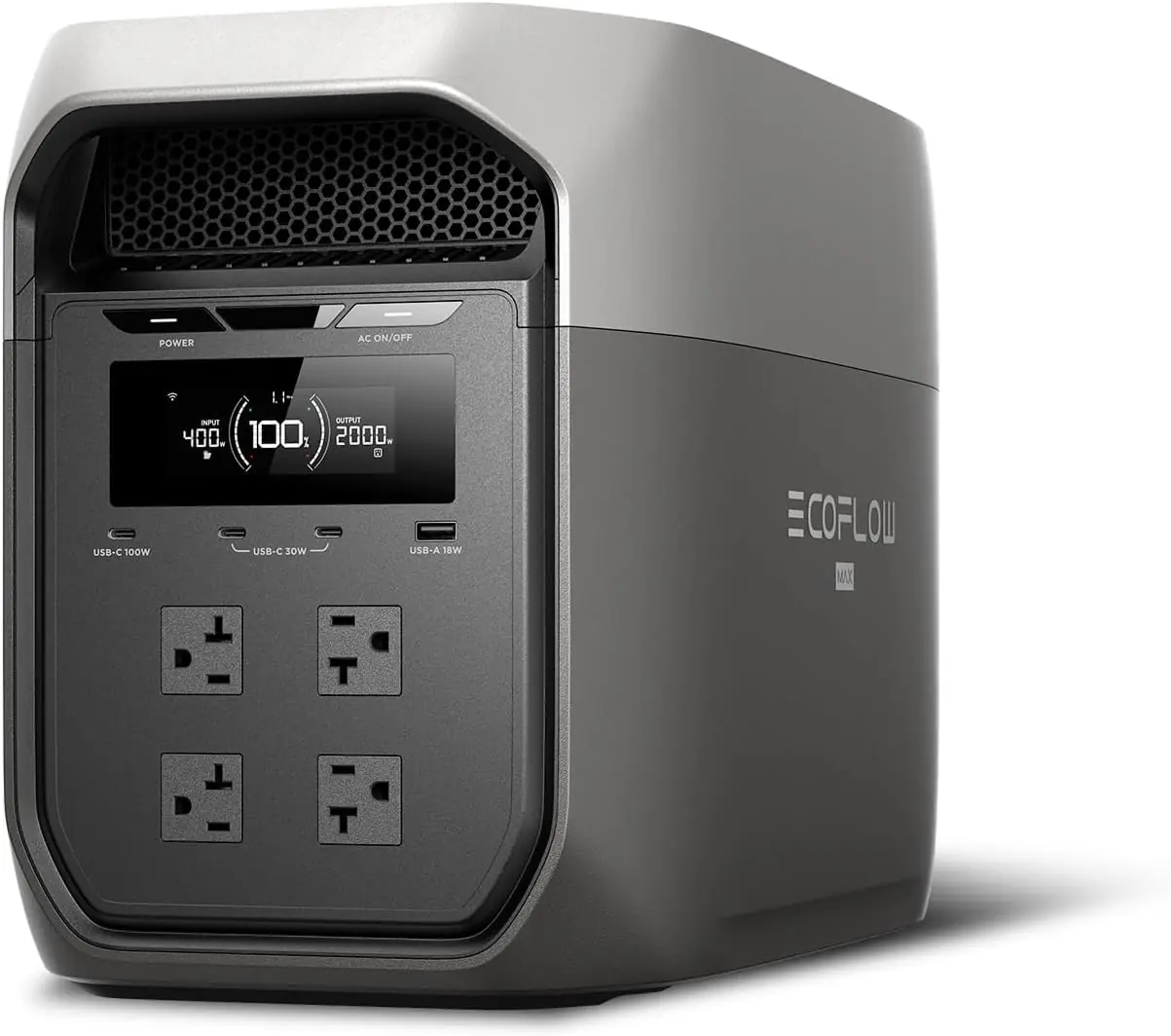
The box contains the station, one AC charging cable, and the manuals and warranty card. That is the complete list. There is no car charging cable, no solar input cable and no panel — and at this price, a car cable is the sort of thing that should be included. Competitors in the same capacity band often ship one.
Packaging is competent rather than premium. Molded foam braces the unit at both ends, the carton is double-walled, and nothing shifted in transit. It does not feel like opening a laptop at this price, but it does feel like a company that expects the product to survive a delivery truck, which is the more relevant standard.
Physically, the aluminum-and-plastic housing reads as solid. Panels fit tightly, the handle is molded into the chassis rather than bolted on, and there is no flex when you lift it from one side. It is also heavy — around 46 pounds by published figures, which is a two-hand lift up basement stairs and an awkward one through a narrow door. The feet are hard plastic and slide across concrete instead of gripping. So far in this EcoFlow DELTA 3 Max review, the hardware has been the least surprising part.
Budget for one extra purchase. A car charging cable if you plan to top up from a vehicle, and a solar panel if you want off-grid recharge. Neither is optional if you intend to use those features.
Unboxing to first charge took about twelve minutes, and most of that was me reading the quick-start card twice. The station arrived at roughly 30 percent state of charge, which is normal for shipping. Plugging the AC cable into a standard 15A wall outlet started X-Stream charging immediately — no app required, no firmware dance. Pairing with the EcoFlow app over Bluetooth took another three minutes. The printed documentation is thin. The app is where the real settings live, and that surprised me.
There is a learning curve, and it has nothing to do with the hardware. It is about understanding what 2,048Wh means once it goes through an inverter. Conversion is not lossless, and the app’s remaining-percentage readout drops faster than new owners expect as soon as a compressor cycles on. The concept that took me longest to internalise was X-Boost. It raises the ceiling on what the unit will start, but it does that by reducing voltage, so some motor-driven tools run slower. Give yourself a week of ordinary use before the numbers stop feeling abstract.
The first real test was the outage itself. I ran the chest freezer in 90-minute blocks, the sump pump on demand, the router continuously, and two LED lamps in the evening. Average draw sat near 350 to 400W whenever a compressor or pump was running, and closer to 40W when neither was. That 2,048Wh pack carried the load through a full evening and most of an overnight before I recharged it from the wall the next morning, hitting 80 percent in a little over an hour. Nothing tripped. Nothing browned out. That was the answer I needed.
For reference, the EcoFlow DELTA 3 Max review and rating average on the product page sits at 4.7 stars from 632 buyers, which lines up closely with what I saw over four months of use.
This is the section most write-ups skip. Plenty of DELTA 3 Max review pros cons lists are assembled from a spec sheet in an afternoon. These notes came from four months of use.
The first thing that improved was load planning. After about three weeks I stopped guessing and started scheduling — the app lets you set charge windows and discharge limits, and I eventually had the unit topping up during off-peak hours and holding at 60 percent for storage. Placement improved too. The unit is heavy enough that I gave up moving it around and found it a permanent spot near the panel. Reading the input and output graphs got easier with practice, which made it obvious when an appliance was drawing more than I had assumed.
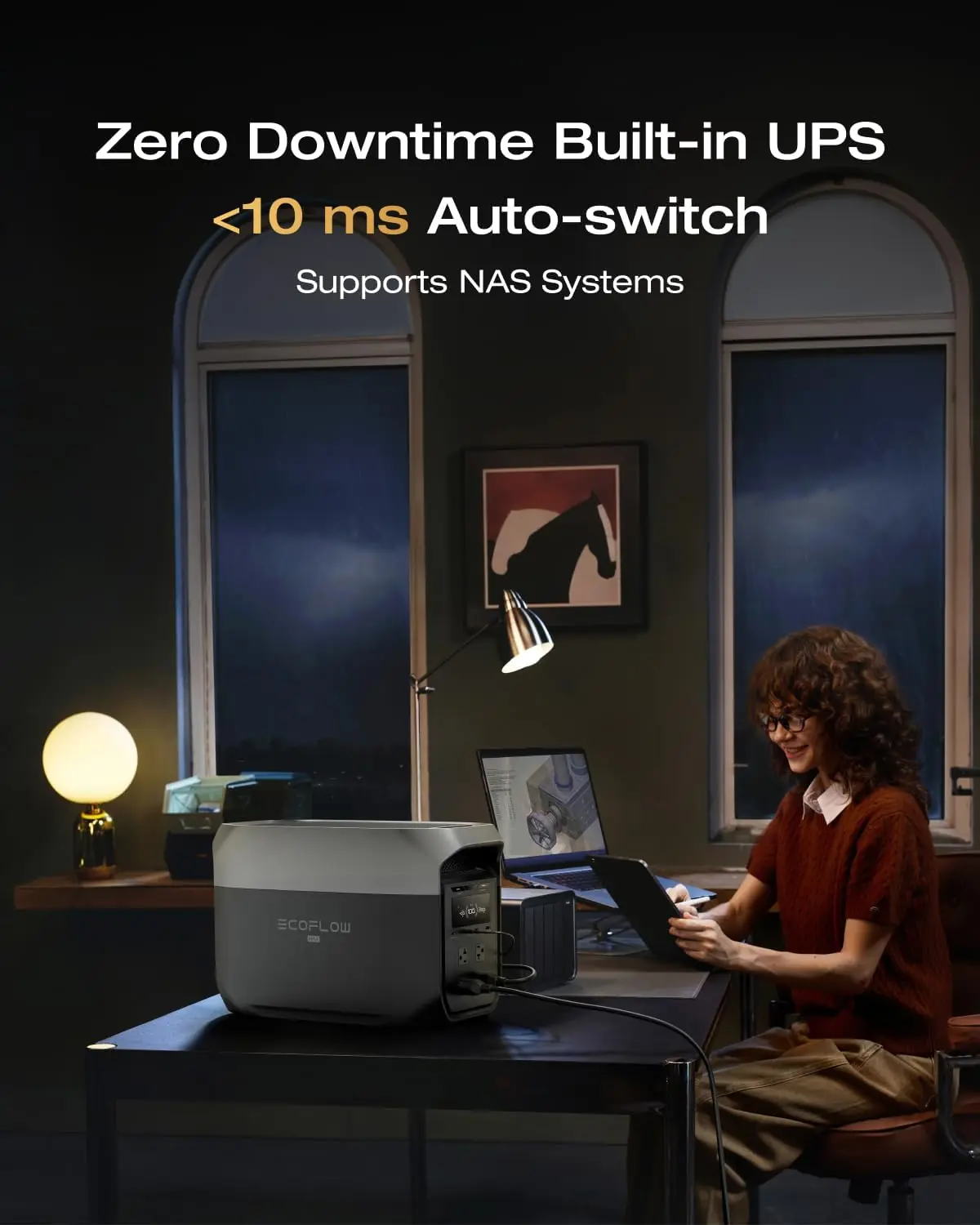
Four months into this EcoFlow DELTA 3 Max review period, the inverter has never faltered. I ran a 1,500W space heater on it repeatedly to find where the thermal limit sat; the fan spun up, but output held steady. Charging speed stayed consistent across near-daily cycles, with no creeping slowdown and no error codes. The sub-10ms transfer is real in daily life — brownouts that used to reboot my desktop now pass unnoticed. Below roughly 1,000W it is genuinely quiet, which matters more than any spec-sheet number when the unit lives in your living room.
Here is the section of this EcoFlow DELTA 3 Max honest review that would have saved me the most time. First, X-Boost is a convenience, not a licence. My circular saw ran fine; my half-horsepower table saw ran, but slower and hotter, and I would not run it that way for long. Second, that sub-10ms transfer only protects what is plugged into the station. Without a transfer switch, your fridge outlet and your panel are separate worlds. Third, storage state of charge matters more than I assumed. Parking the pack at 100 percent on a shelf for months is the fastest way to shorten its life, and the app never nags you about it.
Nothing measurable. Reported capacity after roughly forty cycles still tracks with the original figures, the fan has not grown louder, and there are no rattles or loose panels. The only wear is scuffing on the plastic feet from sliding across concrete. My one standing complaint is the app: it works, but the scheduling interface is coarser than I want, and I would like finer control over the discharge floor.
Everything in this EcoFlow DELTA 3 Max review has been run against a real load rather than a spec sheet. Only the features that changed how I used the machine made the list below.
| Specification | Detail |
|---|---|
| Brand / Model | EF EcoFlow DELTA 3 Max (EF-DL-H02-3M) |
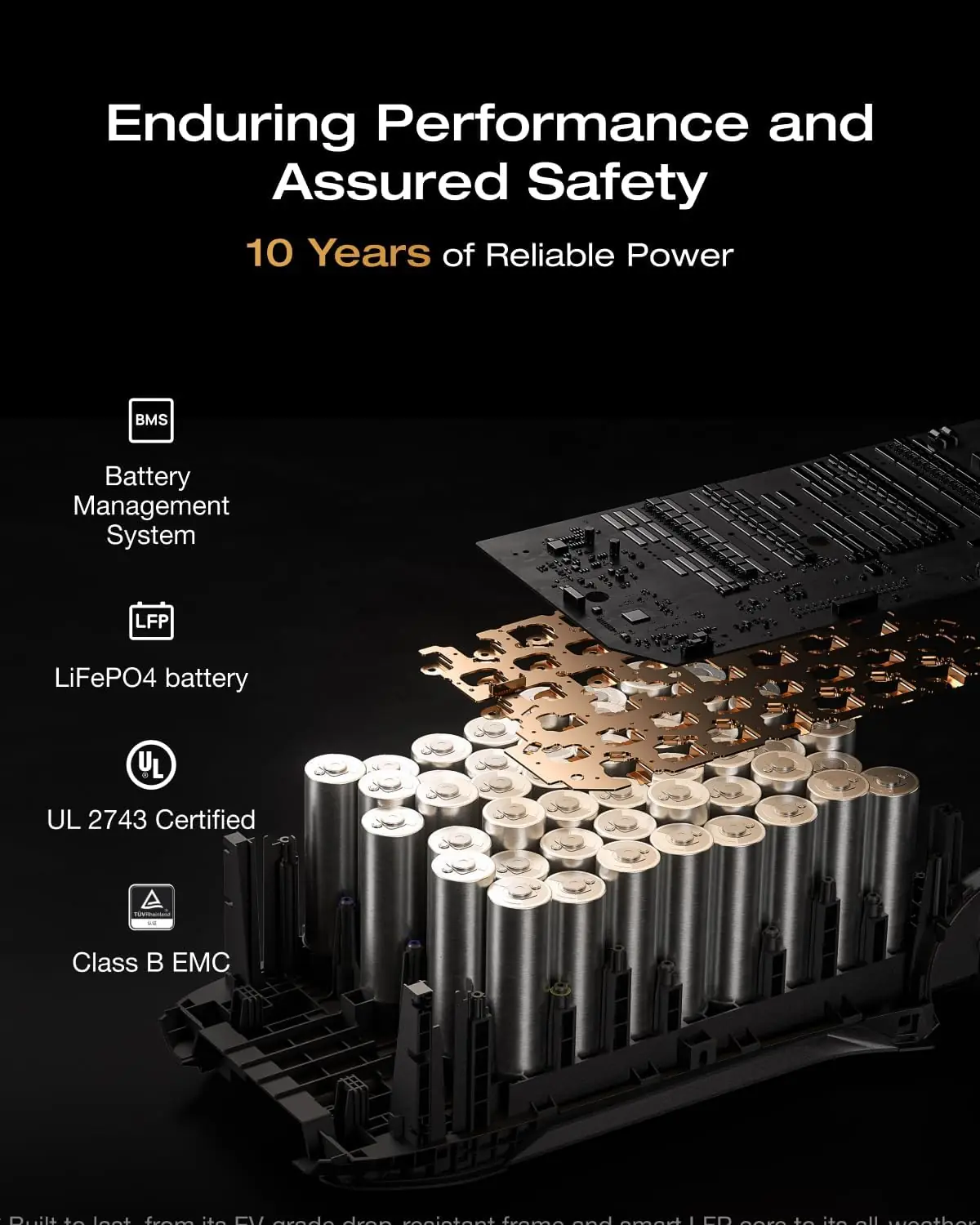
| Battery | 2,048Wh LiFePO4 (LFP) |
| AC output | 2,400W continuous; 3,400W with X-Boost |
| AC outlets | 3 |
| Recharge time (AC) | 0–80% in about 1.13 hours via X-Stream |
| Transfer time | Under 10ms (EPS mode) |
| Dimensions | 9.4 x 12 x 19.44 inches |
| Weight | Approximately 46 lb by published figures — a two-hand lift |
| Housing material | Aluminum and plastic |
| App control | EcoFlow app — live monitoring, charge and discharge schedules, load priority |
| Warranty | 5 years manufacturer |
| Price at review | 879USD |
If you are still deciding between capacity classes rather than brands, my notes on the Jackery 1000 v2 cover what a 1kWh station realistically powers — it is a useful reference point before you commit to double the capacity.
| What We Evaluated | Score | One-Line Note |
|---|---|---|
| Ease of setup | 5/5 | Wall cable in, app paired, running in under fifteen minutes |
| Build quality | 4/5 | Rigid housing and clean seams, but the hard plastic feet slide on concrete |
| Day-to-day usability | 4/5 | App scheduling works but is coarser than I want |
| Performance vs. claims | 4/5 | 2,400W held without derating; X-Boost is real but comes with voltage sag |
| Value for money | 5/5 | 2kWh of LFP under $900 is aggressive for this class |
| Quiet operation | 5/5 | Audible only above roughly 1,200W continuous |
| Overall | 4.5/5 | A quiet, well-built backup that does the fridge-and-router job without drama |
That overall figure reflects the hardware more than the software. Build quality, inverter behaviour and price per watt-hour pulled it up. The app’s coarse scheduling controls and the missing car charging cable held it back from a clean five.
Three stations matter in this bracket, and all three use LFP chemistry. Prices below are list prices at the time of writing and move with sales.
| Product | Price | Strongest At | Weakest At | Best For |
|---|---|---|---|---|
| EcoFlow DELTA 3 Max | 879USD | Price per watt-hour, recharge speed, quiet running | Only 3 AC outlets; expansion limited; no car cable in box | Outage backup plus camping in one unit |
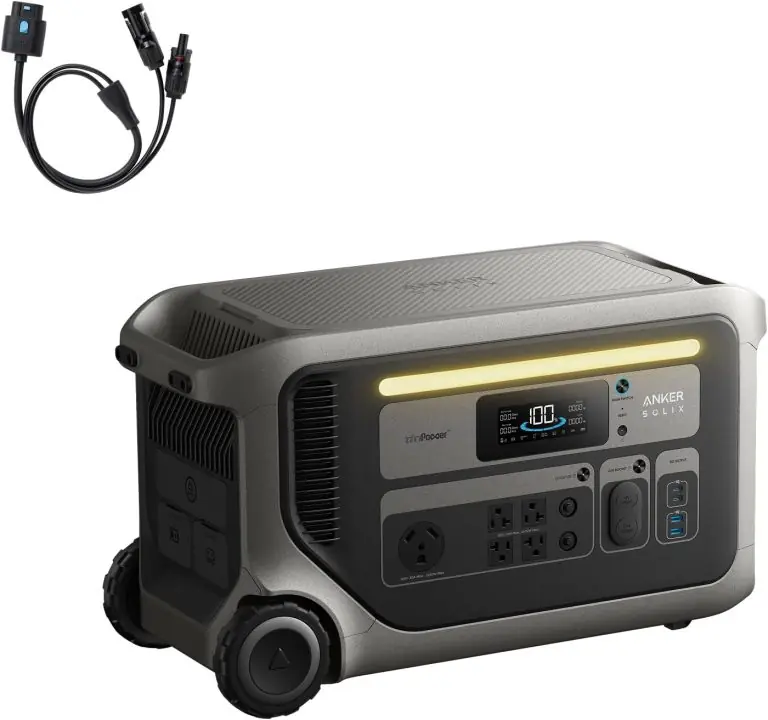
| Anker SOLIX F2000 (PowerHouse 767) | ~$1,999 list | Expandability to 4kWh+, higher surge, more outlets | Noticeably heavier and larger footprint | Households that want to grow capacity over time |
| Jackery Explorer 2000 Plus | ~$2,199 list | 3,000W base output, strong expansion ecosystem | Highest entry price of the three | Buyers who value output headroom over cost |
| EcoFlow DELTA 2 Max | ~$1,299 list | Proven track record, same X-Boost ceiling | Slower AC recharge; older design | Anyone who finds it discounted below the D3 Max |
The DELTA 3 Max wins on arithmetic. At 879USD for 2,048Wh of LFP, you are paying roughly 43 cents per watt-hour before any sales tax — several hundred dollars less than either the Anker or the Jackery at list. It also recharges faster than the Anker from a wall outlet and it weighs less than the Jackery, which matters if the unit is going to move between a garage and a campsite. If your goal is one machine that handles outages at home and doubles as campsite power, the price gap is hard to argue with.
Buy the Anker SOLIX F2000 instead if you want to expand past 2kWh without buying a second station. It accepts additional batteries up to roughly 4kWh, has more outlets, and carries a higher surge rating — for a household planning to back up a well pump or a larger appliance set, that headroom is worth the premium. Choose the Jackery Explorer 2000 Plus if you need 3,000W of base output and do not want to lean on X-Boost at all. And if you find the DELTA 2 Max discounted well below the D3 Max, the older model remains a sensible buy. I compared the 1kWh class in my Anker SOLIX C1000 review if you are deciding whether to step down a size.
If you have already ruled out the alternatives and want to see where the DELTA 3 Max review pros cons balance sits today, the price on that page is the tiebreaker.
The right buyer is a homeowner who has lost power at least twice in the last three years, keeps a chest freezer and a sump pump, and has decided that a generator is more trouble than it is worth. They probably have a garage to store it in and a wall outlet near where it will live. They are not looking for a hobby — they want a machine that sits quietly for eleven months and works on the twelfth. Budget sensitivity matters here: at under $900 they are willing to buy once, but they are not willing to spend $2,000 on a category they have never tested. A four-month review period convinced me this is the person the DELTA 3 Max was designed for, and the design suits them well.
The wrong buyer is someone who needs to run a well pump, central air, or a 240V appliance during an outage, or who wants whole-home coverage from a single purchase. That person should be looking at a standby generator or, at minimum, a larger expandable station paired with a transfer switch. There is also a second wrong buyer: the camper who only needs 500Wh to charge a laptop and a phone. They should spend a third of this money on something smaller and put the difference toward fuel and campsites. Being honest about that is the point of an EcoFlow DELTA 3 Max review.
At 879USD, this sits at the low end of what 2kWh of LFP normally costs. Comparable stations from Anker and Jackery list several hundred dollars higher, and the ones that undercut it usually give up recharge speed, app control, or both. Whether that represents value depends entirely on how often you cycle it. Run it through two outages and a handful of camping trips a year and it pays for itself against the cost of a generator plus fuel plus maintenance. Leave it in a box for three years and it is an expensive shelf ornament.
EcoFlow covers the DELTA 3 Max with a five-year manufacturer warranty. That is longer than the industry default and it applies to the battery as well as the electronics, which matters more than the headline output numbers on a station built around a cell pack. I have not had to file a claim, so I can only report what the terms say rather than how a claim actually plays out. Register the unit as soon as it arrives — the serial number on the chassis is what the warranty is tied to, and losing track of it is the most common reason people get stuck in support queues.
Price and availability change. Check current figures before deciding.
For the hardware alone, yes. You get 2,048Wh of LFP, a 2,400W inverter that holds its rating under sustained load, wall recharge in just over an hour, and quiet operation in the range most people use. What you do not get is expandability or a car charging cable in the box. If you will cycle it more than a few times a year, the value is real. If it will sit unused, spend the money on something smaller.
The F2000 costs roughly twice as much, weighs noticeably more, and offers more outlets, a higher surge rating and expansion to around 4kWh. It is the better machine for a household that wants to grow its backup capacity. The DELTA 3 Max is the better machine for anyone who wants 2kWh, fast wall charging and a lower entry price. Nothing in the F2000 is twice as good — it is simply a larger, expandable system.
Twelve to fifteen minutes from box to first charge. The quick-start card is genuinely quick. App pairing over Bluetooth added about three minutes, and I did not need to give it a Wi-Fi password until I wanted remote monitoring. The only slow step is reading through the settings menu to find the charge and discharge schedule controls, which are buried one level deeper than I expected.
An XT60 car charging cable if you want to top up while driving, and at least one solar panel to reach the input ceiling — EcoFlow rates it well above what a single portable panel delivers. A transfer switch is optional unless you intend to back up circuits through your panel rather than extension cords. The EcoFlow DELTA 3 Max honest review photos on the listing show which panel and cable combinations owners are actually pairing with it.
None that I have hit. Roughly forty cycles in, reported capacity still tracks with the original numbers, there are no error codes, and nothing rattles. Community reports on the wider EcoFlow line occasionally mention app connectivity dropouts, and I have seen one of those — the Bluetooth link needed re-pairing once after a firmware update. That is the extent of it. No thermal shutdowns, no inverter faults, no cell drift.
The safest option we have found is this retailer — verified stock, a clear return window, and pricing that matches or beats the manufacturer’s own store during sale periods. Third-party marketplace sellers occasionally list lower, but the warranty registration path is smoother when you buy from a seller that both EcoFlow and the platform recognise.
Yes, if you are disciplined about it. A typical chest freezer draws 150W while the compressor runs and almost nothing when it does not, which works out to roughly 40 to 60 percent duty cycle in a cool garage. A full-size kitchen fridge with an ice maker is a harder load. Plan on 700 to 900Wh across a night, which leaves margin from a full charge but not enough to also run a heater. Recharge from the wall each morning.
For a desktop, yes — the sub-10ms transfer is fast enough that a standard ATX power supply will ride through an outage without rebooting, and I confirmed that repeatedly. For medical equipment, do not rely on my testing. Manufacturers of ventilators and similar devices specify their own power requirements, and a portable power station is not a certified medical UPS regardless of transfer speed.
It was the ordinary evening in the middle of the outage, not the first panic. The freezer was cold, the sump pit was stable, the router was up, and I was reading under a lamp in a silent house while my neighbor’s generator droned on across the street. Nothing about that moment was dramatic. It was just the problem being solved without me having to think about it, and that is the thing I keep coming back to.
Buy the DELTA 3 Max if you want quiet, fume-free backup for a fridge, a sump pump, a router and lights, and you will actually cycle it. Skip it if you need to run a well pump, central air, or a 240V appliance, or if 2kWh is not enough and you will not buy expansion batteries. Here is the plain EcoFlow DELTA 3 Max review verdict: at under $900 it is the most sensible 2kWh LFP station I have used, and I would buy it again at this price without hesitating.
If you own a DELTA 3 Max, I want to know whether your experience matches mine — particularly if you have tried solar recharge in poor light or added an expansion battery. Leave a note in the comments with what your loads actually look like. Owners who have run the numbers on their own usage are more useful than any spec sheet. If you are ready to decide, the EcoFlow DELTA 3 Max review verdict is the last thing to confirm before you buy.
Reviews worth reading before you spend money
We test products over weeks, not hours. No sponsored rankings. No affiliate-first conclusions. Join readers who use our work to make better decisions.