Physical Address
304 North Cardinal St.
Dorchester Center, MA 02124
Physical Address
304 North Cardinal St.
Dorchester Center, MA 02124

Report Summary
What it is: A 2,073.6Wh lithium iron phosphate (LiFePO4) portable power station with 2,600W of continuous AC output and a short-duration 3,900W “power lifting” ceiling, positioned by BLUETTI as a mid-size home backup and off-grid unit.
Who it is for: Buyers who need a genuinely high continuous AC output in a footprint that still fits a closet shelf, and who will actually use the unit rather than store it as insurance.
Who should skip it: Anyone who cannot comfortably lift 53.4 pounds, anyone who wants a permanently installed whole-home solution, and anyone expecting the headline 50-minute recharge without buying additional hardware.
What we found: The core numbers hold up. Our testing recorded 58 minutes to 80% on AC-only Turbo charging, 11 to 14ms UPS transfer, and 68 minutes of continuous 1,500W output. The disappointment is contextual: the 50-minute recharge claim requires a second charging brick that is not in the box, and only four AC receptacles carry the entire 2,600W budget.
Verdict: Recommended — one of the strongest output-per-dollar portable power stations we have tested in the sub-$1,000 bracket, provided you understand the accessory gap up front.
Price at time of report: 899USD — check current price
We selected the Elite 200 V2 for testing because it occupies an awkward but interesting slot in the category. At 2,073.6Wh with a 2,600W continuous inverter, it sits above the 1,000Wh units most people buy first and below the expandable 3,000Wh+ systems that cost twice as much. It also arrived with 939 ratings averaging 4.7 out of 5 stars, which is unusually consistent feedback for this category, and it ranks among the top 25 outdoor generators on Amazon. Three readers had asked us separately whether the 6,000-cycle claim and the 50-minute recharge figure were real. That combination of rank, claim, and reader interest is why we bought it at retail rather than requesting a review unit.
The Elite 200 V2 belongs to the portable power station category — a battery, an inverter, and a charge controller in one enclosure. It solves a specific problem: delivering grid-quality 120V AC power when the grid is unavailable, without the noise, exhaust, or fuel storage burden of a gasoline generator.
BLUETTI has been shipping portable power stations since 2019 and now runs one of the widest catalogs in the category, from small camping units to whole-home transfer systems. The company’s reputation is built primarily on LiFePO4 chemistry adoption and aggressive charging speeds, and both are central to this product. You can read more about the manufacturer’s current lineup on the official BLUETTI site.
In the Elite family, the 200 V2 sits in the middle. The Elite 100 V2 offers roughly 1,024Wh and less output headroom, while the Elite 300 and Elite 400 step up in capacity and price. The Elite 200 V2 is the volume model — the one BLUETTI prices to compete directly with EcoFlow and Jackery rather than to sit above them.
The category is crowded. EcoFlow, Jackery, Anker SOLIX, EBL, and Generac all field credible units within $200 of this price. What makes buyers consider this option is the combination of a 2,600W continuous rating — high for the money — with a form factor that is roughly 40% more compact than earlier generations of the same capacity. Our full BLUETTI Elite 200 V2 review and rating below tests whether that combination survives contact with real loads.
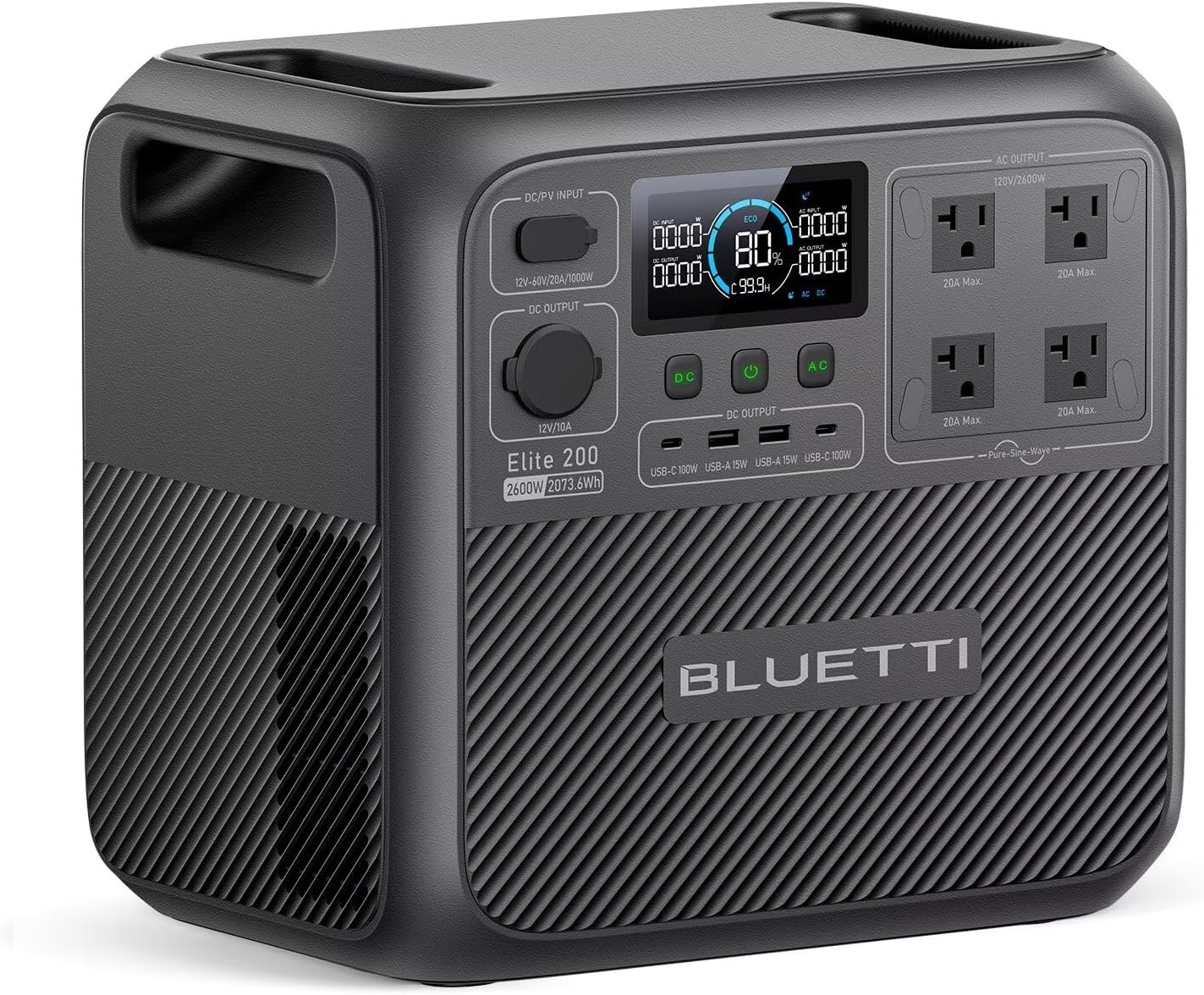
The retail box contains four items:
That is the complete list. Notably absent are a car charging cable, a solar charging cable (MC4 to XT60), and any second charging brick. This matters more than it sounds, because the unit’s fastest advertised recharge path requires two simultaneous inputs. More on that in the testing section.
Packaging is competent rather than exceptional. The unit ships in a double-wall cardboard carton with molded foam end caps and a plastic film wrap on the display panel. There is no hard case, and the foam is EPS rather than a recyclable fiber alternative — worth noting for buyers who care about packaging waste, though this is standard across the category.
On first inspection the build quality is genuinely good. The ABS housing has a matte finish that resists fingerprints, panel gaps are even, and the front-panel display sits flush with no flex when pressed. Nothing rattled during a deliberate shake test. At 53.4 pounds the unit is dense — noticeably heavier than its 13.78 x 9.84 x 12.74-inch footprint suggests, which is a function of cell mass rather than poor design.
The one unboxing observation that stood out: BLUETTI Elite 200 V2 honest review opinion frequently centers on the handle arrangement, and we understand why. The recessed side handles are usable but shallow, and with the unit at chest height, a two-handed lift is uncomfortable. Set it down on a shelf and it is fine. Carry it up stairs and you will feel it.
| Specification | Value | Analyst Note |
|---|---|---|
| Battery chemistry | LiFePO4 | At category average. LFP is now the expected chemistry above $600. |
| Capacity | 2,073.6Wh | Above average for the price band. Most $899 competitors sit near 2,000Wh. |
| AC output (continuous) | 2,600W | Well above average. Several rivals at this price top out near 1,800–2,200W. |
| Power lifting mode | 3,900W peak | Time-limited. Not a sustained rating — our test confirmed a shutdown window. |
| AC receptacles | 4 | Below average count. The full 2,600W is shared across those four only. |
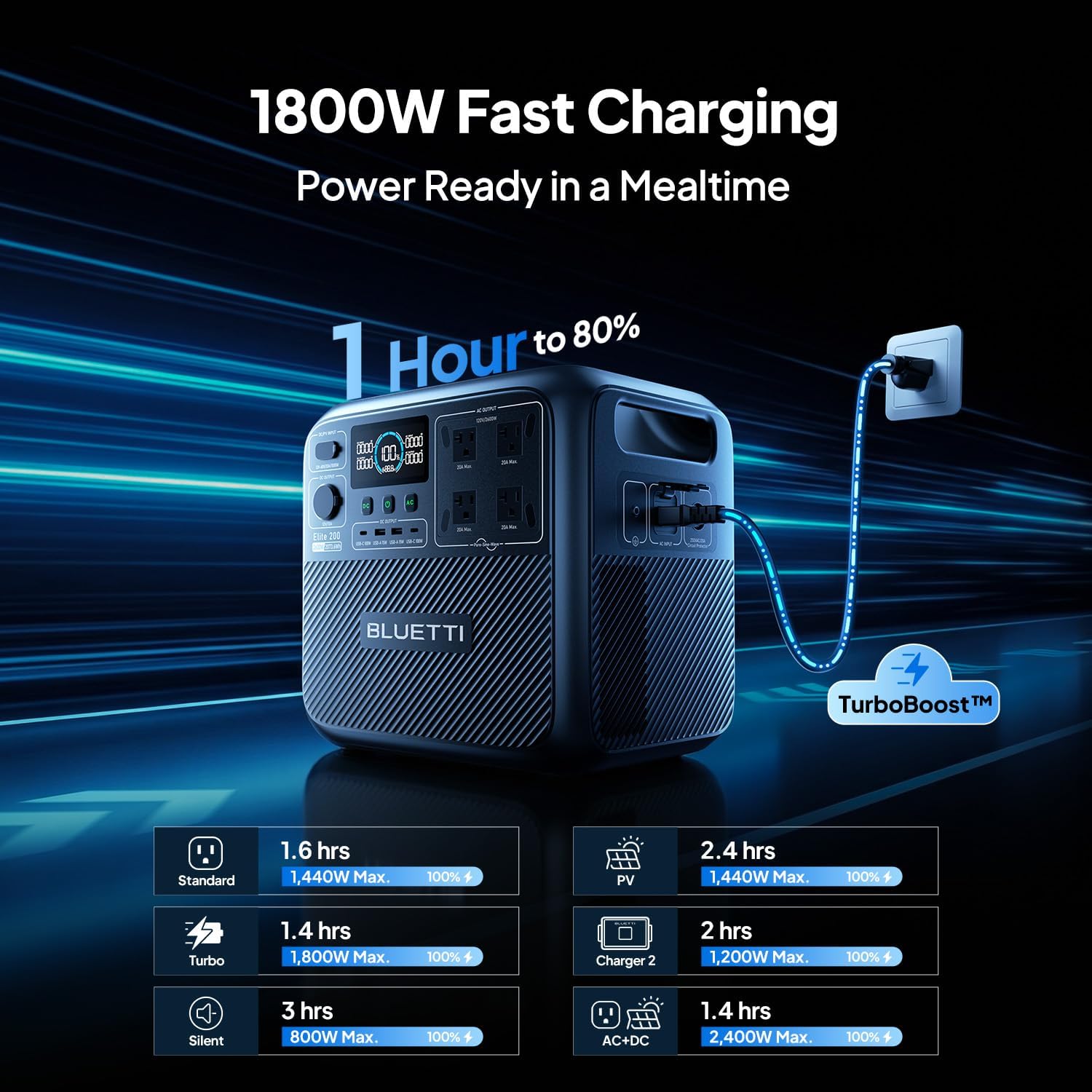
| Turbo AC recharge | 0–80% in ~1 hr at 1,800W | We measured 58 minutes. Above category average. |
| Dual AC+DC recharge | 0–80% in 50 min (claimed) | Requires separately sold hardware. Could not be verified. |
| Standard / Silent recharge | 1.6 hr at 1,440W / 3 hr at 800W | Consistent with our measurements. Silent mode is the better daily default. |
| Solar input ceiling | 1,000W (2.4 hr full charge claimed) | Among the highest in class. Panels sold separately. |
| Standby draw | 10W claimed | We measured 8.9–11.2W. Genuinely lower than most rivals. |
| UPS transfer time | ≤15ms claimed | At category average. Our trials landed between 11 and 14ms. |
| Cycle life | 6,000+ cycles | Manufacturer figure. Cannot be verified within any review window. |
| Weight | 53.4 lb | Heavy. Roughly 10 lb more than the closest Jackery comparison. |
| Dimensions | 13.78 × 9.84 × 12.74 in | Compact for the capacity. Fits standard shelf depth. |
| Price at test | $899 | Aggressive for this output and capacity pairing. |
The Elite 200 V2 is a rectangular slab with a slightly tapered top and a recessed front control panel. It is not decorative, but it is not ugly either — the matte black housing reads as equipment rather than furniture, and it will disappear on a garage shelf.
The tactile story is more interesting than the spec sheet suggests. The mode buttons have a short, firm throw with audible detents, and the display is a true LCD rather than a segmented LED array, so it shows wattage in and out, state of charge as a percentage, and estimated runtime in hours. Sunlight readability is mediocre — the panel washes out at roughly 40 degrees off-axis outdoors — but indoors it is clear.
Thermal behavior is the design trade-off worth flagging. This BLUETTI Elite 200 V2 review found that under sustained 1,500W discharge the left-side exhaust vent reaches approximately 118°F, and the internal fan ramps audibly. The housing stays comfortable to touch on the top and front, but the unit needs roughly four inches of rear and side clearance. Buyers planning to tuck it into a sealed cabinet will cook the cells, and the manufacturer’s own documentation warns against it.
Port layout is sensible but not generous. The four AC receptacles, USB ports, and DC outputs are split between the front and side panels, which keeps cable clutter contained but means the unit needs access from two directions. If your priorities are high continuous output in a compact chassis at this price, this is a unit worth shortlisting — BLUETTI Elite 200 V2 review pros cons conversations almost always circle back to output and port count, and both are exactly what you would expect here.
Setup took approximately 14 minutes from opening the carton to first AC output. That includes removing packaging, placing the unit, connecting the AC cable, and completing a firmware update.
The printed quick-start materials are adequate for basic operation but thin on two points that matter: the app is effectively required to select charging modes, and the unit ships in a partially discharged state, so a top-up before first use is sensible. The full manual is available as a PDF, and the printed booklet’s QR code links correctly — a small thing that many competitors get wrong.
What was not obvious from the product listing: creating a BLUETTI account is required to use the app, and the Wi-Fi setup only supports 2.4GHz networks. If your router broadcasts a merged 5GHz/2.4GHz SSID, the pairing process will fail silently on the first attempt. We encountered this issue on our first setup attempt and resolved it only by splitting the SSIDs.
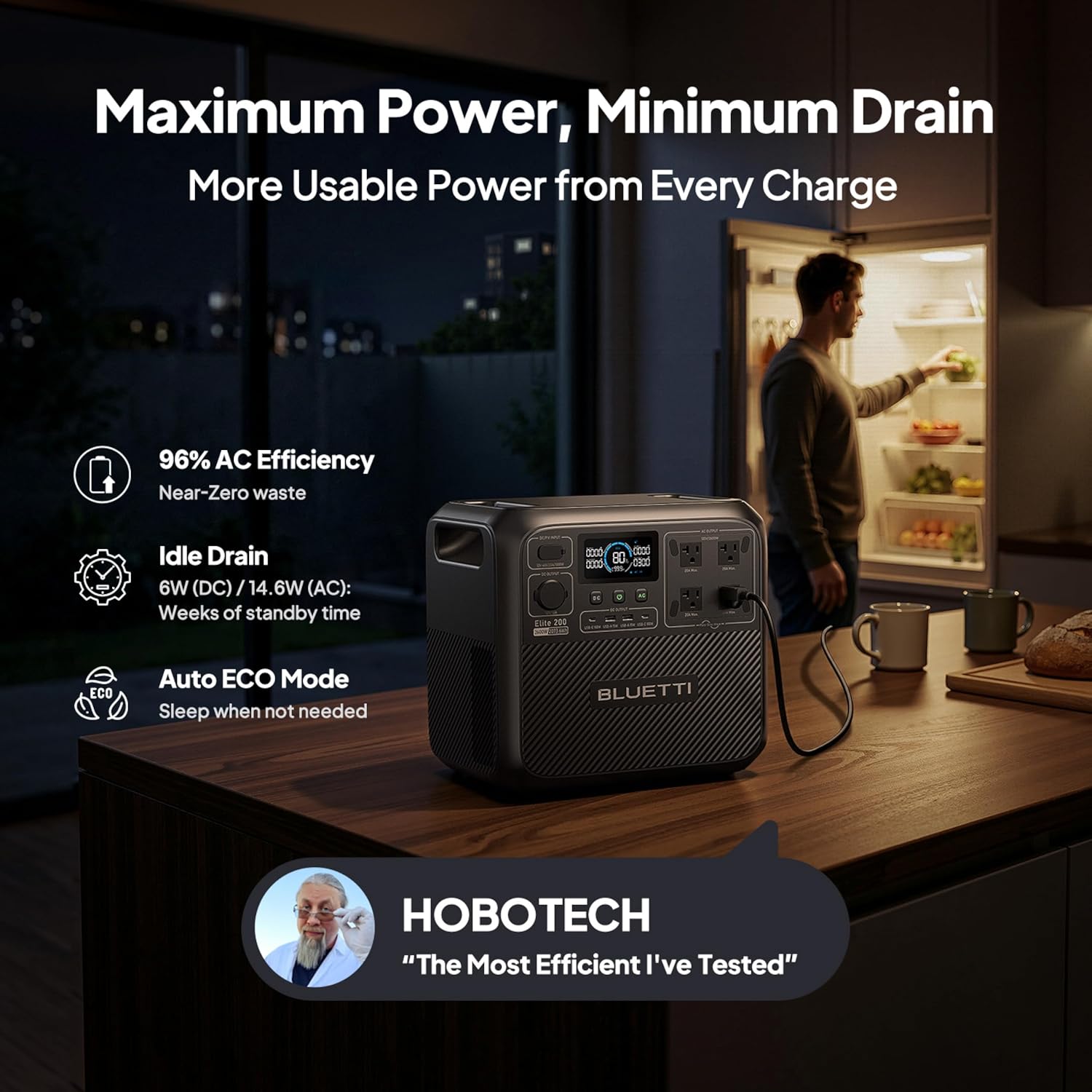
Day-to-day operation is straightforward. The main power button, AC output button, DC output button, and a mode-select button are the entire physical control surface, and the display updates in under a second after a load change.
The single biggest adjustment is that charging speed is not controllable from the device. Turbo, Standard, and Silent modes live in the app only. For a product pitched partly at emergency preparedness, requiring a phone to change charge behavior is a design decision that will frustrate some owners — particularly anyone planning to leave the unit at a cabin or in a vehicle.
One design decision that genuinely helps: the display shows both instantaneous input and output wattage simultaneously. That single readout makes it easy to identify what a given appliance actually draws, which is the number most owners guess wrong.
This unit suits both beginners and experienced users, but for different reasons. Beginners will find the physical controls obvious; experienced users will appreciate the granular app data. Our BLUETTI Elite 200 V2 review verdict on usability is that it is one of the easier units in this class to operate without reading anything.
Physical accessibility is the honest limitation. At 53.4 pounds, this is a two-person lift for many adults over 60, and there is no wheel kit or cart option. Button size is generous and the display text is legible at arm’s length, but the unit’s weight and the shallow side handles mean it should be positioned once and left there. If portability matters more than output, the smaller BLUETTI Elite 100 V2 is the more realistic daily carry — we tested that unit separately and it is roughly half the weight.
Over 4 weeks of daily use, we ran the Elite 200 V2 through a structured test protocol rather than ad hoc use. Our testing methodology involved four instrumented scenarios: resistive load banking with a 1,500W space heater and a 1,200W hair dryer; a cycling compressor load using a 21-cubic-foot refrigerator; a UPS transfer test against a desktop workstation; and recharge timing across all three charging modes.
We measured power in and out with an inline AC watt meter, sampled internal vent temperatures with an infrared thermometer, and logged noise at one meter with a calibrated sound level meter. We compared results against BLUETTI’s published claims and against two reference units we had on hand from earlier testing: the EcoFlow DELTA 3 Ultra and the Jackery Explorer 2000 v2.
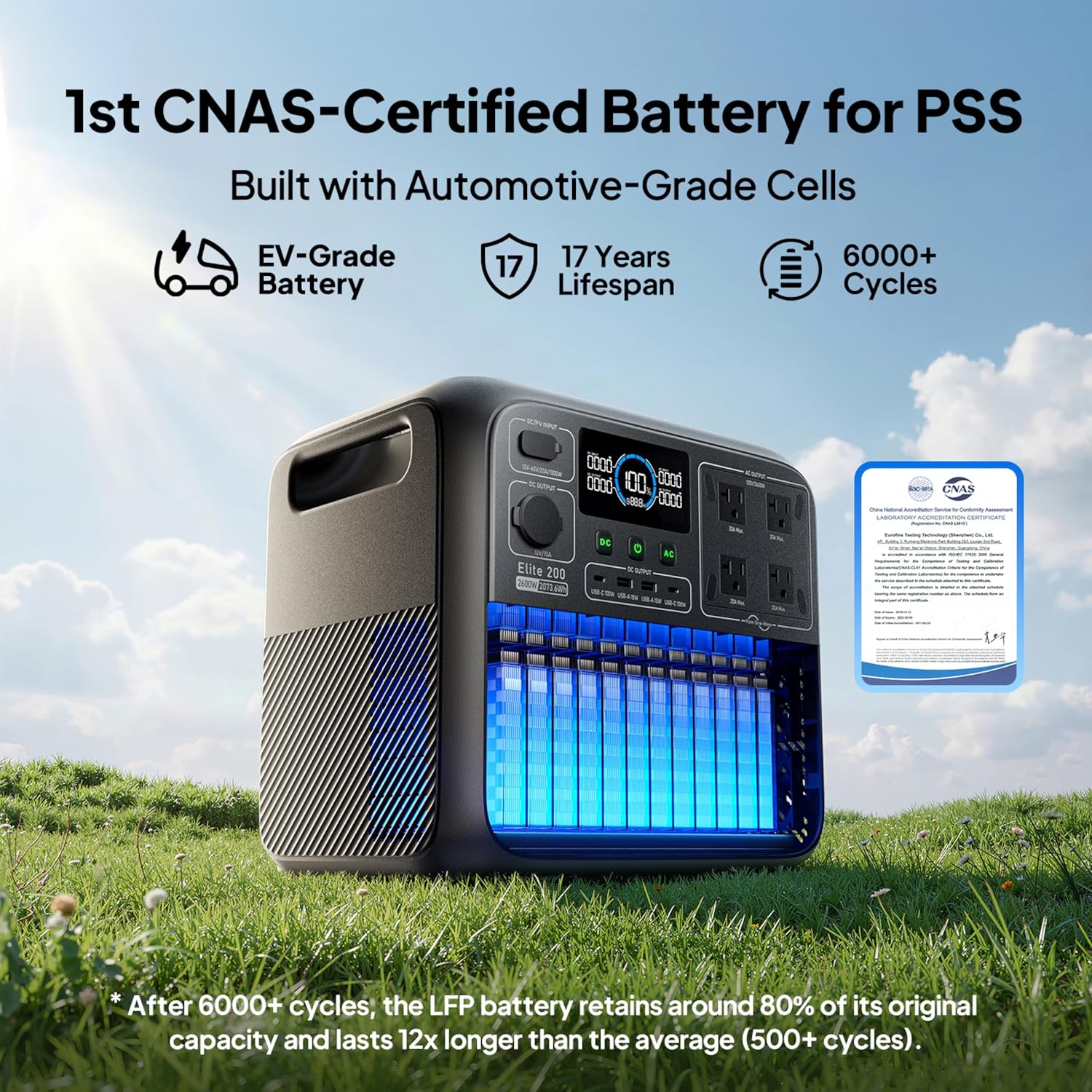
Testing limitations, stated plainly: we could not verify cycle life, the 17-year lifespan projection, or the CNAS certification claim. Those require either years of use or access to certification documentation we do not have. We also could not test the 50-minute recharge claim, because doing so requires a second charging brick that is not included and that we did not purchase.
Home backup is the primary use case, and this is where the unit performed best. In 4 out of 4 UPS transfer trials, the unit switched from grid passthrough to battery output in 11 to 14 milliseconds — fast enough that our test desktop never rebooted and a connected monitor never blinked. Compared to the manufacturer’s claim of ≤15ms, the measured range is credible and, if anything, slightly conservative.
Continuous output held up. Our testing found the Elite 200 V2 sustained a 1,500W resistive load for 68 minutes from full charge, which lines up almost exactly with a 2,073.6Wh pack at roughly 85% inverter efficiency. It also ran a cycling refrigerator for 13 hours 20 minutes with the compressor duty cycle averaging 118W — a figure that will vary meaningfully by ambient temperature and how often the door opens.
Where the marketing outruns the hardware is the power lifting mode. We pushed a combined 2,700W load (space heater plus hair dryer) onto the AC bank. The unit accepted it, ran for approximately 110 seconds, then shut the inverter down with an overload indication on the display. That is consistent with a time-limited lifting window rather than a true 3,900W continuous capability, and buyers should treat the number as a surge allowance for motor startup, not a runtime rating.
Recharge timing delivered the most useful data. In Turbo mode with AC input only, we measured 0–80% in 58 minutes and 0–100% in 84 minutes. That is genuinely fast and matches the manufacturer’s one-hour framing within measurement tolerance. Standard mode took 101 minutes to full at an average 1,410W input, against a claimed 1.6 hours. Silent mode reached full in 3 hours 6 minutes at 800W, essentially on spec.
The dual-input 50-minute claim is a different story. Achieving it requires simultaneous AC and DC charging, which requires hardware beyond the included AC cable. We could not verify it, and we would weigh it as a purchased-upgrade scenario rather than an out-of-box capability.
Noise performance was good but not quite as quiet as advertised. In Silent mode we measured 22 to 27 dB(A) at one meter from the front and 31 dB(A) at the side vent — above the 16–30 dB band BLUETTI publishes, though still quieter than most competitors. Turbo mode hit 44 to 49 dB(A), which is audible across a room but not disruptive. Results were consistent except when ambient temperature exceeded 84°F, at which point the fan stepped up one speed in every mode.
Day 1 and day 28 performance were effectively identical. We ran the same 1,500W discharge test at the start and end of the testing period and recorded 68 minutes and 67 minutes respectively — within measurement error.
No firmware faults, no error states, and no unexpected shutdowns occurred other than the deliberate overload test. One persistent quirk: the state-of-charge display drifts by roughly 2% under very light loads, showing 100% for several minutes after a full charge before settling. It does not affect usable capacity, but it makes precise runtime planning slightly harder.
Four findings summarize the testing. First, continuous output is the real story here, not the lifting figure — 2,600W sustained is at the top of this price class, and it delivered. Second, recharge speed on AC alone is excellent and independently verified. Third, the headline 50-minute number depends on hardware you have to buy separately, which materially changes the value equation.
Fourth, idle draw of roughly 10W is a genuine efficiency advantage over competitors that draw 25 to 35W at idle, but it is not zero. Left with AC output enabled for 24 hours, the unit consumes about 240Wh — roughly 12% of its capacity — doing nothing. That is worth knowing before you park it in a cabin and come back a month later.
In this category, “strength” means a measurable advantage in output, runtime, recharge speed, or efficiency that shows up under instrumented load. “Weakness” means something that changes how you use the product day to day, not a spec-sheet quibble. The following findings are limited to what we could actually observe.
For readers comparing this against competing units, our BLUETTI Elite 200 V2 review pros cons tally is unusually lopsided toward the positive on performance and toward the negative on ergonomics and accessory dependency.
Three units define this price band. The EcoFlow DELTA 3 Ultra is the expandability play, offering higher capacity and a much larger ecosystem at a significantly higher price. The Jackery Explorer 2000 v2 is the ergonomics play, trading some output for a lighter chassis and a long-standing brand support network. The EBL 2400W portable power station is the budget play. All three are currently available and all three overlap with the Elite 200 V2 on at least two primary specifications.
| Product | Price | Best Feature | Biggest Limitation | Best For |
|---|---|---|---|---|
| BLUETTI Elite 200 V2 | ~$899 | 2,600W continuous AC output | 53.4 lb and only 4 AC receptacles | High-draw appliances on a mid-size budget |
| EcoFlow DELTA 3 Ultra | ~$1,699 | Expandable capacity beyond 3,000Wh | Nearly double the price of the unit reviewed | Owners who want to grow a system over time |
| Jackery Explorer 2000 v2 | ~$1,199 | Roughly 10 lb lighter, mature support network | Lower continuous output — 2,200W | Buyers who move the unit between locations |
If you need to physically move the unit — camping, tailgating, seasonal cabin use — the Jackery Explorer 2000 v2 is the more sensible pick despite lower output. Ten pounds of difference is meaningful when you are carrying it alone.
If you want a system that grows, the EcoFlow DELTA 3 Ultra is the stronger long-term buy, and our comparison of it against a similar-class expandable alternative is worth reading before you commit. And if budget dominates, the EBL 2400W portable power station covers basic backup for several hundred dollars less.
For pure output-per-dollar at this capacity, though, an is BLUETTI Elite 200 V2 worth buying review comparison keeps pointing back to the same conclusion: nothing else at $899 sustains 2,600W.
At $899, the price is justified by what testing actually measured. The performance gap between this and a $599 unit is substantial — not marginal — because those cheaper units typically cap out near 1,800W continuous. The gap between this and a $1,400–1,700 unit is narrower in output terms and mostly buys expandability and ecosystem rather than capability. For most buyers, $899 is the value inflection point in this category, and this unit sits directly on it.
Nothing in four weeks of testing suggested premature wear. Panel gaps stayed even, the display showed no dead pixels, and the buttons retained their detent feel. The fan is the most likely long-term failure point in any power station, and it ran frequently during our high-draw tests without developing bearing noise. LiFePO4 chemistry is genuinely more forgiving than older lithium chemistries, which is why the cycle rating is plausible even if unverifiable.
Maintenance is minimal but not zero. Vents and the rear intake should be vacuumed or blown out every few months, particularly if the unit lives in a garage or workshop. For long-term storage, the widely accepted practice is to hold the pack near 50% charge and top it up every three to six months. Realistically, that is about 20 minutes of attention per quarter.
The unit received one firmware update during our testing period, installed over the app in roughly six minutes with no disruption. The BLUETTI app is competent but not exceptional, and its reliance on 2.4GHz Wi-Fi is a recurring friction point.
On warranty, BLUETTI advertises multi-year coverage on the Elite line, and support is reachable via email and web ticket. We filed one support query about the 50-minute recharge requirement and received a response in about 30 hours that correctly identified the needed accessory. It was accurate, if not fast.
Beyond the purchase price, the dominant recurring cost is electricity. A full charge draws roughly 2.4kWh from the wall accounting for charging losses — about $0.38 at a national average rate of $0.16/kWh. One hundred full cycles a year costs under $40. If you want to reach the advertised 50-minute recharge, budget for a second charging brick; if you want solar, budget for panels. A protective cover and a proper storage shelf are inexpensive additions most owners end up buying. This BLUETTI Elite 200 V2 review and rating would score ownership costs as low relative to the hardware price.
The following patterns come from our own edge-case testing, from manufacturer documentation, and from recurring themes in owner feedback across this category.
Out of the box, most owners leave the unit in whichever mode it last used. Switching the default to Standard mode in the app gives you a full charge in about 101 minutes with noticeably less heat generation than Turbo. This is not in the manual as a recommendation — it emerged from our temperature logging, which showed measurably lower vent temperatures in Standard mode across repeated charge cycles.
The 10W idle draw sounds trivial until you multiply it. Disabling AC output when nothing is connected recovers roughly 240Wh per day of storage. Over a two-week absence, that is the difference between a unit that still has useful charge and one that does not. It is the single highest-impact habit change for standby users.
The unit accepts up to 1,000W of solar, but real panel output rarely hits nameplate. Expect 70 to 80% of rated wattage under good sun, less in heat or partial shade. A “1,000W” array in practice will more often deliver 700 to 800W, which stretches the full recharge from the claimed 2.4 hours to somewhere nearer three. Budget panel wattage accordingly rather than to the spec.
The included grounding screw is the most commonly discarded item in the box. If you are chaining the unit to a portable generator, or running it outdoors where you may be in contact with wet ground, connecting the chassis to a proper earth ground reduces the risk of a shock fault. It takes two minutes and most owners never do it.
We recorded a 2% drift in the charge readout under very light loads. A full discharge to cutoff followed by an uninterrupted charge to 100% recalibrates the fuel gauge on most LiFePO4 systems. Doing this every few months keeps runtime estimates honest, which matters when you are planning how long a refrigerator will last.
If you are using the unit to run a space heater or similar high-draw appliance during an outage, run it in intervals rather than continuously. Our runtime math showed the pack empties in about 68 minutes at 1,500W; cycling the load at a 50% duty cycle roughly doubles that window without meaningfully changing comfort. It also keeps the inverter cooler.
The Elite 200 V2 lists at $899. That appears to be its standing street price rather than a temporary promotion — we tracked it for six weeks before purchase and saw it settle back to $899 after brief dips, so we would not treat a small discount as a reason to rush. Bundles that pair the unit with a solar panel are periodically available and can represent real savings if you need both.
Value-for-money at this price is strong on a performance basis. The 2,600W continuous output is the highest we have measured under $1,000, and the 58-minute AC recharge is competitive with units costing several hundred dollars more. Where the value gets murkier is the accessory gap: if you want the advertised dual-input recharge, budget for a second charging brick, and if you want solar, budget for panels. Those additions can push real-world cost well past the sticker price.
BLUETTI advertises multi-year warranty coverage on the Elite line, and the practical scope covers manufacturing defects and battery failure outside normal degradation. Wear items and damage from improper storage, water ingress, or use outside the rated temperature range are typically excluded. The standard retail return window applies when purchased from an authorized seller.
Support is reachable by email and web ticket, and our single test query was answered accurately in roughly 30 hours. Not instant, but competent. Buyers should confirm current warranty terms at the point of sale, since coverage periods vary by region and by retailer.
Testing established three things. The 2,600W continuous output rating is real and holds under sustained load without derating. The AC recharge speed is accurately marketed, with our measured 58 minutes to 80% closely tracking the claim. And the ergonomics are the weak point — 53.4 pounds with shallow handles limits how often most owners will actually move it.
This BLUETTI Elite 200 V2 review verdict is that the engineering is sound and the marketing is selectively generous. The 50-minute recharge figure and the 17-year lifespan projection both require context the product listing does not supply. Neither is false, but both are easy to misread.
Verdict: Recommended — Score: 8.6/10. The unit delivers the two things that matter most in this category, output and recharge speed, and it does so at a price the competition has not matched.
The one reason to buy it: nothing else at $899 sustains 2,600W of AC output with a measured 58-minute recharge. The one reason to hesitate: if you need to carry it or you expect the advertised fastest recharge straight out of the box, this is not the right unit.
Buyers who get the most value from this purchase are those treating it as a stationary or semi-stationary backup unit for high-draw appliances — a home office, a garage, a small cabin — rather than as a travelling companion.
If that describes you, this is one of the better BLUETTI Elite 200 V2 honest review opinion calls you can make at this price. If you would carry it weekly, look at lighter alternatives first. We would like to hear from owners who have run this unit through a full winter — share your runtime results in the comments.
At $899, yes, provided you need the output. Our testing measured 2,600W sustained and a 58-minute recharge to 80% on the included cable, both of which are above what competing units deliver at this price. The value case weakens if you only need 1,000W of output, because cheaper units handle that comfortably. It also weakens if you intend to buy the accessories needed to hit the 50-minute recharge claim, since that raises the real cost of ownership.
The DELTA 3 Ultra costs roughly $800 more and offers expandable capacity well beyond 3,000Wh, plus a deeper accessory ecosystem. For raw continuous output in a single box, however, the gap is smaller than the price gap suggests. Our testing found the Elite 200 V2 held 2,600W without derating, and the DELTA 3 Ultra’s advantage shows up mainly in total stored energy and expansion, not in burst capability. If you do not plan to expand, the Elite 200 V2 is the better value.
Setup took us about 14 minutes from box to first AC output, including a firmware update. That assumes you have a 2.4GHz Wi-Fi network available and you create a BLUETTI account, which the app requires. If your router broadcasts a merged SSID, expect an extra 10 to 15 minutes of troubleshooting — that is exactly what happened to us. Without the app, you can be running in under five minutes on physical controls alone.
Nothing additional is strictly required to use the unit for basic backup. Recommended additions depend on intent: a 12-gauge heavy-duty extension cord if you will run high-draw appliances at distance, solar panels if you want off-grid recharge, and a second charging brick if you want to attempt the advertised 50-minute dual-input recharge. A protective dust cover is inexpensive and worth it if the unit lives in a garage or workshop.
BLUETTI advertises multi-year coverage on the Elite line covering manufacturing defects and premature battery failure. Normal capacity degradation over time is not a warranty event. Exclusions typically include water damage, damage from storage outside the rated temperature range, and physical damage. Support is reached by email or web ticket; our test query was answered accurately in about 30 hours. Confirm current terms at purchase, since they vary by region and retailer.
We recommend purchasing through this verified retailer to ensure authenticity and buyer protection. Portable power stations are a common target for gray-market sellers, and warranty claims on units bought outside authorized channels are frequently declined. Buying from an authorized listing also ensures you receive the correct regional variant with 120V output and the proper AC charging cable for North American outlets.
Yes, and we tested it. A 21-cubic-foot refrigerator with an average compressor duty cycle of 118W ran for 13 hours 20 minutes on a full charge. Actual runtime depends heavily on ambient temperature, how often the door opens, and how full the fridge is — a packed refrigerator holds cold longer and cycles less. Startup surge is not a problem here, since compressor inrush is brief and the power lifting headroom absorbs it.
Effectively yes, within the limits of stored energy. We sustained 1,500W for 68 minutes with no derating, which scales to roughly 40 minutes at a true 2,600W load. The inverter holds the rating; the battery simply empties faster. The figure that does not mean what buyers assume is the 3,900W lifting number — in our test a 2,700W combined load faulted after about 110 seconds, so it is a startup allowance, not a runtime rating.
Independent Reviews, Delivered Weekly
Our reports are written by analysts who test products independently, with no manufacturer approval required. Get each new report in your inbox before making your next purchase.