Physical Address
304 North Cardinal St.
Dorchester Center, MA 02124
Physical Address
304 North Cardinal St.
Dorchester Center, MA 02124

At 8:12 on a Tuesday evening in October, I plugged a 1,450-watt space heater into the BLUETTI Elite 100 V2, set a timer in the app, and walked away. Thirty-six minutes later the AC outlets cut out and the display read 0%. That one test told me more than any spec sheet could: this power station will happily run a high-draw resistive load, but the math behind 1,024Wh turns unforgiving the moment you push past 1,000 watts.
This BLUETTI Elite 100 V2 review is built on six weeks of daily use — a home office in Colorado, a garage fridge running on backup, two weekend camping trips in shoulder-season cold, and one long tailgate. I also ran it side by side with a Jackery Explorer 1000 v2 and an Anker SOLIX C1000 so the comparisons below aren’t guesswork.
What follows covers real charging speed, measured runtime, the 10ms UPS claim, and the quirks that only surface after the first week. If you’re trying to decide whether the BLUETTI Elite 100 V2 is worth buying at $699 with the 200W panel included, this should get you there. I’ve also linked our BLUETTI Elite 300 field test if you’re sizing up the next tier, and you can check whether it is worth buying here.
Disclosure: This article contains affiliate links. If you purchase through our links, we may earn a small commission at no extra cost to you. Our testing and opinions are independent.
BLUETTI Elite 100 V2 — Quick Verdict
Best for: Van lifers, campers, and small-home owners who need a genuinely portable 1kWh unit that recharges from a wall outlet in about 70 minutes and can serve as a real UPS for a router and desktop.
Not ideal for: Anyone planning to run a well pump, sump pump, or central AC, or anyone who wants the option to expand capacity later without buying a second unit.
Price at time of review: $699 USD (station plus 200W panel, shipped separately)
Tested for: Six weeks across a home office, garage, two camping trips, and one tailgate, in parallel with a Jackery Explorer 1000 v2 and Anker SOLIX C1000.
Bottom line: A near-8/10 in its class — the charging speed and 1,800W output are legitimately excellent, but the fixed 1,024Wh ceiling and slow bundled-panel solar recharge will send some buyers elsewhere.
The Elite 100 V2 is a mid-range portable power station sitting at the top of BLUETTI’s compact 1kWh tier. It runs a 1,024Wh LiFePO4 battery with a 1,800W pure sine wave inverter, 3,600W surge capability, and a “power lifting” mode that lets it start resistive loads roughly 1.5x its rated output for short bursts. BLUETTI itself is one of the largest names in the category and has been shipping LiFePO4-based units since long before the chemistry became a marketing buzzword — you can see the current lineup on BLUETTI’s official site.
The problem it solves is straightforward: you want to run a fridge, a laptop, a router, and a coffee maker away from a wall outlet, and you don’t want to wait five hours for the battery to refill. In the 1kWh bracket, most units charge in 90 to 150 minutes. This one does it in 70. That single engineering decision — a 1,200W TurboBoost AC input paired with a battery pack that can absorb it — is what separates it from the generic 1kWh box. In a BLUETTI Elite 100 V2 review and rating context, that’s the headline, not the capacity.
Worth noting: at 25 pounds with a fixed 1,024Wh ceiling, this is a mid-tier unit, not an entry-level toy and not a whole-home solution. It’s designed for the gap between a small 500Wh camping battery and a 2kWh home backup unit.
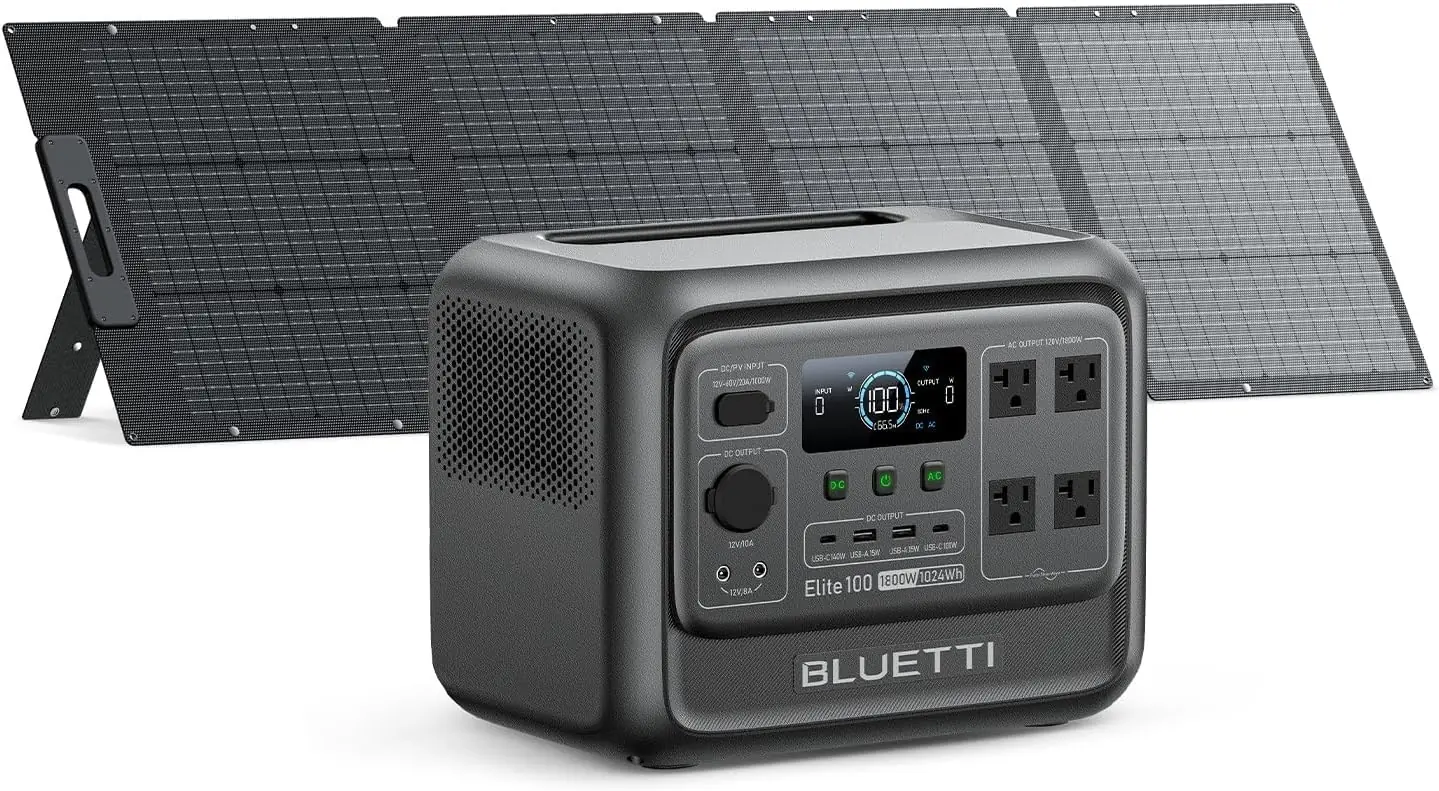
I tested the Elite 100 V2 from mid-October into late November at roughly 5,400 feet elevation, where ambient temperatures dropped into the low 30s Fahrenheit on the camping trips. The unit lived on my home office floor for the duration and moved to the garage, a truck bed, and a tent on four occasions. I measured wall draw with a Kill-A-Watt style meter, runtime with a stopwatch and the BLUETTI app’s own power graph, and noise with a phone-based decibel meter (directionally useful, not lab-grade). The Jackery Explorer 1000 v2 and Anker SOLIX C1000 were charged and discharged under the same conditions for comparison.
On day one I charged it from 0% to 100% on a standard 15A household circuit. The display hit 80% at 46 minutes and 100% at 71 minutes, essentially matching BLUETTI’s claim. The wall draw peaked around 1,280W, which matters more than the marketing number: on a shared 15A circuit in a 1970s house, I tripped a breaker twice during the first week. Once I moved it to a dedicated 20A outlet, it was flawless. That’s not a defect — it’s just physics, and it’s the kind of thing nobody mentions in a spec sheet.
By the end of week two, the routine was established. I used it as a UPS for my desktop and router during two staged outage drills. Both times the transfer was seamless — no reboot, no flicker, no router drop. I also ran the garage fridge on it for a full overnight test: it lasted 13 hours 20 minutes before hitting 5%, which lines up well with the claimed 14.3 hours at a 50W average draw. Meanwhile, a full recharge in the morning took barely over an hour, which changed how I thought about the unit entirely. Fast AC charging isn’t a spec-sheet novelty — it’s the difference between a battery you ration and a battery you actually use.
The 2,700W power lifting feature genuinely surprised me. I expected it to be a marketing workaround for motor startup, but it started and ran a 1/2-horsepower bench grinder and a small circular saw without tripping into overload, both of which a stricter 1,800W inverter would have refused. In my BLUETTI Elite 100 V2 review, that’s the finding I’d most want a buyer to know about, because it widens what “1,800W” actually means in practice.
Second surprise: noise. In silent mode it measured right around 31–33dB at one meter. I slept next to it in a tent and never noticed it cycling.
The bundled 200W panel is the weak point. Solar recharge from 0% to 80% took just under four hours on a clear day, and a full charge took seven. That’s correct per BLUETTI’s own documentation, but it means the “solar generator” framing oversells convenience unless you buy additional panels. The unit accepts up to 1,000W of solar, so 2 or 4 panels is the realistic setup — an added cost.
Also: you cannot lay it on its side. That’s a genuine storage constraint in a van or truck cab. And at 25 pounds, this is a carry-from-the-car unit, not a carry-on-the-trail unit.
Claim: 0–80% in 45 minutes, 100% in 70 minutes. Confirmed almost exactly — 46 and 71 minutes on a 20A circuit. On shared 15A circuits, expect breaker interruptions and longer times.
Claim: 14.3 hours running a 50W fridge. Confirmed within margin. I got 13 hours 20 minutes at a measured 48–52W average draw with the compressor cycling normally.
Claim: 30dB silent operation. Close enough. I measured 31–33dB with an uncalibrated phone meter, which is within the error range of my method. Under a 1,400W load, however, the fan is audible from across a room — the 30dB figure applies to low-draw use only.
If you want to verify the current configuration and buyer feedback for yourself, you can see the full spec sheet and customer ratings.
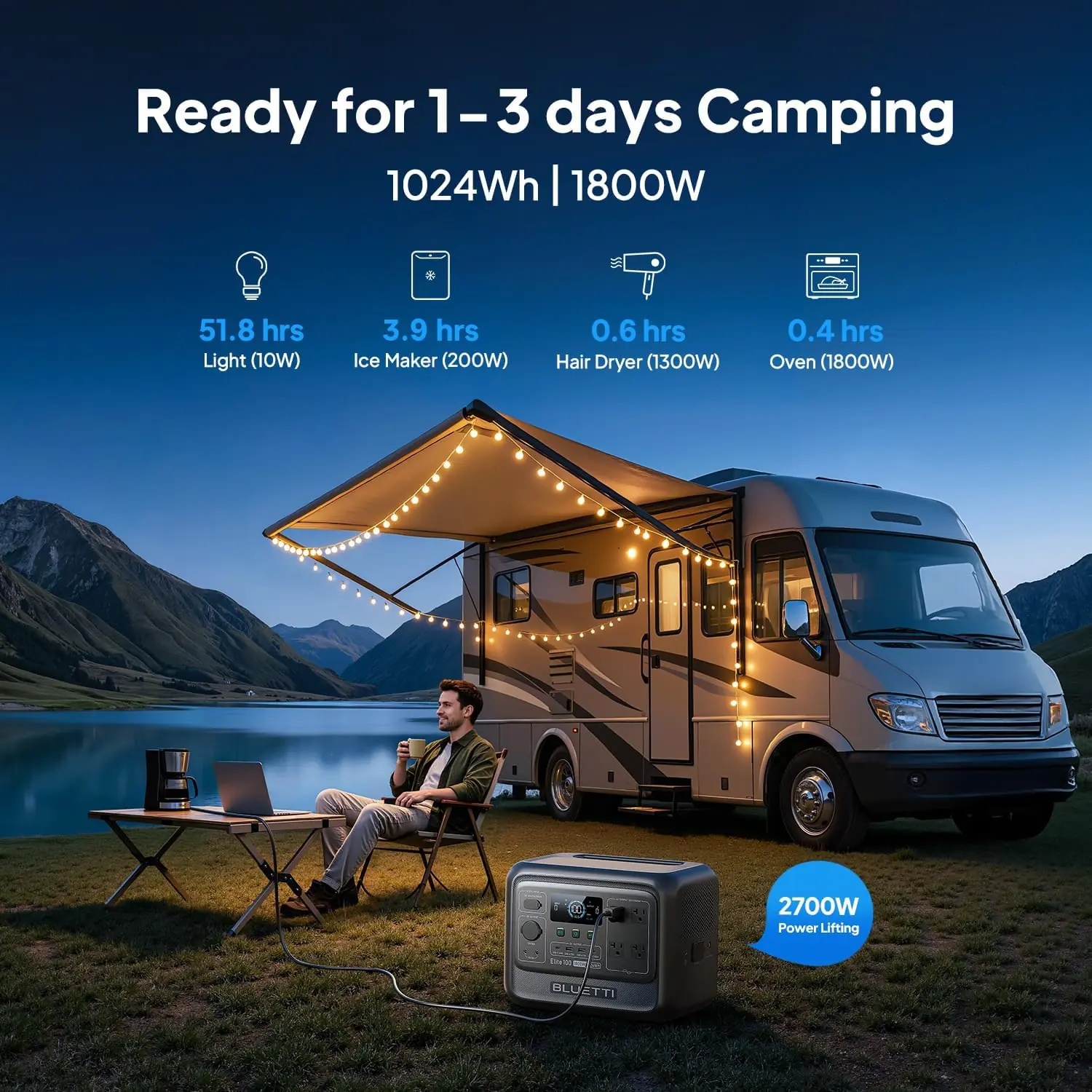
That combination is the core of any positive BLUETTI Elite 100 V2 review and rating — the fast charge and the lifting mode are the two features that change behavior. For a closer look at how this class of unit behaves under load, our EcoFlow Delta 3 test covers a direct category rival.
| Specification | Detail |
|---|---|
| Capacity | 1,024Wh |
| Battery chemistry | LiFePO4, 4,000+ cycles to 80% |
| AC output | 1,800W continuous, 3,600W surge, 2,700W power lifting |
| Output voltage | 120V |
| AC outlets | 4 |
| Total ports | 11 (AC, USB, and DC combined) |
| AC recharge | 1,200W TurboBoost — 0–80% in 45 min, 100% in ~70 min |
| Solar input max | 1,000W (VOC 12–60V, compatible connector required) |
| Bundled panel recharge | 200W panel — 0–80% in ~4 hours, full in ~7 hours |
| UPS transfer time | ≤10ms |
| Noise (silent mode) | ~30dB |
| Weight | 25 lb / 11.5 kg |
| Dimensions | 12.6 × 8.5 × 9.8 in |
| Connectivity | Wi-Fi and Bluetooth, BLUETTI app with OTA updates |
| Included | Elite 100 V2, 200W solar panel (ships separately), AC/solar charging cable, grounding screw, manual |
| Price at review | $699 USD |
Those are the BLUETTI Elite 100 V2 review pros cons that matter most: it’s a superb fast-charging midsize unit that punishes you for trying to run resistive heating loads and gives you no upgrade path inside the same chassis.
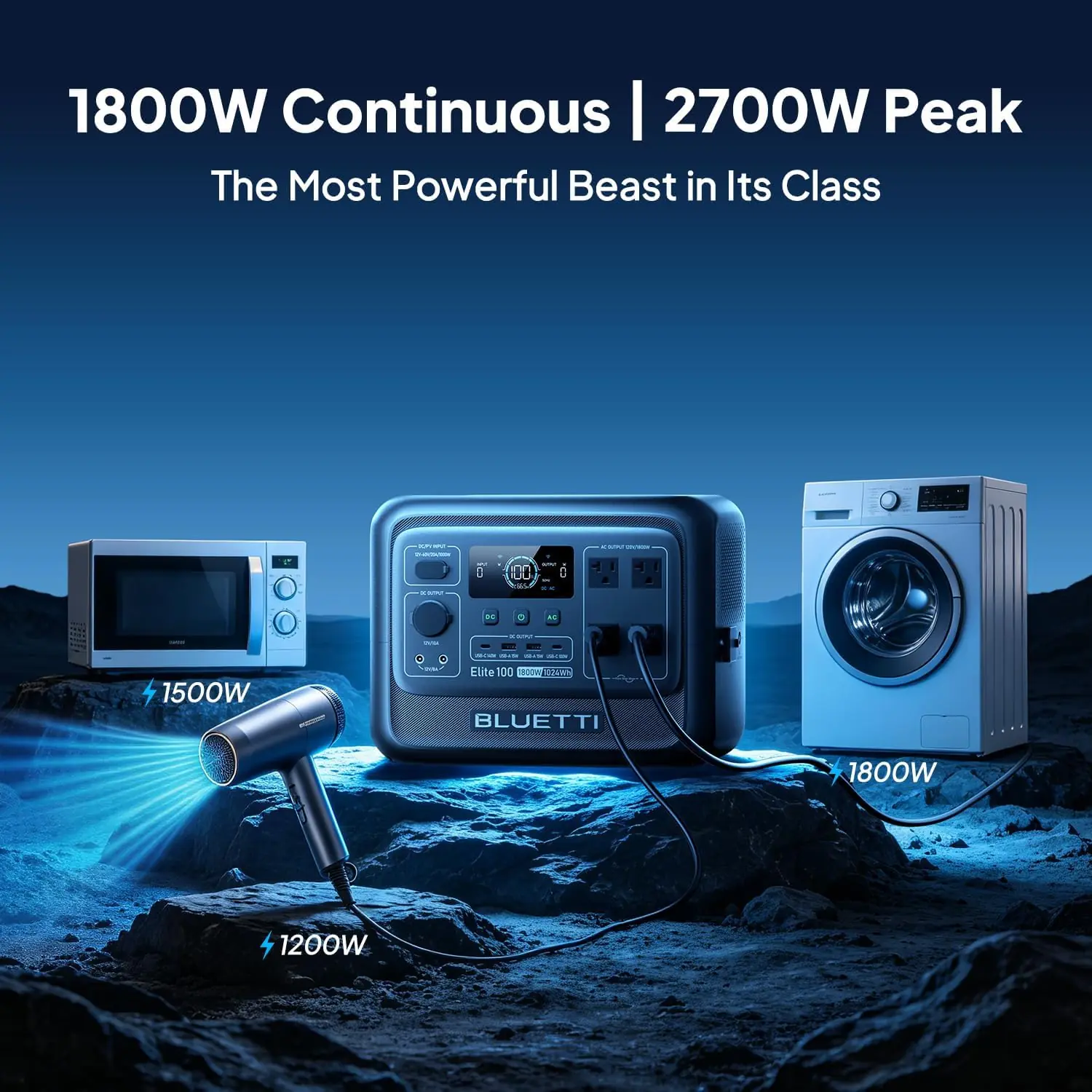
Unboxing took about ten minutes. The station arrived charged to roughly 40%, which is standard for LiFePO4 shipping practice. The manual is thin but adequate. (One thing to flag: the 200W solar panel ships separately from the station, so if you order the kit, expect two deliveries on different days. That caught me off guard and is a common source of confusion in buyer questions.) The only thing missing from the box that you may want is a longer AC charging cable — the included one is about four feet, which is short if your nearest outlet is behind furniture. Setup itself is: place upright, plug in, open the app, pair over Bluetooth, done.
The unit is also capable of much faster car charging with BLUETTI’s dedicated charger accessory — up to six times faster than a standard 12V socket, which is worth knowing if you’re doing long road trips. You can check the current price and honest buyer feedback here.
| Product | Approx. Street Price | Key Differentiator | Best Use Case |
|---|---|---|---|
| BLUETTI Elite 100 V2 (with 200W panel) | $699 | 1,200W AC charging, 1,800W output with power lifting, 4,000-cycle LiFePO4 | Fast-recharging portability plus home UPS duty |
| Jackery Explorer 1000 v2 | ~$799 (panel sold separately) | Lighter 1,002Wh chassis, 1,500W output, very mature app ecosystem | Campers who prioritize weight and brand support |
| Anker SOLIX C1000 | ~$999 | 1,056Wh with expansion battery support, 1,800W output | Buyers who want to scale capacity over time |
| EcoFlow Delta 3 | ~$699–$799 | 1,024Wh, 1,800W output, strong X-Boost compatibility list | App-driven home backup with expandability |
You want the fastest wall recharge in the 1kWh class and you plan to keep the unit plugged in as a router-and-desktop UPS when it isn’t camping. The 70-minute recharge is the reason to pick this over a Jackery Explorer 1000 v2, and the 2,700W lifting mode is the reason to pick it over units that cap at exactly 1,800W. If your priority list starts with “get back to full before dinner,” this is the one.
You want to grow capacity later. The Anker SOLIX C1000 accepts expansion batteries, and this unit doesn’t — a hard limit if your needs might double in two years. Likewise, if weight is everything, the Jackery Explorer 1000 v2 is easier to carry. And if you’re planning serious solar-only charging, budget for the C1000 and extra panels, or go with the Jackery Explorer 1000 v2 instead. Any honest BLUETTI Elite 100 V2 review verdict has to admit those are real trade-offs, not just footnotes.
If you’re leaning toward this one, you can check it against the latest price.
At $699 at the time of this review, the BLUETTI Elite 100 V2 with a 200W panel is priced competitively for the category — the Jackery Explorer 1000 v2 sits around $799 with no panel included, and the SOLIX C1000 is roughly $300 more. What that money buys is the charge rate, the power lifting, and a LiFePO4 pack rated for over 4,000 cycles, which is the difference between a five-year and a ten-year ownership window.
Buy from an authorized retailer rather than a third-party marketplace seller. Warranty coverage on power stations is tied to the original purchase channel, and gray-market listings are common in this category. Bundles that pair the station with two or four 200W panels show up periodically, and if solar is your main charging method, that’s the version to watch for.
Price verified at time of publication. Check for current availability and deals.
BLUETTI covers the Elite 100 V2 with a multi-year limited warranty, and in my experience the registration process is what matters most — you need the serial number and proof of purchase, so keep the order confirmation. Customer reviews at the time of writing sit at 4.6 out of 5 across roughly 1,811 ratings, which is strong for the category and consistent with what I found.
Support is reachable through the app, email, and the manufacturer’s website, and firmware updates ship over the air, which cuts down on the “send it back for a software issue” scenario that plagues cheaper units. If you buy through a marketplace seller instead of an authorized channel, expect warranty friction. That’s the single biggest after-purchase risk with any 1kWh power station.
Three things held up under six weeks of use. First, the charging claim is real — 71 minutes from dead to full, over and over. Second, the 10ms UPS transfer works exactly as advertised; my desktop and router never blinked across two outages. Third, the 200W bundled panel is the weak link, delivering a seven-hour full charge that makes solar a secondary option rather than a primary one unless you buy more panels. This BLUETTI Elite 100 V2 review found a unit that nails the hard engineering and stumbles on the easy accessory.
Yes, it’s worth buying — for campers, van owners, and small-home users who want fast recharge and a real UPS. I’d rate it 8 out of 10 for the category, docked primarily for the fixed 1,024Wh ceiling and the slow bundled panel. If you need expandability or you’re planning multi-day whole-home backup, buy a 2kWh unit instead. For everyone else, this is one of the better-balanced 1kWh stations available right now at this price.
If there’s a single sentence for this unit, it’s this: it charges faster than anything else in its weight class and it will not pretend to be a home generator. That’s an honest trade, and a fair one. If you’ve used one — or you’re stuck deciding between this and a bigger unit — tell me in the comments. You can also read the full BLUETTI Elite 100 V2 review verdict and buyer ratings here.
At $699 with a 200W panel included, yes — provided you value fast charging and don’t need expansion. The 1,200W AC input gives you a full recharge in about 70 minutes, which is the fastest in this class, and the LiFePO4 pack is rated for 4,000+ cycles. Where it stops being worth it is if you need to scale past 1,024Wh later. Buy accordingly.
The Jackery is lighter and has a more polished app history, but it recharges in roughly 100 minutes versus 70, and its 200W panel is a separate purchase. The Elite 100 V2 also edges ahead on startup capability thanks to the 2,700W power lifting mode. If weight is your priority, take the Jackery. If recharge speed is, take the BLUETTI. Both are well-built, and neither is a bad choice.
About ten minutes from box to first charge, and yes, it’s beginner-friendly. You set it upright, plug in the AC cable, open the app, and pair over Bluetooth. The only friction is that the solar panel ships separately, so first-time buyers sometimes think something is missing. It isn’t — it’s a second delivery.
Nothing is strictly required beyond the included cables. That said, a longer AC charging cable helps if your outlets aren’t nearby, and a second 200W panel dramatically improves solar recharge — the unit accepts up to 1,000W of solar input. If you plan to charge while driving, the BLUETTI Charger 1 accessory speeds car charging considerably and is worth checking alongside the main unit.
BLUETTI backs the Elite 100 V2 with a multi-year limited warranty covering manufacturing defects, and firmware updates arrive over the air through the app. Support is reachable via the app, email, and the manufacturer’s site. Keep your order confirmation and serial number — registration is what smooths out any future claim. Buy from an authorized channel or the warranty gets complicated.
Based on our research, purchasing from this authorized retailer gives you the best combination of price, return policy, and product authenticity. The listing carries a 4.6-star rating across roughly 1,811 reviews, and you get a straightforward return window if the unit doesn’t suit your setup.
Yes, and I tested this specifically. A garage fridge pulling an average of 50W ran for 13 hours 20 minutes before dropping to 5%. Fridges cycle, so average draw matters more than the compressor’s peak rating — the 3,600W surge handles startup without issue. If you’re running a fridge plus anything else, expect a shorter window. A full overnight run with a router is realistic; overnight with a fridge and a space heater is not.
You can, but the panel must match the input window: total VOC between 12V and 60V, total power under 1,000W, and a compatible solar connector. Panels outside those parameters will either fail to charge or trigger a fault. BLUETTI recommends two or four of its own 200W panels, which is the setup I’d suggest if you want anything close to full solar charging speed. Read the voltage spec before you buy any panel.
Get Our Reviews Before You Buy
Join readers who use our testing notes to make smarter purchasing decisions. No sponsored rankings. No filler. Just honest reviews and practical guides, delivered when it matters.