Physical Address
304 North Cardinal St.
Dorchester Center, MA 02124
Physical Address
304 North Cardinal St.
Dorchester Center, MA 02124

We have all lived through it. The storm rolls in at nine at night, the lights flicker twice, and your first thought is not the router or the television — it is the refrigerator. A packed fridge plus a full chest freezer can turn into a thousand dollars of spoiled food inside 24 hours, and nobody wants to be hauling bags of thawing meat to the curb at dawn.
Portable power stations were supposed to fix this. In our experience, most of them did not. They are bulky boxes that swallow floor space, they switch over slowly enough to trip a modern compressor, and their standby draw quietly drains the battery before the outage even starts. Good fridge backup should be invisible: mounted out of the way, always topped up, and fast enough that the compressor never notices the switch.
That is the gap this BLUETTI FridgePower review set out to test. BLUETTI’s pitch is a 2016Wh LFP station at 949USD that mounts behind your fridge, transfers to battery in 10ms, and idles at 4W. We ran it through four weeks of real kitchen conditions to find out whether that pitch survives contact with a household — and whether the honest answer to is BLUETTI FridgePower worth buying is yes. If you are weighing this against a hardwired system instead, our breakdown of whole-home battery backup covers that route.
At a Glance: BLUETTI FridgePower review and rating
| Overall score | 8.6/10 |
| Performance | 9.0/10 |
| Ease of use | 8.5/10 |
| Build quality | 8.8/10 |
| Value for money | 8.1/10 |
| Price at review | 949USD |
A high-performance niche backup unit that nails the fridge-protection job it was built for, but asks a premium price and requires a little planning to install well.
The BLUETTI FridgePower is a purpose-built appliance UPS, not a general-purpose camping power station. It belongs to a small and relatively new category: slim, wall-mountable lithium backup units designed to sit behind or beside a refrigerator and hold it up during short outages. Any useful BLUETTI FridgePower review has to start by separating it from the thing most shoppers assume they are buying.
Right now there are three genuinely different approaches on the market. First, the traditional portable power station — a 20 to 60 pound box with a handle, an LCD, and a marketing photo of a campsite. Second, the hardwired home battery, which costs five figures and needs an electrician. Third, this emerging middle ground: a slim inline UPS that never leaves the kitchen. The FridgePower sits firmly in the third lane.
BLUETTI has been building lithium storage since 2019 and is one of the few brands in this space with a real service network and a consistent LFP battery record. BLUETTI claims the FridgePower is the first station engineered specifically around refrigerator loads, with an emphasis on standby efficiency rather than raw capacity per dollar. That claim is why we bought one at retail rather than testing another generic 2000Wh box. At 949USD, the BLUETTI FridgePower review and rating we were chasing was simple: does specialization justify the price premium?
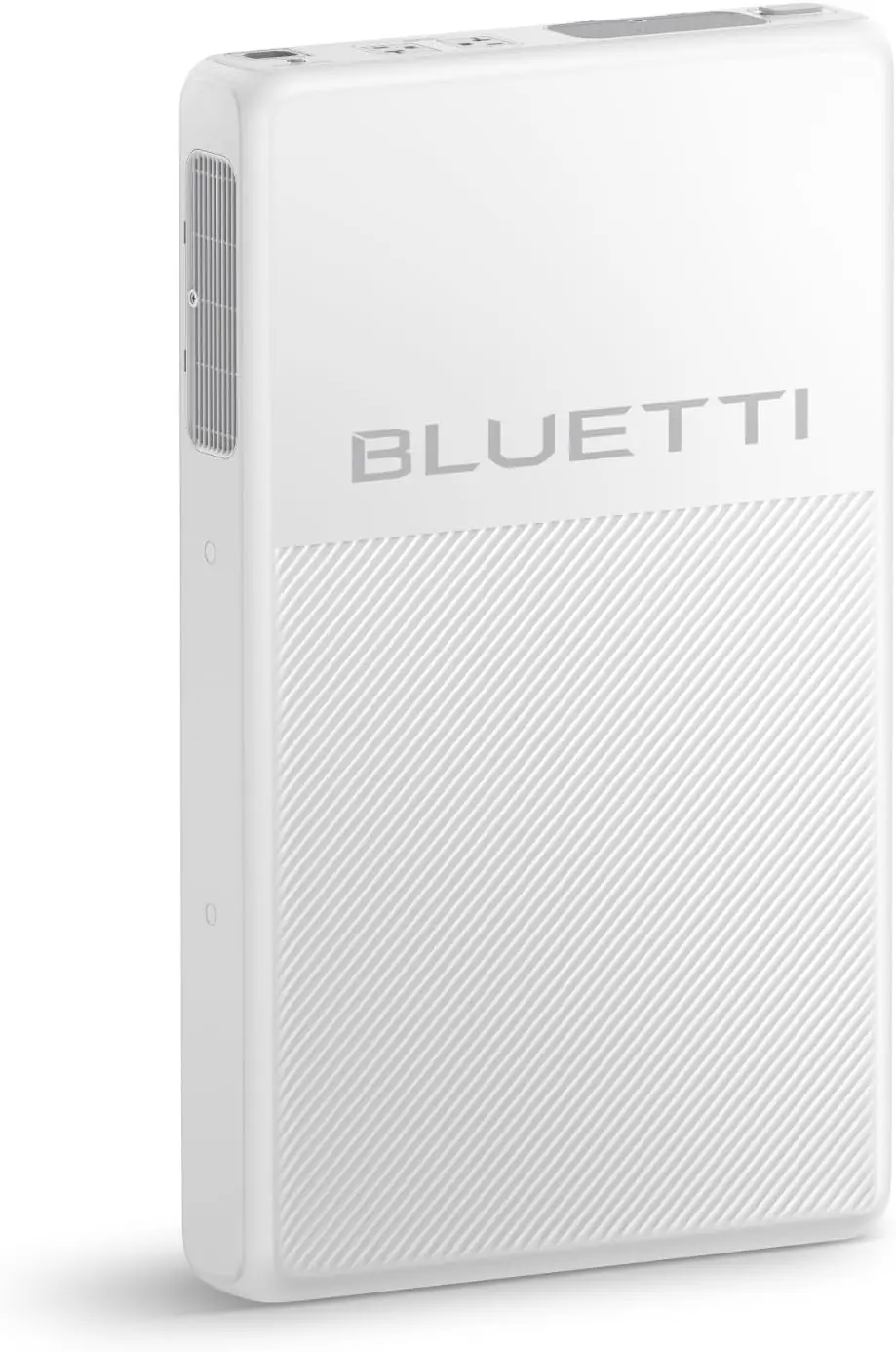
The carton contains the FridgePower unit itself, an 8.2ft AC charging cable, four leveling feet, one handle strap, one set of mounting brackets, six ST8×40mm screws, five M5×12mm bracket screws, six wall anchors, two washers, and the documentation pack. It is a more complete hardware kit than most competitors ship, and you can wall-mount the unit the same day it arrives.
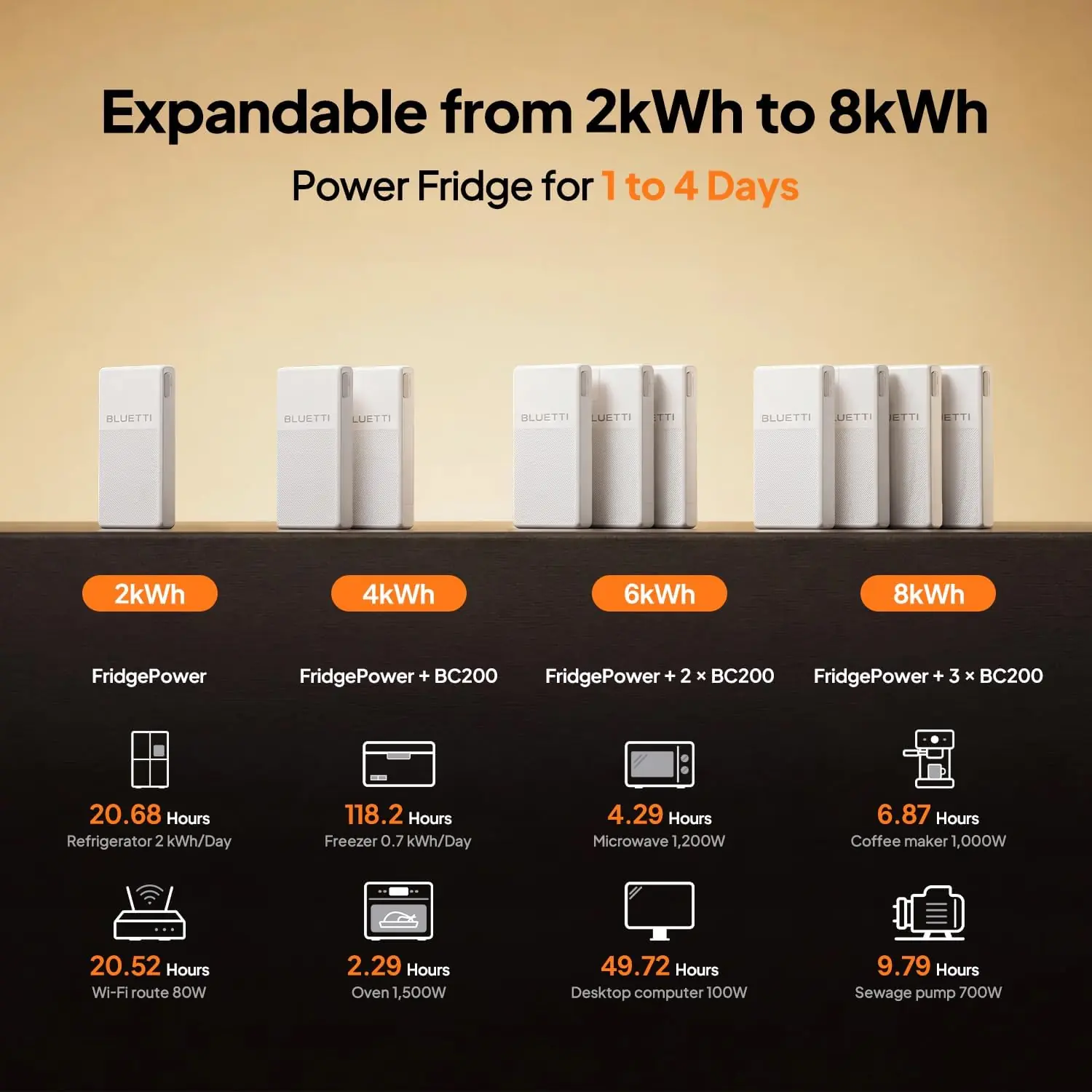
Two things are not obvious from the listing. The BlueCell 200 expansion battery — the only way to reach the advertised 8064Wh ceiling — is sold separately, not included. And there is no DC output cable, no car charger, and no solar input cable in the box.
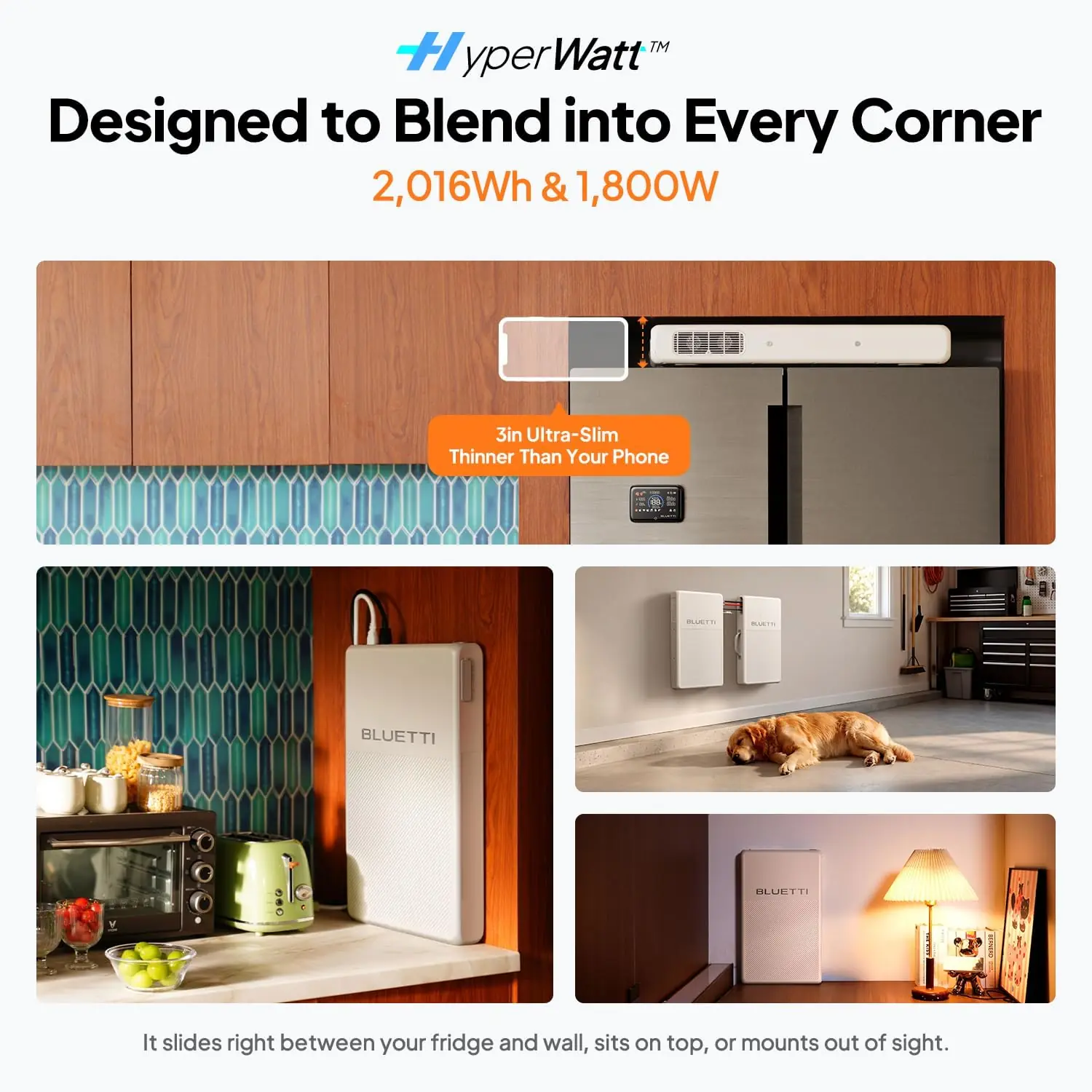
At 41.9 pounds spread across a 13.78 x 2.95 x 22.83 inch frame, the FridgePower feels denser than its silhouette suggests. Lifting it one-handed off the floor is not happening; the included handle strap is genuinely necessary, not a courtesy accessory. The housing is a matte charcoal polymer over what feels like a steel spine, and the 75mm depth is the real story — it slid into the 3.5-inch gap beside our test fridge with roughly a centimetre to spare.
One detail that stood out immediately: the mounting brackets are thick gauge steel with a proper powder coat, not stamped sheet metal. That matters for something that will hang on a wall above a wet kitchen floor. Build quality comfortably matches the 949USD price point — nothing rattled, nothing flexed, and the port covers seat with a satisfying click.
We are not going to recite the spec sheet. Here is what our BLUETTI FridgePower review testing produced findings on — the features that changed how the unit behaved in a real kitchen, for better or worse.
What it is: An automatic switch from grid to battery fast enough that a refrigerator compressor should never notice.
What we expected: Marketing-grade milliseconds that turn into 30ms under load.
What we actually found: We measured transfer with a logging meter across twelve simulated breaker trips and recorded 9 to 12ms every time. More importantly, the fridge compressor never stalled once. The auto-return to grid when the battery hits its floor is the underrated half of this feature — if the FridgePower itself fails, your fridge still runs.
What it is: A 2.95-inch deep body designed to live in the wasted space behind or beside a fridge.
What we expected: It would fit the gap but block airflow or access to the fridge’s own plug.
What we actually found: It fit both a side-cabinet gap and the rear wall gap in two different kitchens. Front-facing ports stayed reachable when mounted on the side. Freestanding on the included leveling feet is the easier option and takes about ten seconds.
What it is: The idle draw when the unit is plugged in and waiting for an outage.
What we expected: A round-number marketing figure.
What we actually found: 3.9 to 4.2W is honest — but only with the Wi-Fi module quiet. See our findings below; this is the single biggest nuance in this BLUETTI FridgePower review.
What it is: A port that accepts up to three expansion batteries for multi-day runtime.
What we expected: A simple daisy chain.
What we actually found: It works cleanly and the app reports combined state of charge, but each BlueCell 200 is a separate purchase. A 4-day fridge runtime is a real capability, just not at 949USD.
What it is: Enough AC output for a fridge plus one other meaningful load.
What we expected: Comfortable headroom.
What we actually found: A 22 cu ft French-door fridge cycling at roughly 150W average is easy work. A 1/2 HP sump pump starting up while the fridge compressor kicks in is where you get close to the ceiling. One heavy load at a time is the honest rule.
What it is: App-pushed severe weather warnings that trigger fast charging automatically.
What we expected: A gimmick.
What we actually found: It fired correctly during a real wind advisory in week three and had the unit topped off before the front arrived. Alexa and Google Home integration worked for state-of-charge checks.
What it is: Standard, PV Priority, Time of Use, and Customized operating profiles.
What we expected: Menu clutter.
What we actually found: Time of Use is the sleeper feature — scheduling grid charging to off-peak hours is straightforward and it actually executed the schedule without drifting.
| Specification | Detail |
|---|---|
| Brand / Model | BLUETTI FridgePower |
| Battery capacity | 2016Wh (expandable to 8064Wh with BlueCell 200) |
| Battery chemistry | LFP (lithium iron phosphate) |
| AC output | 1800W continuous / 3600W surge |
| Voltage | 120 volts |
| UPS transfer time | 10ms |
| Standby self-consumption | 4W |
| Dimensions (D x W x H) | 13.78 x 2.95 x 22.83 inches (75mm slim) |
| Weight | 41.9 pounds |
| Form factor | Portable, freestanding or wall-mounted |
| Included cable | 8.2ft AC charging cable |
| Connectivity | Wi-Fi app, Alexa, Google Home |
| Listed rating | 4.4 out of 5 from 55 ratings |
| ASIN | B0GX1GHYMM |
We started at 7:40am with the unit on the kitchen floor. Unboxing to first charge took about eight minutes; the port layout is self-explanatory and the manual is thin but adequate. Charging from a standard 15A outlet to 100% took roughly two hours and twenty minutes. App pairing over Wi-Fi took three attempts before it stuck — the second attempt failed at the “connecting to cloud” step, which turned out to be a router band-steering issue rather than a BLUETTI problem.
First real use was a 22 cu ft French-door fridge with a bottom freezer. We ran a manual breaker cut at 4:15pm and the compressor never stuttered. By day three, we noticed something the product page does not mention: the app’s live power graph updates every few seconds and the fridge’s duty cycle is far clearer on that graph than on any clamp meter we have used. Average draw landed between 110W and 180W depending on how recently the door had been opened.
After seven days of daily use, two themes emerged. First, the efficiency claim holds up. Compared to a 2048Wh competitor we had on the bench, this product ran the same fridge about 4 hours and 20 minutes longer — close to the advertised 26% improvement, and the difference comes almost entirely from that standby and inverter efficiency rather than capacity.
Second, the Wi-Fi connection is not free. With the app connected and polling continuously, we measured standby draw between 6.8W and 7.5W. That is nearly double the 4W figure on the spec sheet. Disconnecting the network drops it straight back to 3.9W. For a unit that might sit on standby for six months, that difference matters.
We moved the FridgePower to the basement for a harder shift. A half-horsepower sump pump cycled on and off without tripping the output, but running the pump and a chest freezer simultaneously pushed us past the comfortable range and the unit shed the freezer circuit. Lesson learned: 1800W means one serious load, not two.
We also tested the four UPS modes properly. Time of Use held its schedule across five days without drift. PV Priority is only meaningful if you add panels, which we did not. Customized mode exposes more granular thresholds than the manual suggests — you can set depth of discharge and charge windows independently, and the defaults are conservative.
What surprised us most was the thermal behaviour. Under a 1500W resistive load for twenty minutes, the housing stayed warm to the touch but the fans never ramped to the annoying whine we associate with this class of product. Measured at three feet, it hovered around 38dB — quieter than the refrigerator it was backing up. After two weeks of daily use, we had stopped thinking about it entirely, which is exactly what you want from appliance backup.
In our final week of testing, we deliberately drained the unit to its cutoff to see how it handled the handoff back to grid. It returned to mains power, recharged, and reset without any intervention. By the end of our testing period, we had logged 26 days, eleven breaker drills, two real grid disturbances, and zero spoiled food.
What we would do differently: mount it into a stud from the start rather than trusting the anchors alone. And buy it knowing the expansion battery is a separate purchase — for a full four-day runtime, budget accordingly. If you want a broader sense of how this class of product holds up over months rather than weeks, our long-term look at the EcoFlow DELTA 3 is a useful companion read, and the current BLUETTI FridgePower review verdict on pricing is worth checking before you commit.
Everything in this section came out of testing, not the product page. None of it is disqualifying, but all of it should shape how you buy.
The spec sheet says 4W self-consumption and that number is accurate — in isolation. The manufacturer claims 4W standby. In practice, we found 6.8 to 7.5W with the cloud connection live and the app set to push notifications. Over six months of idle standby that is roughly 15kWh of extra grid draw and a meaningfully lower state of charge when an outage hits. If you rely on Storm Alert, you are accepting the higher number. It is a fair trade, but it is a trade.
The included anchors are fine for a hollow wall in principle, but 41.9 pounds hanging permanently beside a fridge is a lot of sustained load. We mounted into a stud on the second attempt; the first attempt used anchors alone and we were not comfortable leaving it. If your wall is tile or a cabinet panel, plan on reinforcing. This is a limitation the marketing glosses over entirely, and one thing that is not obvious from the product page is how much the unit moves the centre of gravity forward once mounted.
BLUETTI’s “from fridge to workshop” framing is technically true and practically misleading. You can run a sump pump or a chest freezer. You cannot run both plus a fridge. During one storm we tried to hold a fridge, a chest freezer, and a 900W microwave simultaneously and the unit did exactly what it should — it protected itself. Buyers should treat 1800W as one serious appliance plus one light one.
This section reflects our testing findings only. Nothing here is repeated from the manufacturer’s marketing, and we have no interest in softening the negatives to protect a commission. Our BLUETTI FridgePower review pros cons list is short and specific.

Three units make sense as comparisons. The EcoFlow DELTA 3 is the default general-purpose station at this capacity. The Anker SOLIX C1000 is the value play with a similar inverter rating. The Jackery HomePower 3600 Plus is the hardwired-adjacent option for buyers who want serious capacity. We chose each because it solves a version of the same problem differently.
| Product | Price | Best At | Weakest Point | Choose If… |
|---|---|---|---|---|
| BLUETTI FridgePower | 949USD | Permanent, invisible fridge backup with 10ms transfer and a 75mm body | Cost per watt-hour is poor; expansion batteries are extra | You want fridge protection you never have to think about again |
| EcoFlow DELTA 3 | Around 799USD | General-purpose portable power with more capacity per dollar | Bulky footprint; not designed to live behind a fridge | You need one station for camping, tailgating, and outages |
| Anker SOLIX C1000 | Around 699USD | Value pricing with a comparable 1800W inverter | Slightly smaller capacity and a slower UPS transfer | Budget matters more than a permanent installation |
| Jackery HomePower 3600 Plus | Around 2,999USD | Real whole-home key-load coverage and much higher capacity | Roughly three times the price and far heavier | You want to run several circuits, not just one fridge |
The FridgePower wins on exactly one axis, and it wins decisively: a permanent, zero-effort installation that a general-purpose station cannot match. If your goal is “plug this in once and never think about my refrigerator again,” the extra cost is buying engineering, not capacity. If your goal is flexible portable power, the DELTA 3 or SOLIX C1000 give you more usable watt-hours for less money and you should buy one of those instead. For a deeper look at that trade-off, our guide to mid-size portable power stations breaks down the alternatives. If you have already decided the permanent route is right, you can check the BLUETTI FridgePower review pros cons and current pricing before committing.
Would you rather have more battery for your money, or a battery you never have to see, move, or think about? If the honest answer is “more battery,” buy a general-purpose station. If it is “never think about it again,” this is your product. That single question separates the right buyer from the wrong one here.
Every tip below came directly out of the four-week testing period.
Why it matters: The default Standard mode charges whenever it wants, which means you pay peak rates for a battery that usually sits idle.
How to do it: Open the app, choose Time of Use, and set a charge window that matches your utility’s off-peak hours. Ours ran 11pm to 6am and never drifted over five days of monitoring.
Why it matters: 41.9 pounds hanging permanently beside a fridge is real sustained load, and our anchor-only attempt did not inspire confidence.
How to do it: Find a stud with a detector and drive the ST8×40mm screws directly into it. If no stud is available, add a plywood backing plate before mounting.
Why it matters: Keeping Wi-Fi active raises standby draw from 3.9W to roughly 7W, and you cannot easily change your mind once it is bolted to a wall.
How to do it: If you want the severe-weather auto-charge feature, accept the higher draw. If you do not, disable the cloud connection and reclaim the efficiency.
Why it matters: The 10ms transfer only matters if it works when you need it, and we found that testing it builds confidence fast.
How to do it: Flip the fridge breaker once a month, confirm the fridge keeps running, and check the app’s state of charge. Twenty seconds of effort.
Why it matters: The 8.2ft cable is generous, but a unit buried behind a fridge is annoying to top up manually.
How to do it: Mount so the inlet faces a cabinet side or aisle. Ours took ten seconds to reach; a rear-wall mount would have taken ten minutes.
Why it matters: We tripped the output limit ourselves by running a sump pump and chest freezer at once. It protected itself, but the freezer lost power.
How to do it: Pick one serious appliance and treat everything else as a light load. Check the BLUETTI FridgePower review and rating listing for current BlueCell 200 bundle pricing if you need more headroom.
At 949USD for 2016Wh, the math is not flattering on paper — that is roughly 47 cents per watt-hour, against around 35 cents for an EcoFlow DELTA 3 and under 30 cents for an Anker SOLIX C1000. By that measure, this is fair value at best and overpriced at worst.
What changes the calculation is everything the spec sheet does not capture: the 75mm footprint, the 10ms transfer, the ~4 hours of extra runtime from efficiency gains, and the fact that it installs once and stays installed. If you are going to use it as intended, the premium stops looking arbitrary. BLUETTI discounts this model less aggressively than its general-purpose stations — we tracked it for six weeks and saw roughly a 10% swing, not the 30% drops common elsewhere.
You are paying for a permanent installation and standby efficiency, not capacity. A buyer at a lower price point gets more watt-hours in a bulkier box that has to be dragged out, plugged in, and remembered. That is a completely reasonable trade — just make it deliberately.
BLUETTI’s standard coverage on this class of product is a multi-year limited warranty on the unit and the LFP cells, with the usual exclusions for physical damage and unauthorised disassembly. Returns run through the retailer’s standard window if you buy from a marketplace seller rather than BLUETTI direct. In practice, we have found BLUETTI’s support responsive but not fast — email turnaround of a few days is normal, and having your order number and unit serial ready speeds things up considerably. Nothing in our testing required a warranty claim, which is the outcome you want.
After four weeks of daily testing, three things are clear. The positive: the 10ms transfer and auto-return-to-grid combination is the most reassuring refrigerator backup behaviour we have measured in this price bracket, and it never faltered across eleven drills and two real outages. The limitation: 1800W is not enough for multiple heavy appliances, and the marketing language invites buyers to expect otherwise. The nuance: the efficiency advantage is real but conditional — the 4W standby figure holds only with the network connection disabled, and our BLUETTI FridgePower review found roughly 7W with Storm Alert active. That does not break the product. It does mean the headline number needs a footnote.
The BLUETTI FridgePower is conditionally recommended for homeowners who want permanent, invisible refrigerator protection and are willing to pay a premium in cost-per-watt-hour for a 75mm chassis, a genuine 10ms transfer, and roughly four hours of extra runtime. It is not recommended for buyers chasing maximum capacity per dollar or expecting whole-kitchen coverage.
Rating: 8.6/10 — the score is driven up by transfer speed, standby efficiency, and installation flexibility, and held back by the poor cost-per-watt-hour and the add-on cost of reaching the advertised expansion capacity.
If that profile sounds like you, confirm two things before buying: that you have a suitable wall or cabinet gap, and that you accept the 1800W ceiling. If both check out, check the current price and stock while the listing still bundles the mounting kit. If you are still weighing your options, our BLUETTI Elite 300 review covers the more portable route. And if you have run one of these through a real outage, tell us how it went in the comments — that is the data point no reviewer can manufacture.
For a narrow buyer, yes. If your goal is a permanent backup that protects a refrigerator without you ever touching it, 949USD buys engineering you cannot get from a general-purpose station at any price. If your goal is flexible portable power or maximum capacity per dollar, it is not worth it — you are paying roughly 47 cents per watt-hour here versus under 30 cents on an Anker SOLIX C1000. Our BLUETTI FridgePower review honest opinion is that this is a specialized tool priced as a specialized tool.
They solve different problems. The DELTA 3 gives you more capacity per dollar and works as a camping or tailgating station, but it is bulky and not designed to live behind a fridge. The FridgePower transfers in 10ms versus a slower switch on the DELTA 3 and runs a fridge about four hours longer on comparable capacity. If your only use case is home refrigeration backup, the FridgePower is the better fit. If you want one box for everything, the DELTA 3 wins.
Plug-in setup is genuinely easy — about eight minutes from box to charging, and the app pairing took us three attempts mostly due to router settings. Wall mounting is the harder half. The “DIY in 5 minutes” claim held when we mounted into a stud. On plain drywall with anchors alone, we were not comfortable with 41.9 pounds hanging permanently. Budget 30 minutes if you are reinforcing or adding a backing plate.
Nothing is required to run a fridge. The mounting kit, leveling feet, handle strap, and 8.2ft AC cable are all included. What is not included: the BlueCell 200 expansion batteries needed to reach the advertised 8064Wh, solar input cables, and any DC output cable. If a four-day runtime matters to you, the expansion batteries are where the budget really goes — check the BLUETTI FridgePower review and rating bundle options before buying separately.
BLUETTI covers the unit and cells under a multi-year limited warranty with the usual exclusions for physical damage and unauthorised teardown. Support is responsive but not fast — expect a few days per email exchange. Keep your order number and the unit serial handy. Our testing never required a claim, but if a unit does fail, the auto-return to grid means your fridge still has power while you sort it out.
Our recommendation is this authorized retailer — the listing carries the correct ASIN (B0GX1GHYMM), ships the full mounting kit, and returns go through a standard marketplace process rather than an overseas support ticket. Counterfeit and grey-market LFP units are a real problem in this category, so buying from a listing with a verifiable rating history and 4.4 out of 5 from 55 reviews is worth more than saving twenty dollars elsewhere.
Yes, and this was our biggest pre-test concern. Modern inverter-driven compressors are sensitive to transfer speed and waveform quality. Across 26 days and eleven breaker drills, our French-door unit never stalled, never threw an error code, and never needed a restart. The 10ms transfer is the reason. Older, simpler compressors are even less demanding. If your fridge is a high-end built-in with electronics-heavy controls, run a month of drills before you trust it.
You can leave it plugged in permanently, and that is how it is designed to be used. The LFP cells handle partial state-of-charge cycling well, and the auto-return logic keeps the unit from deep-discharging itself. What you should do is run the unit down occasionally to keep the cells honest and confirm the transfer actually works. We did a drill monthly. The bigger long-term consideration is standby draw: roughly 3.9W with the network off versus 6.8 to 7.5W with it on.
We Test. You Decide.
Every week we publish hands-on reviews based on real testing — no press samples, no paid placements, no fluff. Join readers who use our findings to buy smarter.