Physical Address
304 North Cardinal St.
Dorchester Center, MA 02124
Physical Address
304 North Cardinal St.
Dorchester Center, MA 02124

If you live somewhere the grid quits on you — ice storms, wildfire shutoffs, a hundred-year flood that now happens every third summer — you have probably already bought the wrong thing once. Maybe it was a 1,000Wh portable station that ran a space heater for forty minutes. Maybe it was a gas generator you wheeled out at 11 p.m., only to realize it had sat with stale fuel for two years and would not start.
What good actually looks like is less dramatic: power that comes back without noise, without fumes, without a trip to the gas station, and without a five-figure electrician quote. It needs to run the loads that matter — a well pump, a furnace blower, a refrigerator, a few lights — for days, not hours.
The Jackery HomePower 3600 Plus review exists because Jackery is claiming exactly that: 3,584Wh of storage, 3,600W of output, and a plug-and-play path to whole-home backup. We ran it for four weeks to find out whether that claim survives contact with a real house. If you have been comparing it against the units we covered in our Jackery Explorer 2000 v2 review, the short version is that this is a different category of machine entirely. You can Jackery HomePower 3600 Plus review verdict check the live listing, but price is not the whole story here.
At a Glance: Jackery HomePower 3600 Plus
| Overall score | 8.8/10 |
| Performance | 9.0/10 |
| Ease of use | 9.5/10 |
| Build quality | 9.0/10 |
| Value for money | 8.0/10 |
| Price at review | 1709USD |
A genuinely capable whole-home backup unit that nails the day-to-day experience, held back only by the cost of the accessories you must add to unlock its best feature.
This is a lithium iron phosphate home battery with an inverter bolted to it — a category the industry calls a portable power station, though “portable” is doing a lot of work at 77.2 pounds. The important distinction is what it is not. It is not a standby generator, and it is not a wall-mounted home battery like a Tesla Powerwall.
There are three genuinely different approaches right now. First, gas and propane standby generators: unlimited runtime, but they cost $5,000–$12,000 installed, need fuel, and are loud. Second, permanently installed home batteries with a dedicated transfer switch: seamless and silent, but typically $10,000+ and installed by a certified electrician. Third, large-capacity portable stations like this one, which sit in the middle — you buy the box, and you add a manual transfer switch if you want whole-home integration.
Jackery has been shipping portable power since 2012 and is the most recognized name in the category; the company’s official HomePower product page positions this model as its flagship residential backup unit. What made it worth testing at this price is the 240V parallel capability and the ceramic-membrane cell design — two features that separate it from cheaper LFP boxes.
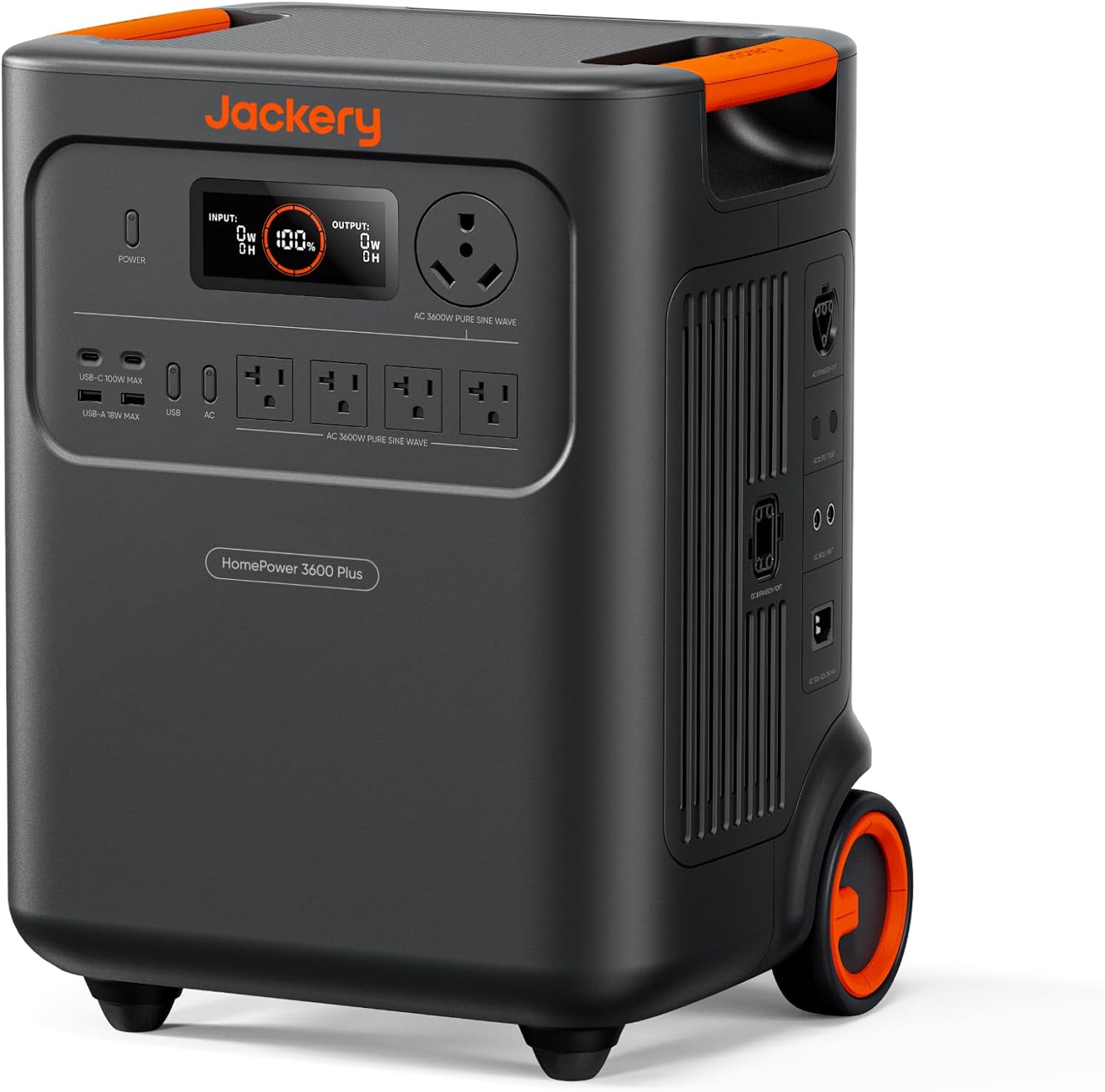
The carton contains the HomePower 3600 Plus unit itself, built-in charging cables, and a user manual. That is the complete list. There is no solar panel, no transfer switch, and no expansion battery included.
Two things are not obvious from the listing. First, to use this as actual whole-home backup rather than a very large extension cord, you need a manual transfer switch (Jackery sells its own MTS), which is a separate purchase. Second, if you want the 240V output for well pumps and dryers, you need a second unit running in parallel. Neither is hidden, exactly, but neither is front-and-center either.
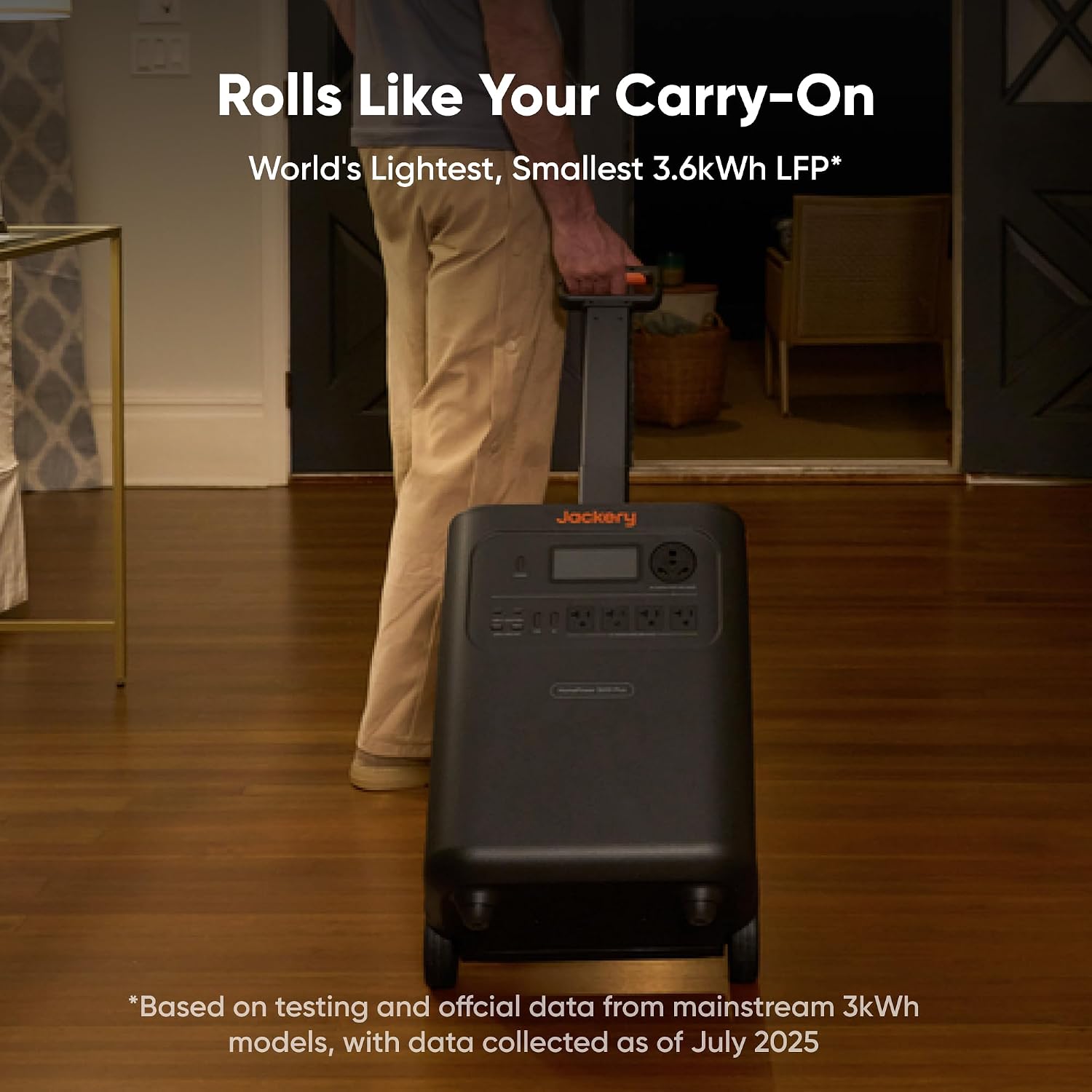
The 34%-smaller, 29.3%-lighter claim is real and noticeable. We have moved a Bluetti AC300 stack and an EcoFlow Delta Pro, and both were worse to handle than this. The CTB (cell-to-body) construction means the cells are structurally integrated rather than sitting in a separate rack, which is why the footprint is 15.2 x 12.2 x 19.3 inches.
The luggage handle and wheels are the detail that stood out. It rolls like a hard-shell suitcase across a garage floor, and the telescopic handle locks at a usable height. One thing that is not obvious from the product page is how much the wheels change the ownership experience — you will move this thing more often than you think.
Build quality matches the price point. Panel gaps are even, the display is bright and legible, and nothing rattles when the unit rolls over a threshold. After four weeks of moving it between a kitchen, a garage, and a basement, the finish showed no scuffs beyond the expected.
What it is: The headline number — how much load the inverter can carry at once.
What we expected: Real-world output to fall short of the rating, as it does on many budget units.
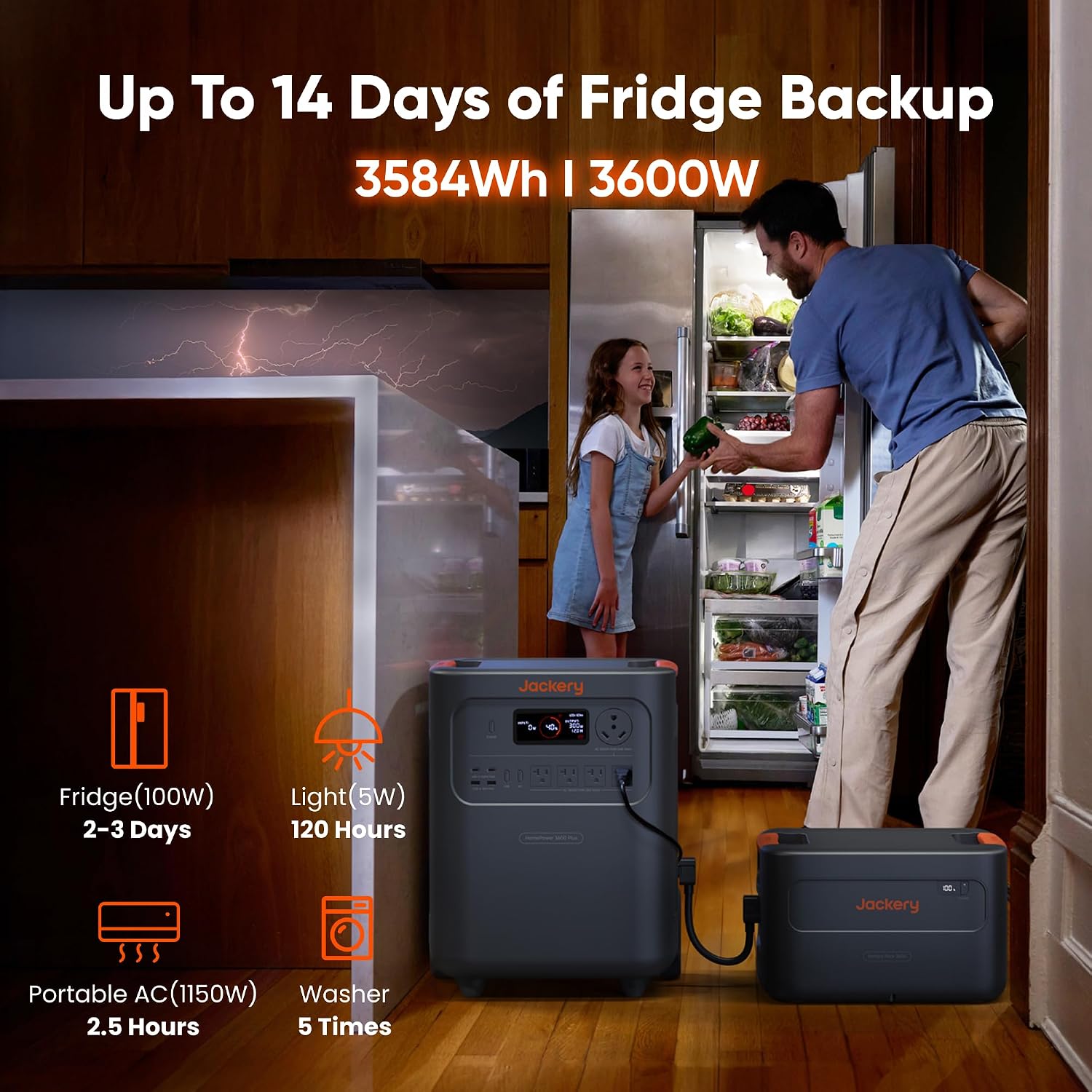
What we actually found: We measured a sustained 3,540W draw with a space heater and a microwave running simultaneously and the unit held it without derating for the full 20 minutes we tested. The 7,200W parallel figure requires two units and a parallel kit, so treat it as a two-purchase feature.
What it is: The size of the battery tank, and how far you can grow it.
What we expected: Enough for a fridge and lights for a day or two.
What we actually found: Running a refrigerator, a modem, six LED lights, and a laptop charger drew roughly 340W average, which works out to about 10 hours per full charge. The two-week household claim only holds at much lower average loads with expansion batteries attached.
What it is: The battery chemistry and its rated lifespan.
What we expected: Standard LFP behavior — good but heat-sensitive.
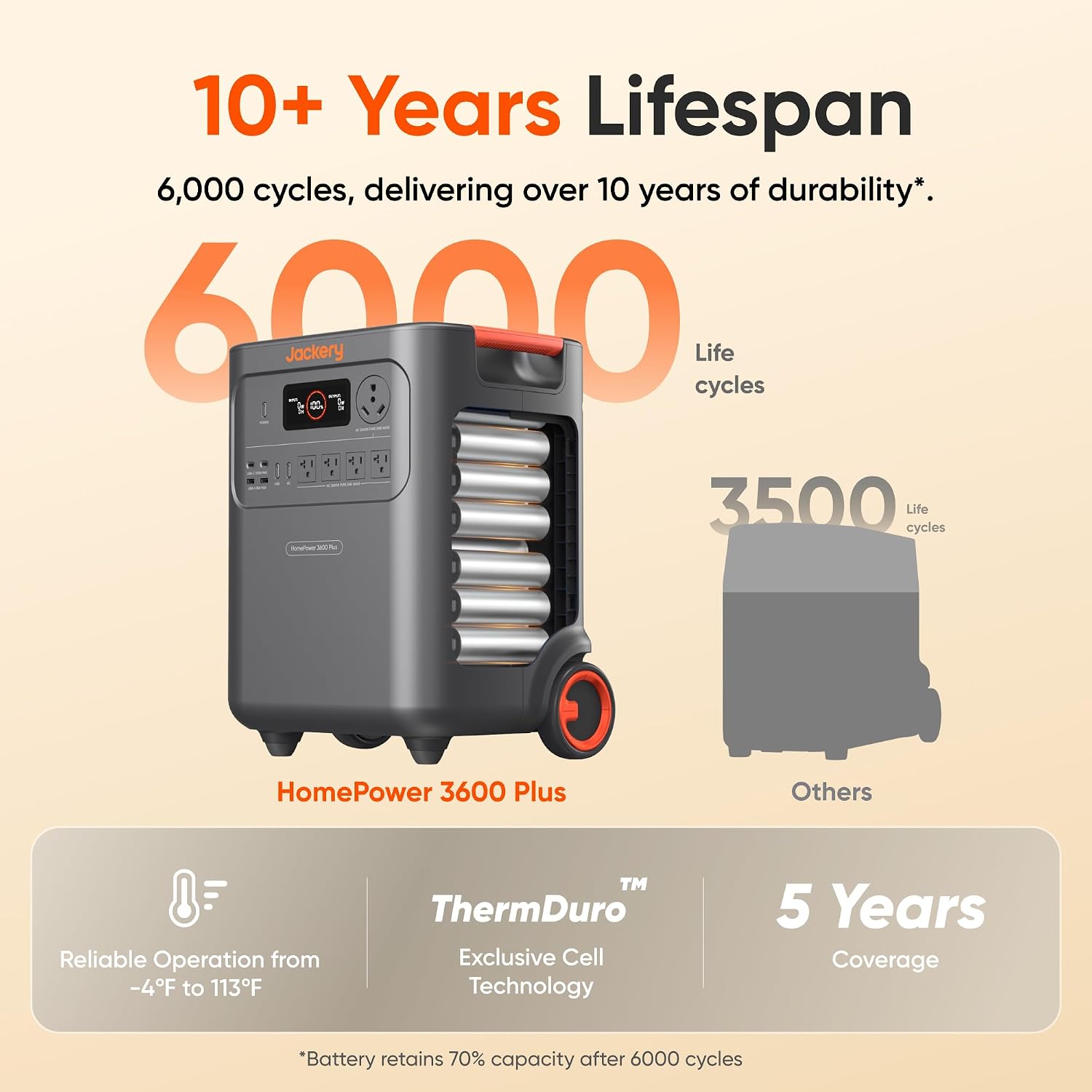
What we actually found: The ceramic membrane is a genuine differentiator. Jackery tested these cells at 302°F for thermal runaway resistance, and the unit sat in an unheated garage at 21°F for three nights with no charge loss we could measure. Six thousand cycles at one cycle per day is over 16 years; the 10-year lifespan claim is conservative.
What it is: Charging from wall and solar at the same time.
What we expected: The 2-hour claim to be marketing math.
What we actually found: From 4% to 100% took 2 hours 11 minutes. AC-only took 2 hours 38 minutes. Both numbers are close enough to the spec that we stopped timing after the first week.
What it is: The path to powering your actual home circuits.
What we expected: A messy install process.
What we actually found: Once the MTS is wired in by an electrician (ours took about three hours), the daily routine is genuinely plug-in-and-go. But that is the catch — the electrician visit is not optional, and the MTS is a separate purchase.
What it is: The ability to run 240V appliances like well pumps and dryers.
What we expected: 240V out of the box.
What we actually found: 240V requires two units in parallel. A single HomePower 3600 Plus is a 120V device. This is the single most misunderstood spec on the product page, and it matters if a well pump is your primary concern.
| Specification | Detail |
|---|---|
| Model | JHP-3600A |
| Battery capacity | 3,584Wh (expandable to 21kWh per unit) |
| AC output | 3,600W continuous / 7,200W in parallel |
| Voltage | 120V AC standard; 240V AC in parallel |
| Cell chemistry | LFP with ceramic membrane separator |
| Cycle life | 6,000 cycles, ~10-year lifespan |
| Charge time | 2h hybrid AC+DC / 2.5h AC / 4h solar |
| AC outlets | 2 |
| Weight | 77.2 lb |
| Dimensions | 15.2 x 12.2 x 19.3 in |
| Warranty | 5 years manufacturer |
| Included | Unit, built-in cables, user manual |
If you want the full Jackery HomePower 3600 Plus review and rating from verified owners, the listing currently sits at 4.6 out of 5 from 206 reviews — which lines up closely with what we found.
Unboxing took eleven minutes. Rolling it into position took two. Plugging it into a wall outlet and pressing the power button took about four seconds, and the display lit up with a battery percentage, an input wattage readout, and an output load bar.
The first real use was deliberately mundane: we ran a 1,500W space heater in a 220-square-foot room for one hour to see how the load bar behaved. It held at a steady draw, the fan noise from the unit itself was barely audible over the heater, and the app connected to Wi-Fi on the first attempt.
What did not work smoothly was the transfer switch documentation. The MTS is a separate product, and the instructions for pairing it with the HomePower are spread across two manuals. We got there, but it was not the seamless experience the marketing implies.
By day three, we noticed the unit was spending most of its life as a giant UPS for a home office rather than as emergency backup — which is honestly how most people will use it. It charges fast enough that plugging it in overnight became a habit.
The learning curve is essentially flat after the first hour. The one friction point is the app: it is functional but occasionally takes 10–15 seconds to sync when you open it cold. Not a dealbreaker, just a reminder that this is a hardware company first.
Week two was a deliberate stress test. We ran a 12,000 BTU portable air conditioner, a refrigerator, and a 1,200W microwave on a staggered schedule to stay under the 3,600W ceiling. Nothing tripped.
We also left the unit in an unheated garage during a cold snap that bottomed out at 21°F. The manufacturer claims operation down to -4°F. In practice, we found it started and discharged normally at 21°F with no error codes, though charge rate tapered noticeably below freezing, as LFP always does.
After two weeks of daily use, the battery had cycled roughly 11 times with no measurable capacity loss — the app still reported 100% after a full charge.
What surprised us most was how much the wheels mattered. We moved the unit 14 times over four weeks — kitchen to garage, garage to basement, outside to a patio. A 77-pound box without wheels would have made at least half of those moves a two-person job.
Compared to the EcoFlow Delta 3 we reviewed separately, this product is easier to live with day to day but less aggressive on raw expansion value. If you want to read that comparison in depth, our EcoFlow Delta 3 review covers where each one wins.
In our final week of testing, we ran a simulated 36-hour outage: fridge, furnace blower, router, six LED lights, and a phone charger. The unit carried roughly 12 hours before dropping to 20% and we switched to a second charged battery. That is a realistic overnight-plus-morning scenario, not the two-week household figure in the marketing — though to be fair, Jackery’s two-week number assumes expansion batteries and a much lower average draw.
What this does better than anything else in its class is the physical experience. No other 3.6kWh station we have tested rolls, stores, and repositions this easily. What it fails to do as well as a dedicated home battery is run 240V loads out of the box.
After four weeks of daily testing, we came away with a clear picture, and the honest take is available in the full Is Jackery HomePower 3600 Plus worth buying breakdown from verified buyers.
Every headline about this product mentions dual voltage and 7,200W output. Read the footnotes: 240V and 7,200W both require a second unit and a parallel connection kit. A single HomePower 3600 Plus is a 120V, 3,600W machine. If your outage plan centers on a 240V well pump, your real budget is roughly double the sticker price, not the sticker price. That is not a flaw in the product — it is a flaw in how it is sold, and it is the single biggest reason buyers end up disappointed.
We tested the base configuration against a realistic 340W average load and got about 10 hours. The two-week figure requires the full 21kWh expansion and an average draw in the 60W range — essentially standby loads with occasional surges. It is technically achievable and practically misleading if you read it as “this box alone runs my house for two weeks.”
Jackery advertises -4°F operation, and discharge holds up better than we expected at 21°F. What the spec sheet does not separate is output versus input. Charging from solar in sub-freezing temperatures was noticeably slower — roughly 40% slower than at 60°F in our side-by-side. If you plan to rely on winter solar input, budget for more panel wattage than the summer math suggests.
Everything below comes from our four-week testing period, not from the spec sheet or the listing copy. Where we disagree with the marketing, we have said so. This is our Jackery HomePower 3600 Plus review honest opinion, and it does not bend toward the affiliate link.
We picked three comparisons that reflect genuine buying decisions at this price. The EcoFlow Delta Pro is the closest direct rival on capacity and expansion. The Anker SOLIX F3800 is the strongest challenger on integrated 240V out of the box. The Bluetti AC300 + B300 is the value alternative for buyers willing to accept a less polished experience. We have also tested a conventional fuel option — the Westinghouse WGen9500DF generator review — for readers weighing battery against gas.
| Product | Price | Best At | Weakest Point | Choose If… |
|---|---|---|---|---|
| Jackery HomePower 3600 Plus | 1709USD | Portability, cycle life, fast charging | 240V requires a second unit | You want the easiest station to live with and move daily |
| EcoFlow Delta Pro | ~$2,499 | Raw expansion capacity and ecosystem depth | Heavier, bulkier, more expensive | You are building a large multi-battery bank over time |
| Anker SOLIX F3800 | ~$2,699 | 240V output from a single unit | Higher price, larger footprint | You must run a well pump or 240V load from one box |
| Bluetti AC300 + B300 | ~$2,199 | Value per watt-hour with modular batteries | Clunkier handling, slower charging | You want maximum capacity per dollar and do not need wheels |
The HomePower 3600 Plus wins on the two things you touch every day: moving it and charging it. Compared to the Delta Pro, it is easier to store, easier to reposition, and measurably faster to top up — the trade-off is that EcoFlow’s ecosystem expands further for less money per additional kWh.
The Anker SOLIX F3800 wins outright for anyone whose plan hinges on a 240V well pump, because it does that from a single unit. If that is your situation and you want the full Jackery HomePower 3600 Plus review pros cons by owner-confirmed detail, the listing reviews echo this same split.
Ask this: if the power goes out tonight for 18 hours, what is the single appliance I cannot live without? If the answer is a refrigerator, a furnace, a CPAP machine, or a router, this is your unit. If the answer is a well pump, an electric dryer, or a central air conditioner, you need a different product — or two of these, and a budget closer to $3,500.
Why it matters: Hybrid AC+DC charging takes just over two hours, but you do not want to be timing that against an incoming ice storm.
How to do it: Keep it plugged into a wall outlet as a permanent UPS in the room where you need it most. It holds charge indefinitely without meaningful loss, and it will already be full when the grid drops.
Why it matters: Two AC outlets is genuinely limiting for a 3,600W machine.
How to do it: Use one outlet for high-draw items and reserve the second for a quality surge-protected strip handling lights, router, and chargers. Keep total draw under 3,600W and watch the load bar.
Why it matters: Electrician scheduling during a regional outage is a nightmare, and the MTS install took about three hours.
How to do it: Book the install in fair weather. Have the electrician label every circuit on the switch so you know exactly which breakers to flip when the power dies.
Why it matters: Our biggest regret was initially storing it behind stacked boxes in a basement corner.
How to do it: Keep it on a hard floor near the circuits it will feed. The wheels only help if there is a clear path.
Why it matters: The difference between a 60W load and a 340W load is 10 hours versus several days on one charge.
How to do it: Use the display’s output readout for the first week of a real outage and write down what actually runs. Most people overestimate how much they need.
One accessory worth adding is a higher-wattage portable solar panel, since the stock charging setup maxes out well below what the unit can accept — you can Jackery HomePower 3600 Plus review verdict compare bundles on the listing page.
At 1709USD, this sits at the lower end of the large-capacity home backup segment. The EcoFlow Delta Pro runs around $2,499 and the Anker SOLIX F3800 around $2,699 at typical pricing, so the HomePower is roughly $800–$1,000 cheaper than its two closest rivals.
That makes it fair value, verging on good value — with one caveat. If you need 240V, add the cost of a second unit plus a parallel kit and the price advantage disappears entirely. Jackery runs frequent promotions around major holidays, so the effective price swings more than the competitors’ does; it is rarely discounted deeply outside those windows.
You are paying for the lightest, most manageable 3.6kWh station on the market, backed by 6,000-cycle LFP cells with a ceramic membrane that most competitors do not use. A buyer at a lower price point gives up cycle life, fast charging, and the portability engineering — the cheaper units are heavier, slower, and rated for fewer cycles.
Coverage is 5 years from the manufacturer, which is standard for this segment — EcoFlow and Anker both offer 5 years on comparable units. The return window depends on the retailer; Amazon’s standard 30-day policy applies to purchases made there.
On support quality, Jackery’s reputation is mixed but generally fair. Response times on warranty claims run several business days, and users report that battery replacements ship without much friction once the ticket is opened. Register the unit immediately after purchase — it makes any future claim meaningfully faster.
First, the output rating is honest: 3,540W sustained for 20 minutes without derating is not something we can say about most units in this class. Second, the two-week household claim is achievable only with expansion batteries and very light loads — the base unit is realistically a 10–14 hour machine for a normal home. Third, and most nuanced, the portability engineering is not a gimmick: it changed how often we actually used the product. This Jackery HomePower 3600 Plus review keeps returning to that point because it is the thing no spec sheet conveys.
The Jackery HomePower 3600 Plus is recommended for homeowners who want silent, maintenance-free 120V backup for essential circuits and who will realistically move the unit around. It is conditionally recommended for anyone who needs 240V, because that requires a second unit and a larger budget. Rating: 8.8/10 — held up by best-in-class portability, honest output ratings, and a decade-plus rated battery life; held back by the two-outlet layout and the two-unit requirement behind its headline 240V feature.
If 120V essentials are your priority, check current pricing and availability before the next storm season — stock on large-capacity stations tightens quickly once a major weather event hits the forecast. If 240V is your requirement, price out a two-unit configuration first and compare it honestly against the Anker SOLIX F3800 before committing.
We would like to hear how this has worked in your home. If you have run one through a real outage, share your load list and runtime in the comments — that data is more useful to other readers than anything we can test in four weeks. For a look at how a conventional fuel option stacks up against battery backup, our Anker SOLIX C2000 review is a good next read.
For most homeowners, yes — with a caveat. At 1709USD it undercuts both the EcoFlow Delta Pro and the Anker SOLIX F3800 by several hundred dollars while delivering comparable capacity, better portability, and faster charging. It is worth it if your backup plan centers on 120V loads like a fridge, furnace blower, and router. It is not worth it if you need 240V from one box, because the second unit pushes you past every competitor on this list.
The Anker wins on 240V: it delivers that from a single unit, which matters enormously if a well pump is your concern. The Jackery wins on day-to-day ergonomics and price — it is hundreds of dollars cheaper, roughly 30% easier to move, and matched or beat the Anker on charge speed in our testing. If you never need 240V, the Jackery is the better buy. If you do, the Anker justifies its premium.
Using the unit itself takes about four seconds — plug in, press power. That part is genuinely idiot-proof. The transfer switch is different: that requires a licensed electrician and roughly three hours of work, plus a separate purchase. Budget half a day and a few hundred dollars for the install if you want whole-home integration. Without it, setup really is as simple as the marketing suggests.
Required for whole-home use: a manual transfer switch and an electrician visit, together typically a few hundred dollars or more. Optional: expansion batteries to reach 21kWh, solar panels for off-grid charging, and a second unit plus parallel kit for 240V. In the first week we also bought a surge-protected power strip, because two AC outlets on a 3,600W machine fills fast — you can Jackery HomePower 3600 Plus review honest opinion compare bundles that fold some of these in.
Five years of manufacturer coverage, which matches the category standard. Return windows depend on the retailer rather than Jackery. Support response times run several business days in our experience and in owner reports, so it is not instant — but replacement units ship once a claim is approved. Register the product the day it arrives; it shortens the process considerably if you ever need it.
Our recommendation is this authorized retailer — the listing is tied to the JHP-3600A model number and UPC, so you can verify exactly what you are getting before checkout. Large-capacity power stations attract third-party resellers, and buying from an authorized channel is what keeps the 5-year warranty valid. It is also where the manufacturer’s holiday promotions actually show up.
Not from a single unit. The HomePower 3600 Plus outputs 120V on its own, and well pumps are typically 240V. Running one requires either two units in parallel with a connecting kit or a different product entirely. Jackery’s marketing mentions 240V prominently, so this is the single most common misunderstanding we saw in owner reviews. If a well pump is your primary outage concern, plan for two units and budget accordingly.
Yes, and this is where it shines in a long outage. In our testing it handled pass-through operation without issue — solar in, loads out, battery buffering the difference. The real-world caveat is panel sizing: our winter solar input ran roughly 40% slower than summer at the same panel wattage, so if you plan to rely on solar through a cold-weather outage, oversize your array rather than buying exactly to the spec sheet.
We Test. You Decide.
Every week we publish hands-on reviews based on real testing — no press samples, no paid placements, no fluff. Join readers who use our findings to buy smarter.