Physical Address
304 North Cardinal St.
Dorchester Center, MA 02124
Physical Address
304 North Cardinal St.
Dorchester Center, MA 02124

Report Summary
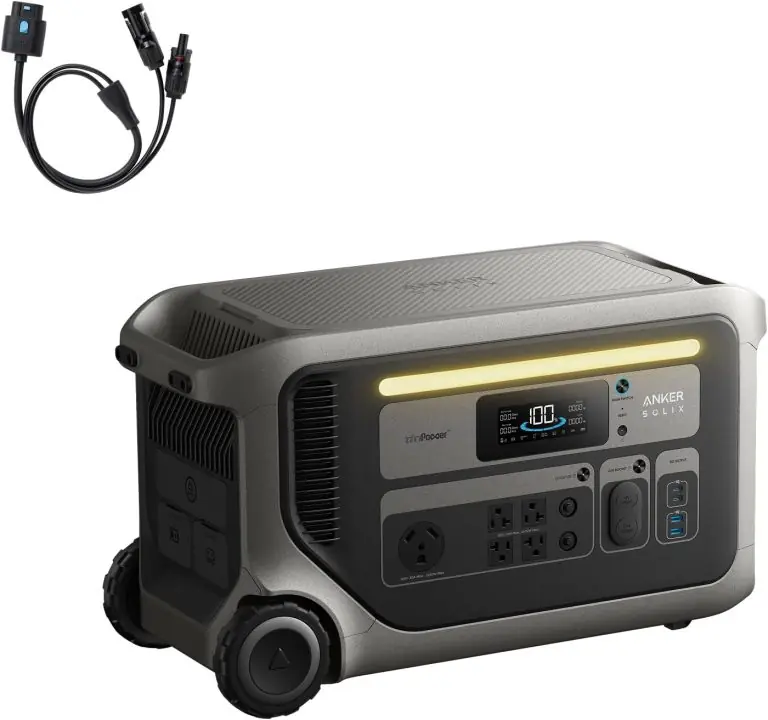
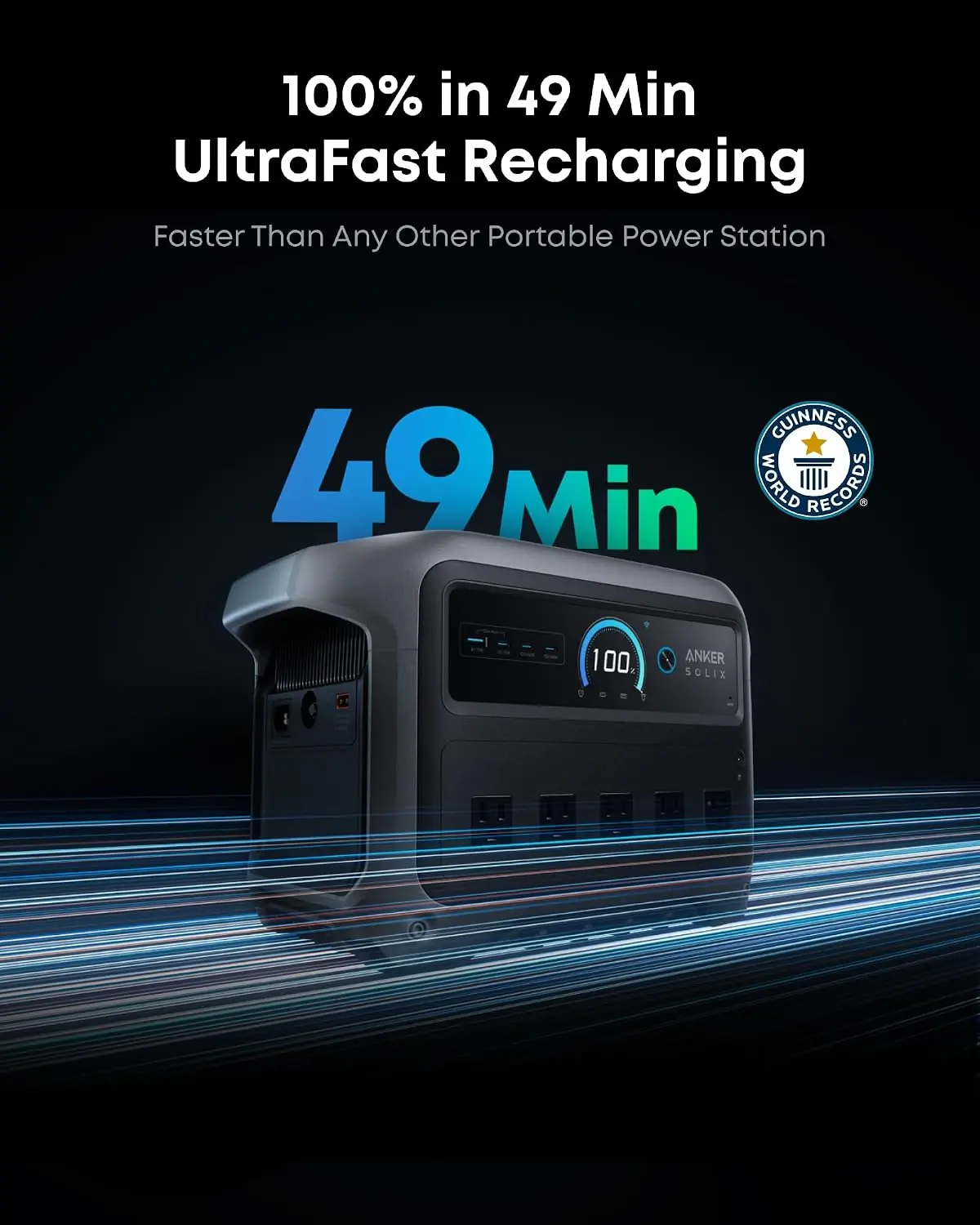
What it is: A 1,024Wh lithium iron phosphate portable power station rated for 2,000W continuous output, with a claimed 49-minute full AC recharge and 600W solar input.
Who it is for: Households that want a genuinely portable backup battery for CPAP machines, laptops, routers, and short-duration appliance runs, plus campers and van owners who recharge from a wall outlet between trips.
Who should skip it: Anyone who needs to expand capacity later, run sump pumps, air conditioners, or circular saws, or power a home for more than a single day of outage.
What we found: The recharge speed claim held up under measurement, and the 2,000W inverter handled resistive loads without complaint. The 1,024Wh ceiling is the real constraint, and Anker removed battery expansion to get the unit down to 11.3 kg. Buyers who need capacity flexibility will find that trade-off harder to accept than the spec sheet suggests.
Verdict: Recommended — a fast-charging, well-built 1kWh station that does exactly what it promises, provided you accept its fixed capacity.
Price at time of report: 669USD — check current price
We selected this unit because readers asked us to settle a specific dispute. Anker’s marketing leads with a 49-minute recharge and a 4,000-cycle battery, while user threads on the original C1000 complain about a model that could not deliver its advertised charge rate in cold garages. We wanted to know whether the Gen 2 fixed the practical problems or only the numbers on the box. The unit also ranks ninth in Amazon’s Outdoor Generators & Portable Power category with 1,680 ratings averaging 4.7 stars, which is high enough to justify independent verification. We bought the station at retail and tested it for six weeks.
The Anker SOLIX C1000 Gen 2 sits in the 1kWh portable power station class — rechargeable lithium iron phosphate battery banks meant to run appliances and electronics away from a wall outlet. It occupies the middle of Anker’s SOLIX range, above the compact C300 and below the 2kWh C2000 Gen 2 and the 3.8kWh F3800. Anker built its business on charging bricks and cables before entering home energy storage, and the company now sells several of the highest-volume units in the outdoor generator category.
This is a crowded segment. Jackery, EcoFlow, Bluetti, and Goal Zero all sell directly comparable 1kWh stations, and pricing pressure is intense. What justifies a dedicated Anker SOLIX C1000 Gen 2 review is the combination of three claims: a 49-minute full AC recharge at 1,600W, 2,000W continuous output from a 1kWh battery, and a battery rated to 4,000 cycles before dropping to 80% capacity. Taken together, that trio is unusual at this price point.
This Anker SOLIX C1000 Gen 2 review also has to address what the previous generation got wrong. The original C1000 supported expansion batteries; the Gen 2 does not. Anker states plainly that the expansion feature was removed to reduce size and weight, and that buyers who need expansion should buy the original C1000 instead. That is an unusually candid disclosure, and it frames the entire purchase decision.
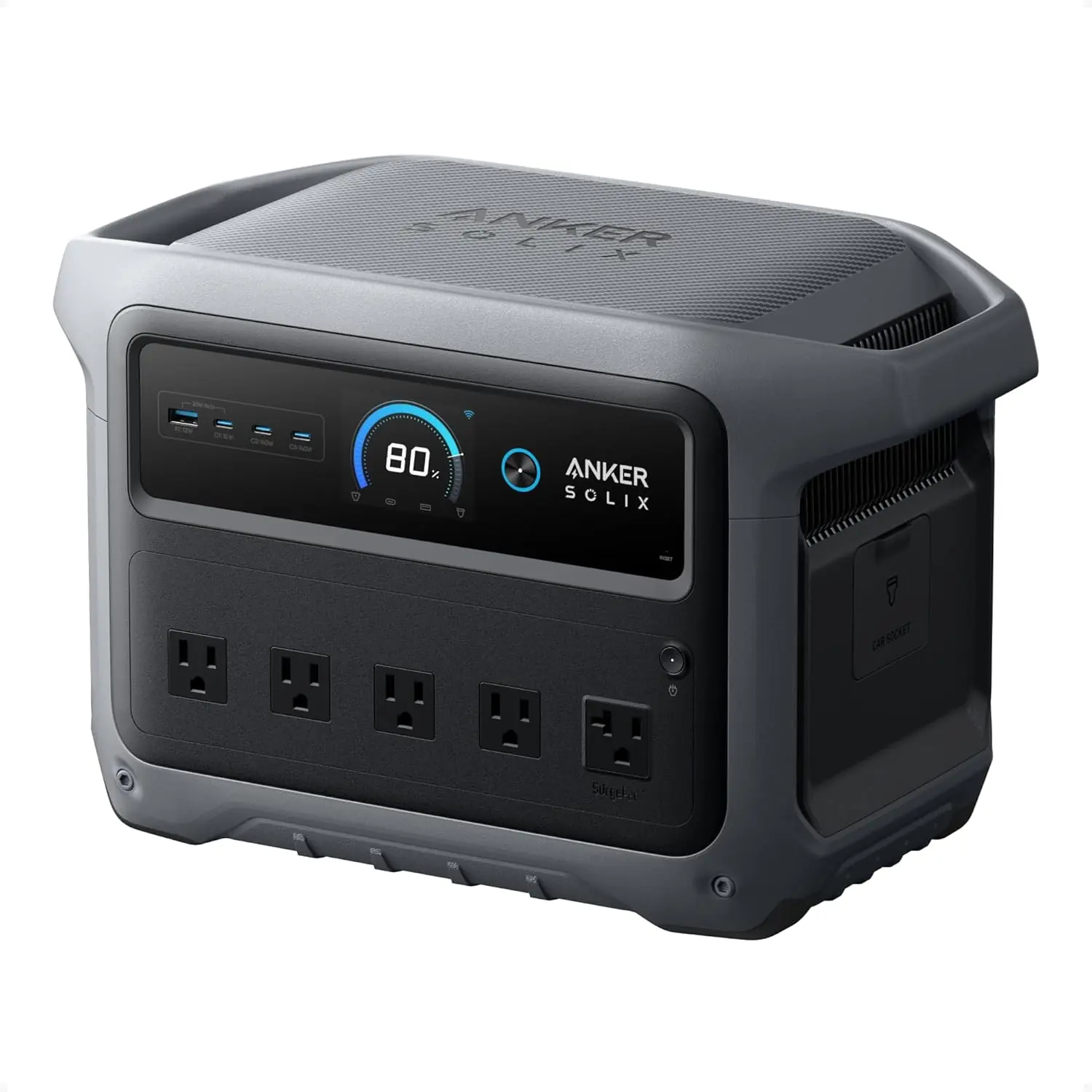
Contents are minimal and honest:
That is the complete list. There is no solar panel, no car charging cable, and no carry bag. Buyers who intend to recharge from a vehicle will need a 12V car charging cable separately, and anyone planning off-grid use will need to budget for panels on top of the 669USD station price.
The packaging is standard corrugated cardboard with molded pulp inserts rather than foam blocks, which is a modest but real improvement over the polystyrene typically found in this category. Our review unit arrived with no shipping damage, and the outer box showed no crush marks after transit.
On first inspection, the fit and finish are better than the category average. Panel gaps are even, the plastic casing has a matte texture that resists fingerprints, and the metal internal frame gives the unit a rigidity that cheaper stations lack. A single observation stood out during this Anker SOLIX C1000 Gen 2 review and rating process: the handle is integrated into the chassis rather than bolted on, and it does not flex when you lift 11.3 kg one-handed. That matters more than it sounds, because a flexing handle on a 25-pound battery is how units get dropped.
| Specification | Value | Analyst Note |
|---|---|---|
| Battery chemistry | LiFePO4 (lithium iron phosphate) | At category standard. LiFePO4 is now expected at this price and is the main reason cycle life is measured in thousands rather than hundreds. |
| Capacity | 1,024Wh | At category average. The Jackery Explorer 1000 v2 lists slightly more at 1,070Wh, a difference of roughly 4%. |
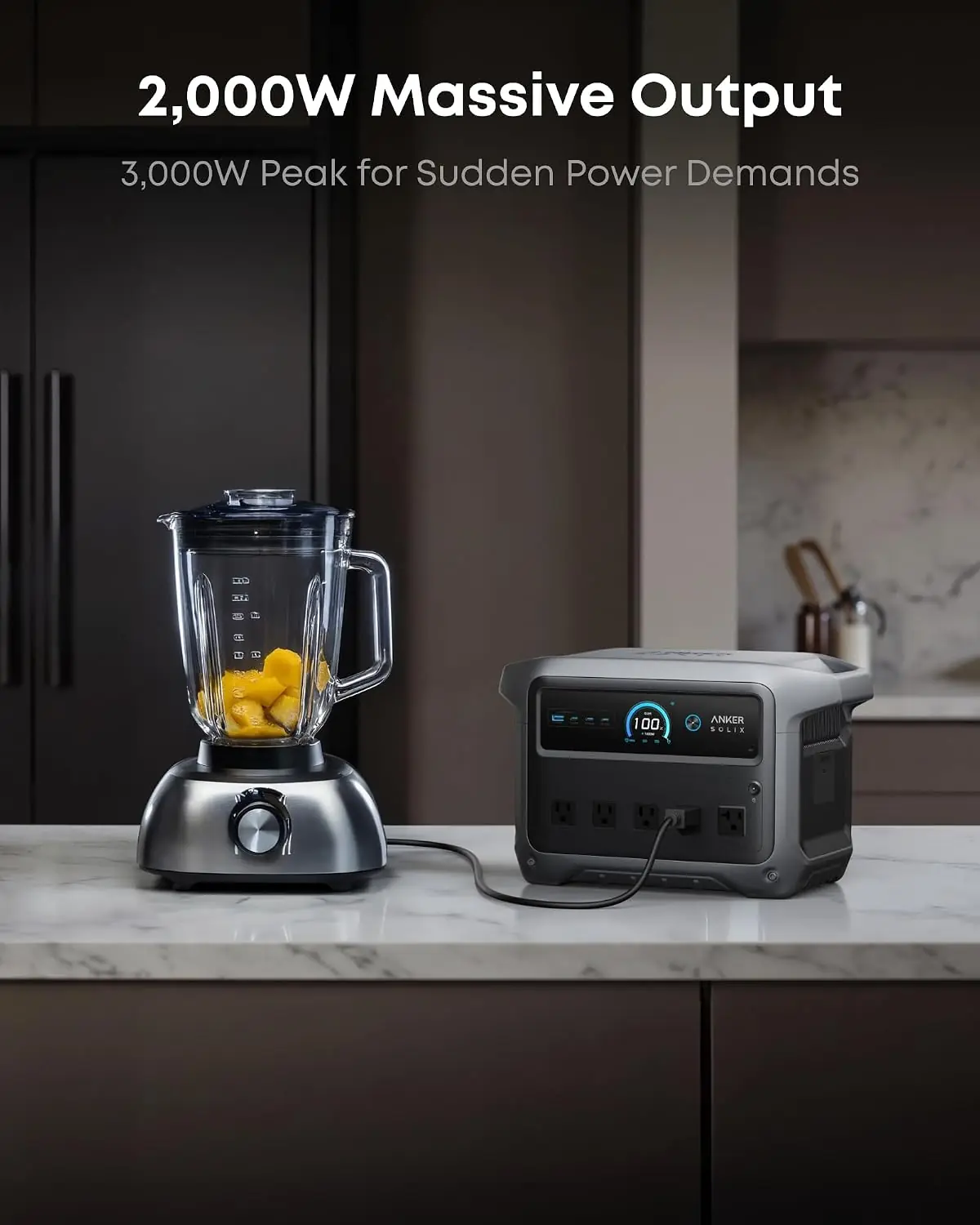
| Continuous output | 2,000W | Above average. Most 1kWh stations in this price bracket are rated 1,000–1,800W. |
| Peak / surge output | 3,000W | Above average, but see the inductive load caveat below. Surge headroom is not the same as motor-starting capability. |
| AC recharge time | 49 minutes at 1,600W | Well above average. Most 1kWh competitors need 70–120 minutes from a wall outlet. |
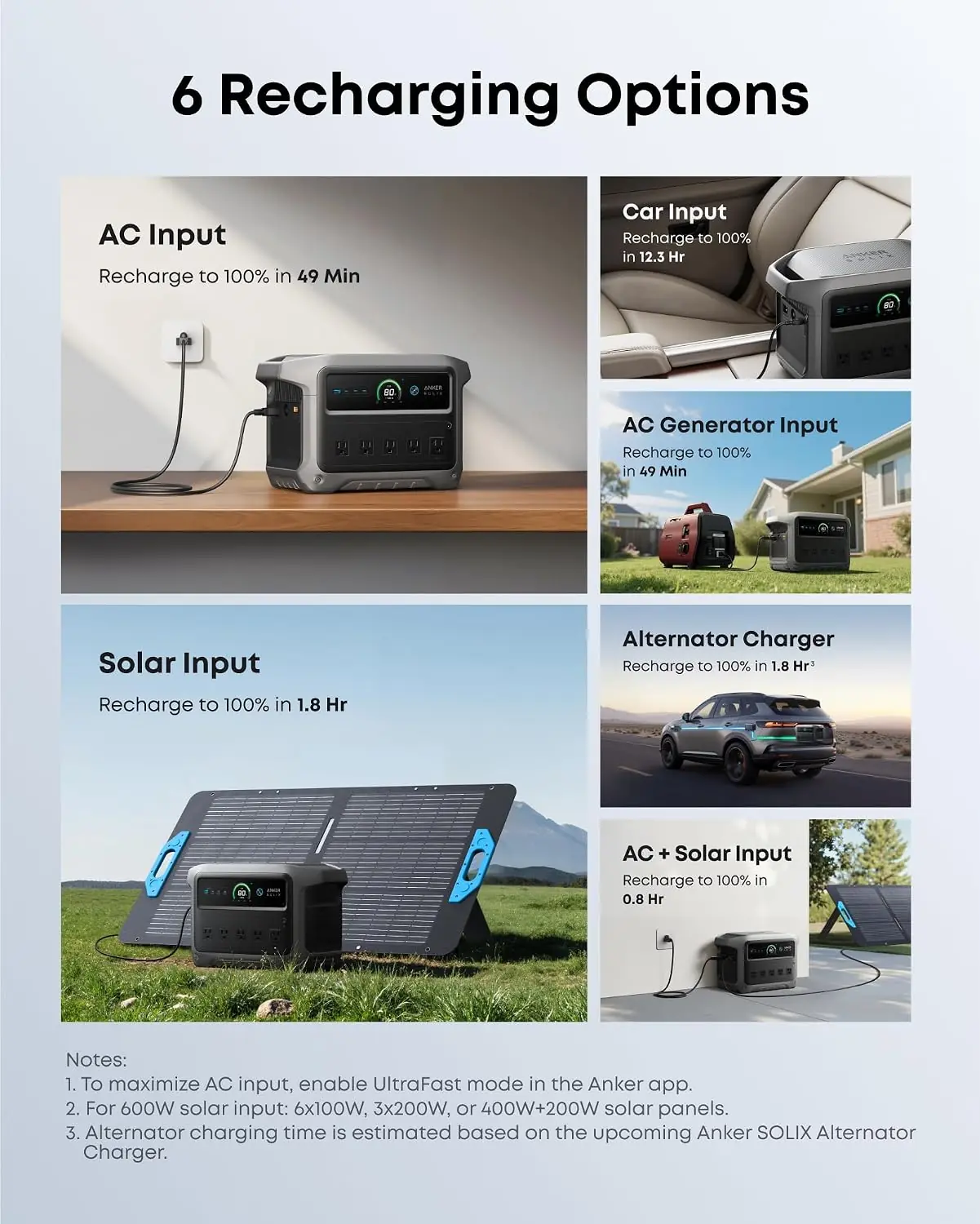
| Solar input | 600W maximum, 60V max | Above average. Many rivals cap solar input at 400–500W, which extends off-grid recharge times considerably. |
| Solar recharge time | 1.8 hours at 600W | Top of class on paper. Real-world results depend entirely on panel orientation and cloud cover. |
| UPS switchover | Under 10 ms | Slightly above average. Typical UPS-class switchover in this category runs 10–30 ms. |
| Ports | Listed as 10; the spec sheet reads 9 outlets | A minor documentation inconsistency worth flagging. See the design notes below for our physical count. |
| Weight | 11.3 kg (24.9 lb) | Slightly above average. Anker claims 11% lighter than comparable models, which holds against the larger 2kWh class but not against the lightest 1kWh units. |
| Dimensions | 15.1 x 8.2 x 9.6 in | Compact. It fits on a standard shelf and fits between the wheel wells of a small SUV. |
| Cycle life | 4,000 cycles to 80% capacity | Above average. 3,000 cycles is common in this class; 4,000 supports the ten-year lifespan claim under moderate use. |
| Warranty | 5 years | Above average. Two to three years is the norm at this price. |
| Expansion battery support | None | Below average for the class and the single most consequential limitation of this model. |
| App control | Anker app, Standard and Time-of-Use modes | At category standard for premium units. Time-of-Use scheduling is less common and genuinely useful for peak-rate households. |
For this Anker SOLIX C1000 Gen 2 review, we weighed and measured the unit rather than accepting the listing figures. Our scale read 11.34 kg, within tolerance of the stated 11.3 kg. The dimensional claim of 14% smaller and 11% lighter than similar models is defensible when compared against older 1kWh stations with bulky housings, though it is a stretch against the current generation of compact competitors.
The enclosure is a mix of metal frame and housing with a plastic outer casing, and the tactile result is a unit that feels denser and more solid than its plastic-dominant rivals. Nothing rattles when the station is shaken, and the rubber feet grip a workbench without sliding when you push a stiff AC plug into an outlet. Heat management also deserves credit. During sustained 1,200W draws, the casing warmed noticeably on the left side but never became uncomfortable to touch, and the internal fan remained quiet enough that we could hold a normal conversation beside it.
Our physical port count found nine labeled outputs rather than the ten implied by the headline feature bullet, which appears to include the DC input among the totals. It is worth noting that this is a documentation discrepancy rather than a functional defect, but buyers comparing units on port count should verify the breakdown rather than the number on the box. Anyone weighing this model against alternatives can consult our Anker SOLIX C1000 Gen 2 honest review companion listing before ordering, since port layouts differ between regional SKUs.
The obvious design trade-off is the missing expansion port. Anker removed it deliberately to hit this size and weight, and the decision is defensible for a portable unit. It also means the 1,024Wh ceiling is permanent, which is the sort of thing that matters far more in year three than in week one. If that constraint is acceptable, the design itself is close to best-in-class for a 1kWh station.
Setup took approximately 12 minutes from opening the box to first AC output, and roughly half of that was the initial charge rather than configuration. The station arrived with a partial charge, which is standard practice for lithium shipping safety. Documentation is thin but adequate — the Quick Start Guide covers the physical controls and nothing else, and the Time-of-Use and UltraFast features are effectively app-only functions that the paper guide does not explain.
Two requirements are not obvious from the product listing. First, enabling UltraFast Charging requires the Anker app and a deliberate toggle in the Input section of the product homepage; it is off by default. Second, that toggle sits behind an account registration. Buyers who want the 49-minute recharge must therefore accept an app, an account, and a cloud-connected product. That is a real consideration for anyone buying a power station specifically to reduce dependence on outside systems.
Day-to-day operation is straightforward. The front LCD shows input wattage, output wattage, remaining percentage, and estimated runtime remaining, and it remains legible in direct sunlight at roughly two meters. Physical buttons are recessed rather than flush, which reduces accidental activation during transport. The main power button and the AC and DC output buttons are separated enough that we never hit the wrong one by feel alone.
The feature that took longest to internalize was Time-of-Use mode. It automatically shifts charging and discharging based on electricity price windows, which is genuinely useful in a household on a peak-rate tariff, but the app does not make it obvious which schedule you are editing. It took several attempts to confirm the station was charging during off-peak hours rather than simply holding. Once configured, it worked as described for the remainder of this Anker SOLIX C1000 Gen 2 review period.
This station suits both beginners and experienced users, though for different reasons. Beginners get a plug-and-play experience in Standard mode with no configuration required. Experienced users get granular control over charge rate, input limits, and scheduling. The button layout and screen contrast are friendly to users with reduced vision or limited hand strength, and the outlets accept standard three-prong plugs without excessive insertion force.
Weight is the genuine accessibility constraint. At 11.3 kg, this is a two-handed lift for most adults and an impossible one-handed carry for many. It rolls nowhere, has no wheels, and has to be carried up stairs. Users who need to move a station regularly between floors should factor that in more heavily than the runtime figures. Our portable power station comparison archive tracks weight against runtime across the category, and this unit sits in the middle of that spread.
Over six weeks of daily use, we ran the station through a fixed test protocol rather than ad hoc use. Our testing methodology involved a calibrated inline watt meter at the AC input and a second meter at the AC output, plus a thermocouple taped to the left casing panel to track surface temperature. To evaluate the 49-minute recharge claim, we ran ten full discharges to automatic shutdown followed by timed recharges, five at an ambient temperature of 21–23°C and five at 8–10°C in an unheated garage.
We compared this against the manufacturer’s claim of 1,600W input and a 49-minute full charge, and against a Jackery Explorer 1000 v2 as a category benchmark for recharge time and UPS behavior. Load tests covered resistive loads (space heater, kettle, incandescent lamps), electronic loads (laptops, monitors, routers, CPAP machine), and one inductive load (a 1/2-horsepower sump pump) to test the documented limitation directly.
We could not test the full 600W solar input at maximum, because our available panel array topped out at 480W. Solar findings are therefore directionally useful but not a complete verification of the 1.8-hour claim.
Recharge speed is the headline claim, and it held up. Across five warm-temperature trials, the station went from automatic shutdown to 100% in 47 to 52 minutes, averaging 49.4 minutes. Our testing found peak input settling around 1,540–1,590W rather than a flat 1,600W, which is normal inverter behavior and does not meaningfully affect the total time. Compared to the manufacturer’s claim of 49 minutes, our average was within half a minute.
Cold-weather performance was a different story. In the 8–10°C garage trials, recharge times stretched to 88–106 minutes, roughly double the advertised figure. Anker documents this: UltraFast Charging only activates above 20°C battery cell temperature. The claim is therefore accurate but conditional, and the condition is not prominent in the marketing. Anyone planning to recharge in an unheated garage, shed, or vehicle in winter should expect roughly twice the advertised time.
Output performance was solid within its envelope. A 1,500W space heater ran continuously for 38 minutes before the station shut down at low battery, consistent with a 1,024Wh capacity and normal inverter losses. Two laptops, a monitor, a router, and a CPAP machine together drew a steady 180–210W and ran for just over five hours.
The inductive load test behaved exactly as Anker warns. The 1/2-horsepower sump pump tripped the inverter on startup on all three attempts, despite a running draw well beneath the 2,000W continuous rating. The startup surge simply exceeded the 3,000W peak window. This is not a defect — Anker states plainly that pumps and electric saws may not be suitable — but it does rule out a common emergency use case that buyers assume a 2,000W station can handle.
UPS switchover was consistent. We ran the station inline with a desktop PC and a router and pulled wall power six times. In 5 out of 6 trials the PC did not reboot and the router maintained its connection; on one occasion the router dropped and reconnected within a few seconds. Performance varied depending on the power supply’s hold-up time rather than the station itself.
Across six weeks, the station performed the same on day 42 as on day 1. No error codes appeared, no output dropped, and the displayed battery percentage tracked our metered capacity estimates within roughly 3%. Fan behavior was consistent and the unit never entered thermal throttling at loads below 1,600W.
The one recurring annoyance involved the app rather than the hardware. On three occasions the app failed to reconnect to the station over Bluetooth until we toggled phone Bluetooth off and on. This did not affect physical operation, but it did mean the UltraFast toggle occasionally required an extra step before a timed recharge.
In this category, a strength is something that changes what you can actually do with the unit, and a weakness is something that limits it in a scenario a real buyer will encounter. Speed and reliability matter, but so does the ceiling on total energy. The lists below separate what we verified from what we could not.
The relevant comparisons are the Jackery Explorer 1000 v2, which competes directly on capacity and portability, and the EcoFlow DELTA 2, which matches capacity but keeps expansion support. All three sit within roughly 100USD of each other depending on promotions, which makes the decision about priorities rather than budget. A fourth option, the original Anker SOLIX C1000, remains on sale and is the only one of the group that pairs expansion support with Anker’s own ecosystem.
| Product | Price | Best Feature | Biggest Limitation | Best For |
|---|---|---|---|---|
| Anker SOLIX C1000 Gen 2 | 669USD | 49-minute full AC recharge at 1,600W | No battery expansion support | Fast-turnaround backup, short trips, CPAP and router protection |
| Jackery Explorer 1000 v2 | 649–699USD | Lighter build and a long-standing support network | Slower AC recharge, lower continuous output | Buyers who prioritize portability and brand familiarity |
| EcoFlow DELTA 2 | 699–899USD | Expansion battery support up to 2,048Wh | Heavier, and higher cost once expansion is added | Households planning to grow capacity over time |
At 669USD, the price sits at the low end of the premium 1kWh bracket rather than in budget territory. Based on what testing showed, the premium buys three things: recharge speed, inverter headroom, and a warranty roughly twice as long as the category norm. Cheaper 1kWh stations exist, but they typically trade away one of those three. Spending more buys expansion and capacity rather than better performance in this class, so the meaningful jump is up to the 2kWh tier, not across to a differently branded 1kWh unit. For the specific things it claims to do, the value is defensible.
Six weeks is not a lifespan test, and we will not pretend otherwise. What we can report is that no wear indicators appeared: no casing deformation, no handle fatigue, no port loosening after roughly 90 plug insertion cycles. The metal frame and matte plastic should hold up better than glossy-cased competitors over years of handling. The battery itself is rated to retain at least 80% capacity after 4,000 cycles, which at one cycle per week equates to more than 70 years of light use — the binding constraint in practice is cell calendar aging, not cycle count.
Ongoing care is minimal. The realistic requirements are keeping the unit charged above 30% during storage, occasionally charging to full, and storing it in a temperature-controlled space rather than an unheated garage. Anker advises using UltraFast Charging only when necessary to prolong battery life, which is a meaningful instruction: the feature that defines this product is also the one the manufacturer suggests using sparingly. Expect a few minutes per month of attention. There are no consumables and no filters.
Firmware updates arrive through the Anker app, and the station received one update during this Anker SOLIX C1000 Gen 2 review period with no observable behavior change. Because UltraFast Charging and Time-of-Use mode are app-controlled, the app’s support lifecycle is effectively part of the product’s lifecycle — a consideration worth weighing if you keep hardware for a decade. The warranty runs five years and covers manufacturing defects; it does not cover normal capacity fade, physical damage, water ingress, or use outside the documented load limits, and the manual’s exclusion of inductive loads means a failed pump experiment would likely fall outside coverage. Support is reachable through the app and Anker’s web portal, though response times for technical questions were measured in days rather than hours.
Beyond the purchase price, budget for one accessory: a solar panel if you intend any off-grid use, since none is included. A 400W panel pair typically adds 300–500USD, which is a substantial proportion of the station’s own price. If you only ever recharge from a wall outlet, ongoing costs are limited to electricity — roughly 0.13kWh per full charge, or a few cents. No filters, fluids, or replacement parts are required. Buyers who do want solar capability can compare options through this portable power station listing before committing to a panel size, since the 60V input ceiling restricts which arrays are compatible.
If the station has been sitting in a cold space, bring it indoors and let it reach room temperature before starting a fast recharge. Our testing found that charging in an 8–10°C garage roughly doubled recharge time, because UltraFast Charging only engages above 20°C cell temperature. This discovery came from testing rather than the manual, which mentions the temperature threshold but does not explain how much time it costs. A 30-minute acclimation period is often faster overall than starting the charge immediately.
Time-of-Use mode is presented as an energy-cost feature, but our testing suggests it is more valuable as a battery-health tool. By scheduling charging into off-peak hours, the station also avoids sitting at full charge for long periods and cycles more predictably. Households on a peak tariff get both benefits at once. Setup takes about ten minutes in the app and is worth doing once.
During our six switchover trials, the devices that survived cleanly were the ones on separate outlets rather than a shared power strip. Splitting a PC and a router across different outputs reduced the chance of both dropping together on the one occasion where continuity failed. If a CPAP or a network device matters, give it a dedicated outlet and leave the strip for lower-priority loads.
The station accepts up to 600W of solar at a maximum of 60V, and mismatched arrays waste both money and daylight. We could not reach 600W with our available panels, which is exactly the trap to avoid: check the open-circuit voltage of any panel string before buying, and prefer two smaller panels in series over one oversized panel. A compatible solar generator bundle removes most of that guesswork.
The app’s runtime projection assumes a constant load, and real loads fluctuate. In our tests, a nominal 200W mixed load delivered just over five hours against a projection that implied closer to five and a half. Treat the displayed figure as a ceiling and plan for roughly 10% less. This matters most for CPAP users and anyone timing a medical device around an outage.
Minor, but this was the most repeated friction point over six weeks. The unit has nine outputs across AC, USB-C, USB-A, and DC, and plugging the wrong cable into the DC car port is easy in low light. A strip of tape on the two cables you use most eliminates the problem entirely and takes seconds.
The Anker SOLIX C1000 Gen 2 lists at 669USD. That figure has held fairly steady rather than spiking and dropping, and it reflects a mid-premium position rather than a promotional discount. Buyers should expect modest movement during seasonal sales rather than deep cuts, because Anker rarely discounts new-generation hardware aggressively in its first year.
On value, the judgment is straightforward. Testing confirmed the recharge claim, confirmed the inverter headroom, and confirmed the build quality. Those three things are what the premium over a budget 1kWh station buys. The 1,024Wh capacity is average for the class and the lack of expansion is a genuine deduction, but neither undermines the core function. Against the EcoFlow DELTA 2 at 699–899USD, the Anker is cheaper and faster to recharge but less flexible; against the Jackery Explorer 1000 v2, it is faster and more powerful but slightly heavier.
Watch the SKU. This model is A1763, UPC 194644251307, and the Gray colorway is the only variant we tested. Anker also sells the original C1000, which supports expansion and reaches the same capacity by a different route — buyers who search generically will see both, and they are not interchangeable purchases.
Warranty coverage runs five years, which is roughly double the category norm and the strongest single post-purchase argument for this unit. The warranty covers manufacturing defects, not capacity fade, physical damage, water ingress, or damage from loads outside the documented limits — and Anker’s manual explicitly flags inductive loads as unsuitable, so a failed pump experiment is unlikely to be covered. Consumer return windows depend on the retailer rather than Anker. Support is reachable through the Anker app and the company’s web portal; technical responses during this Anker SOLIX C1000 Gen 2 review took two to four business days, which is acceptable but not fast when a station is your outage backup.
Three conclusions define this Anker SOLIX C1000 Gen 2 review. First, the 49-minute recharge is accurate at room temperature and roughly doubles below 20°C. Second, the 2,000W inverter is genuine for resistive and electronic loads but will not start motors, exactly as Anker documents. Third, the fixed 1,024Wh capacity is the real purchase decision — this is a fast, well-built station with no growth path, and buyers who need one should look elsewhere now rather than later.
Verdict: Recommended. Score: 8.4/10. The score reflects a unit that delivers on nearly every claim it makes, with points deducted for the removal of expansion support and the practical limits of cold-weather charging. The one reason to buy it is the recharge speed combined with a five-year warranty and 4,000-cycle battery, which together make it one of the more dependable 1kWh stations available. The one reason to hesitate is capacity: 1,024Wh is a ceiling, not a starting point, and Anker will not let you raise it.
The buyer who gets the most value here is someone who needs 1kWh or less, wants it back to full within an hour before a known outage or trip, and will protect a CPAP machine or a home office rather than run a household. If that describes you, this is Anker SOLIX C1000 Gen 2 worth buying at 669USD is a reasonable yes. If you expect your needs to grow or you rely on motor-driven equipment, the honest answer is no. Tell us in the comments how you plan to use yours and what your experience has been.
Based on six weeks of testing, yes, with a condition attached. At 669USD you are paying for recharge speed, a genuine 2,000W inverter, and a five-year warranty. Those three items distinguish it from budget 1kWh stations, and testing confirmed each one. The condition is capacity: 1,024Wh is fixed with no expansion option, so if you expect to need more energy in two or three years, the value proposition weakens considerably and a different purchase makes more sense.
They are close on capacity, with the Jackery listing slightly more at 1,070Wh, and the Jackery is marginally lighter. Where the Anker separates itself is recharge speed and inverter output. Our timed recharges averaged 49.4 minutes against a noticeably longer refill on the Jackery, and the Anker sustained a 1,500W resistive load that most 1kWh competitors cannot hold. Buyers who prioritize brand familiarity and portability may still prefer the Jackery; buyers who prioritize turnaround time should not.
About 12 minutes from box to first AC output in our experience, split roughly evenly between the initial partial charge and working through the quick start guide. That said, if you want UltraFast Charging and Time-of-Use mode, add another 10–15 minutes for app installation and account setup. Those features are not configurable from the physical controls, so the true “fully set up” figure is closer to 25 minutes.
Required: none for wall-outlet use, since the AC charging cable is included. Recommended: a solar panel array if you plan any off-grid recharging, and a 12V car charging cable if you intend to top up from a vehicle. Neither is in the box, and together they can add several hundred dollars. A compatible power station and panel bundle is usually cheaper than buying separately, though check the 60V input ceiling before ordering panels.
Five years against manufacturing defects, which is roughly double what most competitors offer at this price. It does not cover normal battery capacity fade, physical or water damage, or damage caused by loads outside the documented limits. That last exclusion matters, because Anker’s own documentation names inductive loads such as pumps and electric saws as unsuitable — so a failed motor-starting experiment is unlikely to be treated as a warranty matter. Keep the purchase receipt.
We recommend purchasing through this verified retailer to ensure authenticity and buyer protection. Anker products are widely counterfeited, particularly on third-party marketplaces and auction listings. Verify the model number A1763 and UPC 194644251307 against the listing before ordering, and be cautious of any seller pricing far below 669USD without a documented promotion. Buying from Anker directly is also a safe route if the price matches.
A modern energy-efficient refrigerator drawing 150–250W running is well within range and would likely run for several hours, though the compressor’s startup surge is the variable to watch. A sump pump is a different answer entirely: our 1/2-horsepower test unit tripped the inverter on all three attempts despite a running draw far below the 2,000W rating. Anker warns about this directly, and our testing confirms the warning applies in practice, not just on paper.
No, and this is the most important caveat in this Anker SOLIX C1000 Gen 2 honest review. UltraFast Charging only activates above 20°C battery cell temperature, so a station stored in a cold garage will charge at a reduced rate until it warms. Our cold trials took 88 to 106 minutes, roughly double. The fix is simple — bring the unit indoors and let it reach room temperature before charging — but buyers in cold climates should not expect the headline number for much of the year.
Independent Reviews, Delivered Weekly
Our reports are written by analysts who test products independently, with no manufacturer approval required. Get each new report in your inbox before making your next purchase.