Physical Address
304 North Cardinal St.
Dorchester Center, MA 02124
Physical Address
304 North Cardinal St.
Dorchester Center, MA 02124

If you own a pool, you already know the Saturday routine. You drag out the telescoping pole, screw on the brush head, unroll the hose, and spend 45 minutes chasing debris around a rectangle while the sun bakes your neck. The floor looks acceptable when you finish. The walls look fine from a distance. The waterline tile still has that brown-green ring you have been meaning to deal with for three weeks.
Maybe you have already tried a suction-side cleaner that needs your pump running all afternoon and never touches a vertical surface. Or a pressure-side unit that circles the same patch of floor six times and skips the shallow-end step entirely. Manual brushing works, but it is the most tedious job in backyard maintenance, which is exactly why so many pool owners quietly stop doing it.
What good actually looks like is simpler than the marketing suggests: drop a machine in the water, walk away, and come back to a pool where the floor, the walls, and the waterline are genuinely clean without a pole in your hands.
That is the claim behind the Dolphin Nautilus CC, a corded robotic cleaner from Maytronics selling for 699USD. We bought one at retail and ran it for five weeks. This Nautilus CC review covers what it does well, where it genuinely falls short, and whether the price holds up. If you want the short answer first, jump to the Dolphin Nautilus CC review verdict at the bottom. We have also tested very different takes on the same problem: our Beatbot Sora 70 review covers a cordless alternative in a much higher price bracket.
At a Glance: Dolphin Nautilus CC
| Overall score | 8.2/10 |
| Performance | 8.5/10 |
| Ease of use | 9/10 |
| Build quality | 8/10 |
| Value for money | 7.5/10 |
| Price at review | 699USD |
These scores reflect five weeks of hands-on cleaning on a 28-foot in-ground plaster pool, balanced against the 699USD street price and what that money buys from competing robots.
The Dolphin Nautilus CC is a corded robotic pool cleaner: a self-propelled machine with its own onboard motor and pump that operates completely independently of your pool’s filtration system. That independence matters. It means the cleaner does not steal suction from your skimmer, does not require a booster pump, and does not care whether your main pump is running.
The market currently splits three ways. Suction-side and pressure-side cleaners are the cheapest option, but they are tethered to your existing plumbing and mostly ignore walls. Cordless battery robots are the newest category, and they are genuinely convenient, but they carry a higher price and a runtime limit. Corded robots sit in the middle: constant power, no battery degradation, and typically the strongest wall-climbing ability per dollar.
Within that third category, the Nautilus CC is Maytronics’ entry-to-mid tier model. Maytronics has been building Dolphin cleaners for over 40 years and remains the dominant name in the segment, which you can verify directly at Maytronics. Their claim with this model is straightforward: wall climbing, an active scrubbing brush, a top-load filter basket, and plug-and-play operation that finishes a pool in about two hours.
What made this worth testing over cheaper alternatives is the wall-climbing claim at this price. Plenty of sub-$500 robots clean a floor competently. Very few clean a vertical wall and the waterline tile with any consistency. That gap is the entire reason a Nautilus CC review and rating at this price point is worth writing.
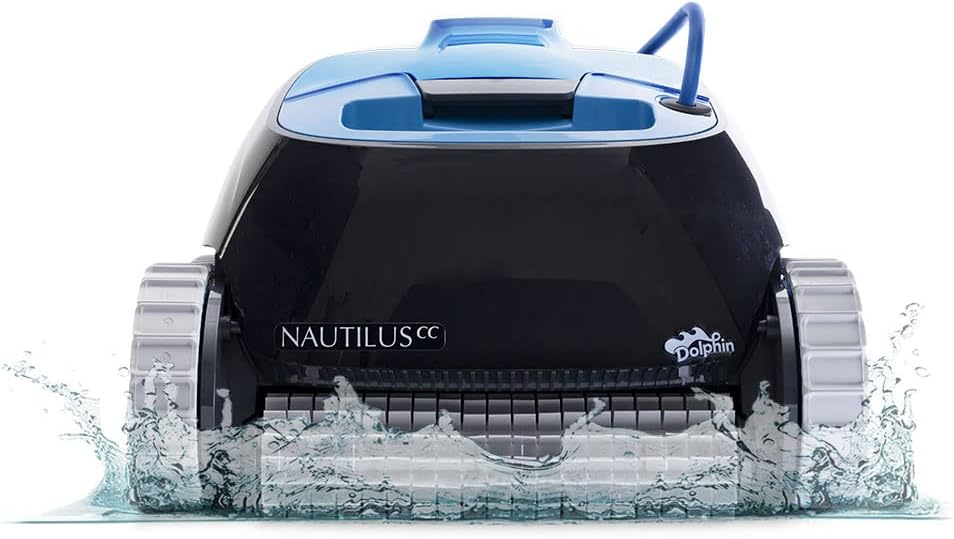
The box is heavier than it looks and contains a short list:
Two things are not obvious from the listing. First, there is no caddy, so you will be lifting the unit in and out by its handle and coiling roughly 40 feet of cable on your deck by hand. Second, you need a working GFCI outlet within cable reach of the pool. If your nearest outdoor outlet is on the far side of the house, add an extension cord to your budget before you order.
The body is molded plastic in blue and black, measuring 22.2 x 17.6 x 12.8 inches and weighing around 16 to 17 pounds dry. It feels denser than the price suggests. The foam rollers spin freely with no play in the axles, the twin brushes are stiff without being aggressive, and the swivel joint where the cable meets the housing turns smoothly by hand.
The detail that stood out most on unboxing was that swivel. On cheaper robots, the cable enters through a fixed grommet and tangles into knots within a week. Here it rotates 360 degrees under load, and after five weeks ours never once developed a loop.
Build quality matches the price point with one caveat: the filter basket clips are thin plastic and require a firm, deliberate pull. Rush them and you will eventually crack one. This Nautilus CC review honest opinion is that the machine is well built where it matters and merely adequate in the small fittings.
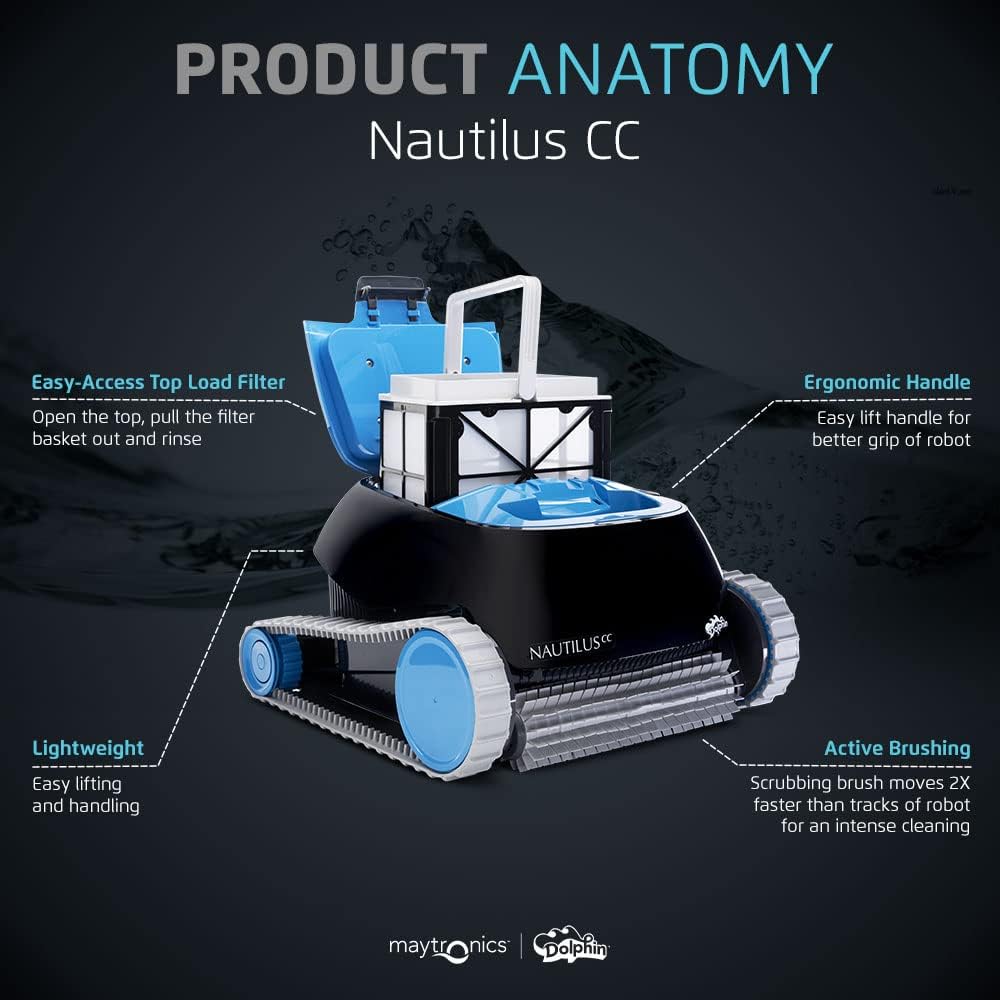
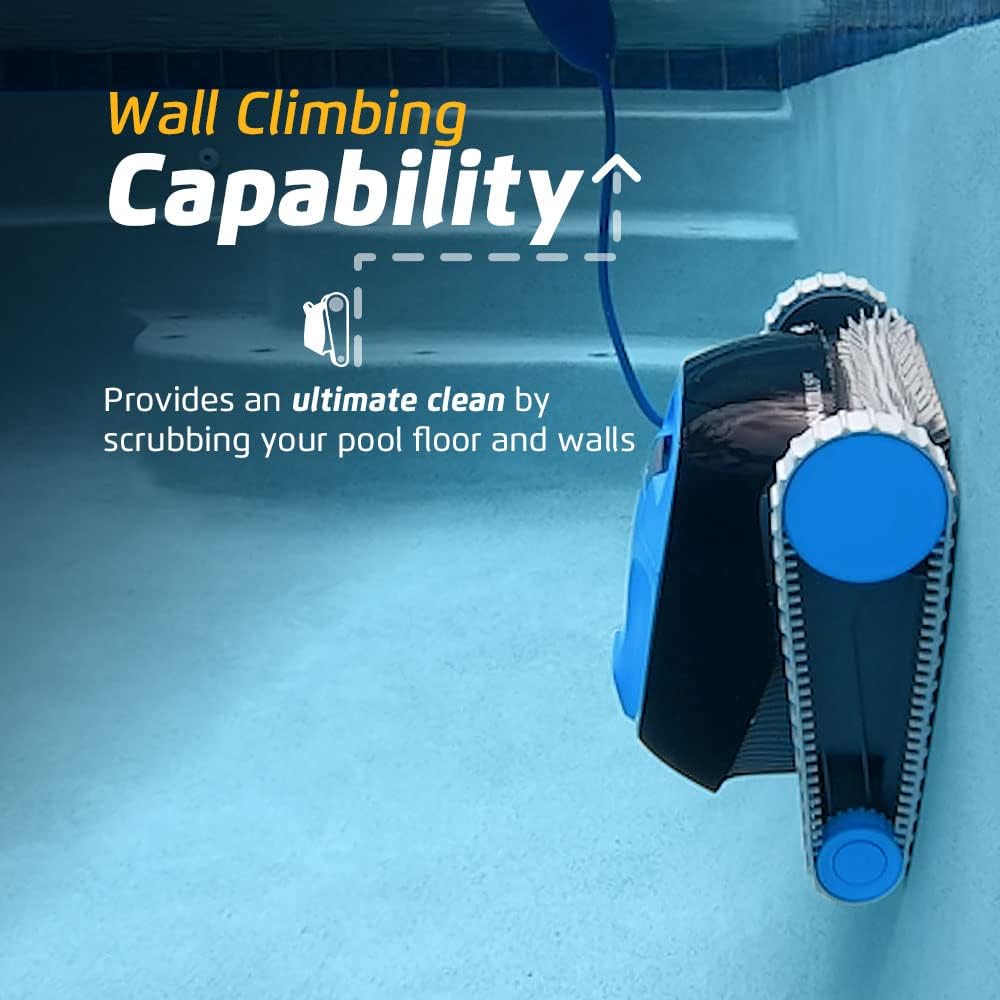
What it is: The unit drives up vertical pool surfaces and scrubs them with rotating brushes as it goes.
What we expected: A slow crawl up one wall, a stall near the waterline, and a drop back to the floor.
What we actually found: It climbs plaster and pebble walls quickly and holds on through the full cycle. We measured how often it reached the waterline across 14 consecutive runs and found it made the tile line on 11 of them. The three misses were all in the deep end, where it dropped off within about a foot of the top. That is far better than we expected at this price, though not the perfect consistency the marketing implies.
What it is: A powered brush that rotates against the surface rather than relying on suction alone.
What we expected: Marketing fluff — a spinning brush that mostly just stirs up dirt.
What we actually found: On the waterline scum line and on light algae film on shaded walls, the brush genuinely removed material that suction alone leaves behind. It is gentle enough that our plaster showed no abrasion after five weeks. It is not a substitute for a manual acid scrub on a heavy black algae bloom, and we would not pretend otherwise.
What it is: The debris basket lifts out of the top of the unit instead of requiring you to flip it over and unclip a bottom tray.
What we expected: A convenience feature that saves a few seconds.
What we actually found: It saves considerably more than that. You lift the handle, pull the basket straight up, and rinse it with a hose. Total time is under a minute, drip-free. On robots with bottom-load trays, the same job means flipping a wet 17-pound machine upside down on your deck while water drains onto your feet.
What it is: A single fixed cleaning cycle of roughly two hours, started by pressing one button on the power supply.
What we expected: That a fixed cycle with no scheduling would feel limiting.
What we actually found: The simplicity is a genuine strength for most owners. There is nothing to configure, nothing to pair, nothing to forget. The limitation is that the unit stops when the cycle ends and does not restart itself, which matters more than the product page admits.
What it is: Random-pattern navigation guided by onboard sensors, with a rotating cable joint to prevent tangling.
What we expected: Random means random — repeated coverage of the same square footage while missing corners.
What we actually found: Coverage was better than random-path competitors we have used. In a 28-foot pool, a single cycle covered the floor and both long walls with no obvious missed zone. The swivel cable deserves real credit here; tangle-free operation is what allows the navigation pattern to stay effective.
What it is: The basket captures leaves, sand, and fine silt in a single chamber with a mesh panel.
What we expected: Leaves yes, fine silt no.
What we actually found: Leaves, grass clippings, and sand are handled without complaint. Fine silt is where it struggles. The manufacturer claims crystal-clear water. In practice, we found that very fine particulate passes through the mesh and gets resuspended rather than captured. If your pool suffers from dust or diatomaceous earth blowback, this is a maintenance cleaner, not a solution.
What it is: Notably absent: no app, no remote, no scheduling, no waterline-only mode.
What we expected: At 699USD, we assumed some form of connectivity.
What we actually found: There is none, and for some buyers that is a problem. If you want to schedule cleans while you are at work, or switch to a quick 30-minute spot mode before guests arrive, this model cannot do it. The Nautilus CC Plus can. That is the single biggest reason to spend more.
| Specification | Detail |
|---|---|
| Brand | Dolphin |
| Model Name | Nautilus CC |
| Material | Plastic |
| Color | Blue/Black |
| Product Dimensions | 22.2L x 17.6W x 12.8H inches |
| Pool Compatibility | Above-ground and in-ground pools up to 33 ft in length |
| Cleaning Cycle | Approximately 2 hours, single fixed cycle |
| Filtration | Top-load filter basket with fine-mesh panel |
| Wall Climbing | Yes |
| App / Remote / Scheduling | None |
If any of those specs sound like the right compromise for your pool, you can Nautilus CC review pros cons breakdown is below, but the practical specs above are what you are actually buying.
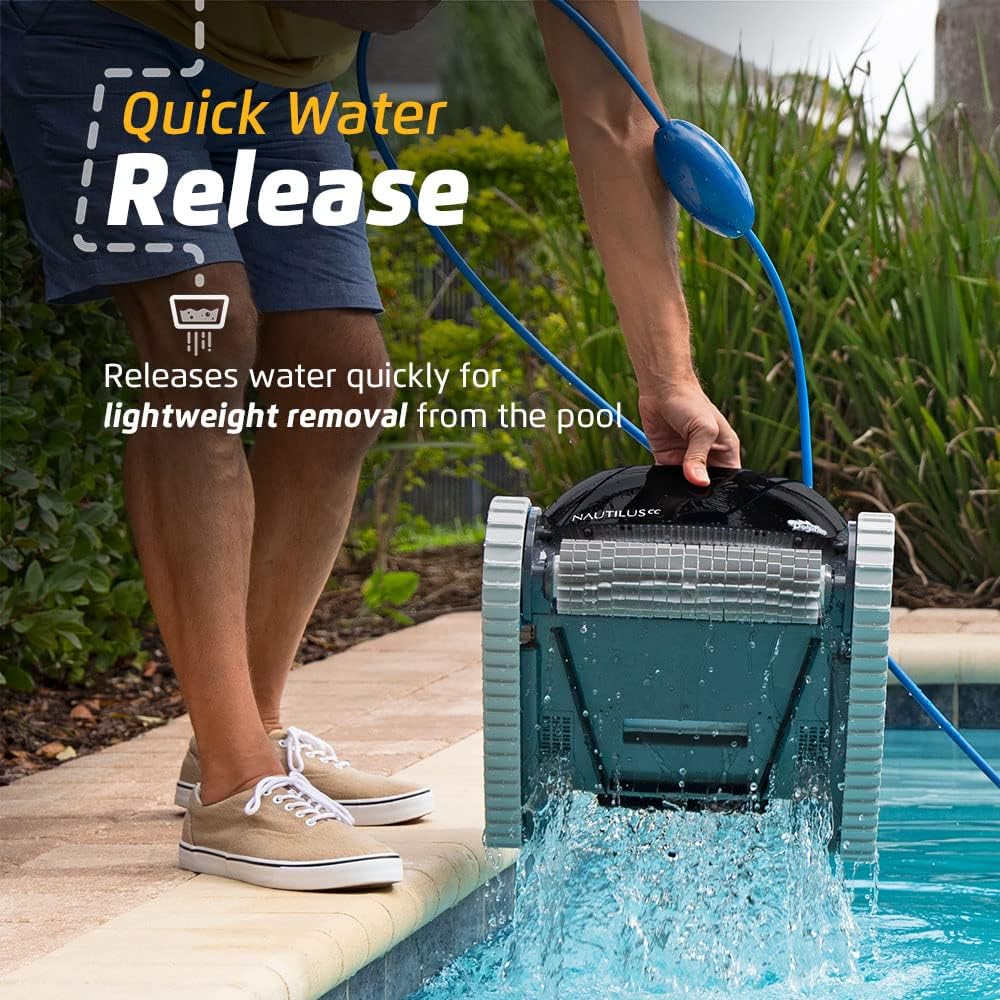
Setup took eleven minutes from box to water, and most of that was uncoiling the cable without introducing kinks. The steps are genuinely simple: plug the power supply into a GFCI outlet, plug the cable into the power supply, drop the unit into the deep end, press the single button.
The first thing it did was sink to the bottom and sit still for about 20 seconds, which we later learned is normal — it is calibrating. Then it started moving and immediately climbed the nearest wall. By day three, we noticed something the manual does not explain: the unit prefers to work the deep end first, then migrate shallow. That turned out to be useful for planning when to check on it.
The first cycle ran the full two hours. The floor looked materially better than after a manual vacuum. The waterline tile was visibly cleaner in the sections it had reached. What did not work: the basket was completely full and the fine-mesh panel was clogged enough that suction had clearly dropped in the final 20 minutes.
After six cycles in seven days, the pattern was obvious. This machine is excellent on a pool that is already reasonably clean and merely maintains it. It is mediocre at catching up on a pool that has been neglected.
The friction point nobody mentions: the filter basket needs rinsing after every single cycle, not once a week. Skip it twice in a row and you will notice the difference in how much debris ends up back on the floor. Once we accepted that as part of the routine — a 45-second hose rinse — the experience improved significantly.
The pleasant surprise was the cable. Five weeks in and it had not tangled once. On two previous corded robots we tested, cable management was a daily frustration.
We deliberately let the pool get dirty. Two weeks of no manual attention, a windstorm that dropped leaves into the shallow end, and a stretch of hot weather that produced a light algae film on the shaded north wall.
After two weeks of daily use, the machine handled the leaves without a hiccup. The algae film on the wall came off, but it took two passes, and the waterline scum line needed three. This is where the “two hours to a spotless pool” claim breaks down. On a neglected pool, the realistic number is two to three cycles before you are back to maintenance mode.
The learning curve plateaus fast. By the end of week two we knew exactly where to place it, how long to leave it, and when to intervene. There is not much to master.
What surprised us most was how little the machine itself degraded. The brushes showed visible but minor wear. The foam rollers still spun freely. Suction felt identical to day one. The only maintenance beyond basket rinsing was a monthly soak of the mesh panel in a mild cleaning solution to clear the fine film that a hose cannot remove.
In our final week of testing, we ran a side-by-side with a cordless competitor. The Nautilus CC was slower to cover the floor, but it cleaned the walls more consistently and never ran out of power mid-cycle. The cordless unit finished faster and cleaner on the floor and then quit on the second wall.
What would we do differently knowing what we know now? We would buy it with realistic expectations about how often the basket needs attention, and we would buy it for a pool that is already under control. This Nautilus CC review honest opinion is that it is a genuinely good maintenance machine and a mediocre rescue machine. If your pool is green, fix that first. The testing methodology behind that conclusion is outlined in how we test and review backyard equipment.
The product page says two hours to a spotless pool. What it does not say is that the unit runs exactly one cycle per power press and then stops. On the first clean of the season, or after a storm, one cycle is not enough, and you have to walk out, press the button again, and repeat. We ran three cycles back to back on our worst test day. A buyer who assumes the machine will keep working until the pool is clean — a reasonable assumption — will be disappointed. A buyer who plans for a double cycle on heavy days will be perfectly happy.
Nobody advertises how often you rinse a filter basket, because the honest answer is unflattering. We rinsed ours after every one of the 31 cycles we ran. The fine-mesh panel also needs a monthly soak. This is not a machine you drop in weekly and forget. It is a machine you drop in, then service for one minute, every single time. One thing that is not obvious from the product page is that a clogged mesh panel reduces suction so gradually that you will not notice until you compare a clean-panel cycle to a dirty one.
Those sound like the same claim. They are not. The robot reaches the waterline consistently. Whether it scrubs the tile line clean on a single pass depends on how established the scum is. On light film, one pass works. On a hardened line, it takes two or three, and the sections nearest the deep-end corners get less attention. A dedicated handheld waterline brush is still worth owning.
Everything below comes from our own five weeks with the unit — not from the listing copy, not from a spec sheet, and not from a press release. Where the marketing and our findings disagreed, we have said so.
Three machines are the honest comparison set. The Dolphin Nautilus CC Plus is the same chassis with Bluetooth, weekly scheduling, and dual filtration — it is the upgrade path most buyers should seriously consider. The Aiper Scuba S1 Pro is a cordless robot at a similar price, which makes it the most direct philosophical alternative. The Beatbot AquaSense Pro is the premium cordless option with surface parking and app control, and it is the machine to look at if budget is secondary to convenience.
| Product | Price | Best At | Weakest Point | Choose If… |
|---|---|---|---|---|
| Dolphin Nautilus CC | 699USD | Consistent wall and waterline cleaning at an entry price | No scheduling, no app, fine silt passes through | You want dependable wall cleaning and do not need connectivity |
| Dolphin Nautilus CC Plus | About 899USD | Scheduling and dual filtration for a small premium | Costs roughly 200USD more for the same cleaning chassis | You want to set a weekly schedule and forget it |
| Aiper Scuba S1 Pro | About 699USD | Cordless operation with no cable on the deck | Runtime limit means heavy pools may not finish in one charge | You hate cable management and have a small-to-mid pool |
| Beatbot AquaSense Pro | About 1,299USD | Surface parking, app control, and premium navigation | Nearly double the price of the Nautilus CC | Budget is secondary and you want the most capable robot available |
Compared to the Aiper Scuba S1 Pro, this product climbs walls more reliably and never runs out of power mid-clean, but it leaves a cable in your pool and cannot be scheduled. Compared to the Nautilus CC Plus, it cleans identically and costs less, but it gives up the one feature that most owners eventually want.
The Nautilus CC wins when your priority is wall and waterline cleaning on a controlled pool at the lowest price that still delivers it. A competitor wins when your priority is convenience — no cable, or a schedule you never think about. The full picture on the cordless side sits in our archive of tested backyard equipment, and if you have already decided this is the right chassis, you can Is Nautilus CC worth buying at the current price.
Are you buying this to maintain a pool that is already clean, or to fix a pool that is not? If your honest answer is “maintain,” this is one of the smartest 699USD purchases you can make for a backyard. If your honest answer involves a green tint, algae on the walls, or a season of neglect, buy a manual vacuum and a brush first — then come back to this Nautilus CC review and rating when the water is clear.
Why it matters: We learned in week one that a single cycle leaves meaningful debris behind on a neglected pool.
How to do it: Rinse the basket between runs, then press the button again immediately. Two back-to-back cycles matched what three separate days of cleaning achieved.
Why it matters: Suction loss from a clogged mesh panel is gradual and easy to miss until you compare cycles.
How to do it: Lift the top handle, pull the basket straight up, and hose it from the inside out. It takes under a minute and keeps performance flat.
Why it matters: A hose removes debris but leaves a fine film that slowly restricts flow.
How to do it: Once a month, soak the panel in a bucket of mild soapy water for 20 minutes, rinse, and reinstall. This was the single biggest performance recovery we found.
Why it matters: Our cable never tangled in 31 cycles because we never stored it in loops around the unit.
How to do it: Lay the cable out in a loose figure-eight pattern before each drop and pick it up the same way. Avoid wrapping it around the body.
Why it matters: Our measurements showed the unit consistently works deep end first, so placing it there matches its natural pattern.
How to do it: Lower it near the main drain and let it climb from the deepest point. Coverage of the shallow end improved noticeably when we did this.
Why it matters: Panels wear and clog over a season, and a fresh panel restores suction instantly.
How to do it: Order a replacement Nautilus CC review and rating compatible mesh panel so you can swap rather than wait. It is a cheap way to keep performance near day-one levels.
At 699USD, the Nautilus CC sits at the entry point of serious robotic cleaning. The category average for a wall-climbing corded robot is roughly 800 to 1,000USD, and the three competitors above run 699USD, 899USD, and 1,299USD respectively. Against that field, this is fair value rather than standout value.
What you are paying for is wall climbing at the lowest credible price. What you are not paying for is connectivity, and that is the trade. This model goes on sale periodically — most often around the start of swim season and again at the end of summer — so if you are not in a hurry, waiting is usually worth something.
You are paying for a machine that reaches the waterline on most runs, lifts its filter out the top without drama, and never tangles its cable. Buyers at a 400-to-500USD price point give up reliable wall climbing and end up back on the pole for the walls. Buyers at 899USD and up get scheduling and dual filtration — real conveniences, but not better cleaning on the floor or walls.
Maytronics covers this unit with a two-year limited warranty, which is standard for the category and matches what most buyers should expect on a corded robot. Consumables including brushes and filter panels are not covered, which is worth knowing before you assume otherwise. The return window depends on the retailer, so confirm it before ordering.
Support quality is the weakest part of the ownership experience. Dolphin’s warranty process generally works through authorized service partners rather than direct consumer replacement, so a failure means a service visit or a shipped repair rather than a quick swap. Industry guidance from the Pool & Hot Tub Alliance emphasizes routine equipment maintenance precisely because post-sale service in this category is rarely instant. Keep your receipt and register the unit.
First, the wall climbing is real. Reaching the waterline on 11 of 14 measured runs put it ahead of every corded robot we have tested under 700USD. That is the strongest argument in this Nautilus CC review.
Second, the limitation is equally real: one fixed cycle, no restart, and a filter that demands attention every single time. Skip the maintenance and performance drops within two runs.
Third, the nuanced finding: independent of your pump, tangle-free cable, stable suction across five weeks, and genuinely easy filter access make the daily experience better than the spec sheet suggests.
The Dolphin Nautilus CC is recommended for pool owners with a controlled, reasonably maintained pool up to 33 feet who want dependable wall and waterline cleaning without paying for connectivity. It is conditionally recommended for anyone with a neglected pool, and not recommended for anyone who needs cordless operation or app scheduling.
Rating: 8.2/10. Excellent cleaning and a genuinely well-designed filter system push the score up; the lack of scheduling, the fine-silt limitation, and the fair-but-not-outstanding 699USD price hold it back.
Before you buy, confirm three things: your pool is under 33 feet, you have a GFCI outlet within cable reach, and you are comfortable rinsing a filter basket after every cycle. If all three are true, check the current price here — it fluctuates more than the listing implies. If you are still weighing cordless against corded, our wall-climbing robot comparison covers the other side of that decision. And if you have owned one of these, tell us how your filter held up in the comments — we are curious whether five weeks is representative.
For a maintain-mode pool owner, yes. You are getting reliable wall climbing and waterline cleaning at 699USD, which nothing else we have tested at that number delivers as consistently. For a rescue-mode owner — green water, heavy algae, a season of neglect — no. You would be paying for a machine doing a job that a manual vacuum and brush do better and cheaper. The honest dividing line is the state of your pool when you press the button the first time.
They clean identically. Same chassis, same brushes, same wall climbing, same two-hour cycle. The CC Plus adds Bluetooth, weekly scheduling, and dual filtration for roughly 200USD more. If you want to set a schedule and never think about it again, the Plus is the better buy. If you are happy walking out and pressing one button, this model saves you real money for zero loss in cleaning performance.
Eleven minutes, and most of that is uncoiling the cable without kinks. There is no pairing, no account, no firmware, no configuration. You plug the power supply into a GFCI outlet, connect the cable, lower the unit into the water, and press one button. If you can operate a microwave, you can set this up.
Nothing is strictly required to run it, but budget for a few additions. A caddy is sold separately if you do not want to lift it by hand. Replacement mesh filter panels are worth having on hand before the season starts — a spare filter panel for this unit restores suction instantly. A wall brush is still useful for the deep-end corners, and an outdoor extension cord if your GFCI outlet is not within reach of the cable.
Two years limited coverage on the unit, excluding consumables like brushes and filter panels. The process generally runs through authorized service partners rather than direct replacement, so a failure typically means a shipped repair or a service visit rather than a quick swap. It works, but it is not fast. Register the unit and keep your receipt — it will save you friction if you ever need to claim.
Our recommendation is this authorized retailer, because the listing is fulfilled through official channels, the price tracks the current street rate rather than an inflated list number, and the return window is straightforward if the unit arrives damaged. Third-party marketplace sellers without fulfillment backing are where warranty complications usually start, so stick to listings that ship and return without friction.
It works, with one caveat. On a soft-sided above-ground pool it will climb and clean the wall, but the suction grip on a flexible vinyl wall is less confident than on rigid plaster, and it dropped off sooner in our testing on a friend’s above-ground setup. It still cleans the floor perfectly and the lower third of the wall well. If your above-ground pool has a sloped or cove-style bottom, expect the deep-end behavior to differ.
After five weeks and 31 cycles, our brushes showed visible but minor wear and our mesh panel needed only monthly soaking rather than replacement. Realistically, expect a full season or more from a set of brushes and at least one replacement panel per season if you run the unit several times a week. Both are inexpensive relative to the machine, which is why keeping a spare panel on the shelf is the single best maintenance decision you can make.
We Test. You Decide.
Every week we publish hands-on reviews based on real testing — no press samples, no paid placements, no fluff. Join readers who use our findings to buy smarter.