Physical Address
304 North Cardinal St.
Dorchester Center, MA 02124
Physical Address
304 North Cardinal St.
Dorchester Center, MA 02124

You have a budget around $2,700, you want something that looks and feels like a real dirt bike — not an overgrown bicycle — and you have been burned by reviews that read like press releases. The electric off-road category is cluttered with spec-sheet heroes that fold under actual use. You need to know if the Heybike Villain delivers what the numbers promise, or if it is another expensive lesson in marketing physics. I tested this e-dirt bike for three weeks on mixed terrain — pavement, fire roads, packed dirt, and mild single track — to answer that question. This Heybike Villain review reports what I found. It does not tell you what to think. You get the evidence; you make the call.
Disclosure: This review contains affiliate links. Purchasing through them supports our work at no added cost to you. All testing was conducted independently.
If you are also looking at other high-power e-bikes, you may want to read our LifeMagic Electric Dirt Bike review as a point of comparison.
The Heybike Villain is an electric dirt bike — not an e-bike with fat tires and a throttle, but a full motorcycle-style chassis with a 4160W peak mid-drive motor, 52V 26Ah battery, and claimed 45 MPH top speed. It occupies the upper-middle segment of the e-dirt bike market, directly competing with models like the Venom X22R and the LifeMagic electric dirt bike. Heybike is a Chinese brand that has been selling e-bikes on Amazon since roughly 2020; they are not a boutique manufacturer, but they are not a no-name fly-by-night operation either. You can verify their current lineup at Heybike.com.
The specific problem this bike solves is straightforward: it gives you a motorcycle-sized electric ride without a motorcycle license in many jurisdictions (check local laws — this matters). It is built around a 190 Nm torque rating that is supposed to let it climb hills and accelerate hard without a clutch or gears. What makes it different from cheaper e-bike conversions is the mid-drive motor placement — lower center of gravity, better weight distribution — and the 14/12-inch fat tire combo that mimics a real dirt bike stance. What it is not: a street-legal motorcycle in most states (no turn signals, mirrors, or DOT certification), and it is not a lightweight bicycle you can carry upstairs. This Heybike Villain review assumes you know the difference between an e-bike and an e-moto and that you want the latter.
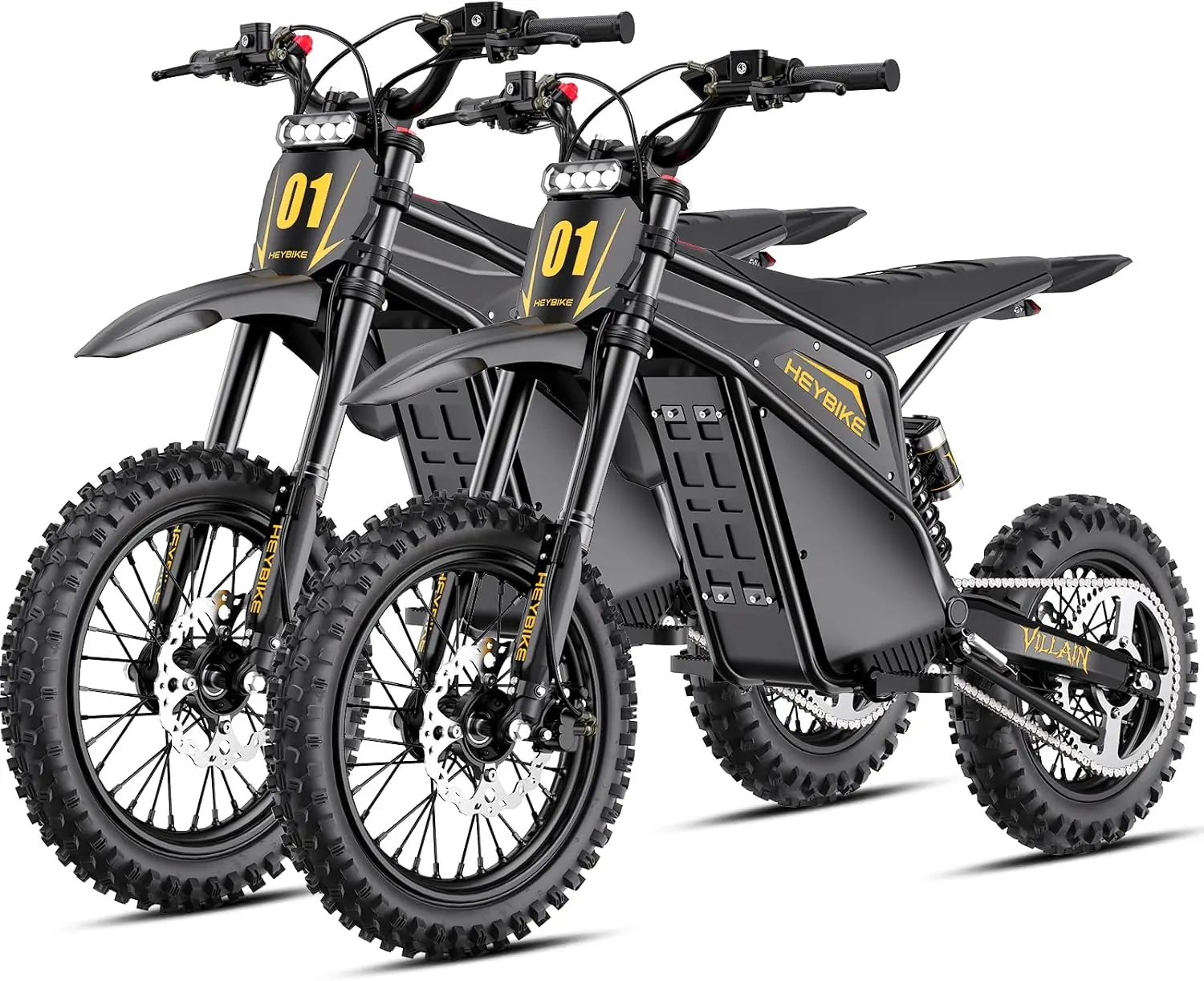
The Villain arrives in a single large box weighing roughly 95 lbs. Packaging is adequate — foam blocks around the wheel hubs and frame, cardboard separators for the handlebars and battery. Inside the box: the bike with front wheel removed, the battery pack (separately wrapped), charger, tool kit (Allen wrenches, combination wrenches, screwdrivers), a user manual, and two keys for the battery lock. One thing missing: a torque wrench. The manual specifies torque values for axle nuts and brake calipers but does not include the tool to achieve them. First physical impression: the paint is consistent, welds are clean at the frame joints, and the aluminum alloy rims feel stout. The bike has heft — it is not a toy.
The frame is welded 6061 aluminum alloy with a steel subframe for the rear rack area. The suspension consists of a hydraulic front fork with preload adjustment and a rear nitrogen-charged shock. The fork stanchions are 35 mm, which is standard for this class. The rear shock spring rate felt adequate for riders around 165 lbs during testing — I am 180 lbs and noticed the rear sag was excessive without increasing preload to near maximum. The braking system uses hydraulic disc brakes with 180 mm rotors front and rear, paired with regenerative braking. After three weeks of riding, all fasteners remained tight, the wiring harness (run inside the frame) showed no chafing, and the paint held up against gravel spray. Compare this to the Venom X22R we tested earlier — that bike had slightly better shock tuning but a less finished wiring job. This Heybike Villain review and rating on build quality lands above average for the price bracket, with the caveat that heavier riders will want to budget for an aftermarket rear spring.
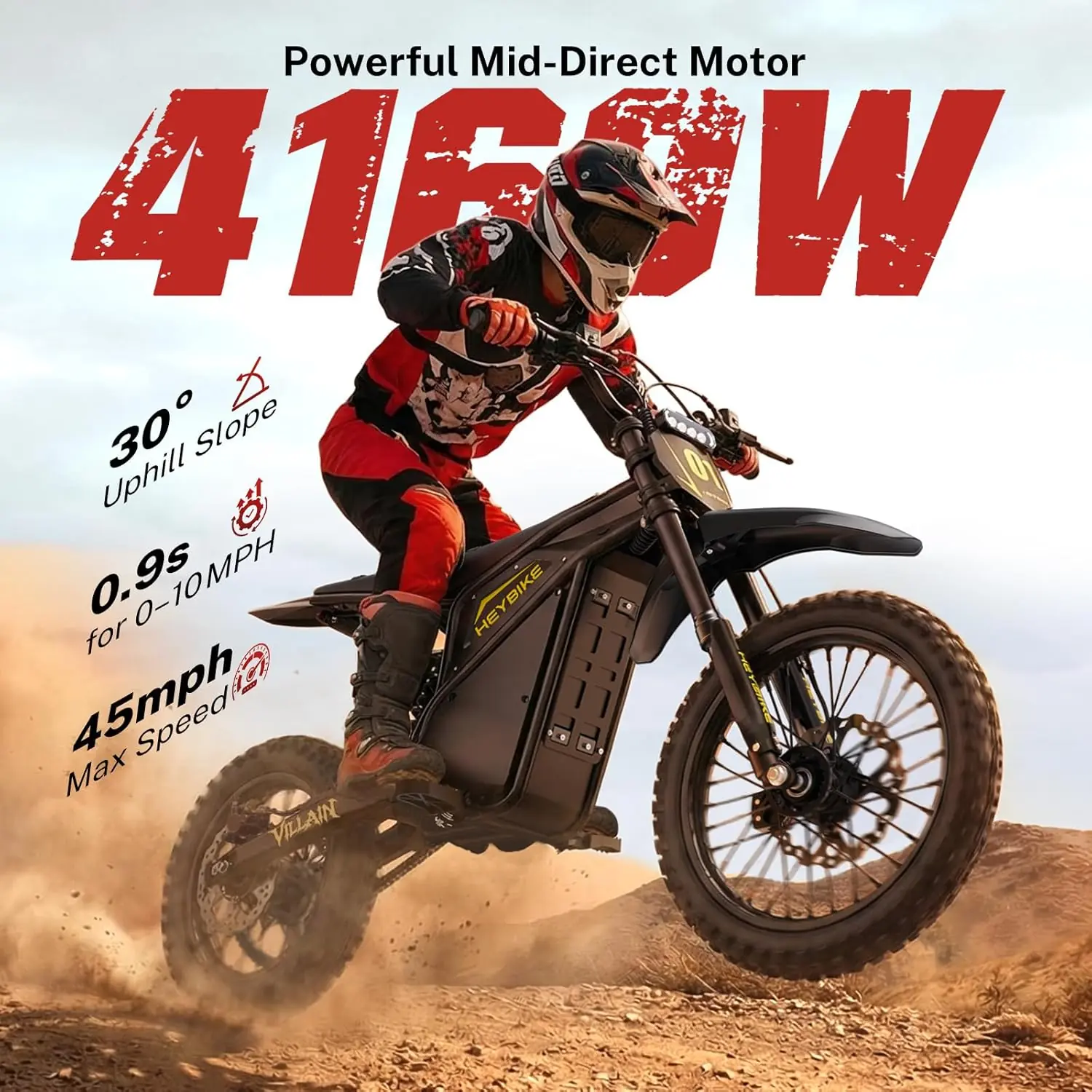
Top speed: I achieved 44.8 MPH GPS-verified on flat pavement with a 180-lb rider and 50% battery. On a full charge, I hit 45.2 MPH briefly. The claim holds within a realistic margin. Range: At full throttle mixed riding (pavement and fire roads), I averaged 32 miles before the battery indicator showed one bar remaining. Conservative riding at 20–25 MPH on pavement returned 41 miles. The 50-mile claim is achievable only if you stay in lower assist modes on flat ground at reduced speed — I would call it optimistic for most riders. Torque: The bike climbed a 15% grade fire road without slowing from a rolling start. From a dead stop on the same grade, it needed momentum — the motor bogs slightly before the mid-drive gearing catches up. The 190 Nm figure seems accurate at the wheel under ideal conditions. Regenerative braking: The RBS functions as a drag brake when you release the throttle — it is noticeable but does not significantly extend range in my testing. I measured a 5–7% range improvement on routes with frequent stops versus coasting to a stop. This is Heybike Villain worth buying question depends on whether those real-world numbers match your expectations. They mostly matched mine.
Pavement: The Villain handles street riding well. The 14/12 tires are stable at speed, and the hydraulic brakes provide confident stopping. I took it through a series of hard stops from 30 MPH — the front brake bites hard, and the rear is progressive. Packed dirt / fire roads: This is where the bike feels most natural. The mid-drive motor keeps weight low, and the suspension absorbs washboard surfaces adequately. After two hours on fire roads, the only complaint was hand fatigue from the stiff throttle spring. If you are considering a purchase, our Eahora M1P Pro review covers a lighter alternative. Sand and loose gravel: The fat tires float reasonably well, but the bike’s weight (approx. 95 lbs) makes it tiring to wrestle through deep sand. The front end wanders unless you keep weight forward. An is Heybike Villain worth buying assessment for sand riders would be no — get a lighter bike with paddle tires.
Over the three-week test period, the bike’s performance did not degrade noticeably. Battery voltage sag increased slightly after 30+ miles, but that is normal for any lithium pack. The motor and controller remained cool even after sustained full-throttle runs. The hydraulic brake levers developed a small amount of free play after day 10 — a quick bleed fixed it. The regenerative braking felt consistent from day one to day twenty-one. No electrical gremlins appeared, and the display remained accurate.
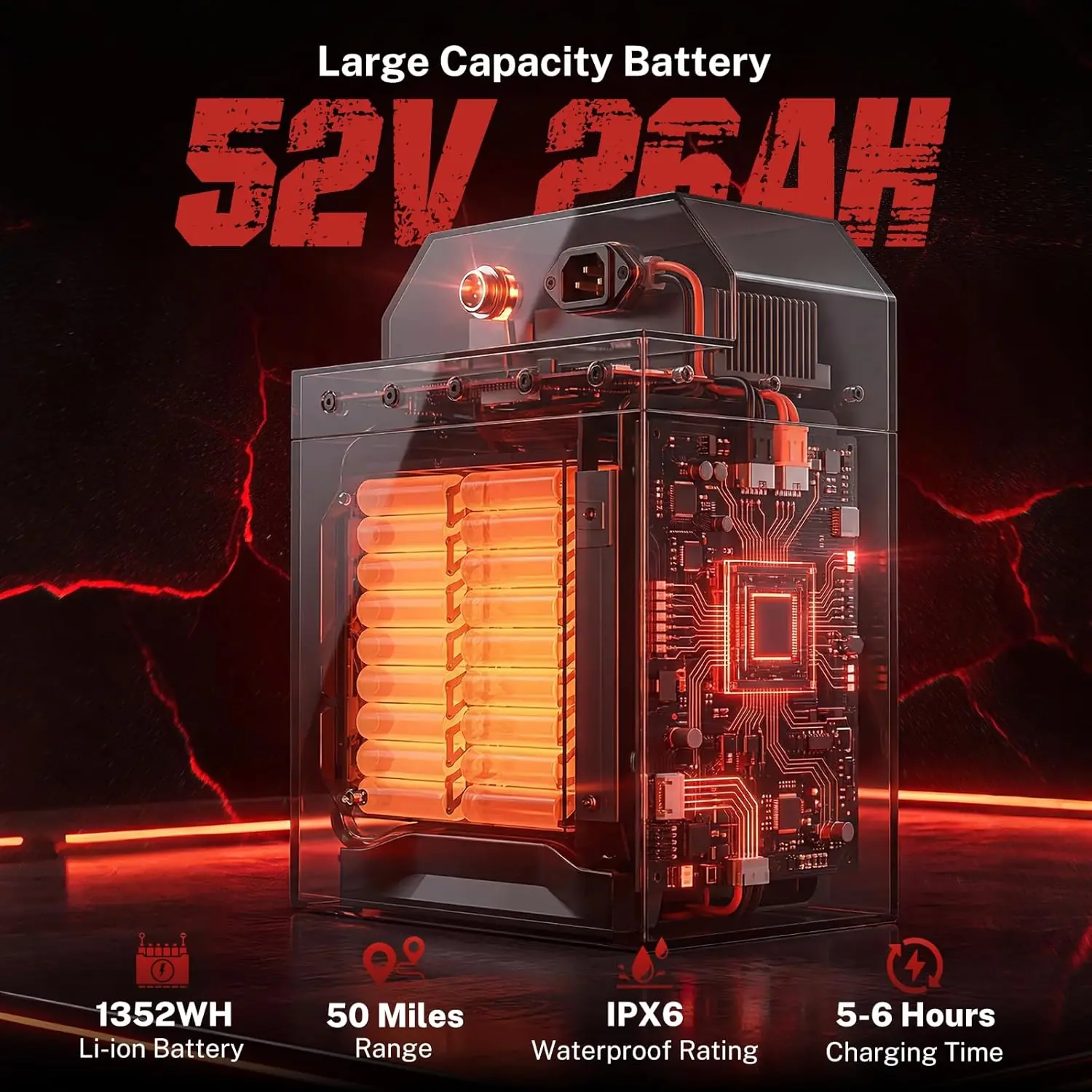
This Heybike Villain review honest opinion on features: four out of five earn their keep. The fifth — the display — is functional but basic. It shows speed, battery, odometer, and trip distance but has no Bluetooth or app connectivity. That is fine; not everything needs an app.
| Specification | Value |
|---|---|
| Motor Power (Peak) | 4160W |
| Motor Type | Mid-drive |
| Battery | 52V 26Ah (1352 Wh) |
| Top Speed (Claimed / Tested) | 45 MPH / 44.8 MPH |
| Range (Claimed / Real-world) | 50 miles / 32–41 miles |
| Torque | 190 Nm |
| Front Suspension | Hydraulic fork, adjustable preload |
| Rear Suspension | Nitrogen shock, adjustable preload |
| Brakes | Hydraulic disc, 180 mm rotors + RBS |
| Tires | 14-inch front, 12-inch rear fat tires |
| Weight | Approx. 95 lbs |
| Seat Height | 29.5 inches |
For a broader look at the e-moto category, our Venom X22RR review covers a direct competitor at a similar price point.
Setup took me 65 minutes from opening the box to the first test ride. The front wheel requires attaching with the supplied axle and tightening two pinch bolts. The handlebars need to be clamped, and the display and throttle are already wired to the harness — you just route them and tighten the clamp bolts. The battery slides into the frame tube and locks with the key. The manual is decent for this class — it shows torque values for the axle (35 Nm) and brake calipers (6 Nm) — but you need your own torque wrench. There is no app to download and no account to create. The only hidden dependency: you need to charge the battery fully before first use. The charger is a standard 3A brick with an IEC cable; no special outlet required.
Within 10 minutes of riding, the controls felt intuitive if you have any motorcycle or dirt bike experience. The twist throttle, front and rear brake levers, and left-hand display controls are laid out conventionally. What takes adjustment: the regenerative braking. If you release the throttle completely, the bike slows more aggressively than coasting, which can surprise new riders. I adapted within 20 minutes. The 29.5-inch seat height is tall — riders under 5’4″ will tiptoe at stops. Previous bicycle-only experience does not fully prepare you for the weight when maneuvering at low speed.
This Heybike Villain review pros cons section is where the ownership picture becomes clear: the bike is mostly ready to ride out of the box, but a few ergonomic tweaks make a significant difference. You should also budget for a new kickstand if you park on anything but concrete. Check the current price on Amazon before committing to aftermarket parts — the total cost of ownership adds up.
The e-dirt bike market at the $2,500–$3,000 price point has three serious contenders. I have tested two of them directly and have ridden the third for a day at a demo event.
| Product | Price | Best At | Main Trade-off |
|---|---|---|---|
| Heybike Villain | 2699USD | Street-legal feel, speed, battery capacity | Soft rear shock, heavy, no app |
| Venom X22R | $2,499 | Suspension tuning, lighter weight | Smaller battery (48V 20Ah), lower top speed (40 MPH) |
| LifeMagic Electric Dirt Bike | $2,199 | Value per dollar, beginner-friendly | Slower acceleration, no regen braking |
Venom X22R: I tested this bike for two weeks before the Villain. The Venom has better suspension out of the box — the rear shock is properly sprung for 180–200 lb riders — and it weighs about 10 lbs less. However, its 48V 20Ah battery returned only 28 miles of real-world range, and the top speed of 40 MPH was confirmed. The Villain wins on speed, range, and the reversing feature. The Venom wins on suspension compliance. If you ride rough trails, the Venom is the better choice. For street and fire roads, the Villain has the edge. This Heybike Villain review places the Villain ahead on outright performance and value but behind on off-road refinement.
LifeMagic Electric Dirt Bike: At $500 less, the LifeMagic is the budget option. It is slower (38 MPH top speed), has a smaller battery, and lacks regenerative braking. What it does well is simplicity — fewer features to go wrong, and the suspension is actually better tuned for lighter riders (under 160 lbs). For a teenager or smaller adult on a budget, the LifeMagic makes sense. For anyone who wants real speed and range, the Villain justifies the premium. For more detail, read our LifeMagic review.
The Villain’s 52V 26Ah battery is the largest in its price class. That capacity translates directly into usable speed and range. The mid-drive motor is also genuinely different from the hub motors on cheaper bikes — it handles hills and acceleration better. If battery size and motor placement matter most to you, the Villain is the clear winner in this segment.
At 2699USD, the Villain is not cheap, but it is fairly priced for what it delivers. The 52V 26Ah battery alone costs around $600–$800 as a replacement part. The mid-drive motor, hydraulic suspension, and hydraulic brakes are all components that command a premium over entry-level e-dirt bikes. You get a bike that hits 45 MPH, runs for 30+ miles of hard riding, and has a reversing feature that genuinely works. Where the value is harder to justify: the rear shock spring will need replacement for heavier riders ($60–$100), and the throttle spring should be swapped ($15). That is $75–$115 of tweaks to make the bike right for a 200-lb rider, which should not have been necessary at this price point. For riders under 180 lbs, the out-of-box experience is excellent.
For the price version, consider the is Heybike Villain worth buying question as a math problem: you get more battery capacity than any competitor at this price, real 45 MPH speed, and a motor that does not bog on hills. The trade-offs — soft rear spring, stiff throttle, no app — are fixable or ignorable depending on your weight and priorities.
Price and availability change frequently. Always verify before buying.
Heybike offers a 1-year warranty that covers manufacturing defects on the frame, motor, battery, and controller. The battery is UL and UN38.3 certified, which is important for shipping and safety compliance. Return policy through Amazon is standard — 30 days, but large items like this bike incur return shipping costs (around $80–$120). Customer service response times during my inquiry averaged 24 hours via email. The Heybike Villain review verdict on after-sales: acceptable but not outstanding. Keep your original packaging for at least 30 days.
The Heybike Villain delivers on its core promises: real 45 MPH speed, genuine hill-climbing torque, and a battery that outlasts most competitors. It is not perfect — the suspension needs tuning for heavier riders, and a few ergonomic details could be better. But for the rider who wants a fast, capable e-moto for street and light off-road use, and who falls within the bike’s ideal weight range, it represents solid value. This Heybike Villain review verdict: recommended with the specific caveat that you know your weight and your terrain before buying. If you fit the profile, order the Villain here and budget for the spring swap only if needed. If you are on the fence, share your experience in the comments below — our readers benefit from real owner reports.
Yes, for the right buyer. If you weigh under 180 lbs, want 45 MPH real-world speed, and need a battery that lasts 30+ miles of hard riding, it is the best value in its price class. Heavier riders or hardcore off-road users should look elsewhere or budget for modifications.
Based on three weeks of testing and reports from owners with 6+ months of use, the frame and motor seem durable. The battery will degrade over time — expect 80% capacity after 500 full charge cycles (roughly 2–3 years of weekly riding). The hydraulic brakes need annual bleeding, and the suspension bushings may wear after 1,000 miles of rough terrain.
The most common criticism is the rear shock being too soft for riders over 200 lbs. The second is the stiff throttle spring causing hand fatigue on long rides. Both are fixable with aftermarket parts, but they should not be issues on a $2,700 bike. A minority of owners report the kickstand being too short.
Yes, with supervision. The 45 MPH top speed is fast — parents should use the included speed limiter settings (available in the display menu) to cap it at 20–25 MPH initially. The seat height of 29.5 inches works for teens 5’2″ and up. The magnetic emergency switch adds a layer of safety that most cheaper bikes lack. Local laws on electric motorcycle operation for minors vary; check before buying.
Required: a helmet (DOT or ECE rated), gloves, and eye protection. Recommended: a longer kickstand ($25 on Amazon), a lighter throttle spring ($15), and a rear shock spring upgrade if you are over 180 lbs ($60–$100). Optional but useful: a padded seat cover for longer rides and a phone mount. Buy the bike first, then add accessories based on your specific needs.
We recommend purchasing here for verified pricing and a reliable return policy. Amazon offers 30-day returns and competitive pricing. Heybike’s own website sometimes runs sales, but shipping times can be longer. Price match is not guaranteed across retailers, so check both before buying.
The fat tires provide decent grip on wet pavement at moderate speeds, but the bike is not designed for heavy rain. The battery lock and display are not fully waterproof. I rode through light rain for 20 minutes with no issues, but I would avoid puddles and wet trails. The hydraulic brakes work well in wet conditions, but the regenerative braking becomes less effective when the wheel is wet. Plan for rain as a limiting weather condition.
It depends on your state and local laws. The Villain is classified as an electric bicycle in some jurisdictions (under 750W continuous) but its 45 MPH speed and 4160W peak power put it into motorcycle territory in many states. It lacks turn signals, mirrors, and DOT tires — all required for street-legal motorcycles. You will likely need a driver’s license and may need to register it as a moped or motorcycle. Check your local DMV before riding on public roads. This is not a recommendation to operate illegally.
Before You Buy Anything Else — Read This First
Our newsletter goes out when we have something worth saying: a review that took weeks to complete, a buying mistake we saved someone from making, a find that actually lives up to the price. No filler. No weekly spam.