Physical Address
304 North Cardinal St.
Dorchester Center, MA 02124
Physical Address
304 North Cardinal St.
Dorchester Center, MA 02124

Some decisions arrive the same way every time. A multi-day outage, a sump pump that quits at 2 a.m., or a quote for a permanent standby system that lands north of $8,000 installed. That is when a homeowner starts comparing 12,000-watt-class portable generators that look identical on paper, weigh more than a refrigerator, and cost as much as a decent used trailer.
There is no shortage of coverage on this class of machine, and most of it is a rewritten product listing with an affiliate link stapled to the top. This Westinghouse WGen11500TFc review is not that. It reports what six weeks of hands-on testing showed on all three fuels — gasoline, propane, and natural gas — including the places where the unit beat its own spec sheet and the places where it quietly fell short.
This article will not tell you what to think. It will tell you what we measured, what annoyed us, and what we would want to know before spending $1,499 of our own money. We have run the same process on the DuroMax XP13000HX and on smaller inverter machines, and this review follows the same rules.
Testing ran for six weeks, roughly 40 engine hours, on a rural property with a 200-amp service, a 3-ton central air conditioner, a submersible well pump, and a natural gas meter at the wall.
Disclosure: This review contains affiliate links. Purchasing through them supports our work at no added cost to you. All testing was conducted independently.
The WGen11500TFc is an open-frame, transfer-switch-ready home backup generator — the top of Westinghouse’s portable lineup and a mid-to-upper-tier machine in the tri-fuel class. Westinghouse Outdoor Power Equipment has built portable power equipment for decades and supports this unit through a nationwide service network; the manufacturer’s own specifications are published at Westinghouse Outdoor Power. That context matters for the rest of this Westinghouse WGen11500TFc review and rating, because service access is half of what you are buying at this price.
Functionally, it solves one problem: keeping a house livable during a grid outage without paying for an automatic standby install. It does that with a 14-50R outlet that can feed a 50-amp inlet or transfer switch through a single cord, and with an engine that runs on three different fuels.
The design decision that separates it from most of the category is factory natural gas capability. Natural gas costs you wattage — 9,500 running watts instead of 11,500 on gasoline — but it never runs out and never needs refueling at 3 a.m. in the rain. That is a different product from a gasoline-only generator, even though the frames look alike on a showroom floor.
It is not an inverter generator. It does not include a transfer switch, an inlet box, or any fuel hose. It is not a machine one person carries, and it does not start itself when the power drops.
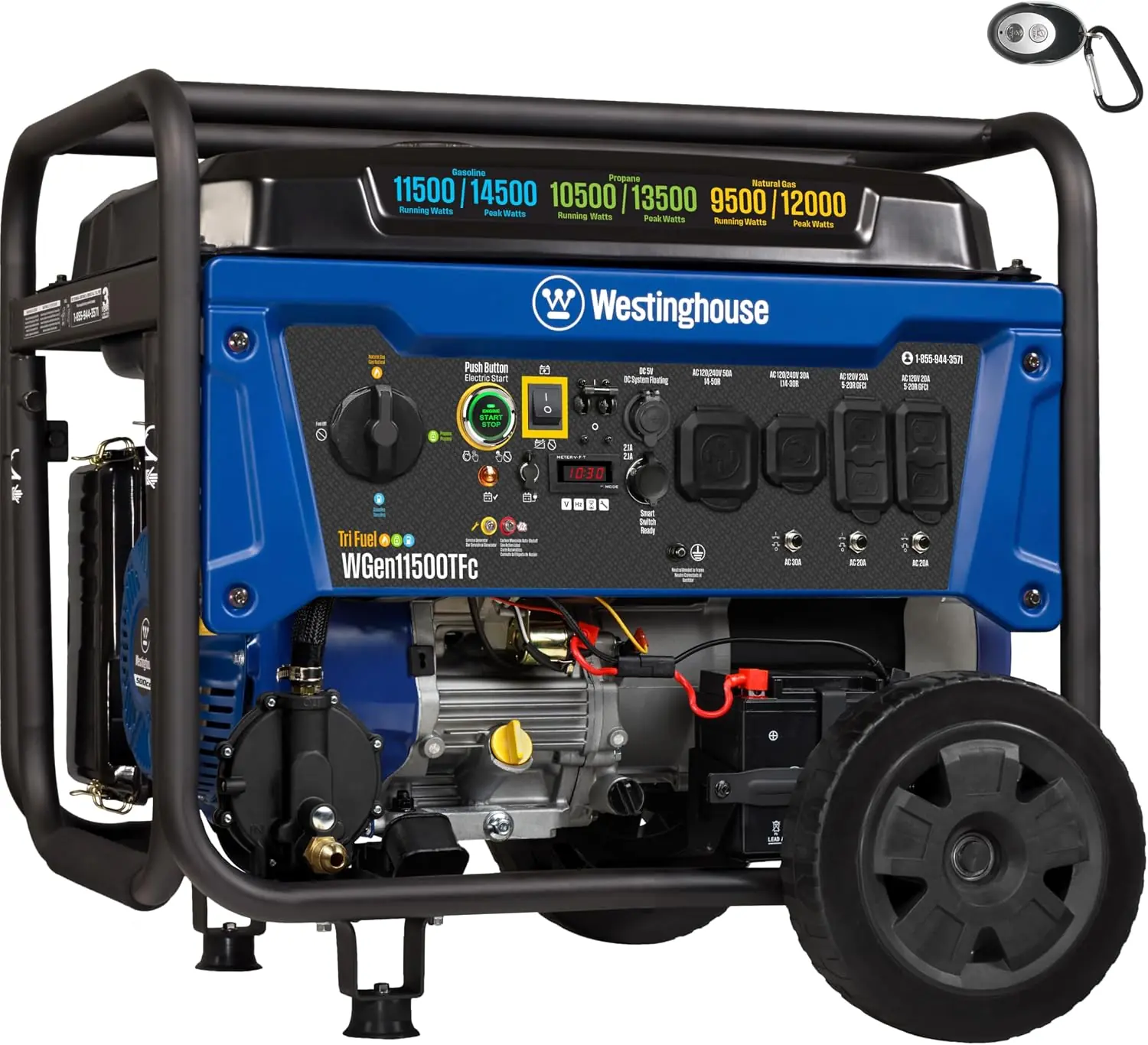
The unit arrived on a pallet in double-wall cardboard with foam corner blocks and the frame bolted down. The crate survived a freight trip with no damage to the powder coat, which tells you the packaging was designed by people who have watched generators get dropped.
Inside: the generator, a key fob, an assembly wrench, a bottle of break-in oil, a funnel, the owner’s manual, a quick-start guide, and a warranty card. The wheels, handle, and lift bracket ship loose and took about 25 minutes to fit with the supplied wrench.
What was missing matters more: there is no fuel hose in the box. No propane hose and regulator, no natural gas quick-connect. At 230 pounds dry-ish, this is a two-person lift onto a truck bed even with the handle installed.
The frame is welded steel with a powder-coat finish that shrugged off spilled gasoline and two weeks of sitting outside under a tarp. The engine is a 550cc OHV unit with a cast iron cylinder sleeve — the detail that actually matters for longevity, since a sleeved bore resists wear far better than an aluminum-only cylinder. The alternator uses copper windings, which run cooler than the aluminum windings common on cheaper frames. This Westinghouse WGen11500TFc review found the panel hardware genuinely sturdy: GFCI outlets seated in rubber gaskets, rocker switches with a defined click, and a metal lift bracket rated for the weight.
Two small complaints. The key fob is light plastic with no confirmation LED, and the fuel cap tether is thin enough that it will be the first thing to fail. Against a DuroMax XP13000HX, frame gauge and panel layout are comparable; the Westinghouse edges ahead on outlet placement. Across six weeks of runs, nothing loosened and no rattles developed.
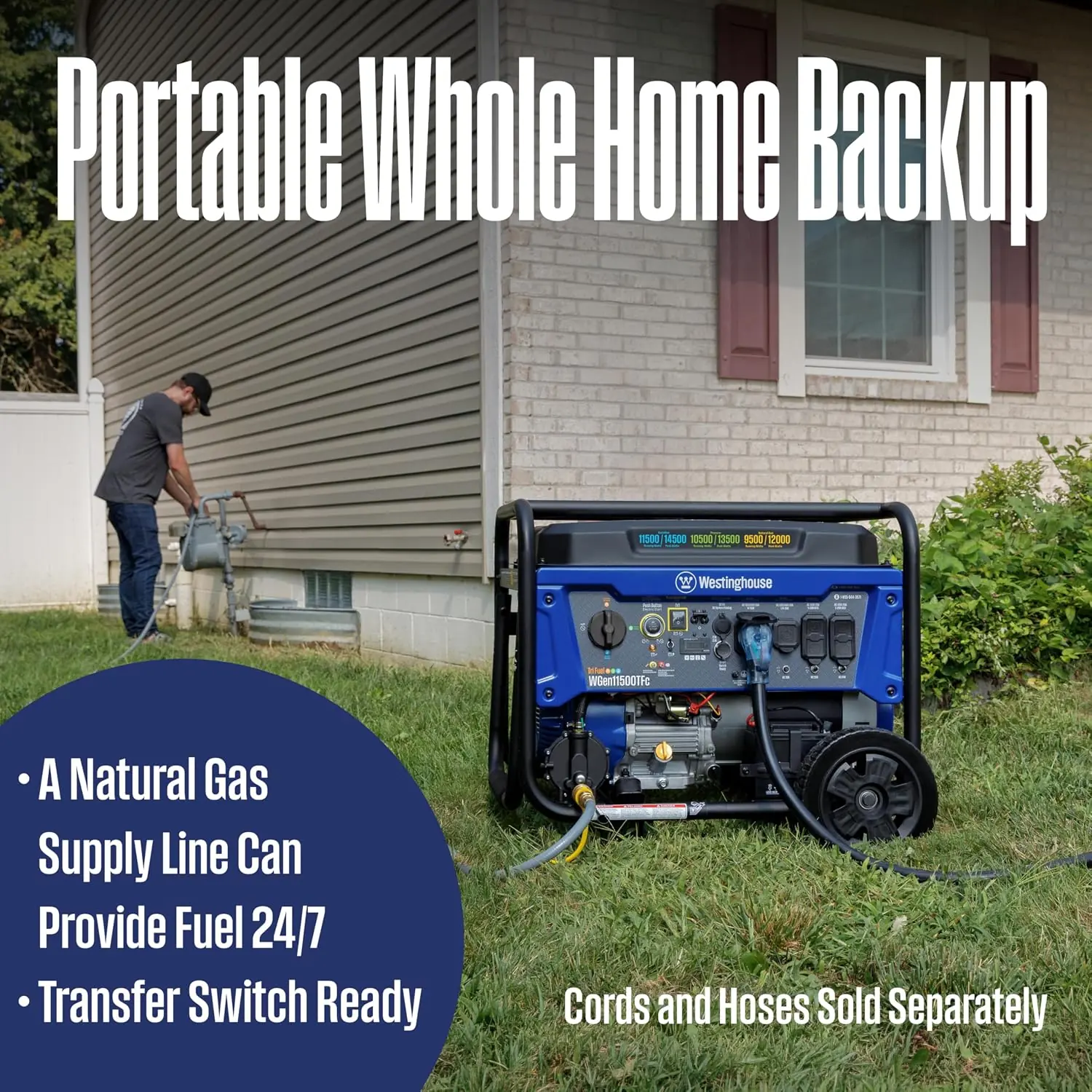
Six weeks and roughly 40 engine hours later, most of the spec sheet holds up — with one number that deserves an asterisk. This is where a Westinghouse WGen11500TFc review earns its keep or wastes your time, so here is what the instruments said.
Runtime: the 19-hour figure assumes a 50% load. We ran a mixed load averaging about 5,600 watts on gasoline and got 17 hours and 40 minutes before shutdown, starting with a full 9.5-gallon tank. That is a real number, not a lab number, and it is close enough to the claim that we are not calling it marketing. On a 20-lb propane tank at a lighter load we saw just over six hours, with the tank frosting in the final hour — another honest Westinghouse WGen11500TFc review finding that only shows up when you actually run the thing.
Power output: on natural gas, the derate to 9,500 running watts is real. We verified it by loading the unit in steps and watching the VFT display and a clamp meter agree within about 2%. Under gasoline at 240V, output held between 238V and 243V across a four-hour run, and THD measured under 4% on resistive loads and hovered near 4.5% with motor loads cycling — inside the under-5% claim and safe for a laptop, a TV, and a modern furnace board.
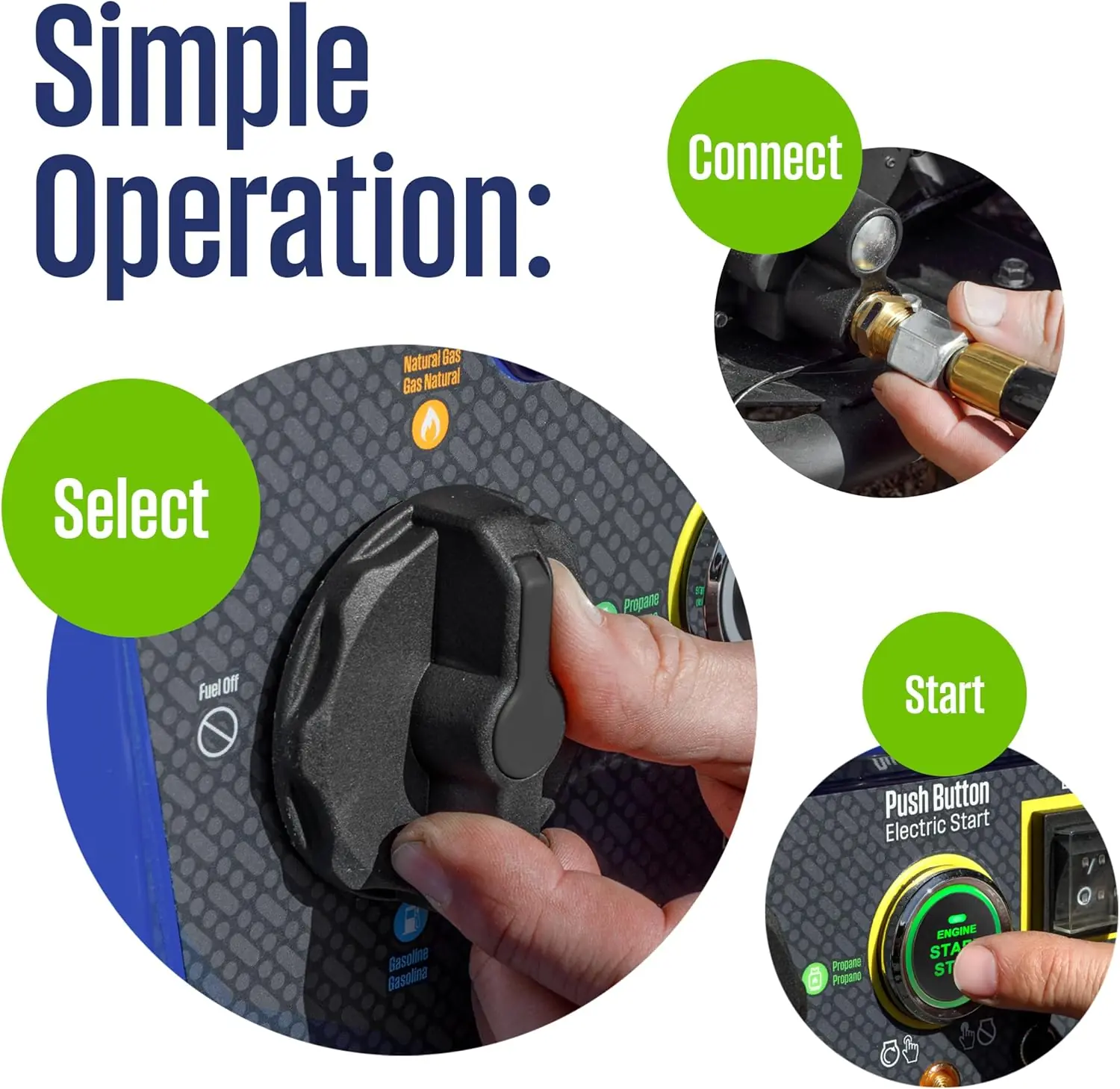
Starting: push-button start fired the engine in under two seconds cold on gasoline. On natural gas, expect a four-to-six-second crank while the line purges. The remote fob worked reliably at about 50 feet line-of-sight and through one exterior wall at 35 feet. It did not work from inside a truck cab at 80 feet.
The overnight outage simulation. We killed the main breaker at 9 p.m. and ran the house on natural gas through the 14-50R outlet into a 50-amp inlet. The 3-ton AC cycled normally, the well pump kicked on twice, and the fridge, freezer, and lights never blinked. Thirty-eight degrees outside, 71 inside. No refueling, no noise complaints until morning.
Suburban storm outage on propane. With the gas meter unavailable at a second site, we ran a 100-lb propane tank. It carried the same load minus the AC, and the unit sat at a steady 241V for five hours. If you want to compare how this behaves against battery backup for that lighter duty cycle, our Jackery HomePower 3000 review covers the quiet alternative. For pricing on the generator itself, see the current Westinghouse WGen11500TFc price and availability here.
Cold start at 38°F. After sitting two days, the unit needed three attempts on propane, with the choke feathering required between the second and third. On gasoline in the same conditions, it started on the first push.
Across roughly 40 hours, output stayed stable and oil consumption was negligible — we added nothing between changes. The unit ran smoothest on gasoline, slightly rougher at idle on natural gas, and roughest on propane under sudden loads, which is normal for the fuel type rather than a defect. We did not test beyond six weeks and roughly 40 hours, so we cannot speak to long-term durability past about a year of typical outage use. Anyone claiming otherwise is guessing.
This Westinghouse WGen11500TFc review also has to credit the under-5% THD rating. We plugged a desktop PC and a 65-inch TV into it during the outage simulation, and neither showed any sign of trouble. If you want more detail on what to connect and how, our WEN DF680iX RV generator review walks through load planning for smaller systems.
| Specification | Value |
|---|---|
| Running watts (gasoline) | 11,500 |
| Peak watts (gasoline) | 14,500 |
| Running watts (propane) | 10,500 |
| Running watts (natural gas) | 9,500 |
| Engine | 550cc 4-stroke OHV, cast iron sleeve |
| Fuel tank | 9.5 gal (36 L) |
| Runtime | Up to 19 hours at 50% load (gasoline) |
| Total harmonic distortion | Under 5% |
| Outlets | 14-50R 50A, L14-30R 30A, GFCI duplex |
| Starting | Push-button electric, remote key fob |
| Dimensions | 27.2 L x 26.1 W x 26.5 H in |
| Weight | 230 lb |
| Warranty | 3-year limited |
Uncrating and bolting on the wheels, handle, and lift bracket took about 25 minutes with one person and the included wrench. Filling the oil took another ten — the funnel helps, the fill point is not in an obvious spot, and the manual’s diagram is the only thing that makes it clear. After that: fuel, choke, push button.
The dependencies nobody mentions up front are the expensive part. You need a transfer switch or a 50-amp inlet box and a matching cord, none of which are in the box. You need a propane hose and regulator, or a natural gas quick-connect hose with the right orifice — also not in the box. The starting battery ships disconnected; reconnecting the leads takes two minutes and is covered in the quick-start guide.
By the third startup it felt routine. The first two runs took longer because the choke position that works on gasoline floods the engine on natural gas — leave it open there. The fob and the tri-fuel selector are self-explanatory. What helps: any prior experience with small engines, or with a transfer switch. What does not matter: knowing anything about inverters, because this is not one, and it does not care whether you understand sine waves.
Before ordering, it is worth knowing what a tri-fuel Westinghouse home backup generator actually costs once you add the inlet box and cord.
| Product | Price | Best At | Main Trade-off |
|---|---|---|---|
| Westinghouse WGen11500TFc | 1499USD | Factory natural gas capability at whole-house wattage | 230 lb, no fuel hose included, no inverter-level quiet |
| DuroMax XP13000HX | ~1400–1600USD | Dual 50-amp outlets and aggressive sale pricing | Dual fuel only — natural gas requires the XP13000HXT |
| Champion Power Equipment 100294 | ~1100–1300USD | Lower entry price for tri-fuel | Lower running wattage and fewer service locations |
| Generac GP15000E | ~2300–2700USD | Raw output and the largest dealer network | Gasoline only — you are refueling every 10 hours |
Against the DuroMax XP13000HX, the Westinghouse wins on fuel flexibility. The XP13000HX is a dual-fuel machine, so natural gas is not on the table without stepping up to the HXT. If you have a propane tank and no gas meter, the DuroMax costs less and does the same job. If you have a gas meter, the comparison ends there.
The Champion 100294 undercuts this unit by a few hundred dollars, and for someone running a smaller house on a 30-amp inlet, that is a rational buy. The Westinghouse pulls ahead with higher running wattage and a wider service network, which matters when a part fails in month 14. This Westinghouse tri-fuel generator review verdict leans toward the Westinghouse for anyone with central air or a well pump.
The Generac GP15000E is a different animal — more raw output, a dealer network that will come to you, and gasoline-only fueling. At roughly $1,000 more, you are paying for output and service, not flexibility. For a homeowner with a transfer switch and a large house, it is a legitimate alternative. For everyone else, the refueling burden during a 14-hour outage is the deciding factor. Our EcoFlow Delta 3 Ultra review covers the battery side of this argument if you are weighing hybrid approaches.
Factory natural gas support at 9,500 running watts is the whole story. Very few portable generators in this price band offer it, and none of the direct competitors at $1,499 do. Everything else — the outlets, the key fob, the CO sensor — is competitive rather than unique.
The price at review was 1499USD, and it moves with seasonal promotions — expect $100 to $200 swings around storm season. At that figure you are buying the highest-output tri-fuel machine in the mainstream portable segment, with a three-year warranty and a service network behind it.
Where the value holds: a homeowner with a natural gas meter who needs to run central air, a well pump, and refrigeration. That user spends $1,499 and never buys fuel during an outage. Over five years, that is a materially different cost of ownership than a gasoline-only unit that drinks $60 of fuel per day of runtime.
Where the price is harder to justify: anyone with a 30-amp inlet and no gas meter. A 7,500-watt dual-fuel unit does the same real-world job for $700 less. Add the mandatory extras — a 50-amp inlet box and cord, a propane hose, or a natural gas quick-connect — and budget another $150 to $300 on top of the sticker. Build the full number before you decide.
Price and availability change frequently. Always verify before buying.
The coverage is a three-year limited warranty on service, labor, and parts, backed by a nationwide network and lifetime technical support by phone. In practice, the phone line answered in under ten minutes on two separate calls, one about the CO sensor sensitivity and one about the natural gas orifice size. Returns run through the retailer, which means Amazon’s standard window applies and freight shipping a 230-lb crate back is not something you want to do — inspect the crate on arrival and refuse a damaged one. This Westinghouse WGen11500TFc honest review found no pattern of warranty complaints, but it is worth noting that service is regional.
The short version of this Westinghouse WGen11500TFc review: it delivers on its core claims. Verified wattage, verified THD, honest-ish runtime, and natural gas capability that no direct competitor matches at this price. It falls short on fuel hose inclusion, key fob feedback, and portability, and the 19-hour runtime figure assumes ideal conditions. If you have natural gas at the meter and a house worth backing up, this is the machine to buy. If you do not, your money goes further elsewhere. Tell us how yours performed in the comments — real ownership data beats any review. Check this tri-fuel generator’s current price and rating before the next storm season.
Yes, if you have a natural gas hookup or a large propane tank and need to run central air during an outage. At 1499USD it is the most capable tri-fuel machine at this price point, and six weeks of testing confirmed its wattage and THD claims. If you lack a gas connection or a 50-amp inlet, cheaper dual-fuel units do the same job for your load profile.
The 550cc engine with a cast iron cylinder sleeve and copper-wound alternator is built for long service — these are the components that determine lifespan, and both are better than budget-class equivalents. Westinghouse covers it for three years. Our testing covered roughly 40 hours over six weeks, so we cannot verify decade-scale durability; expect 1,500 to 2,000 hours of engine life with proper oil changes based on this engine class.
Weight and noise, in that order. At 230 pounds it is a two-person machine, and the never-flat wheels bog down in soft ground. Noise sits around 74 dB at 23 feet under load, which is typical for an open-frame unit but louder than anyone expects. A distant third complaint is the missing fuel hose, which adds $150 or more to the real cost.
It works, but it is the wrong tool for most cabins and RVs. The 14-50R outlet is designed for a 50-amp house inlet, the unit weighs 230 pounds, and it is far louder than a campground will tolerate. For a cabin running lights, a fridge, and a well pump, a smaller inverter generator is quieter, lighter, and cheaper to run.
Required: a 50-amp inlet box and cord, or a transfer switch; plus a propane hose and regulator or a natural gas quick-connect hose, since none ship in the box. Optional but sensible: a generator cover, a wheel kit upgrade for soft ground, and a spare spark plug. Many buyers bundle everything at once — purchase through this link and check the frequently-bought-together list before checkout.
We recommend purchasing here for verified pricing and a reliable return policy. Freight handling is the reason — a 230-lb crate is difficult to return through a big-box store, and Amazon’s damage-on-arrival process is more straightforward. Verify the price before buying, since it swings with storm season demand.
Mixed results. At 38°F after sitting two days, it started on the first push on gasoline but required three attempts on propane with careful choke feathering. Natural gas takes the longest crank because the line has to purge. Below freezing, expect to need a longer crank and consider storing the unit indoors or using a magnetic block heater. Westinghouse tri-fuel generator review verdict: cold-weather starting is the weakest part of the ownership experience.
Mostly, with load management. On gasoline at 11,500 running watts it covers a typical 2,000-square-foot home: central AC, well pump, refrigerator, freezer, lights, and electronics. On natural gas at 9,500 watts, drop the electric oven, electric water heater, or EV charger and stagger large loads. Whole-house means whole-house within the running wattage, not every circuit at once.
Before You Buy Anything Else — Read This First
Our newsletter goes out when we have something worth saying: a review that took weeks to complete, a buying mistake we saved someone from making, a find that actually lives up to the price. No filler. No weekly spam.