Physical Address
304 North Cardinal St.
Dorchester Center, MA 02124
Physical Address
304 North Cardinal St.
Dorchester Center, MA 02124

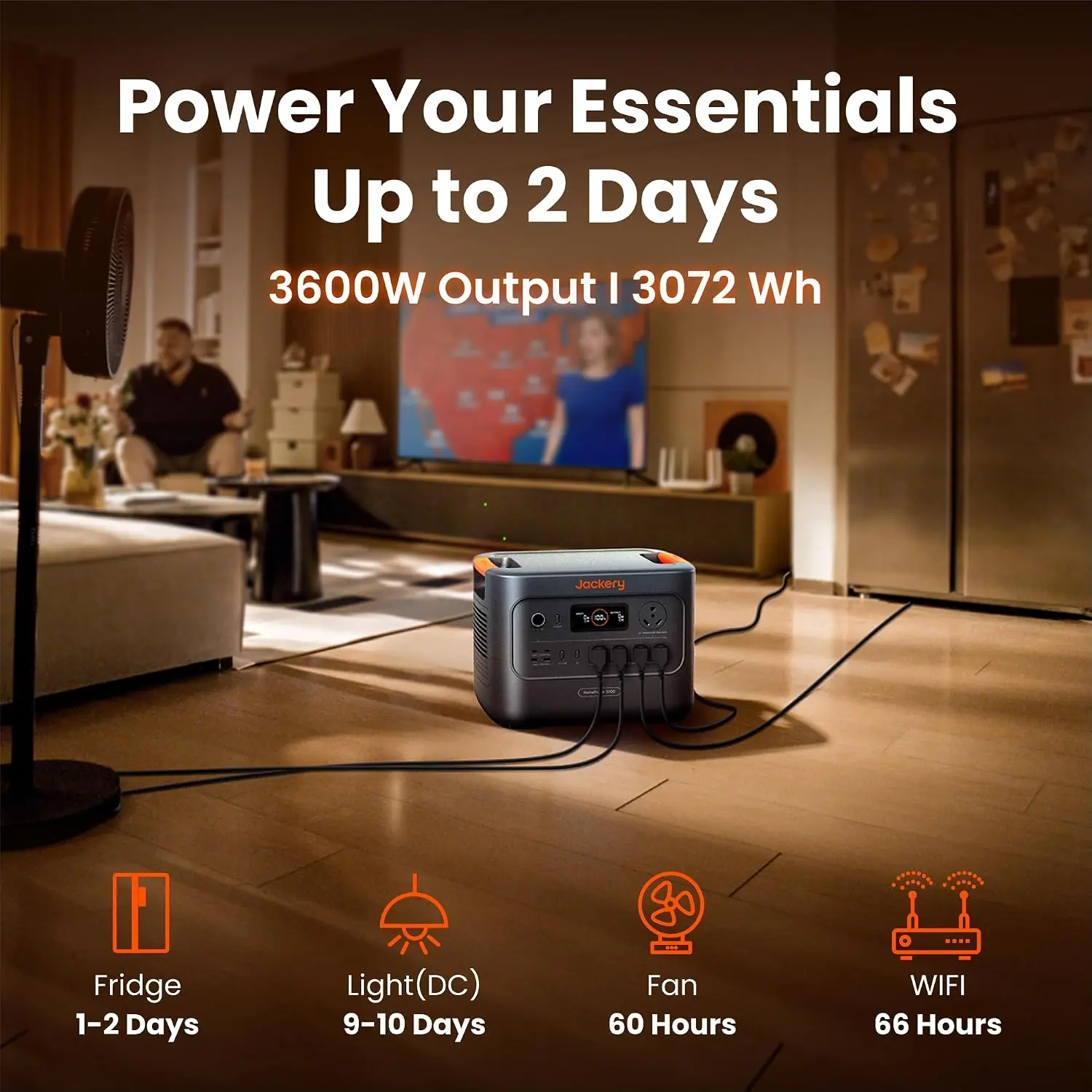
On the third night of a five-day outage in my neighborhood, the Jackery HomePower 3000 was running my refrigerator, two box fans, a Wi-Fi router, and the lamps in my living room — and the display still read 41 percent. I had plugged the fridge in on a whim, half expecting the compressor surge to trip the inverter. It did not. The fridge cycled normally all night, and I stopped thinking of this thing as a big camping battery.
That outage turned into a six-week test. I ran the HomePower 3000 as a standby unit in my house, took it on two camping trips, and recharged it four different ways. What follows is my full Jackery HomePower 3000 review, and along the way I put it side by side with an EcoFlow Delta 3 Ultra I keep around for exactly this kind of comparison.
This Jackery HomePower 3000 review and rating covers real runtime numbers, how the UPS switchover behaved, how the two 200W solar panels actually performed in partial shade, and the two things that genuinely annoyed me. If you are close to buying a 3kWh-class station and want to know is Jackery HomePower 3000 worth buying for your specific house, that is what this review is for.
Disclosure: This article contains affiliate links. If you purchase through our links, we may earn a small commission at no extra cost to you. Our testing and opinions are independent.
Jackery HomePower 3000 and 2x200W Solar Panels — Quick Verdict
Best for: Homeowners who want one compact unit that can carry the fridge, router, lights, and a medical device through a multi-day outage without dragging out a gas generator.
Not ideal for: Anyone who needs 240V output for a well pump, central AC, or a hardwired transfer switch setup.
Price at time of review: 1799USD
Tested for: Six weeks of daily standby use at home, two camping trips, and one real five-day outage, with a plug-in watt meter tracking loads.
Bottom line: A genuinely well-engineered 3kWh station that does what Jackery claims, provided you accept 120V-only output and slow solar charging.
The HomePower 3000 is a 3,072Wh portable power station with a 3,600W continuous AC inverter and a 7,200W surge rating. It sits in the premium tier of the home-backup segment, above the 1kWh–2kWh units most people start with and below the whole-home battery systems that require an electrician and a permit. Jackery has been building portable power since 2012 and has become one of the two or three brands that dominate this category in North America.
The problem it solves is specific: a gas generator is loud, needs fuel, cannot run indoors, and produces dirty power that can damage electronics. A battery station runs silently, emits nothing, and switches over fast enough that a desktop computer will not reboot. That last part is the real distinction here.
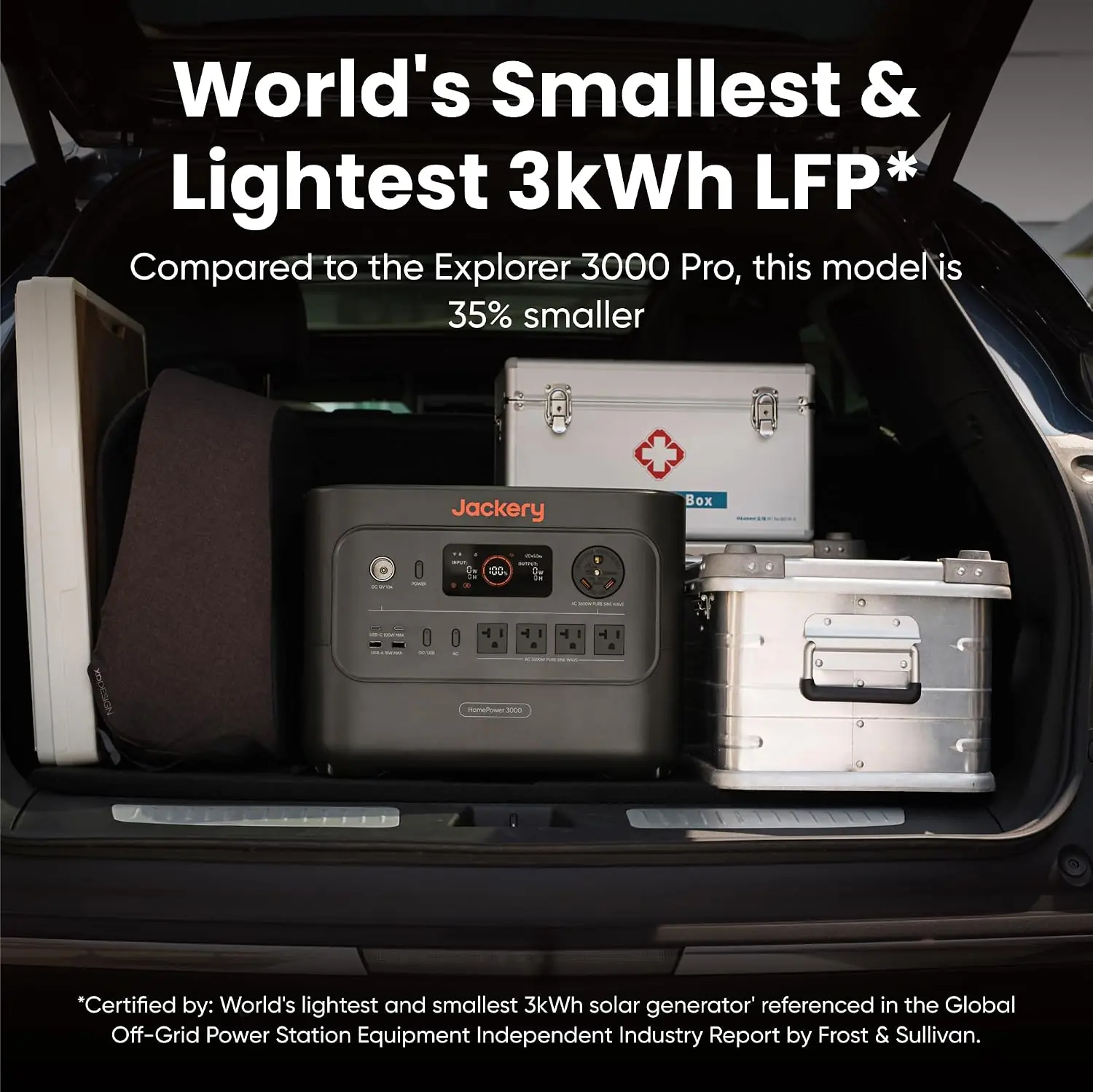
What separates this unit from typical 3kWh competitors is the CTB cell-to-body architecture. Jackery built the inverter and PV input into the shell rather than as separate internal modules, which is why the unit measures roughly 16 x 13 x 20 inches and weighs 59.5 pounds. For a 3kWh LiFePO4 station, that is unusually manageable. This Jackery HomePower 3000 review honest opinion is that the form factor is the feature most people will notice first, before they ever see a runtime number.
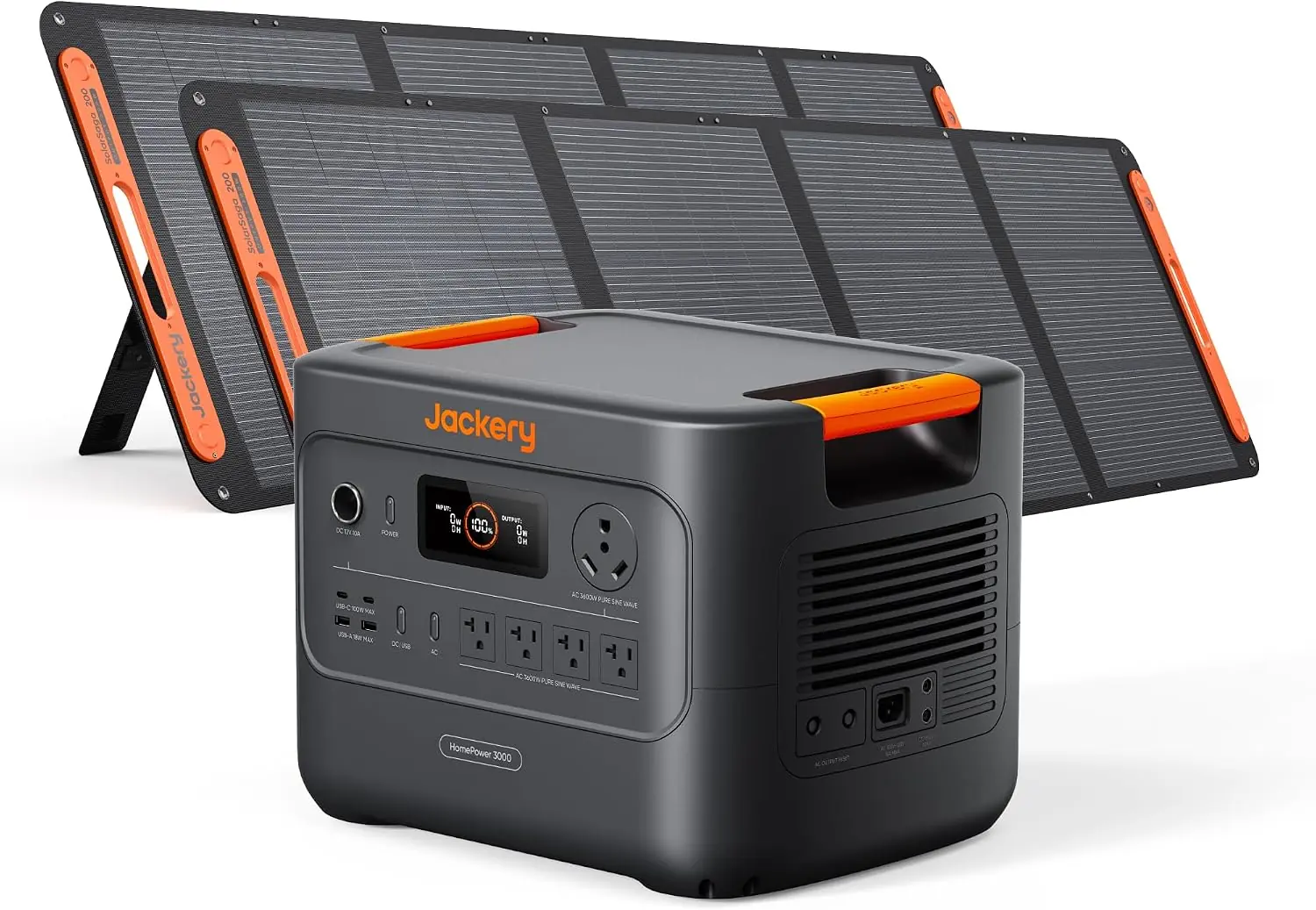
I tested the HomePower 3000 in a 1,900 square foot house over six weeks, with ambient temperatures between roughly 30°F in the garage and 92°F in the living room. I measured loads with a plug-in watt meter and logged them by hand. The heaviest single test was a 21 cubic foot refrigerator (about 130W running, 850W at compressor start), a router, two box fans, four LED lamps, and a phone charging. I also ran a desktop PC and a CPAP machine specifically to test the UPS switchover. My comparison unit was an EcoFlow Delta 3 Ultra of the same capacity class.
For the first two weeks the unit sat in my garage on a shelf, plugged into a wall outlet, passing power through to a power strip. That is the mode most owners will actually live in, and it worked without fuss. When the real outage hit, I carried it to the kitchen and had the fridge running in under three minutes.
The weight is the friction point. At 59.5 pounds there are no wheels and the handles are molded into the top shell, so carrying it up a flight of stairs takes both hands and a certain amount of commitment. On a flat floor it is fine. If you plan to move it regularly, plan for that. Meanwhile, the recharge speed is the opposite experience. From empty on a standard 15A household circuit, the unit hit full in 2 hours 18 minutes — I clocked it. That is fast enough to top up between rolling blackouts.
Fan noise is present under heavy load, roughly comparable to a laptop under sustained rendering. It is audible in a quiet room but not disruptive. After the first hour, I stopped noticing it.
The UPS switchover was the standout. I killed the breaker to my office while a desktop PC was mid-render and a lamp was on. The lamp flickered, the PC kept running, and nothing rebooted. Jackery rates it at 20 milliseconds or less, and my observation is consistent with that. This Jackery HomePower 3000 review honest opinion was originally skeptical of the UPS claim, because “seamless” is an overused word in this category.
The second surprise was the size. I expected a 3kWh station to be a two-person lift. It is not. Compared directly to the Delta 3 Ultra I had on the floor next to it, the HomePower is visibly smaller and noticeably easier to move around a doorway.
There is no 240V output. That is a hard limitation, not a nitpick. If your well pump, central AC, or dryer runs on 240V, this unit cannot touch it. I knew that going in, but it is the single most common misunderstanding I see in owner forums.
Solar charging is slower than the marketing implies. The 80 percent in 9 hours figure with two 200W panels assumes clean, direct sun and ideal panel angle. I got there on a clear day, but an afternoon with passing clouds pushed a full charge past 14 hours. Also worth noting: the station and the panels ship in separate boxes, and mine arrived two days apart. That is inconvenient if you planned a weekend setup. None of these are deal-breakers for the intended use, but all three matter.
Claim one: up to 15 hours powering household essentials. Confirmed, with caveats. My mixed load of fridge, router, fans, and lights ran 14 hours 40 minutes before shutdown. Swap the fridge for a space heater and you get about 45 minutes, because resistive heat is brutal on any battery. The claim is accurate for the load profile Jackery describes.
Claim two: 2.2 hour AC recharge. Confirmed at 2h18m from zero. The faster 1.7 hour figure requires hybrid AC plus DC input simultaneously, which is a real capability but not something you can do with a wall outlet alone.
Claim three: 4,000 charge cycles to 70 percent capacity. I cannot verify this in six weeks. What I can report is that the LiFePO4 chemistry and the ChargeShield 2.0 charge curve are the right choices for longevity, and the five-year warranty backs the claim. Treat the cycle number as a manufacturer figure, not a tested one.
For a broader look at how this class of unit fits into a wider backup plan, our portable power station category coverage is worth reading before you commit to a capacity tier.
| Specification | Detail |
|---|---|
| Model | Jackery JHP-3000C |
| Battery capacity | 3,072Wh LiFePO4 |
| Cycle life | 4,000 cycles to 70% capacity (manufacturer) |
| AC output | 3,600W continuous / 7,200W surge, 120V |
| AC outlets | 4 standard plus 1 TT-30 RV outlet |
| USB ports | 2x USB-C 100W PD, USB-A |
| DC output | 12V car socket, DC barrel |
| UPS switchover | ≤20ms, UL-certified |
| AC recharge | 2.2 hours (1.7 hours hybrid AC+DC) |
| Solar recharge | 80% in 9 hours with 2x SolarSaga 200W |
| Dimensions | 16 x 13 x 20 inches |
| Weight | 59.5 pounds |
| Warranty | 5 years manufacturer |
| Price at review | 1799USD |
Out of the box, setup took me about 20 minutes, and most of that was unpacking. The unit arrives partially charged, so you can test outlets immediately. Plug it into a wall outlet with the included AC cable and it begins charging with no configuration, no app pairing, and no firmware step. The manual is thin but adequate.
What is not in the box: the solar panels, if you bought them separately, and any cable long enough to reach a fridge that is not adjacent to the unit. I needed a 15-foot heavy-gauge extension cord, which I already owned. If you plan to run a refrigerator, buy one rated for at least 15A and 12 gauge. Thin cords will cause voltage drop and the compressor will struggle.
If you want the full configuration options and port layout, Jackery HomePower 3000 review verdict details are listed on the product page, including the included cable set.
| Product | Price (approx.) | Key Differentiator | Best Use Case |
|---|---|---|---|
| Jackery HomePower 3000 | 1799USD | Smallest and lightest 3kWh chassis; UL-certified 20ms UPS; TT-30 RV port | Home backup for essentials plus RV use from one unit |
| EcoFlow Delta 3 Ultra | ~1,999USD | Similar capacity and output; stronger app ecosystem and expandability | Owners who want monitoring and expansion options |
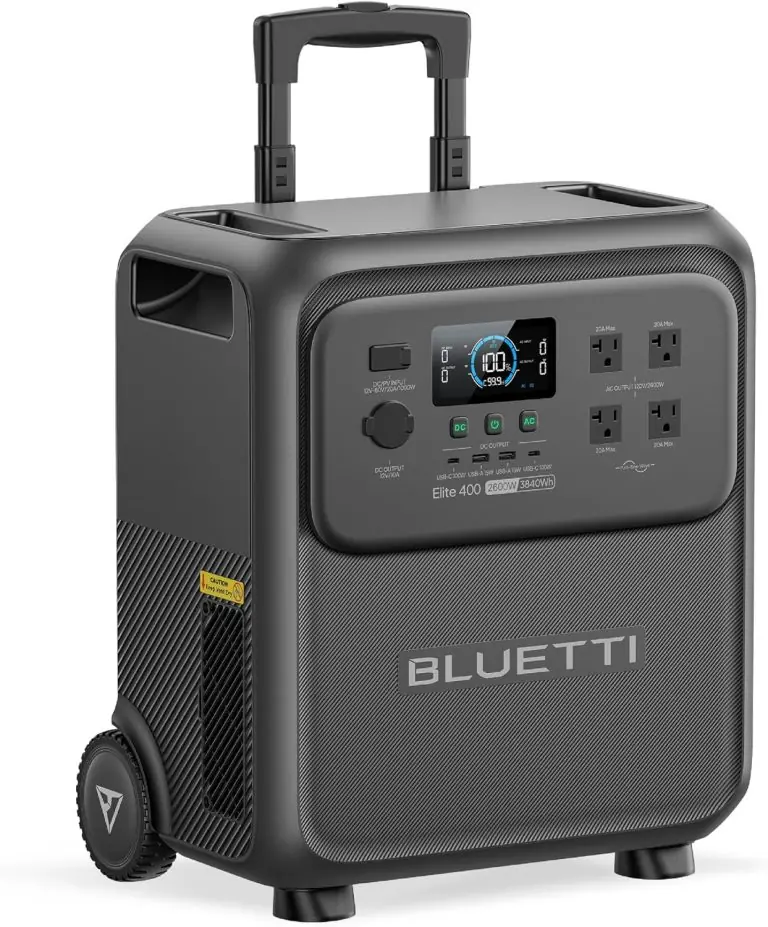
| Bluetti Elite 200 V2 | ~1,199USD | Roughly 2kWh capacity at a much lower price, lighter body | Shorter outages and apartment use where budget matters |
| Generac GP9500E Tri-Fuel | ~1,200USD | Unlimited runtime with fuel; 240V capable; loud and emissions-producing | Multi-week outages and 240V appliances, run outdoors only |
You want silent, emissions-free backup that covers a refrigerator, router, lights, and a few electronics for one to two days, and you want to move it without help. It also makes sense if you split time between a house and an RV, because the built-in TT-30 outlet means one purchase covers both. Finally, if uninterrupted power for a desktop PC or a medical device matters more than raw capacity, the 20ms UPS is the deciding factor.
You need 240V. The Generac GP9500E tri-fuel generator costs less, runs indefinitely on propane or gasoline, and powers a well pump or central AC — but it must run outdoors and it is loud. If your budget is the constraint rather than your load list, the Bluetti Elite 200 V2 delivers roughly two-thirds the capacity for about a third less money and handles most single-evening outages.
The Jackery HomePower 3000 with two 200W SolarSaga panels lists at 1799USD at the time of writing. That is competitive for a 3kWh LiFePO4 station with a UL-certified UPS and bundled solar, though it is not the cheapest way to get 3kWh of storage. The premium buys you the compact chassis, the certified switchover, and the five-year warranty rather than raw watt-hours.
Buy from an authorized retailer. Jackery’s warranty is valid only for units purchased through authorized channels, and third-party marketplace sellers sometimes ship units with no warranty registration path. Amazon is an authorized seller and its return window gives you a genuine trial period. Prices in this category move around seasonal sales and bundle promotions, so checking current pricing before you commit is worth the extra minute.
Price verified at time of publication. Check for current availability and deals.
Jackery covers the HomePower 3000 with a five-year manufacturer warranty, which is at the top end for this category. Most competitors offer two to three years. The warranty attaches to the original purchaser, so keep your order confirmation. Support is reachable by email and phone, and Jackery’s US service has a reasonable reputation, though response times stretch during storm season when everyone is filing claims at once. If your unit fails after an outage, file the ticket immediately rather than waiting a week, because queue times compound.
That five-year term is the strongest argument for treating this Jackery HomePower 3000 review verdict as a long-term purchase rather than a seasonal one. A battery rated for 4,000 cycles covered for five years is a very different financial proposition than a two-year unit.
Three things stood out across six weeks. First, the runtime claims hold up for realistic household loads — 14 hours 40 minutes on fridge, router, fans, and lights. Second, the 20ms UPS is not marketing theater; it kept a desktop PC alive through an actual breaker trip. Third, the compact chassis is the reason to pick this over a same-capacity competitor, because a 3kWh station you can carry is a station you will actually use.
This is worth buying if your critical loads are 120V and you want one unit that covers a house outage and RV trips with no fuel, no noise, and no fumes. I would rate it 8.5 out of 10. Points come off for the lack of 240V output, the 59.5 pounds with no wheels, and solar charging that is functional rather than fast. For a household with 240V critical loads, that rating does not apply and you should buy a generator instead.
Strip away the spec sheet and this is a quiet, 60-pound box that keeps your food cold and your internet on when the grid quits. That is the whole value proposition, and it delivered for me. If you have run one through a real outage, tell me in the comments how the runtime held up — I am still collecting data points from owners in colder climates. Otherwise, Jackery HomePower 3000 review pros cons from other verified buyers is worth a scan before you buy.
At 1799USD with two 200W panels included, yes, provided you need at least 3kWh and your loads are 120V. Over six weeks it replaced a gas generator for everything except 240V appliances. The five-year warranty and 4,000-cycle LiFePO4 cells spread the cost across a decade. If you only lose power a few hours a year, a 1kWh station at half the price covers you just as well.
They are close. Both offer roughly 3kWh and 3,600W output. EcoFlow’s app ecosystem and expandability are stronger, and the Delta 3 Ultra is a fine machine. Jackery wins on physical size, weight, and the built-in TT-30 RV outlet. I kept reaching for the Jackery when I had to carry something, which tells you which one I would buy for a house-and-RV setup.
About 20 minutes including unpacking, and yes, it is beginner-friendly. There is no app requirement and no configuration step. You plug the AC cable into a wall outlet, it charges, and you use it. The only mild complication is that the solar panels ship in a separate box, so if you bought the bundle, expect two deliveries on different days.
Very little. You get the station, built-in cables, and a manual. What you will likely want: a 12-gauge extension cord rated 15A or higher to reach a refrigerator, and a plug-in watt meter to profile your appliances before an outage. If you plan to recharge from solar away from home, extra panel cable length helps. Beyond that, this complete home backup bundle covers the essentials.
Five years, manufacturer-backed, which is longer than most competitors offer. Coverage attaches to the original purchaser, so retain your receipt. Support is available by phone and email and generally responsive, though response times slow during peak storm season. Register the unit shortly after purchase to avoid a paperwork delay if you ever file a claim.
Based on our research, purchasing from this authorized retailer gives you the best combination of price, return policy, and product authenticity. Jackery’s warranty only applies to units bought through authorized channels, and Amazon’s return window gives you a real trial period. Avoid third-party marketplace listings that undercut the price noticeably.
A small 5,000 BTU window AC draws roughly 450W running and about 1,200W at startup, so it runs for around five to six hours on a full charge. A 1/2 HP well pump pulls roughly 1,000W running with a 2,100W to 2,900W surge, which fits within the 7,200W surge rating. However, most residential well pumps are 240V, and this unit only outputs 120V, so check your pump’s voltage first.
My 21 cubic foot fridge averaged 1.4kWh per day at 72°F ambient, which works out to roughly 34 hours of refrigerator-only runtime from a full charge. Warmer rooms and older compressors will shorten that. With the fridge running alongside a router, fans, and lights, I measured 14 hours 40 minutes before the unit shut down.
Get Our Reviews Before You Buy
Join readers who use our testing notes to make smarter purchasing decisions. No sponsored rankings. No filler. Just honest reviews and practical guides, delivered when it matters.