Physical Address
304 North Cardinal St.
Dorchester Center, MA 02124
Physical Address
304 North Cardinal St.
Dorchester Center, MA 02124

A backyard fire pit is a $700 decision most people make in ten minutes, on a phone, after reading three reviews that all say the same five things. You already have the patio. You already have the wood. What you don’t have is a straight answer about whether the Solo Stove Yukon 2.0 does the one thing it claims to do — burn without smoking out your clothes, your hair, and your guests.
That is the question this Solo Stove Yukon review tries to answer. There are half a dozen 27-inch fire pits in this price band, and most coverage of them restates the manufacturer’s bullet points in a slightly different order. We spent six weeks with the Yukon 2.0 Amazon Exclusive Bundle — roughly 20 fires in a suburban backyard, plus two nights at a gravel campsite — and this article reports what happened. It will not tell you what to think. It will tell you what we measured, what we noticed, and where the marketing stretches past the evidence.
If you are cross-shopping the main alternative at this size, our Breeo X Series 24 review covers the comparison from the other side.
Disclosure: This review contains affiliate links. Purchasing through them supports our work at no added cost to you. All testing was conducted independently.
The Yukon 2.0 is a large-format smokeless wood fire pit — the biggest thing Solo Stove sells in its fire pit line. At $689.99 for the Amazon-exclusive bundle, it sits in the upper price band of the category, above the mass-market steel pits you’ll find at hardware stores and roughly level with the American-made competition once you add their accessories.
Solo Stove is a Texas-based company that built its business on portable wood-gasifying camp stoves before moving into backyard fire pits. You can see the current lineup on the company’s own site.
The problem it exists to solve is specific: conventional fire pits smoke because incomplete combustion sends unburned particles up with the heat. The Yukon’s double wall pulls air in at the base, heats it between the two steel layers, and pushes it out over the fire, where it burns off those particles. That is the whole engineering idea. Everything else is packaging.
Our Solo Stove Yukon review and rating has to be clear about what this is not. It is not a grill unless you buy the grill top. It is not a fire pit you can carry to the beach alone. It does not eliminate every trace of smoke, and it will not make damp wood behave. Anyone expecting those three things should stop reading here.
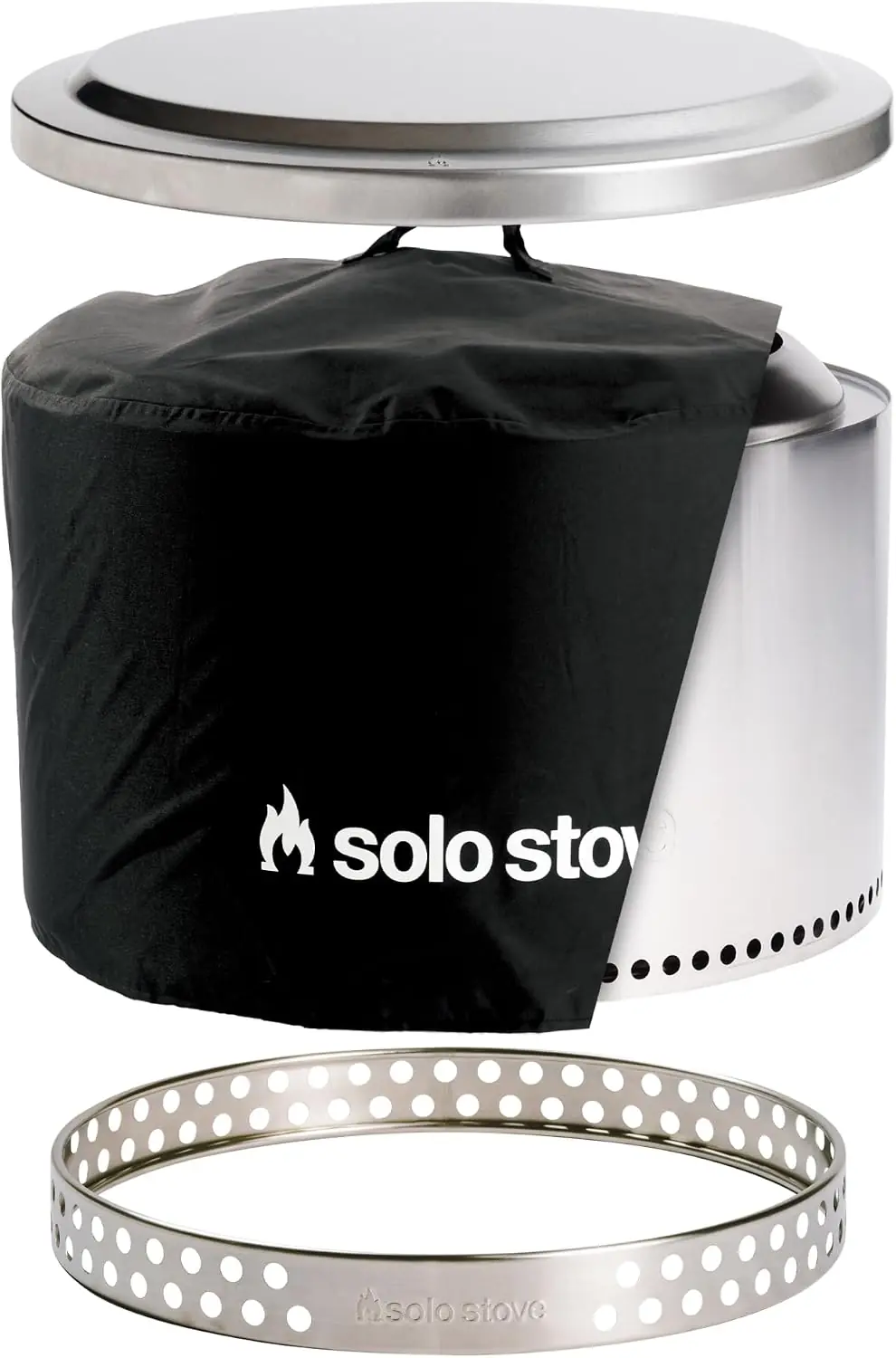
The bundle ships in a single heavy carton with molded foam and cardboard blocking that held up through transit — no dents, no scuffs on the rim. At 59 pounds shipped, you will want a second person or a hand truck for the walk to the patio.
Contents, itemized: the Yukon 2.0 fire pit, a base plate, a removable ash pan, a lid, a stand, and a weather-resistant shelter. What is not in the box: a poker, an ash rake, and any fire-starting material. The missing poker is a small annoyance given the diameter of the bowl — reaching a log at the far side with a stick from the yard works, but it is not elegant.
The body is 304 stainless steel with a high-heat ceramic coating over a polished finish. The coating gives it a slightly muted silver look rather than a mirror shine, which matters less than it sounds — ours developed a warm bronze discoloration on the upper rim and inside the barrel after the third burn, and that is normal for stainless at these temperatures.
Seams are welded cleanly and the rolled top edge has no sharp spots. The ash pan slides in and out without binding. Compared to the Breeo X Series 24, the steel feels slightly thinner in the hand, though we saw no warping, cracking, or rattling across six weeks of use. This Solo Stove Yukon review found the construction to be consistent with the price, not above it.
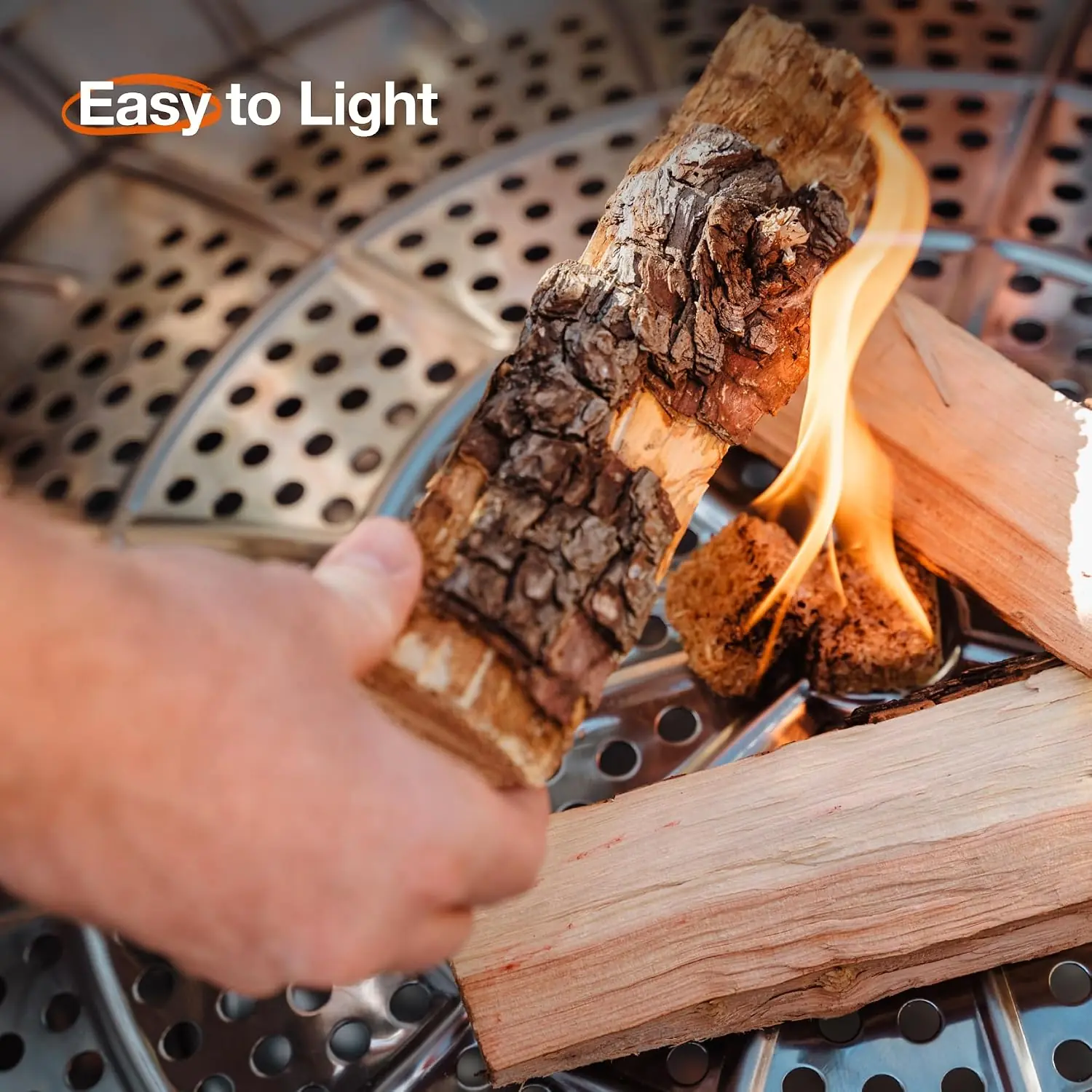
The listed claims are: a nearly smokeless fire through a 360-degree airflow design; a double-wall build that maximizes heat while reducing smoke; a removable ash pan for quick, mess-free cleanup; and no assembly, since you simply flip the ring and light it. The bundle also claims to include everything needed for the experience, and the listing positions the unit as portable enough for camping and beach trips.
Nearly smokeless: mostly confirmed, with conditions attached. For the first 10 to 15 minutes there is visible smoke — that is ignition, and no fire pit avoids it. Once the fire was fully involved and the secondary burn engaged, visible smoke dropped to a thin wisp or nothing. Adding a fresh split produced a three-to-five-minute smoke burst each time. If you stand directly in the plume while reloading, you will smell like a fire. Sitting five to eight feet away, we did not.
Maximized heat: confirmed, with a caveat nobody mentions. The double wall keeps the exterior meaningfully cooler than a single-wall steel pit, but the radiant heat out of the top is substantial. Six feet was comfortable for a full evening. At three feet, our legs were uncomfortably warm after 20 minutes.
Easy cleanup: confirmed. Lifting the base plate and pulling the ash pan takes about two minutes. The catch is that you get fine ash plus larger charred chunks, and the pan fills faster than expected — we emptied every third burn to keep the airflow path clear.
No assembly: confirmed. True to the listing, setup is placing the base plate, seating the ash pan, and flipping the ring. Four minutes, no tools. Our Solo Stove Yukon review honest opinion is that this is the most accurate claim on the page.
Portability: overstated. At just over 43 pounds for the pit alone, this is a two-person move to a vehicle. Anyone reading a Solo Stove Yukon review pros cons list should treat transportability as a marketing line, not a feature.
Calm evening, 55°F, dry oak splits: best case, and the pit’s best argument. Smoke went to near zero at the 14-minute mark and stayed there for two hours. Guests sat in a full circle with nobody shifting seats.
Breezy evening with 10 to 12 mph gusts: noticeably worse. The plume gets pushed sideways and the smoke stops behaving. It was still better than a conventional pit would have been, but the difference shrank. You will rearrange chairs.
Damp campsite wood: worst case. Wood we would estimate at 25 percent moisture or higher never reached a clean secondary burn, and the pit smoked for most of the evening. If you want to check what the Solo Stove Yukon bundle costs right now before reading further, that is the link.
Across roughly 20 burns, performance stayed consistent. Nothing loosened, warped, or degraded. The variability came entirely from fuel and weather, not from the pit. On dry wood in still air it performed identically in week six to week one.
We should be explicit about the limits of this: six weeks is not a durability test. We did not test long-term corrosion resistance, winter storage without the shelter, or how the ceramic coating holds up over multiple seasons. Anyone claiming certainty on those points after a short test is guessing.
If you are still weighing whether Solo Stove Yukon is worth buying against other outdoor purchases this season, our broader backyard gear archive covers what else holds up.
| Specification | Value |
|---|---|
| Material | 304 stainless steel, high-heat ceramic coating |
| Outer dimensions | 28 in D x 28 in W x 19 in H |
| Fire pit weight | Approximately 43 lb |
| Shipped weight | 26.76 kg (59 lb) |
| Fuel type | Wood |
| Finish | Polished |
| Shape | Round |
| Included in bundle | Fire pit, base plate, ash pan, lid, stand, weather-resistant shelter |
| Warranty | Limited, against manufacturing defects |
| ASIN | B0F3ZG9QZ3 |
| Price at review | $689.99 |
Setup took four minutes and required no tools. Drop the base plate into the bottom of the barrel, slide the ash pan into place, flip the ring onto the top edge, set it on the stand. That is the entire process, and the listing’s claim about no assembly is accurate.
There are no hidden dependencies — no app, no account, no gas line, no electricity. The only thing you must supply is fuel and a lighter. What the instructions do not explain is what counts as suitable fuel, which is the single biggest determinant of whether this pit performs as advertised.
Three to four burns before it felt natural, mostly spent figuring out how much wood to load and how to arrange it. The adjustment that took longest was resisting the urge to over-stuff the bowl — a dense pile smolders and smokes, while a loose stack with air gaps lights faster and burns cleaner.
Prior experience helps: if you have run a wood stove or a charcoal chimney, top-down burning will feel familiar immediately. Experience with propane fire tables does not transfer at all — this behaves like a wood fire, because it is one.
Our Solo Stove Yukon review verdict on the learning curve: it is shorter than most wood-fired products, but it is not zero, and the people who struggle are the ones who treat it like a gas fire pit. You can see the current bundle price here if the fuel requirements have not put you off.
| Product | Price | Best At | Main Trade-off |
|---|---|---|---|
| Solo Stove Yukon 2.0 Amazon Exclusive Bundle | $689.99 | Low-smoke heat for six or more people; complete kit in one box | Weight, fuel consumption, no permanent home required but strongly preferred |
| Breeo X Series 24 | Approx. $549 base; $750+ with sear plate | Open-flame grilling and heavier-gauge steel | Costs more once equipped; 24 in bowl seats fewer people |
| Solo Stove Bonfire 2.0 | Approx. $349 | Smaller yards and easier moving | 19.5 in bowl, seats four to five, less radiant heat |
| Tiki Brand Patio Fire Pit | Approx. $395 | Lower entry price and a cleaner furniture-style look | Smoke reduction is less effective; smaller fire and less heat |
Against the Breeo X Series 24, the Solo Stove Yukon review pros cons list is genuinely close. The Breeo uses heavier steel, is made in the United States, and its sear plate turns it into a real grill — something the Yukon cannot do without a separate grill top. The Yukon wins on diameter and on out-of-the-box completeness: the lid, stand, and shelter are already in the box. If open-flame cooking is your priority, buy the Breeo. If seating eight people around a clean fire is the goal, the Yukon does it with less fuss.
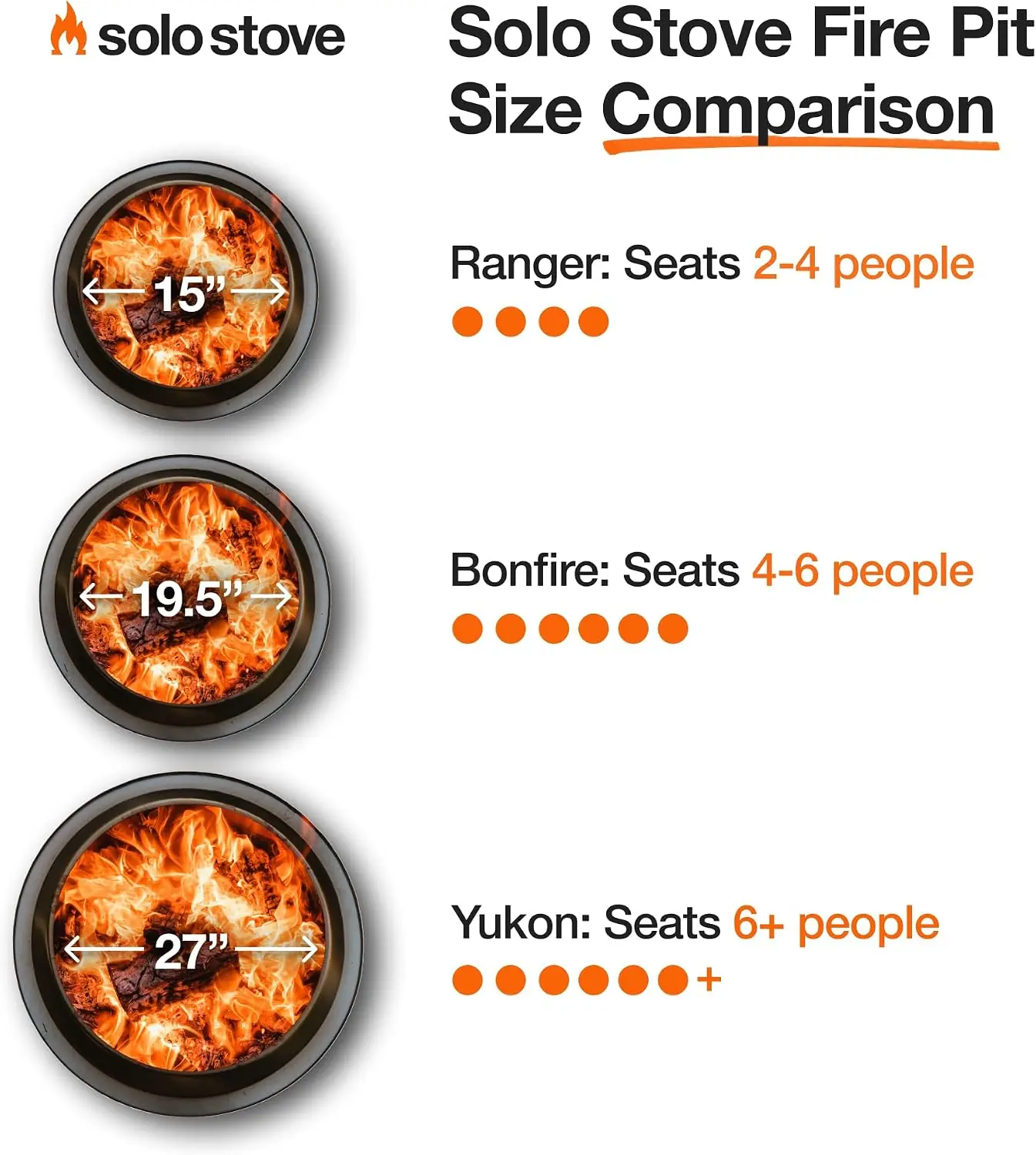
Against the Solo Stove Bonfire 2.0, the choice is about scale rather than quality. The Bonfire is lighter, cheaper, and easier to move, and it uses the same airflow design. It also seats four to five people instead of six or more, and it puts out noticeably less heat. Our side-by-side comparison of smokeless fire pit designs covers the sizing question in more detail.
Against the Tiki Brand Patio Fire Pit, the Yukon costs roughly $300 more and earns most of that back in smoke performance. The Tiki is a fine-looking pit for the money and a reasonable choice if you burn six times a year. It does not deliver the same clean burn, and our Solo Stove Yukon review and rating treats that gap as the single most important difference in this category.
It is not the airflow design — Breeo and others use comparable secondary-burn principles. The differentiator is that Solo Stove bundles the stand, lid, ash pan, and shelter into one price and one box, at a diameter that actually heats a group. That combination, not any single feature, is what you are paying for.
The price at review was $689.99, and Solo Stove products discount frequently — Prime Day and holiday promotions typically move this bundle by $100 or more. If you are not in a hurry, waiting is reasonable. If you are, the price is in line with what a complete 27-inch smokeless setup costs from any manufacturer once you add the accessories separately.
Where it represents good value: a household that burns twice a month with six or more people around the fire. The bundle is genuinely complete, the diameter is honest, and the secondary burn performs. Where it is harder to justify: occasional burners, small patios, and anyone who will end up moving the pit every weekend.
The sticker price is not the real cost of ownership. A 27-inch bowl at a two-hour burn consumed 20 to 30 pounds of hardwood in our testing. That is a fuel bill most buyers do not model before purchasing, and it is larger than a 19-inch pit would run.
Price and availability change frequently. Always verify before buying.
The limited warranty covers manufacturing defects, with defective units replaced or refunded as store credit rather than cash — worth knowing before you buy, because store credit is not the same as a refund. Returns run through the retailer’s standard window; through Amazon that is typically 30 days. Keep the box, because a 59-pound return is a logistical event. This Solo Stove Yukon review did not test the warranty or return process directly, so treat that as policy information rather than a tested finding.
This Solo Stove Yukon review verdict is straightforward. The Yukon 2.0 does the thing it was built to do: with dry wood and reasonable weather, it produces a fire you can sit around without constantly dodging smoke, and it does it for a group of eight. It is also heavy, thirsty for fuel, and less portable than its own listing implies.
Buy it if you have a permanent spot on a patio and people to fill it. Skip it if you need something you can carry, or if you would rather cook than sit. Tell us how yours performed in the comments — especially if you have burned through a full winter with one.
You can check the Solo Stove Yukon bundle price on Amazon before deciding.
For a household that hosts regularly and has a fixed outdoor spot, yes. The smoke reduction is measurable, the bundle is genuinely complete, and the build held up over six weeks without issue. At $689.99 it is not an impulse purchase, and frequent discounts mean patience is rewarded. For occasional burners or small patios, a cheaper 19-inch pit delivers most of the same experience.
We tested for six weeks and saw no warping, cracking, or degradation. The 304 stainless steel and ceramic coating are rated for high heat, and Solo Stove covers manufacturing defects under a limited warranty. Beyond that, we cannot give you a verified multi-year figure — nobody credibly can from a short test. Expect discoloration on the rim and interior, which is cosmetic and normal.
Weight and fuel consumption, in that order. At 43 pounds for the pit alone, it is not the portable fire pit the listing implies, and return shipping on a 59-pound box is a real inconvenience. The 4.1-out-of-5 rating across 43 reviews reflects a generally satisfied base with consistent notes about size and wood appetite rather than defects.
Yes, with one caveat. There is no assembly and no learning curve on the hardware itself — you flip the ring and light it. The learning curve is entirely about fuel. New owners who buy kiln-dried hardwood and learn the top-down burn method get the advertised experience on the first or second fire. New owners who burn whatever is in the woodpile get smoke and blame the pit.
Required: dry seasoned hardwood and a lighter. That is it. Genuinely useful additions: a moisture meter to verify your wood, and a poker for reaching logs across the 27-inch bowl. Optional: the grill top if you want to cook, and a pellet adapter if you prefer consistent fuel. The Amazon exclusive bundle already includes the lid, stand, and shelter, so you are not buying those separately.
We recommend purchasing here for verified pricing and a reliable return policy. This specific configuration is an Amazon exclusive, so you will not find identical bundles elsewhere. Watch for seasonal promotions — the price moves more than the product does.
Wind is the Yukon’s weakest condition. With 10 to 12 mph gusts, the smoke plume gets pushed sideways and the clean-burn advantage narrows considerably. Rain is a non-issue for the hardware, but a wet fire pit smokes badly on the next burn, which is exactly why the included shelter matters. Use it every time, and do not cover the pit while the coals are still hot.
Not without care. The included stand lifts the base off the surface and helps, but the pit still radiates significant heat downward and outward, and embers can escape when you reload. We used it on gravel and stone only. If a wood deck is your only option, use the stand, keep three feet of clearance on all sides, and place a heat shield underneath. Solo Stove’s own guidance on safe surfaces is worth reading before you light anything.
It reduces smoke. This Solo Stove Yukon review honest opinion is that the secondary burn is the real engineering achievement here, not a slogan. The warm air rising between the two steel walls ignites particles that would otherwise leave as smoke. It works after 12 to 15 minutes on dry wood. It does not work on wet wood or in strong wind, and it does not eliminate the smoke from the first ten minutes of ignition or from reloading. The claim is accurate with conditions attached, which is more than most fire pit marketing manages.
Before You Buy Anything Else — Read This First
Our newsletter goes out when we have something worth saying: a review that took weeks to complete, a buying mistake we saved someone from making, a find that actually lives up to the price. No filler. No weekly spam.