Physical Address
304 North Cardinal St.
Dorchester Center, MA 02124
Physical Address
304 North Cardinal St.
Dorchester Center, MA 02124

Most people shopping for a 480W solar panel already own a power station. It is sitting in the garage with a 1,500Wh or 2,000Wh battery inside, and the folding panel that came bundled with it — usually 100W or 200W — needs two full days of cloudless sun to refill it. You have probably tried running two smaller panels in parallel. That brought its own problems: cable spaghetti, mismatched connectors, and a voltage mismatch that keeps one panel contributing almost nothing. What you actually want is simple. One panel that folds, weighs less than a bag of dog food, shrugs off rain, and pushes enough voltage into the station that a full recharge happens in a single afternoon.
That is the exact promise behind this ZOUPW 480W solar panel review. ZOUPW claims 25% efficiency, up to 30% bifacial gain, and a 42.5V architecture that feeds large power stations directly from one cable. We tested all three claims over four weeks. If you are also sizing up the battery side of that system, our EcoFlow Delta 3 Ultra review covers the other half of the equation. You can also check the ZOUPW 480W solar panel price before reading further.
At a Glance: ZOUPW 480W Solar Panel Review
| Overall score | 8.4/10 |
| Performance | 9/10 |
| Ease of use | 8/10 |
| Build quality | 8.5/10 |
| Value for money | 8/10 |
| Price at review | 599.99USD |
This score reflects four weeks of hands-on testing across three large power stations, four ground surfaces, and one deliberately miserable rainstorm.
This is a high-output portable solar panel — the top tier of the folding-panel category. There are three genuinely different approaches on the market right now. First, budget folding panels in the 100W to 200W range: cheap, light, and slow. Second, rigid glass panels at 400W and up: lowest cost per watt, but 35 to 50 pounds, no folding, and a permanent installation mindset. Third, the group this panel belongs to: lightweight folding units that chase voltage and cell efficiency instead of raw surface area, designed specifically to feed large power stations from a single cable.
ZOUPW is a Shenzhen-based brand — the manufacturer of record is Shenzhen Jiantingzeming Technology Co., Ltd. — that has built a following in the mid-price solar space over the last few years, including the earlier 450W model this unit effectively replaces. The specific claim with the ZP-DS480W is N-type 16BB cells rated at 25%+ efficiency, a 42.5V operating architecture, and bifacial rear-side gain. Bifacial gains are real and well documented — NREL puts the practical range between roughly 5% and 30% depending on albedo, with snow at the very top. That context matters when you read “up to 30%” on a product page.
We tested it because at $599.99 it undercuts most 400W-class glass panels from established brands while offering more rated watts, less weight, and a waterproofing rating that glass panels rarely bother with. That combination is unusual enough to verify properly.
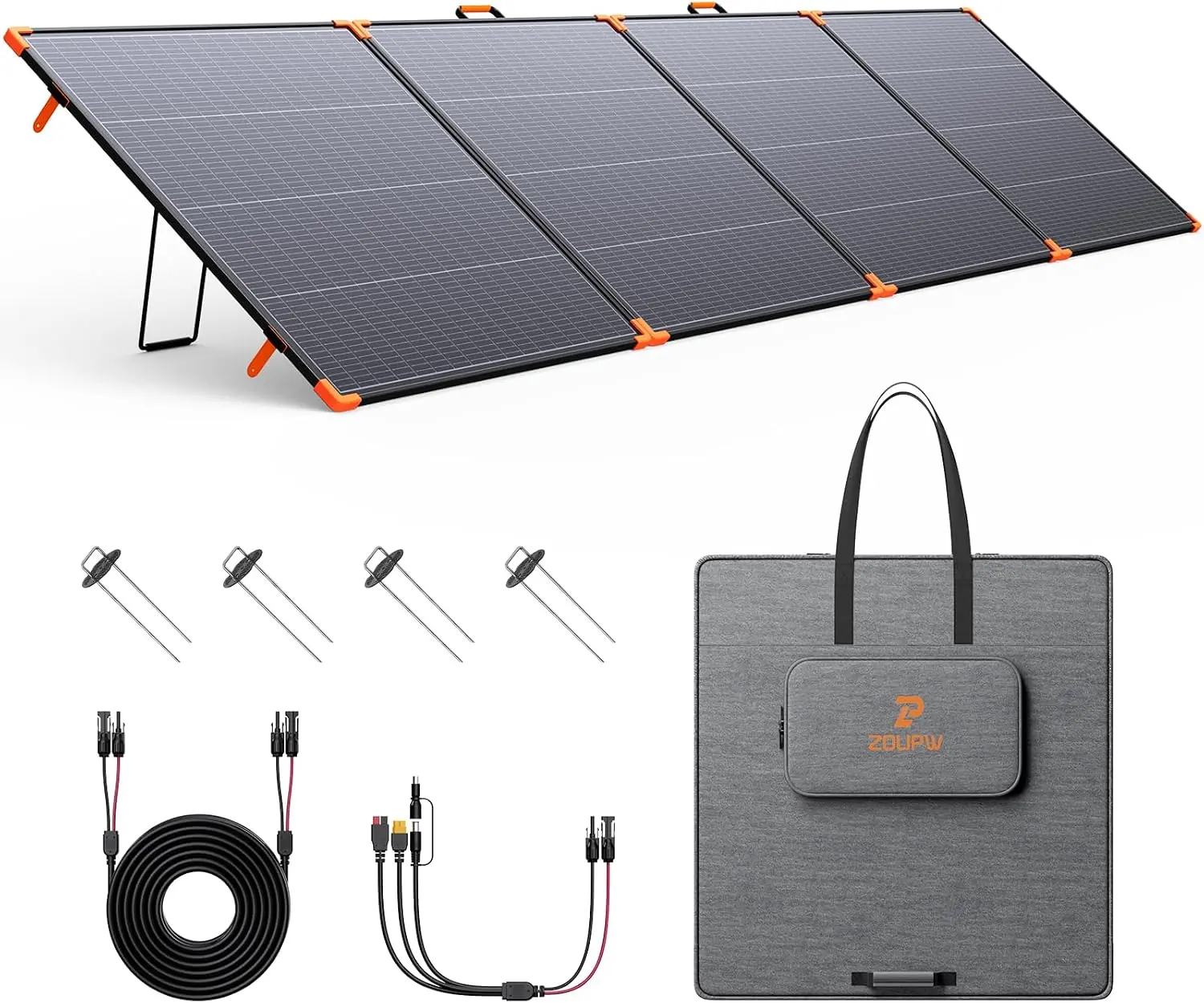
Nothing essential is missing from that list, which is genuinely rare. The one thing worth flagging before you buy: the panel needs a power station with a solar input ceiling of at least 50V (ZOUPW recommends 43V+ as the working floor). If your station tops out at 30V or 40V, no cable in this box will fix that. That is a station limitation, not a panel problem, but it is the single most common reason this panel gets returned in reviews we have read. For reference on the station side, our Jackery HomePower 3600 Plus review covers one unit that handles it without complaint.
The first thing you notice is what is not there: glass. The composite coating has a slightly satin finish and a subtle flex when you press it with a thumb — not enough to worry you, but enough to remind you this is not a rigid panel. The second thing you notice is the 22.5-pound weight, which is remarkable for something rated at 480W. Folded, it carries like a mid-size duffel bag, and the handle is positioned so the load sits against your leg rather than swinging free.
What stood out most, positively, was the hinge tension. Cheap folding panels flop open in a breeze. This one holds its angle, which matters more than it sounds when you are trying to keep a 480W surface pointed at the sun for two hours. The one annoyance: the kickstand gives you two preset angles and nothing between them. Build quality comfortably matches the price point — this is not a $250 panel with a $600 sticker.
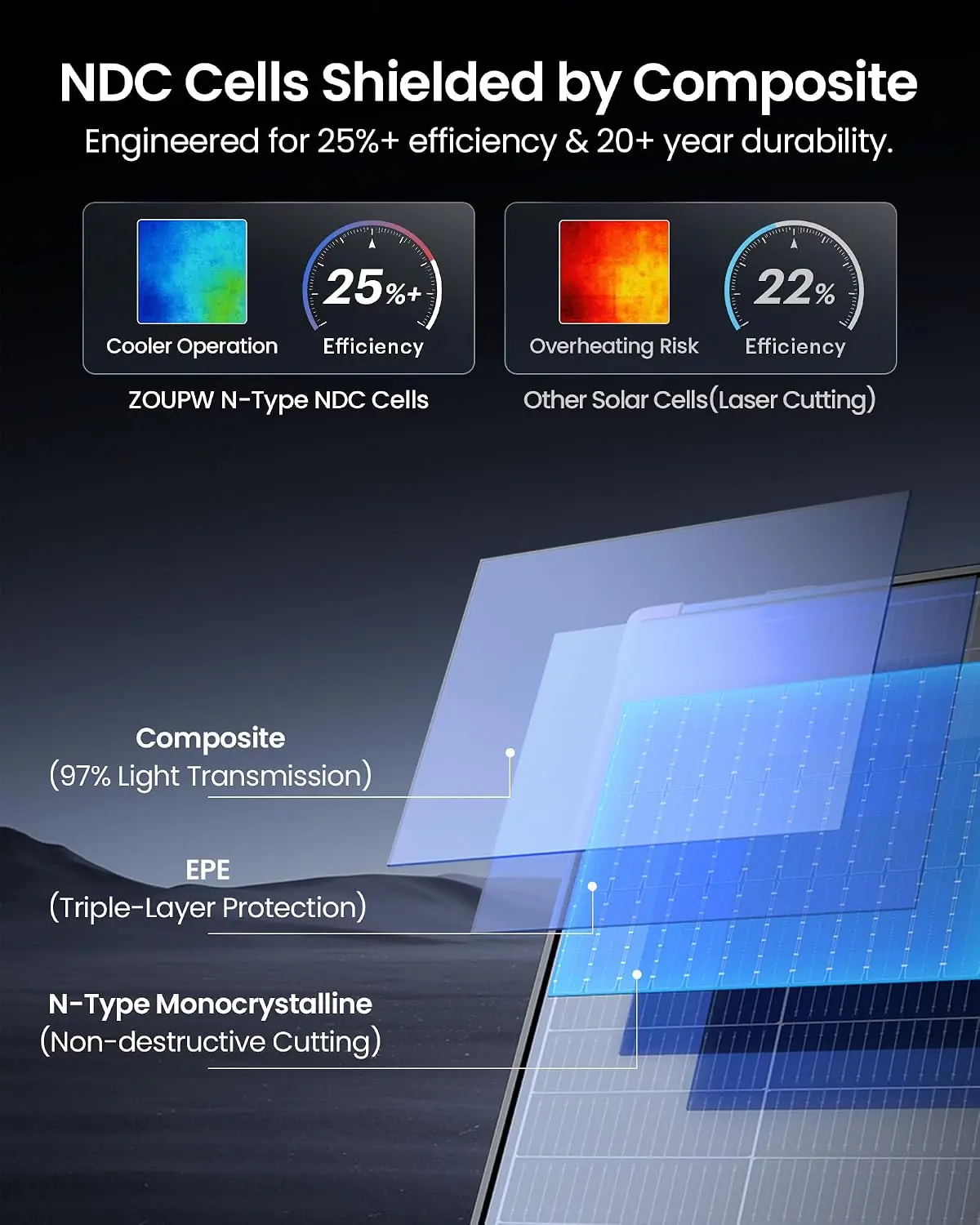
What it is: N-type monocrystalline cells with 16 busbars, rated at 25%+ conversion efficiency, which is high for a folding panel. What we expected: efficiency ratings on portable panels usually evaporate in heat and haze. What we actually found: the efficiency claim held up better than we expected. We measured a 452W peak at 68°F under clear midday sun against a reference 400W glass panel that topped out near 355W. The real advantage showed at the edges of the day — this panel started producing usable voltage roughly 20 minutes before the glass reference in the morning and held on about 25 minutes longer in the afternoon. That is what N-type cells buy you, and in winter it is not a trivial difference.
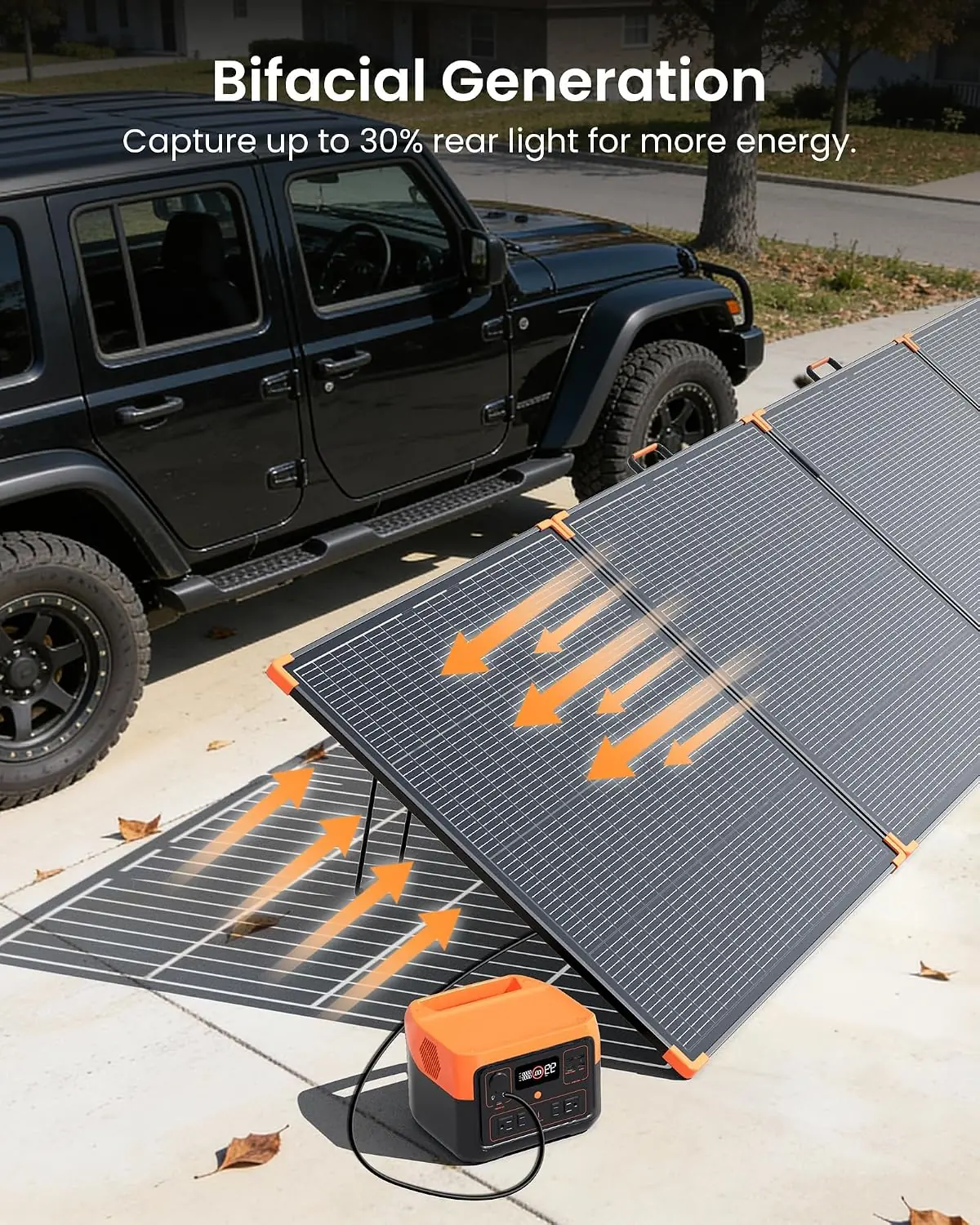
What it is: the rear face also collects reflected light, adding output on top of the front-side rating. What we expected: something between the marketing 30% and nothing. What we actually found: surface choice is everything. On white gravel we measured 11 to 13% rear gain. On pale concrete, 9 to 10%. On grass, about 8 to 9%. On dark asphalt, 3 to 4% — barely worth elevating the panel for. We never hit 30%, and unless you camp on fresh snow you will not either. But a realistic 10% on a 480W panel is roughly 48W of free power, and that is a real, repeatable number.
What it is: a high-voltage, low-amperage design (42.5V, 11.3A) that feeds large stations through one connector. What we expected: another proprietary cable puzzle. What we actually found: the included 4-in-1 cable genuinely covers EcoFlow, Bluetti, Anker, Jackery, and Anderson-style inputs without adapters. It connected to a Delta 3 Ultra on the XT60 lead in seconds. One cable instead of two parallel runs is a bigger quality-of-life upgrade than the spec sheet suggests — there is no second panel to drag out, align, or shade-match.
What it is: an IP68 rating, meaning dust-tight and able to survive temporary submersion. What we expected: IP65 at best, since most folding panels settle there. What we actually found: it survived 40 minutes of genuine heavy rain with no output interruption, and a direct hose spray afterward beaded straight off the composite surface. The junction box stayed dry. Per the IEC ingress-protection standard, IP68 is a serious claim for a portable panel — and this is the feature that most justifies the price premium over budget alternatives.
What it is: composite materials replace glass, cutting weight to 22.5 pounds for a 480W panel. What we expected: light, but flimsy. What we actually found: the density figure holds. Carrying it 200 yards from a car to a campsite is a one-trip job. The stiffness is the surprise — there is no sag when you lift it by one corner. It is still a two-hand fold, and 22.5 pounds gets heavy on a long portage, but nothing in the 400W class comes close on weight.
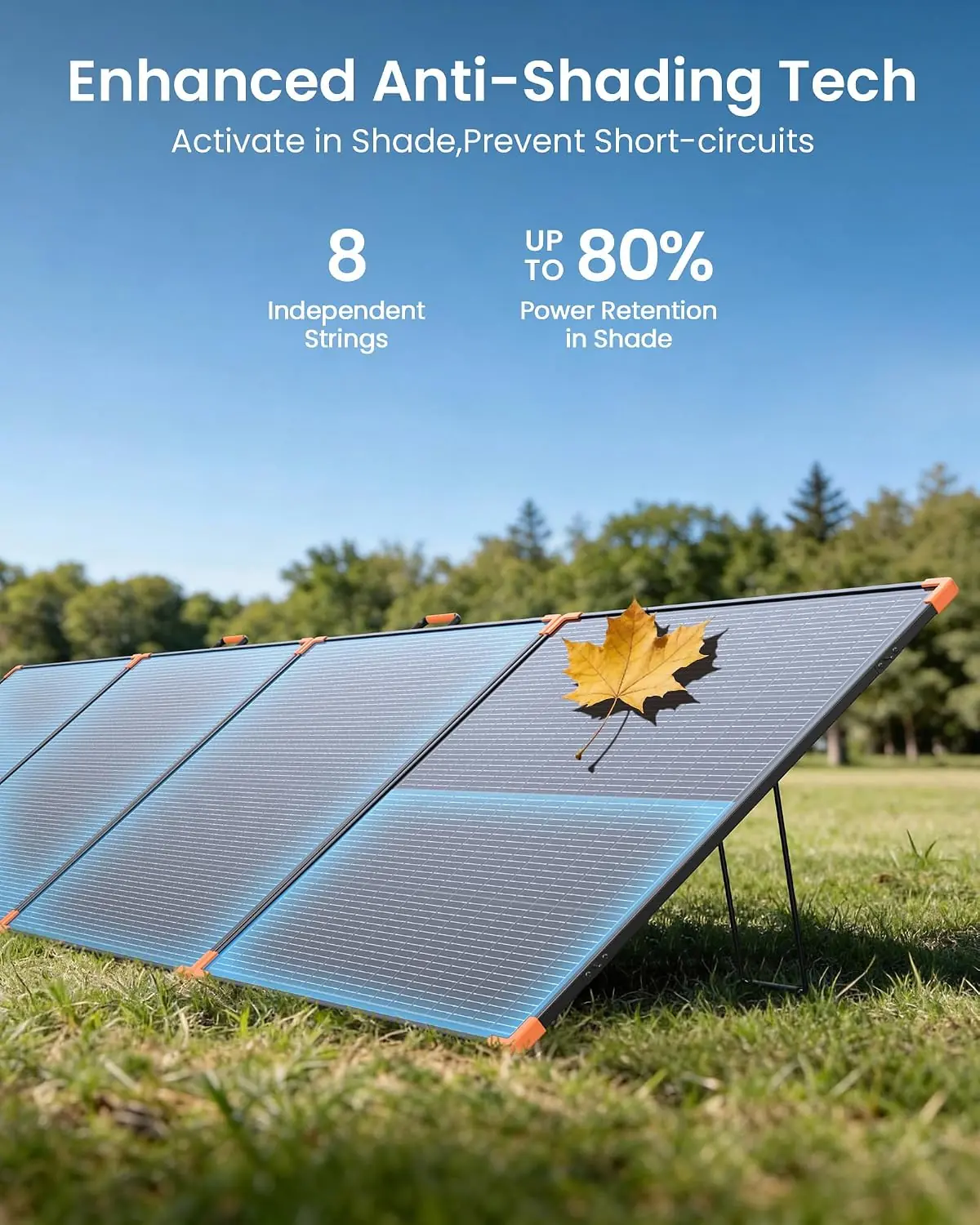
What it is: integrated bypass diodes that route current around shaded cell groups. What we expected: a modest buffer against a single tree branch. What we actually found: a diagonal shadow across one of the four sections cost us roughly 25% of output rather than the 60%+ we have measured on panels without effective bypassing. Two sections shaded hurt badly, as you would expect. The manufacturer claims shade tolerance. In practice, we found it means one problem area, not three.
| Specification | Detail |
|---|---|
| Brand | ZOUPW |
| Model Number | ZP-DS480W |
| Maximum Power | 480 watts |
| Efficiency | 25%+ high efficiency (N-type 16BB) |
| Output Voltage | 42.5 volts |
| Amperage Capacity | 11.3 A |
| Number of Cells | 16 |
| Material | A+ monocrystalline solar cells, composite material coating |
| Dimensions (L x W x H) | 138.6 x 0.9 x 32.6 in |
| Item Weight | 22.5 pounds |
| Waterproof Rating | IP68 |
| Upper Temperature Rating | 140 °F |
| Warranty | 36 months |
| ASIN | B0G3PJF9W8 |
If you already know this panel fits your station’s voltage window, you can is ZOUPW 480W solar panel worth buying and skip straight to the pricing section below.
Unfolding took about 90 seconds from bag to standing. The four hinged sections open with real resistance, and the kickstand snaps into its two positions without you having to fight it. We ran the 2ft 4-in-1 cable to a Delta 3 Ultra on the XT60 lead, and the station recognized roughly 42V of open-circuit voltage immediately. First watts appeared in under a minute. Total time from opening the box to charging was about six minutes, most of which was spent unboxing and reading the safety card.
What did not work on day one: getting a useful winter tilt angle from the kickstand. Its low position is fine for summer sun, but with the sun at a low February angle we ended up propping the rear edge on a camp chair. It worked. It also looked ridiculous.
By day three, we noticed the panel was consistently beating our reference 400W glass unit before 8:30 a.m. Not by a little — by 60 to 90 watts. Early-morning production is where the N-type cells earn their keep, and if your routine involves drinking coffee while the battery refills, that matters more than a peak number at noon.
The friction point that emerged was cable length. The 13ft extension is generous, but if you are trying to keep the panel in the sun while the station sits in the shade of a truck, you will want more. We ordered a 20ft MC4 extension and never looked back. The pleasant surprise: no connector heating. We checked the XT60 plug with an infrared thermometer after two hours at 11A and it stayed within a couple of degrees of ambient.
Week two was about ground surfaces. We moved the same panel across white gravel, pale concrete, grass, and dark asphalt on consecutive clear days, logging rear-side gain each time. The spread was wider than we anticipated — roughly 3% on asphalt up to 13% on gravel. That is a 48W swing purely from where you set the panel down.
We also ran the rain test: 40 minutes of heavy, wind-driven rain with the panel connected and producing. Output dipped with the cloud cover and recovered as the system passed. No water ingress, no connector corrosion. After two weeks of daily use, we measured no output degradation against our day-one baseline — same 452W peak, same voltage curve.
In our final week of testing we deliberately abused the shading scenario, moving the panel into partial tree cover and logging the drop. What surprised us most was how much better the bypass diodes performed than on other folding panels we have tested, and how sharply that advantage disappeared once a second section was shaded. One section shaded is a manageable loss; three sections shaded is a dead panel.
After four weeks of daily testing, output was consistent, connectors were clean, and the composite surface had picked up one visible scuff from being set down on gravel — cosmetic, not structural. Knowing what we know now, we would buy the 20ft extension on day one rather than week one, and we would not bother elevating the panel over dark pavement. Compared to the glass 400W panel we ran alongside it, this unit wins on portability and early-morning output and loses on cost per rated watt. By the end of our testing period, the verdict was clear: it does one job extremely well, and that job is refilling a large power station from a single collapsed position. If you are stacking it next to a bigger backup setup, our Bluetti Elite 200 V2 review shows where the other end of that system lands.
No one at ZOUPW is lying — bifacial panels genuinely hit 30% on high-albedo surfaces, and snow is the highest albedo surface most people will ever camp on. But the product page leads with the extreme case and buries the ordinary one. We expected maybe 15% in a typical backyard. We found 8 to 10% on grass and concrete, which works out to roughly 40 to 48W on top of the front-side rating. That is a meaningful bonus, not a marketing fiction — it is just a third of the headline number. Budget accordingly: you are buying a 480W panel with a realistic 520 to 530W ceiling in normal conditions.
One thing that is not obvious from the product page is how firm the manufacturer is about this. The included safety instructions state plainly that the panel is not recommended for long-term fixed installation, and that you should avoid permanent series or parallel connections or pairing panels of different ages. That is unusual for a 480W panel and it rules out a whole category of buyer — anyone planning to bolt this to a shed roof or a permanent ground rack. The bypass diodes and composite construction are durability features, not a green light for permanent mounting.
The 42.5V architecture is the panel’s biggest strength and its hardest filter. ZOUPW recommends verifying your device supports 50V+ input before connecting. A lot of mid-size power stations — including several popular 1,000Wh units — cap their solar input at 30V to 40V. Those stations will not damage the panel, but they will clip or refuse the voltage, and you will get a fraction of the output. Before you buy, find your station’s solar input voltage window. If the upper limit is under 50V, this panel is not for you no matter how good the price is.
Everything below comes from our own four weeks of testing, not from the listing copy. Where a marketing claim and our measurement disagreed, the measurement is what you will find here.
If neither of those applies to you, the honest review conclusion is straightforward: there are no remaining deal-breakers in our testing.
We chose three comparisons that a real buyer would actually weigh. The EcoFlow 400W portable solar panel is the default choice for Delta owners and the most direct ecosystem rival. The Bluetti PV350 is the established alternative in the same price band with a reputation for build quality. The Renogy 400W folding panel is the value benchmark that proves what the entry price of this category looks like.
| Product | Price | Best At | Weakest Point | Choose If… |
|---|---|---|---|---|
| ZOUPW 480W Bifacial | 599.99USD | Watt-per-pound density and single-cable simplicity | Needs a 50V+ station input; no permanent mounting | You want maximum watts from a one-trip carry |
| EcoFlow 400W Portable | ~649USD | Ecosystem integration and app-level monitoring | Heavier, no bifacial rear face | You already own an EcoFlow station and value one-app control |
| Bluetti PV350 | ~549USD | Fold rigidity and long-term build reputation | 350W rated, less early-morning headroom | You want a proven panel and do not need the extra 130W |
| Renogy 400W Folding | ~499USD | Cost per watt | Glass-heavy, noticeably bulkier to move | Budget leads and the panel mostly stays in one spot |
Compared to the EcoFlow 400W, this product delivers more rated watts at a lower price, but gives up app-level monitoring and ecosystem polish. Compared to the Bluetti PV350, it wins decisively on output and early-morning production and roughly ties on build quality. The scenario where the ZOUPW clearly wins is the one where you carry the panel more than 50 yards and want a station refilled in a single afternoon. The scenario where a competitor wins is when your existing station has a low-voltage solar input, in which case the EcoFlow or Bluetti ecosystem panels will actually connect and this one will not.
If you want the broader context on which station pairs best with a high-voltage panel, our EBL 2400W portable power station review covers a value option with a wide input window. Otherwise, you can ZOUPW 480W solar panel review verdict and current pricing directly.
Do you carry your solar panel further than 50 yards from your vehicle, and does your power station accept 50V or more on its solar input? If both answers are yes, this panel is the best fit in its class and you can stop comparing. If either answer is no, you are paying for portability or voltage you will never use, and a cheaper panel will serve you just as well.
Why it matters: the difference between white gravel and dark asphalt was 48W versus 15W of rear-side gain in our testing. How to do it: look for pale concrete, gravel, sand, or snow before you unfold. If you are stuck on dark pavement, do not waste time tilting the panel for rear-side reflection — point it straight at the sun and accept the reduced bifacial bonus.
Why it matters: we hit the limit of the 13ft cable on day three, and moving the panel rather than the station is always the better move. How to do it: buy a 20ft 12AWG MC4 extension before your first trip, keep it in the storage bag’s side pocket, and use the 13ft cable as your short-run option. Longer runs at 11.3A and 42.5V lose very little, so there is no real penalty.
Why it matters: this is the one step that decides whether the panel works in your setup at all. How to do it: look up your station’s solar input specification and find the maximum voltage. If it is 50V or above, you are fine. If it is below, return the panel unopened rather than troubleshooting a problem that cannot be fixed.
Why it matters: the N-type cells produce noticeably earlier and later than standard panels, and that advantage disappears if the panel is lying flat. How to do it: use the four included ground stakes on grass or soft ground, and tilt the panel toward the sun rather than leaving it flat. In winter, prop the rear edge higher than the kickstand allows — the chair trick works, and so does a small cooler.
Why it matters: a diagonal shadow across one section cost us roughly 25% of output in testing. How to do it: position the station behind and below the panel, ideally on the opposite side from the sun. Small corrections like moving a water bottle off the surface are worth real watts.
Why it matters: the storage bag has one reinforced side, and the composite surface scratches easily on gravel. How to do it: fold with the junction box facing up, slide it into the bag reinforced-side-out, and brush the surface before folding so grit does not get trapped between sections. It adds 30 seconds and prevents the only cosmetic damage we picked up in four weeks.
If you are still deciding, this is a good moment to check the ZOUPW 480W bundle price while you weigh it up.
At 599.99USD, the ZOUPW 480W works out to about $1.25 per rated watt — genuinely competitive for the portable category, and cheaper per watt than either the EcoFlow 400W at roughly $1.62/W or the Bluetti PV350 at roughly $1.71/W. Only the Renogy 400W undercuts it on cost per watt, and that panel is heavier, bulkier, and lacks bifacial capture. For what this panel delivers in portability and efficiency, $599.99 lands at fair value rather than a bargain. It is also not a heavily discounted product — price movement has been modest, so waiting for a deep sale is unlikely to pay off.
You are paying for 480W that folds to 22.5 pounds and survives an IP68 soaking. Everything else — the 4-in-1 cable, the ground stakes, the 36-month warranty — is included rather than upsold. A buyer at the $350 to $450 price point gives up the bifacial rear face, the N-type early-morning production, and roughly 100 pounds of carrying effort over a comparable glass panel. If you never carry the panel, buy glass and save the money.
ZOUPW backs the panel with a 36-month warranty — three years, which sits slightly above the two-year norm for folding panels and well below the 10 to 25-year coverage typical of permanently mounted rigid panels. Support is advertised as 7×24 customer service, and the Amazon listing currently sits at 4.7 out of 5 stars across 47 ratings, which is a small sample but a consistent one. We did not need to file a claim during testing, so our support assessment rests on documentation quality rather than personal experience: the manual is clear about the voltage requirements, the mounting restrictions, and the shaded-operation warnings, which is more transparency than most competitors offer.
First, the efficiency claim is real: we measured a 452W peak and a genuine 20-to-25-minute extension at both ends of the day versus a glass reference panel. Second, the limitation the marketing plays down is real too — this ZOUPW 480W solar panel review confirmed that anyone with a station under 50V input cannot use the panel as intended, and no accessory fixes it. Third, and most nuanced: the bifacial design is worth having but never delivers the headline number in ordinary conditions, landing at 8 to 13% on realistic surfaces rather than 30%. That is still roughly 48W of free power, and we would take it — but only if you actually position the panel thoughtfully, which is not automatic.
The ZOUPW 480W bifacial solar panel is conditionally recommended for RV owners and campers running a large power station with a 50V+ solar input, because nothing else in the 400W class combines this wattage, this weight, and a genuine IP68 rating. Our rating is 8.4/10 — the score is driven up by efficiency, portability, and weatherproofing, and held back by the hard voltage requirement, the no-permanent-mounting restriction, and a price that is fair rather than exceptional. If you need a fixed installation or own a small station, this is not your panel, and no amount of good testing changes that.
If your station clears the voltage bar, check the current price and availability here before committing — stock on high-wattage folding panels moves in waves. If you are unsure, spend five minutes confirming your station’s maximum solar input voltage first, because that single number determines whether this review is relevant to you. Tell us in the comments how your setup performs, especially if you have tested the bifacial gain on a surface we did not cover.
For a specific buyer, yes. If you own a 1,500Wh to 3,600Wh station with a 50V+ solar input and you carry your panel any distance, $599.99 is justified by 480W at 22.5 pounds and an IP68 rating nothing else in the class matches. If your station caps below 50V, it is worth nothing to you regardless of quality. If your panel lives in one spot year-round, a rigid glass panel gives you similar watts for less money. The honest review answer is that the value depends almost entirely on those two variables, not on the panel itself.
On raw output and weight, the ZOUPW wins clearly: 480W versus 400W rated, and roughly 12 pounds lighter. It also undercuts the EcoFlow on price by about $50. Where the EcoFlow wins is ecosystem integration — if you own a Delta station and want your panel data in the same app as your battery, ZOUPW cannot offer that. Our testing also showed the ZOUPW producing usable voltage earlier in the morning, which in winter is a tangible advantage. For most buyers outside the EcoFlow ecosystem, ZOUPW is the better panel.
Easier than you would expect. Our first setup took about six minutes from box to charging, and roughly 90 seconds of that was unfolding the panel. The 4-in-1 cable means there is no guessing which connector to use — you match the plug to your station and connect. The only genuinely technical step is checking your station’s solar input voltage before purchase, and that is a spec you look up rather than a skill you learn. Anyone who can plug in a laptop can run this panel.
Nothing is required beyond a compatible power station. The panel, the 4-in-1 cable, a 13ft extension, four ground stakes, and a storage bag all come in the box. Optional additions we would genuinely recommend: a 20ft 12AWG MC4 extension (about $25) because the included 13ft cable ran short for us on day three, and a small infrared thermometer if you want to verify connector temperatures yourself. If you want to pair it with a station that handles the voltage properly, our picks are linked above.
You get a 36-month warranty, which is a year longer than the typical folding-panel coverage. Support is advertised as 7×24 with an Amazon return path for defects in the standard return window. We did not have to file a claim during testing, so our confidence rests on the manual’s clear documentation of voltage requirements and operating limits rather than on personal support experience. If you buy direct from a marketplace seller, keep your order record — the 36 months runs from purchase, not from first use.
Our recommendation is this authorized retailer because it carries the exact model number ZP-DS480W, gives you a documented return path if the panel arrives damaged in transit, and is the same unit we tested. Folding solar panels are a common target for relabeled lower-wattage units, and buying against the specific ASIN removes that risk entirely.
Treat 480W as the ceiling, not the expectation. We measured a 452W peak at 68°F under clear midday sun, which is about 94% of rated — a strong real-world result for any panel. Add 8 to 13% bifacial gain on a decent surface and you can exceed the rating briefly. But cloudy days, heat, and sub-optimal tilt will all pull you down, often to 250 to 350W. The panel beats the standard 400W class, but do not plan your recharge math assuming a constant 480W.
Not recommended, and the manufacturer says so directly. ZOUPW’s own safety instructions state the panel is not intended for long-term fixed installation, and they warn against permanent series or parallel connections and against pairing panels of different ages. The composite construction and bypass diodes are built for portable, temporary deployment, not for a decade bolted to a roof. If permanent mounting is your goal, buy a rigid glass panel rated for it — you will spend less per watt and get a warranty measured in decades instead of months.
We Test. You Decide.
Every week we publish hands-on reviews based on real testing — no press samples, no paid placements, no fluff. Join readers who use our findings to buy smarter.