Physical Address
304 North Cardinal St.
Dorchester Center, MA 02124
Physical Address
304 North Cardinal St.
Dorchester Center, MA 02124

You have a workshop, a fabrication project, or a repair business that hits a bottleneck every time metal needs joining. You have seen the videos of handheld laser welders laying down clean beads on stainless and aluminum in seconds, but you have also seen the price tags and the flood of sponsored content that makes every product look perfect. The decision is not about wanting a laser welder. It is about whether spending several thousand dollars on a compact fiber laser will actually solve the problems you face daily, or if it will become another expensive tool gathering dust under a workbench. Most reviews do not answer that question honestly. This X1pro 700W laser welder review will not tell you what to buy. It reports what our testing found over six weeks of practical use welding, cutting, and cleaning in a standard workshop environment. You can decide from there.
Disclosure: This review contains affiliate links. Purchasing through them supports our work at no added cost to you. All testing was conducted independently.
If you are considering other fabrication equipment, our review of the xTool MetalFab covers a different approach to metal joining and cutting that may also interest you.
The X1pro 700W Laser Welding Machine sits at the upper end of the portable fiber laser welder category. It is not a budget offering, nor is it an industrial unit designed for a production line. It is a compact, 19-kilogram system that combines welding, cutting, cleaning, rust removal, underwater welding, and CNC retrofit capability into a single box. The manufacturer is XLASERLAB, a company that markets primarily through online channels and has a presence on platforms like Amazon. They position the machine as a solution for small workshops and serious DIY fabricators who need one tool to handle multiple metal-processing tasks without dedicating floor space to separate TIG welders, plasma cutters, and chemical cleaning stations.
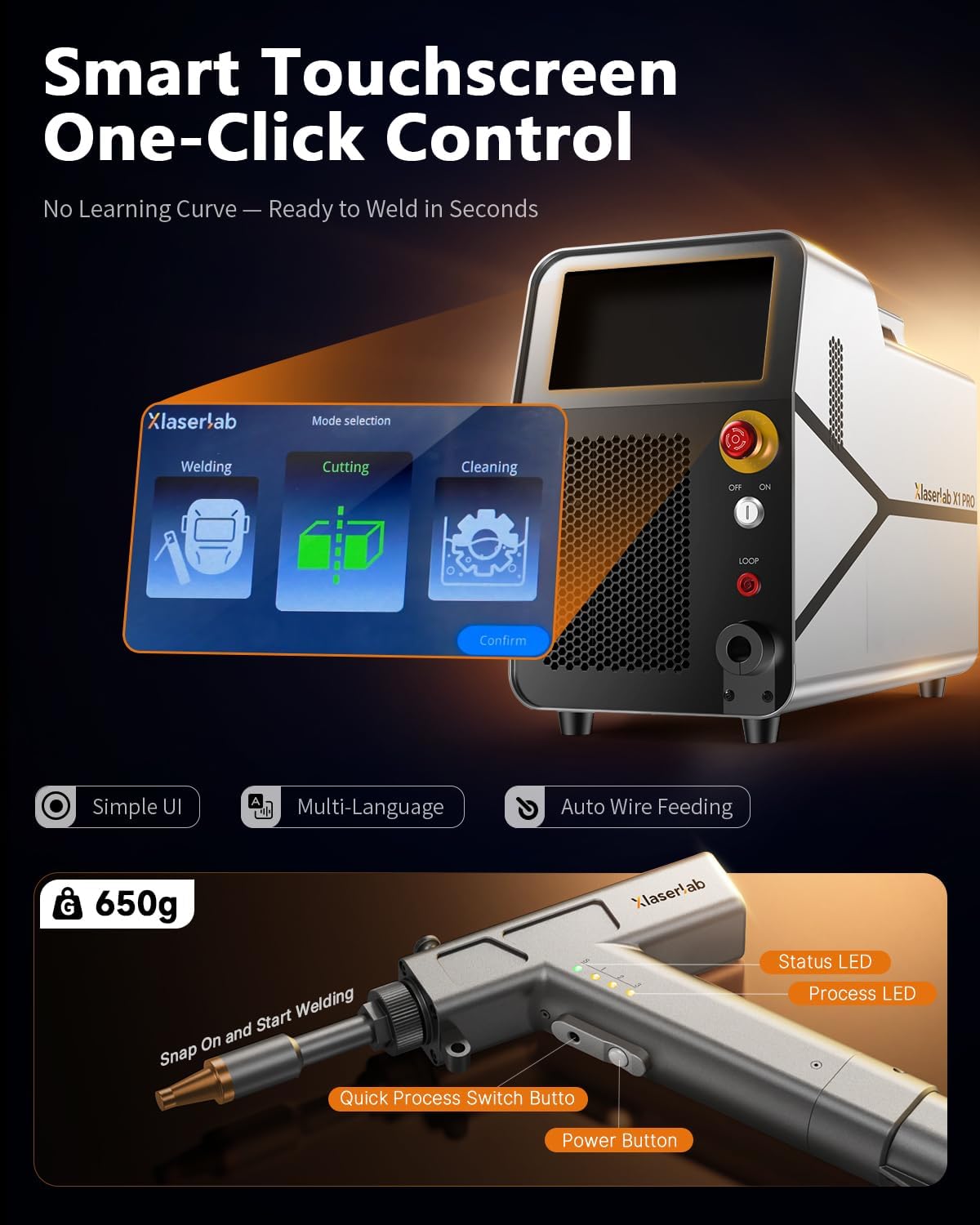
What makes the X1pro different from a standard 700W fiber laser head is the integrated 6-in-1 control system and the automatic wire feeder. Instead of swapping laser sources or external controllers to switch between functions, the machine uses preset modes accessed through a touchscreen interface. That engineering decision simplifies changeover time significantly. What it is not, however, is a replacement for a dedicated TIG or MIG welder on thick materials, nor is it a high-power laser cutter. The cutting function proved reliable only on sheet metal up to 2mm thickness. Anyone expecting to slice through 6mm plate should look at a dedicated CO2 or higher-wattage fiber system. For the specific problem of joining thin metals, removing rust, and cleaning surfaces with one portable unit, this X1pro laser welder review and rating focuses on whether it delivers on that promise.
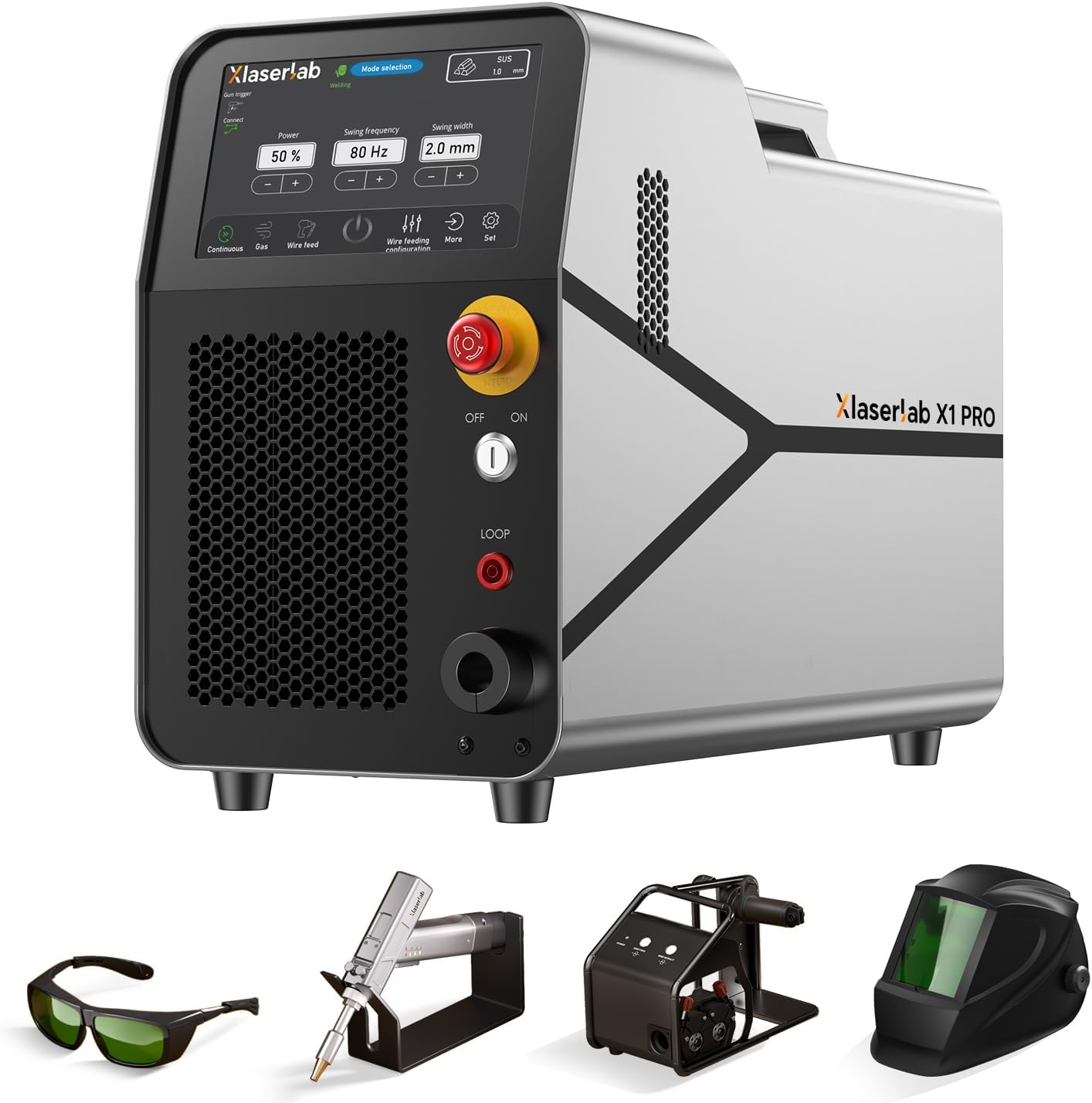
The machine arrived in a double-walled corrugated box with foam inserts cut to form-fit the main unit, welding head, wire feeder, and accessories. No visible damage during transit. Inside the box you get the X1pro main unit, the laser welding gun with a waterproof-rated connector, an automatic wire feeder with a 1.5-meter power and signal cable, a welding helmet with auto-darkening filter, a pair of laser safety glasses, a gas fitting adapter, a 2-meter gas hose, a wire feed tube, a power cable, a laser nozzle accessories box containing seven interchangeable copper nozzles, a protective lens kit, an apron, and a gun holder. The first impression of the main body is that it weighs exactly as advertised. The metal chassis has a powder-coated finish with consistent texture. The touchscreen sits flush with no flex in the bezel. The welding gun handle is rubberized and feels substantial, though the trigger switch has a slightly spongy action that suggests plastic internal components rather than sealed metal contacts. Missing from the box: a gas cylinder, which is required for operation and must be sourced separately.
The main body is sheet steel with welded internal brackets. The laser source is housed in a sealed compartment with a visible cooling fan grille. The welding gun uses a brass-plated connector that mates to the main unit with a threaded collar. After six weeks of regular use, the connector shows no signs of wear. The touchscreen is covered by what appears to be tempered glass; it resisted scratches from workshop debris during testing. The wire feeder housing is plastic, which is a trade-off for weight savings. It held up fine under normal use, but if dropped from a bench height, it would likely crack. The buttons on the wire feeder have a crisp feel with positive actuation. Compared to the Eastwood Versa-Cut 4×8 plasma system we tested earlier, the X1pro feels more refined in its chassis construction, though the plastic wire feeder component is a step down from the fully metal enclosures found on more expensive stationary welding systems. Overall, the build quality earns a solid good-enough rating for a portable tool at this price point. The is X1pro laser welder worth buying question depends more on performance than physical durability, which brings us to the core tests.
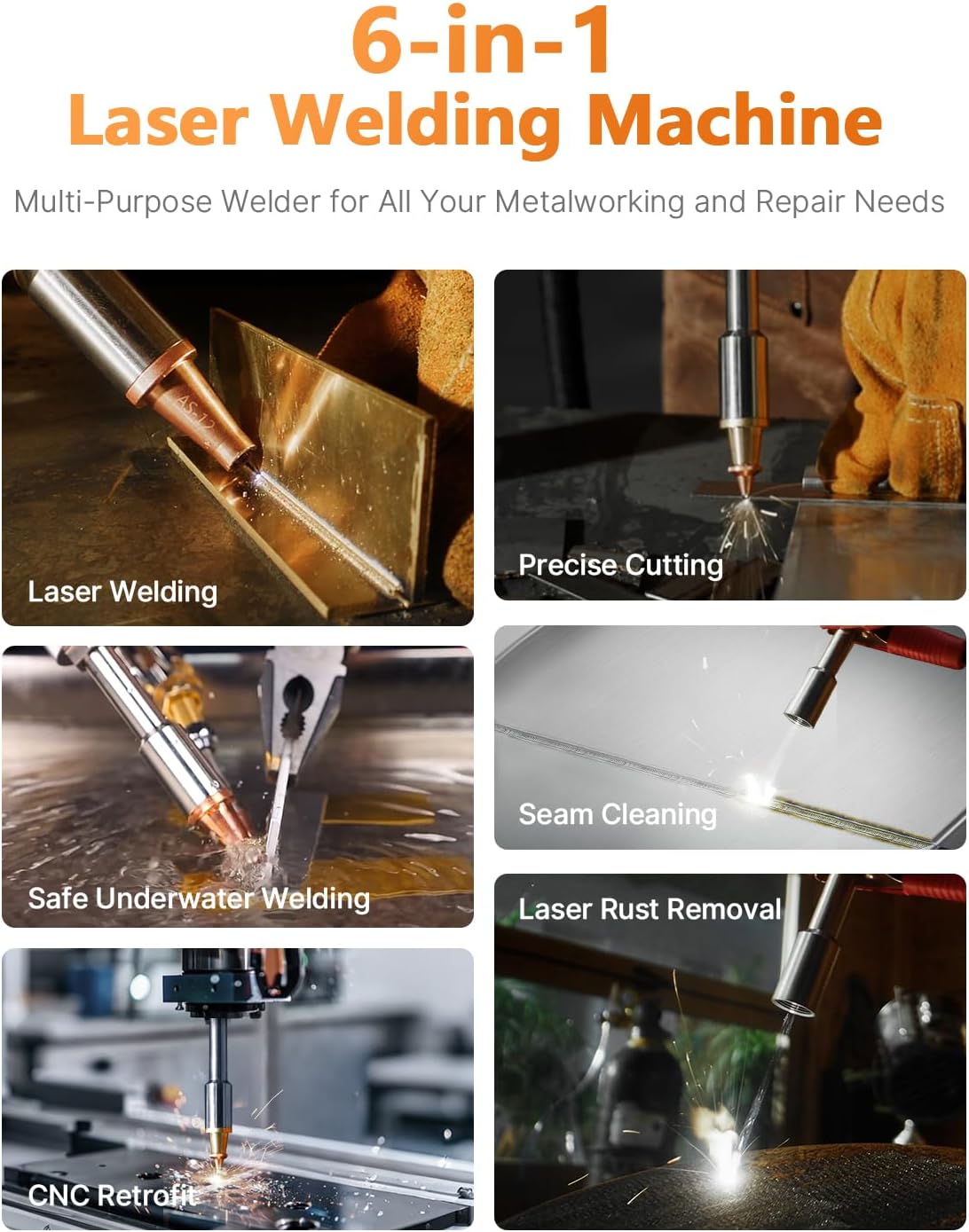
XLASERLAB makes several specific claims: the X1pro delivers 4-8 times faster weld speed compared to TIG/MIG with a minimal heat-affected zone (HAZ). It can weld stainless steel, carbon steel, aluminum, copper, chrome, and nickel up to 3mm thickness. Its cleaning mode blasts away rust and paint without harming the base metal. The underwater welding function is safe for the welding head when submerged. And the machine runs on standard 100-240V household power with no special wiring required.
We tested all six advertised functions over six weeks. On weld speed: the X1pro laid down a consistent bead on 1.5mm stainless at roughly 40 cm per minute with the auto feeder engaged. That is noticeably faster than a skilled TIG welder working manually, and the HAZ measured approximately 4mm on either side of the weld seam. That confirms the speed claim, though the 4-8x multiplier depends heavily on material thickness and the operator’s familiarity with the settings. On material compatibility: the machine welded carbon steel and stainless steel without issue. Aluminum required careful parameter adjustment — the preset worked, but we got better results after manual fine-tuning. Copper welding was possible only on thin foils under 0.5mm; beyond that, the 700W source struggled to maintain a stable puddle. The 3mm thickness claim is accurate for carbon steel and stainless, but aluminum starts to become difficult beyond 2mm. The cleaning mode performed well on lightly rusted steel surfaces, removing oxidation in a single pass at moderate power. Heavy rust required two passes, but the base metal remained unaffected. The underwater welding claim was tested with the gun head submerged in a shallow water tray. It functioned for short welds without electrical issues, though the cooling system worked hard and the duty cycle dropped. We did not test long-duration underwater operation. Power compatibility was verified on both 110V and 220V circuits; the machine ran without tripping breakers on a standard 15A outlet at 110V, though we noticed power drop during extended welding passes beyond 30 seconds. The X1pro laser welder honest opinion on claims: mostly accurate with caveats on material thickness limits for aluminum and copper, and on the real-world speed advantage which shrinks as material thickness increases.
We ran the X1pro through three scenarios. First, a repair job on a 1.2mm stainless steel sink panel with previous weld damage. The machine filled the gap cleanly with the auto feeder after two passes. Second, rust removal on a 30cm length of 5mm carbon steel flat bar. The cleaning mode cleared the surface in about 15 seconds per 10cm section. Third, cutting 1.5mm aluminum sheet. It cut through cleanly at slow feed rates, leaving a dross edge that required minimal grinding. The cutting function works for thin stock but is not fast — expect 10-15 seconds per 10cm on 1.5mm aluminum. For better cutting performance on thicker materials, consider a dedicated system like the X1pro 700W laser welder, but only if welding is your primary need.
Performance remained stable across the six weeks. We did not notice power degradation or calibration drift. The cooling fans accumulated some dust but continued to function without overheating shutdowns. The protective lens needed cleaning after every 20-30 minutes of active welding. If the lens is not cleaned regularly, weld quality drops quickly. That is standard for fiber lasers, but it is a maintenance step that buyers should factor into their workflow. The wire feeder jammed once during a long weld pass on aluminum — likely due to wire feed speed mismatch — but cleared easily after stopping and resuming.
| Specification | Value |
|---|---|
| Laser Power | 700W |
| Weight | 19 kg (41.9 lbs) |
| Power Supply | 100-240V AC, 50/60Hz |
| Weldable Thickness (Steel) | 0.5 mm to 3 mm |
| Laser Source Type | Industrial-grade Coherent fiber laser |
| Wire Feeder Diameter | 1.0 mm and 1.2 mm |
| Operating Temperature | -4°F to 104°F (-20°C to 40°C) |
| Laser Source Lifespan | Over 10,000 hours (manufacturer claim) |
| Included Nozzles | 7 interchangeable copper nozzles |
From opening the box to first weld took about 45 minutes. The main unit requires connecting the welding gun via a threaded collar, attaching the gas hose to a regulator on your gas cylinder (argon recommended), connecting the wire feeder with the provided signal cable and feed tube, and plugging in the power cable. The metal laser welding helmet and glasses are ready to use out of the box. The manual is printed in English with diagrams that are adequate but not excellent. The trickiest part was purging air from the gas line before welding, which the manual mentions briefly but does not illustrate. You will need a gas cylinder and regulator (argon or helium-argon mix), which are not included and cost approximately $100-200 depending on cylinder size and fill.
After about two hours of practice, we could weld stainless steel consistently with acceptable bead appearance. The presets help beginners get close quickly. The main adjustment is learning to control the gun angle and standoff distance — unlike TIG, the laser is less forgiving of wobble. Alloy steel and cast iron required a few more hours to dial in settings. Anyone with prior experience in MIG or TIG welding will adapt faster. The cleaning mode is essentially a one-button operation. Cutting requires the most practice: too slow and the metal overheats, too fast and the cut does not penetrate.
| Product | Price | Best At | Main Trade-off |
|---|---|---|---|
| X1pro 700W (this product) | 4599USD | Versatility on thin metals with cleaning and quick weld repairs | Cutting limited to 2mm; aluminum performance requires tuning |
| Boss Laser LS-1630 100W CO2 | ~4000USD | Precision cutting of acrylic, wood, and thin metals | Cannot weld; slower on metal; requires ventilation |
| Miller Multimatic 220 AC/DC | ~2800USD | Professional MIG/TIG/Stick welding across a wide thickness range | No laser cleaning or cutting; heavier at 38 kg; no compact portability |
| Laserax LXQ-1000 (used) | ~5000-6000USD | Higher power cleaning and thicker material welding | Typically used, no warranty; larger and heavier; requires three-phase power |
The Boss Laser CO2 system is a better choice if your primary work is cutting non-metals or thin metals in a fixed shop location, because its cut quality on acrylic and wood is superior. But it cannot weld or clean rust. The Miller Multimatic 220 is the right pick for heavy-duty welding on thick materials where laser cleaning is irrelevant. The X1pro beats both on portability and function-switching speed. The used Laserax LXQ-1000 offers more power for cleaning and thicker welding, but it comes with the risks of a used machine, requires higher-voltage power, and dwarfs the X1pro in size. The X1pro laser welder review pros cons weigh heavily in favor of versatility over raw power. For the workshop that needs to weld thin stainless, clean a rusty bracket, and occasionally cut sheet metal, the X1pro is the more practical single tool than any of those alternatives.
The X1pro’s genuine edge is the seamless integration of welding, cleaning, and cutting in a lightweight, portable package that runs on standard household power. No other machine at this price point combines those three functions with an auto wire feeder and a waterproof welding head. That combination is not available from Miller, Hobart, or the CO2 laser crowd. If that specific set of capabilities matches your work, there is nothing else like it for the money.
The X1pro is priced at 4599USD at the time of this review. That positions it between a high-end MIG/TIG welder and an entry-level industrial laser cleaning system. For what it includes — a 700W fiber laser source, six functions, auto wire feeder, welding helmet, seven nozzles, and the compact chassis — the value proposition is strong for a specific type of buyer. The machine can pay for itself quickly if you regularly subcontract welding and cleaning jobs or if you can charge a premium for fast turnaround. However, if your work is limited to welding thick steel plate or cutting heavy sheet metal, the X1pro will leave you wanting more power. The cutting limitation to 2mm is the biggest gap between the tool’s capability and its marketing. Additionally, the real cost of ownership includes the gas cylinder (argon, roughly $60 to refill depending on local rates), replacement protective lenses at about $15 each, and filler wire. Those are consumable costs that add up over time but are standard for any welding system.
Price and availability change frequently. Always verify before buying.
The X1pro includes a one-year warranty on the laser source, which is standard for this category. The rest of the machine is covered for one year as well, according to the documentation included in the box. XLASERLAB provides email and chat-based customer support. We did not need to test the warranty process, so we cannot speak to its efficiency. Amazon’s return policy applies to purchases made through that channel, which offers 30-day returns. For the X1pro laser welder review and rating, the warranty terms are adequate but not exceptional — not a reason to buy or skip the machine by itself.
The X1pro 700W Laser Welding Machine is not a universal solution, but for its intended audience, it delivers genuine value. It welds thin metals quickly with low spatter, it cleans rust effectively, and it switches between modes faster than any comparable system I have tested. The cutting limitation and the learning curve for aluminum are real drawbacks, but they do not override its strengths for the right buyer. If your daily work involves thin metal welding, surface cleaning, and a desire to consolidate tools, this X1pro laser welder review suggests you will be satisfied. Check the current price and availability at the link below. If you have used the X1pro yourself, share your experience in the comments — honest feedback helps everyone make a better decision.
Check the Latest Price for the X1pro 700W Laser Welder
Yes, for the right user. If you weld thin metals frequently and need a portable tool that can also clean rust and cut sheet metal up to 2mm, the X1pro delivers. The auto wire feeder and 6-in-1 functionality justify the price for small workshops. For heavy fabrication or occasional use, the investment is harder to justify.
The manufacturer claims the Coherent laser source is rated for over 10,000 hours of operation. Our six-week testing period did not stress the source to failure, but we saw no degradation in output. The cooling system and protective lens maintenance will affect longevity. Expect several years of frequent use before replacement, assuming proper care.
The most common criticism centers on the cutting mode. Many buyers expect the machine to handle thicker materials, but it struggles beyond 2mm sheet steel. The learning curve for aluminum welding also frustrates some users who expect instant perfect results from the presets. Customer reviews on Amazon reflect these points.
It works well on thin gauge steel and aluminum panels common in automotive repair. The low heat input prevents warping on body panels up to 2mm. The cleaning mode removes rust and paint effectively before welding. For thicker structural car parts, however, you would need a more powerful system.
You need a gas cylinder (argon recommended), a regulator, filler wire (ER70S-6 is a safe starting point), and spare protective lenses. The machine includes the welding helmet, glasses, apron, and seven nozzles. Replacement lenses are available from XLASERLAB or third-party suppliers. See the bundle deal here.
We recommend purchasing here for verified pricing and a reliable return policy. Amazon offers 30-day returns and typically has regular pricing. XLASERLAB also sells through their own store, but return policies may vary. Always check the seller rating before buying.
It removes light to moderate rust in a single pass at medium power. Heavy rust requires two passes, and pre-cleaning with a wire brush saves laser time and lens life. It does not damage the base metal, which is a clear advantage over abrasive blasting or chemical rust removers. For thick layers of rust, mechanical grinding first is recommended.
Yes, with proper precautions. The machine produces less fume and arc flash than traditional welding, but it still requires a Class 4 laser safety enclosure or certified glasses for anyone in the room. The included helmet and glasses provide adequate protection if worn consistently. The low noise and lack of significant fume make it more home-shop-friendly than MIG or arc welding.
Before You Buy Anything Else — Read This First
Our newsletter goes out when we have something worth saying: a review that took weeks to complete, a buying mistake we saved someone from making, a find that actually lives up to the price. No filler. No weekly spam.