Physical Address
304 North Cardinal St.
Dorchester Center, MA 02124
Physical Address
304 North Cardinal St.
Dorchester Center, MA 02124

There is a moment when a garage quietly stops being a garage. It usually arrives in the second season of owning a riding mower: the tarp comes off, four bags of mulch go in, and the car ends up in the driveway because there is no floor space left.
You have probably already opened a dozen tabs on horizontal sheds. Most of what is out there is a spec sheet with a star rating bolted onto it. That does not help you decide anything.
This Suncast Horizontal Storage Shed review reports what six weeks of real use showed. It will not tell you what to think. It will tell you where the claims hold up, where they do not, and what this unit is genuinely bad at. We tested the 98 cu ft Suncast Glidetop model (BMS4950D) from late summer into fall in a climate with steady rain and wide temperature swings. Inside went a riding mower, two adult bikes, and four stacked storage bins. For context on how it stacks up against other resin sheds we have examined, our Aoxun 8×6 storage shed review covers a very different approach to the same problem.
Disclosure: This review contains affiliate links. Purchasing through them supports our work at no added cost to you. All testing was conducted independently.
The Suncast BMS4950D is a horizontal resin storage shed — a mid-range unit in a category that runs from roughly $200 flip-top boxes up to $1,500 walk-in resin buildings. It sits in the middle. It is not a bargain bin item and it is not a permanent structure.
Suncast has been manufacturing molded resin lawn and garden products since the mid-1950s and is based in Batavia, Illinois. You can see the full product line at Suncast’s official site. The company’s core competency is injection-molded resin, and that shows here.
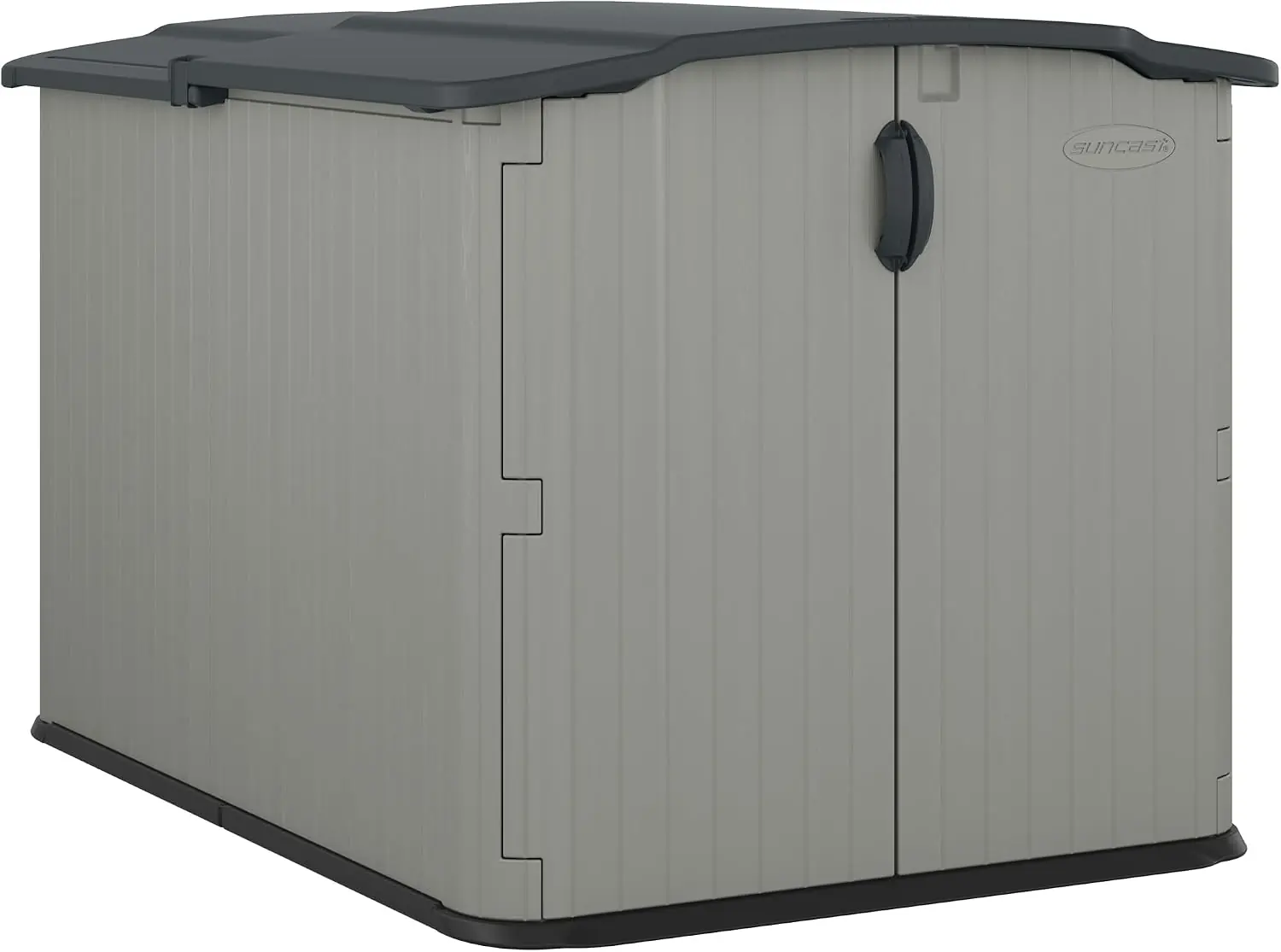
The problem it solves is functional, not aesthetic: weatherproof storage in a footprint that fits against a fence, a back wall, or the side of a garage, where a vertical shed simply will not go. It is 57.5 inches deep, 79.75 inches wide, and 52 inches tall. That last number is the whole design idea. It is short enough to sit under a fence line and wide enough to swallow a mower sideways.
The differentiator is the sliding lid. Most sheds in this class open with swinging doors, which require clearance in front of the unit. The Glidetop lid slides back on molded tracks, so the shed can sit flush against a wall and still give you full access to the top. Anyone who has wrestled a mower out of a shed pressed against a fence will understand why that matters. That is where this Suncast Horizontal Storage Shed review and rating starts — with the access mechanism, because it is the one thing this unit does that most rivals do not.
What it is not: it is not walk-in, not insulated, not wired for power, and not a substitute for a permitted structure. If you want shelving you can stand in front of, this is the wrong product.
The shed arrived in one long flat carton weighing 112 pounds shipping weight. The packaging was unremarkable but effective: foam corner blocks, taped bundles, no crushed edges on arrival. That is a low bar, but a lot of large resin products fail it.
Inside: eight wall panels, two lid sections, one reinforced floor panel, three door panels with hinges and latches pre-molded, a hardware bag, and a diagram-only instruction booklet. There is no padlock, no anchor kit, and no shelving. The anchor omission is the one that matters, and we will come back to it.
First physical impression: the panels have a matte, slightly chalky finish in gray. They are lighter than they look. Each wall panel can be carried by one person without strain, which tells you what you need to know about wind resistance before you even assemble it.
The body is multi-wall resin — hollow-cored panels with an inner and outer skin, not solid plastic. That construction is why the unit insulates slightly better and flexes less than single-wall competitors. The floor is the same resin, molded with a ribbed underside.
Panel joins are snap-together with screws at stress points, including the hinge mounts and lid tracks. Over six weeks of daily use, the Suncast Horizontal Storage Shed review and rating criteria that mattered most were the ones you only notice over time: no warping at the door edges, no cracking around screw points, no separation at the roof seam.
Compared to the Rubbermaid horizontal shed we have handled previously, the panels here feel slightly thinner but the fit tolerances are tighter. Nothing loosened during testing. The lid tracks are the weakest mechanical point — more on that below.
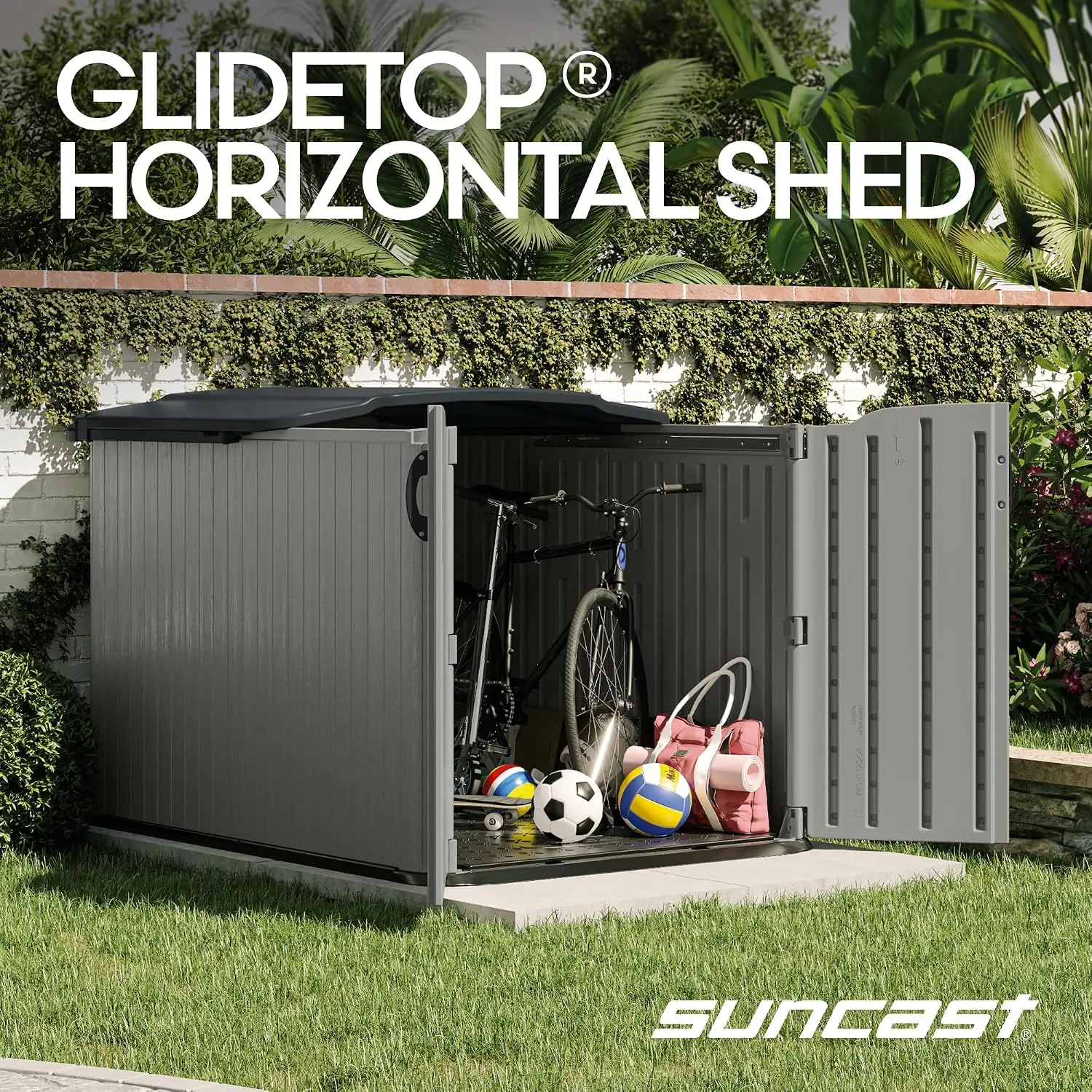
Suncast states four things plainly on the listing. First, 98 cubic feet of storage capacity. Second, multi-wall resin panels that withstand weather. Third, a reinforced floor that supports heavy items including tractors and bikes. Fourth, a pad-lockable three-door locking system, with the padlock not included. The listing also claims water resistance and UV protection, and easy assembly with minimal tools.
Capacity held up. We measured the interior and loaded it with a 46-inch-deck riding mower, two adult bikes, and four 27-gallon storage bins, and it all fit with room to spare at the ends. The nominal 98 cu ft figure is honest for bulk items. It is less honest for anything tall — the lid slopes, and headroom drops by several inches toward the outer edges. Plan for that if you are storing upright equipment.
The reinforced floor claim is the strongest of the four and the one that most justifies the price. We rolled a 540 lb riding mower in and out daily for six weeks. No flex, no cracking, no deformation at the ramp edge. For an honest Suncast Horizontal Storage Shed review, that is the finding that matters most, because a floor failure would make the whole unit useless.
The weather claim is mostly true with one caveat. After a two-day rain event totaling just over two inches, the interior was dry. But wind-driven rain did leave a damp patch roughly the size of a dinner plate near the threshold on the door side. It dried without issue. The doors are not gasketed.
UV protection we cannot verify. Six weeks is not a long enough window to judge resin degradation, and we will say so rather than repeat the marketing line. Anyone claiming otherwise after a month of testing is guessing.
The locking claim is accurate but narrower than it sounds. The three doors accept a padlock. The sliding lid does not lock on its own — with the lid closed but the doors unlocked, the unit is open. That belongs in any Suncast Horizontal Storage Shed review pros cons list, because it changes how you use the shed day to day.
After a two-day rain event, the interior stayed dry except for the threshold patch noted above. The floor panel sits slightly proud of the base, so water that sheets underneath does not wick up into the storage area.
In a stretch of humid, warm days with damp gear inside, we saw light condensation on the underside of the lid. Nothing got wet, but the unit is not ventilated, and a sealed resin box full of damp grass-covered equipment will sweat. Leave the doors cracked on dry days if you can.
Daily mower access was the third scenario and the one that sold us on the design. The Glidetop lid slides back far enough to give a full-width opening, and the Suncast Glidetop horizontal shed can be loaded from directly above without moving anything else out of the way. Getting a mower in took under 30 seconds. Try that with a swinging-door shed against a fence.
Performance did not degrade across six weeks. The lid tracked the same way on day 42 as it did on day one, the doors stayed aligned, and no fasteners backed out. The one recurring maintenance item was the lid tracks, which collected grit and grass clippings and needed clearing twice with a stiff brush. Left alone, that debris would eventually make the lid bind.
Best performance came on dry, cool days. Worst came in sustained wind, where the unit showed its weight problem — more on that in the setup section.
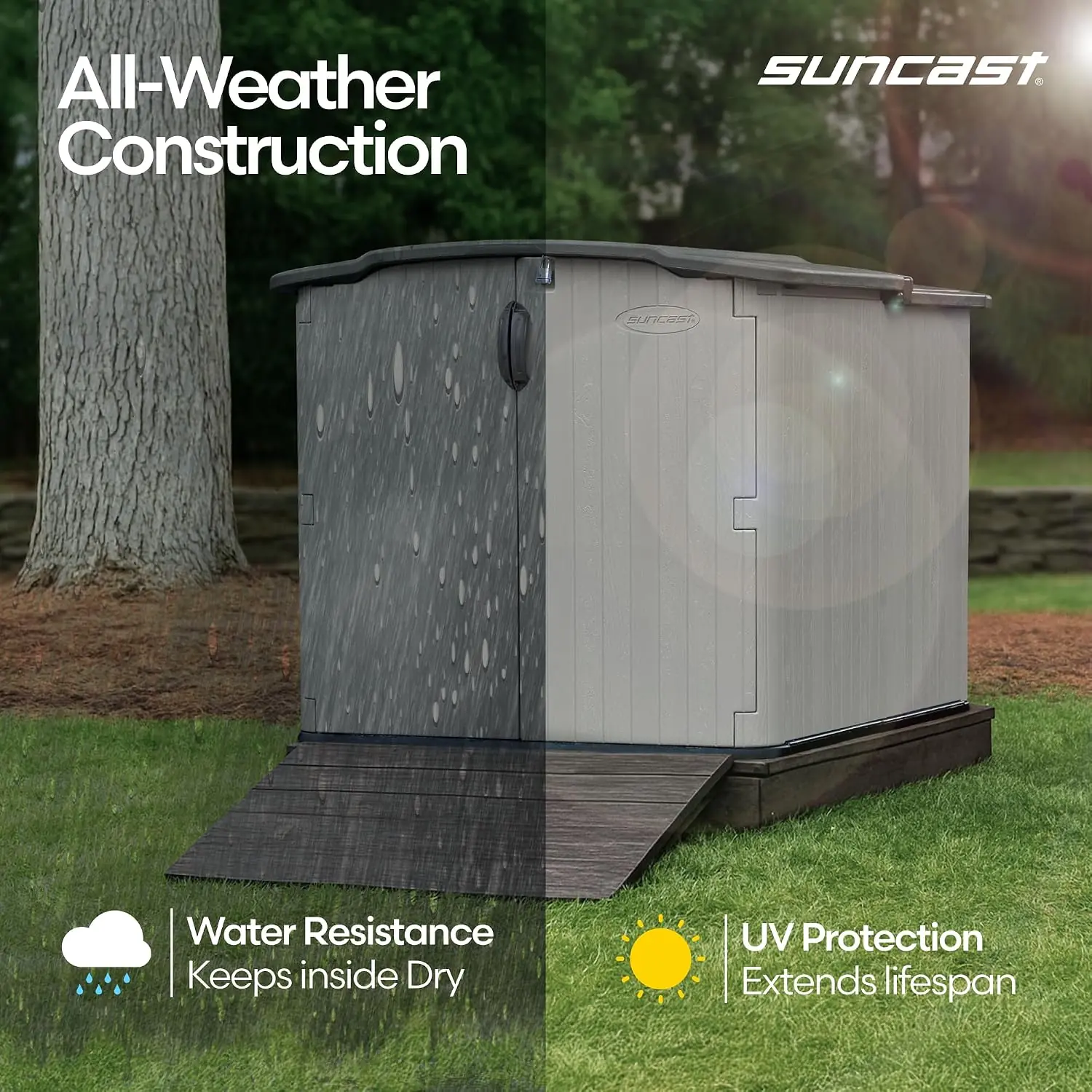
If you are weighing this against smaller plastic boxes, the honest Suncast Horizontal Storage Shed review pros cons picture is simple: you are paying for the floor and the lid. Everything else is standard for the category. For a wider look at how we evaluate outdoor equipment generally, our full archive of backyard gear testing is the place to start.
| Specification | Value |
|---|---|
| Model | BMS4950D |
| Capacity | 98 cu ft |
| Dimensions (D x W x H) | 57.5 x 79.75 x 52 in |
| Item weight | 112 lb |
| Door width | 42.5 in |
| Door height | 46.25 in |
| Chamber depth | 57.5 in |
| Material | Multi-wall resin |
| Floor | Reinforced resin, molded in |
| Color | Gray |
| Locking | Three padlockable doors (padlock not included) |
| Water resistance | Water resistant, not gasketed |
| UV protection | Stated by manufacturer, not verified in testing |
| Assembly | Minimal tools, two people recommended for lid |
Two people assembled it in about 95 minutes, including unpacking and cleanup. One person can do the walls alone; the lid sections are awkward enough that a second set of hands saves real time and swearing. Tools required: a Phillips screwdriver, a rubber mallet, and a level.
The critical dependency that is not obvious from the listing is the base. The shed needs a flat, level surface — patio pavers, concrete, or well-compacted gravel. We assembled ours on ground that was level to within half an inch, and the lid still needed a shim under one corner to track smoothly. There is no app, no account, and no power requirement.
It felt natural after about a day. The only real adjustment was learning to slide the lid fully back before lifting anything, rather than trying to angle a mower through a half-open gap. Ten minutes of trial and error solves that.
Prior experience with flat-pack furniture helps more than experience with tools. What does not matter at all: whether you have assembled a shed before. The panels only fit one way, and the mistakes are self-correcting.
| Product | Price | Best At | Main Trade-off |
|---|---|---|---|
| Suncast Horizontal Storage Shed (BMS4950D) | 0USD as recorded | Overhead access in a tight footprint; floor strength | Light panels, no anchors included, no walk-in access |
| Rubbermaid Large Horizontal Storage Shed (FG374701) | Typically $450–$600 | Thicker resin panels and heavier overall construction | Swinging doors need clearance in front; higher price |
| Keter Store-It-Out MAX | Typically $200–$320 | Price and a smaller footprint for smaller yards | Roughly 42 cu ft — will not fit a riding mower |
| Lifetime 8×5 Outdoor Storage Shed (6405) | Typically $900–$1,200 | Stand-up interior with shelving and a real door | Vertical footprint, permits, and a much higher cost |
The Rubbermaid FG374701 is the closest direct competitor, and it is built heavier. Its panels have more mass, its hinges feel more substantial, and it holds up better on an exposed site without anchoring. But it opens with doors, which means it needs three feet of clear space in front of it. If your shed has to sit flush against a fence, this Suncast Horizontal Storage Shed review and rating gives the Suncast the edge on layout alone.
The Keter Store-It-Out MAX costs less and assembles faster. It is also roughly a third of the capacity and cannot accept a riding mower. For garden tools, cushions, and bikes, it is the better buy. For equipment, it is the wrong product.
The Lifetime 6405 is the real upgrade path. It is a walk-in steel-reinforced building with a full-height door, and it costs roughly twice as much. If you have the yard space and the budget, it solves a broader problem. If you want a shed you can place against a wall this weekend without a permit, it is overkill. Readers storing patio furniture alongside equipment should also see our Aoxun aluminum patio furniture review before deciding how much covered space they actually need.
It is the sliding lid, and it is not close. Every competitor in this class opens forward. This one opens upward and backward, which changes where the shed can physically go in your yard. If that constraint does not apply to you, you are paying a small premium for a feature you will never use, and the Rubbermaid is the more sensible purchase.
The listing data we recorded at the time of writing showed a price of 0USD. That is almost certainly a feed error or a placeholder rather than a real figure — no retailer sells a 98 cu ft resin shed for nothing. Units in this class typically sell between $550 and $850 depending on the season, the retailer, and whether it is a Prime event week. Verify the current figure before you make any decision, because these listings move.
At that typical price, you are paying for three things: the floor, the lid, and the size. The reinforced floor is the strongest value argument — it means no concrete pad, no plywood base, and no reinforcement kit, which is $100 to $250 you would otherwise spend. The lid is the second. The size is the third, and it is the one most buyers undervalue until they try to fit a mower into a 20 cu ft box.
Where the value gets harder to justify: if you only need storage for garden tools, bikes, and cushions, you are paying roughly double what a Keter Store-It-Out MAX costs for capacity you will never fill. The price only makes sense if a riding mower, a motorcycle, or a comparable piece of equipment is going in.
Budget beyond the sticker price for two add-ons: a padlock (roughly $15) and ground anchors (roughly $25). Add a paver or gravel pad if your site is not already level, which can run $50 to $150. Total realistic ownership cost sits meaningfully above the listed price.
Price and availability change frequently. Always verify before buying.
Suncast publishes a limited warranty against manufacturing defects on this line. It does not cover fading, wind damage, or damage to a unit that was not anchored — which is worth knowing before you file anything. We read the terms but did not file a claim, so we cannot tell you how the process performs in practice, and we will not pretend otherwise.
Returns run through the standard retailer window, typically 30 days. Practically speaking, returning a 112-pound assembled shed is a genuine hassle. Inspect every panel before assembly. That is the advice that matters more than the warranty fine print for any Suncast Horizontal Storage Shed review verdict.
This Suncast Horizontal Storage Shed review verdict is a qualified yes. It earned it on the floor and the lid — two features that solve real problems rather than decorate a spec sheet — and it held up over six weeks without a single structural complaint. It lost points on wind resistance, on instructions, and on a locking system that leaves the lid unsecured unless you lock the doors.
If you have a mower and a fence line, buy it. If you have neither, spend less on a smaller unit. Tell us how yours held up in the comments — especially if you have run one through a winter. And if you want to check the current listing, check current pricing and availability here.
Yes, for a specific buyer. If you need to store a riding mower or bikes against a wall with no clearance in front, nothing else in this price band does the same job. If you need walk-in access or live on an exposed ridge, it is not. That is the honest Suncast Horizontal Storage Shed review verdict after six weeks of daily use.
We tested for six weeks and saw no degradation, but we cannot speak to five-year durability from that window. Resin sheds in this class commonly last eight to fifteen years with anchoring and reasonable care. The failure points reported by long-term owners tend to be wind damage and lid track wear, not panel breakdown.
Two themes come up in customer reviews and in our own testing. The first is wind: unanchored units move in storms. The second is the lid tracks collecting debris and eventually binding. Both are solvable with $25 of anchors and a stiff brush twice a year, but neither is mentioned prominently in the listing.
It is the best use case for it. A 46-inch deck mower fit with room to spare, and the reinforced floor handled 540 pounds without flex. The one caveat is that the lid slopes, so the highest point of the mower should sit toward the center of the unit rather than the edges.
A padlock is required rather than optional, since the lid does not lock independently — a standard weatherproof shed padlock and anchor kit covers both gaps. Ground anchors are strongly recommended. A paver base is optional if your site is already level. Shelving and hooks are optional and depend entirely on what you store.
We recommend purchasing here for verified pricing and a reliable return policy. Large resin sheds ship freight, and retailer return handling varies widely. Buy from a seller with a clear 30-day window and inspect every panel before you assemble anything.
We tested into early frost but not deep snow, so this is an inference rather than a measurement. The lid is molded resin with a slight arch, which sheds light accumulation. Heavy wet snow is a different problem, and we would clear it rather than test the limit. Resin gets more brittle in sustained cold.
Yes, but you supply the hardware. The floor is molded resin with no pre-drilled anchor points, so you will drill through the floor flange into your surface. On gravel or soil, ground augers through the base corners work. Do this before the first wind event, not after — a shed that has already moved is a shed with cracked panels.
Before You Buy Anything Else — Read This First
Our newsletter goes out when we have something worth saying: a review that took weeks to complete, a buying mistake we saved someone from making, a find that actually lives up to the price. No filler. No weekly spam.