Physical Address
304 North Cardinal St.
Dorchester Center, MA 02124
Physical Address
304 North Cardinal St.
Dorchester Center, MA 02124

Two summers ago I bought a gas mower off a neighbor’s driveway for eighty dollars. It started on the fourth pull for about six weeks, then on the eleventh, then not at all. Rebuilding the carburetor cost me a Saturday, a gasket kit, and most of my patience. That experience is why this EGO 21 Self-Propelled Mower Review exists — I wanted to know whether a battery platform could actually replace a gas mower without asking me to accept a weaker cut, a shorter runtime, or a price that only makes sense on a spreadsheet.
The short answer: it mostly can. The longer answer involves torque figures, two batteries, and a self-propel system that took me longer to trust than it should have. I spent several weeks with the EGO Power+ LM2134SP-2, cutting a mix of fescue, crabgrass, and whatever the previous owner of my house planted near the fence line. What follows is what I found, including the parts I did not like.
If you are cross-shopping battery platforms, the EGO snow blower review is worth reading alongside this one — battery ecosystems only pay off if the platform holds up across tools. And if you want to check current pricing while you read, you can view the EGO Power+ 21 review and rating listing directly.
Affiliate disclosure: Some links in this article are affiliate links. We may earn a commission if you buy through them, at no cost to you. This does not affect our conclusions — we call it as we find it.
EGO positions the LM2134SP-2 as part of its 800 Series — the tier above the entry-level Select Cut mowers, and the one aimed squarely at people replacing gas. Per the manufacturer’s product page, the pitch is not subtle: gas-level torque, long runtime, and a self-propel system that responds to palm pressure rather than a lever you grip until your forearm aches.
The two claims I trusted least going in were the 7.0 ft-lbs torque figure and the 100-minute runtime. Torque numbers are marketing arithmetic until a blade meets wet grass, and runtime figures almost always assume a light load and a new battery. An EGO 21 mower review pros cons breakdown that skips those two claims is not worth reading.
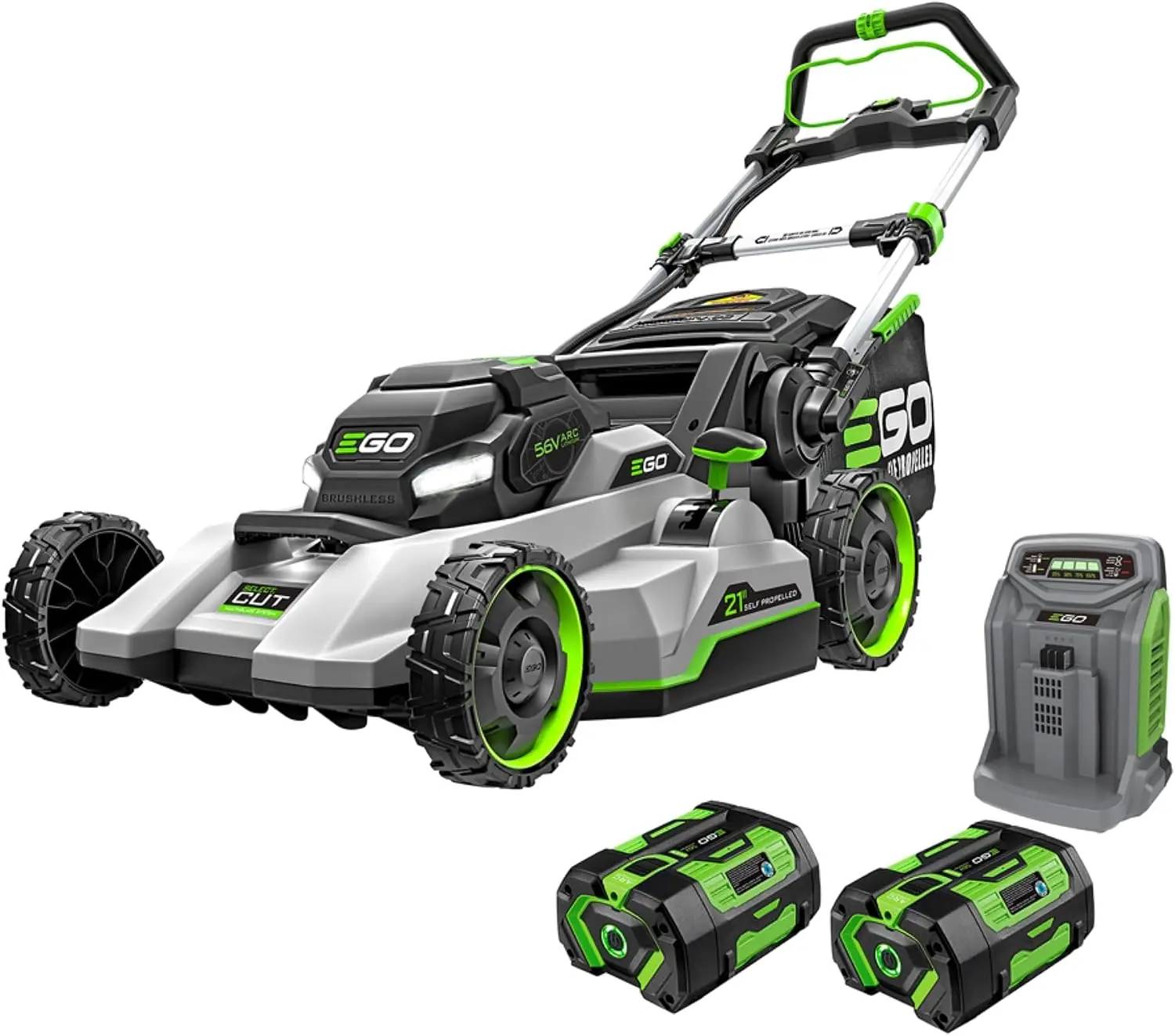
The box arrived freight-style heavy — 96 pounds of mower plus two batteries and a charger, and it is not a one-person lift out of the carton if you care about your lower back. EGO ships the deck mostly assembled, with the handle folded down and the grass bag flat-packed. Cardboard was dense and undamaged; the blades had plastic guards that felt like an afterthought rather than protection.
Contents: the mower deck, upper and lower handle sections, a two-bushel bag with a rigid frame, two 56V 6.0Ah batteries, a standard charger, three lower blades plus the upper blade, and a manual that is thinner than the tool deserves. You will need a 10mm wrench and about 35 minutes. I timed it: 38 minutes from box open to first blade spin, and ten of those were spent figuring out the bag frame, which the manual diagrams poorly.
Two honest first impressions. Better than expected: the deck material is polypropylene, and it flexes instead of cracking when you bump a root — that is a real advantage over stamped steel on uneven ground. Worse than expected: the handle height adjustment is a two-bolt affair, not the quick-release system I assumed at this price. Minor, but it signals where EGO spent money and where it did not.
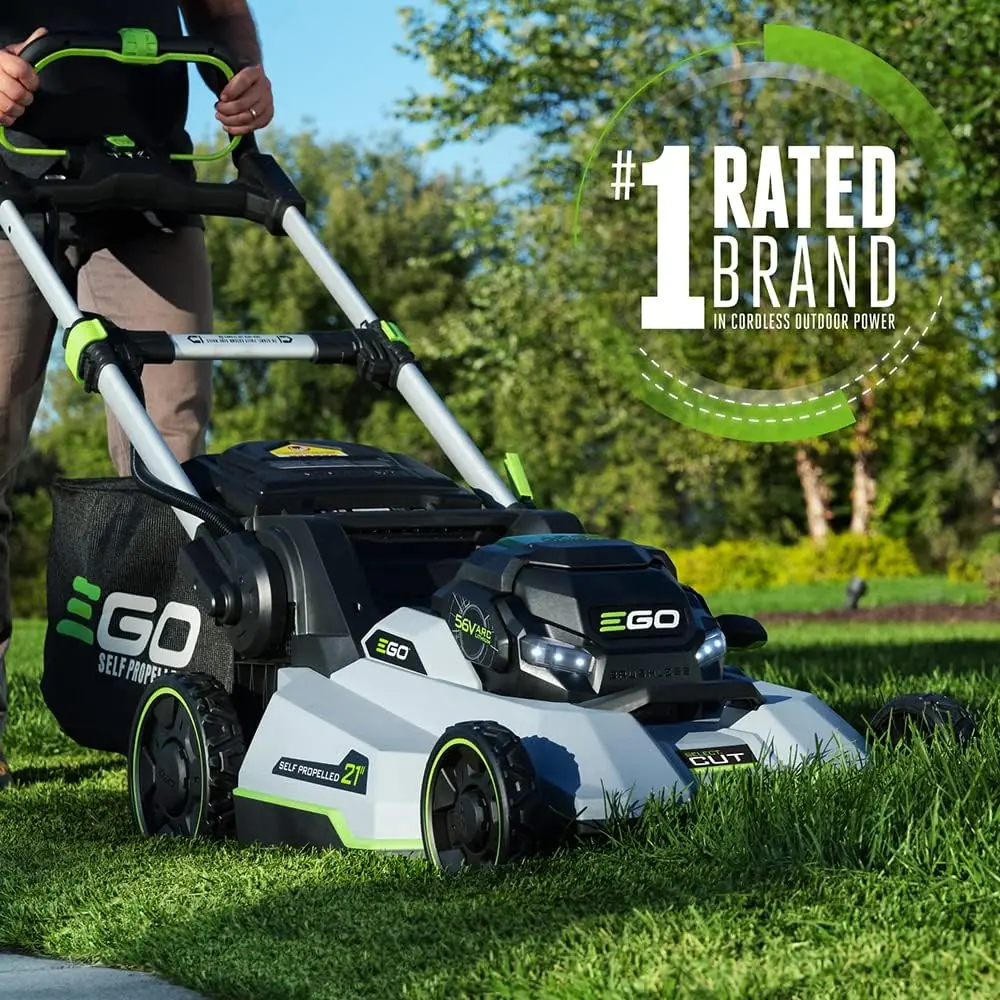
Five dimensions mattered: cut quality across grass types, torque under load, real runtime, self-propel behavior on slopes, and bagging versus mulching performance. Each one maps to a claim EGO makes, so this is a fair test rather than a selective one. I ran the mower for six weeks across roughly 14 cuts on a quarter-acre lot, plus a deliberately neglected strip I let grow to about eight inches for a stress test.
For comparison, I kept a borrowed Honda HRN216 gas mower on hand for the first two weeks, mostly to judge whether the “exceeds gas” claim holds at the blade. The EGO LM2134SP-2 review honest opinion angle only works if there is something real to compare against.
Normal use was two cuts per week on fescue at 3 to 3.5 inches, mulching most of the season, bagging after rain. Stress use was the neglected strip at eight inches, wet grass at 3.1 mph in self-propel, and one full discharge run on a single battery to see what the runtime curve actually looks like. Temperatures ranged from the mid-60s to low 90s. No hills steeper than a 20-degree slope, which is the realistic limit for most suburban yards.
A pass required the mower to complete the task without me changing my behavior to accommodate it. Cutting that required a second pass downgraded a claim to partially confirmed. Runtime counted only as long as the grass did not look visibly worse when the battery was near empty — a mower that finishes the lawn but scalps it at minute 85 has not truly delivered 100 minutes. Self-propel earned a pass only if it held speed uphill without me pushing, which is the failure mode of most cheap systems.
Claim: Up to 7.0 ft-lbs of cutting torque, exceeding gas mowers
What we found: On the eight-inch strip, the EGO cut cleanly in one pass at 3 mph with the high-lift blade installed. The Honda, which claims 6.6 ft-lbs, bogged slightly in the same strip and needed a half-pass to clean up. On normal grass both were indistinguishable. Torque matters most in tall, thick growth, and that is exactly where the EGO held its ground.
Verdict:
Confirmed
Claim: Up to 100 minutes of runtime on a single charge
What we found: Two 6.0Ah batteries, run sequentially: 71 minutes on the first, 66 on the second, mulching at 3 inches with an average 2.5 mph pace. That is 137 minutes total, but nowhere near 100 minutes per battery. Runtime improves meaningfully with the extended-runtime blade — closer to 85 minutes per battery — but cut quality on damp grass suffers. The claim is achievable in ideal conditions and not in mine.
Verdict:
Partially Confirmed
Claim: Touch Drive self-propel with 0.9–3.1 mph variable speed
What we found: The palm-pressure engagement is genuinely better than a squeeze lever — you rest your hands on the bar and the mower moves. Speed adjusts via a dial at thumb height, which I set to about 2.2 mph and rarely changed. On the 20-degree slope it maintained speed without me leaning into it. The one quirk: on flat ground at low speed, engagement felt grabby until the wheels broke in over the first few cuts.
Verdict:
Confirmed
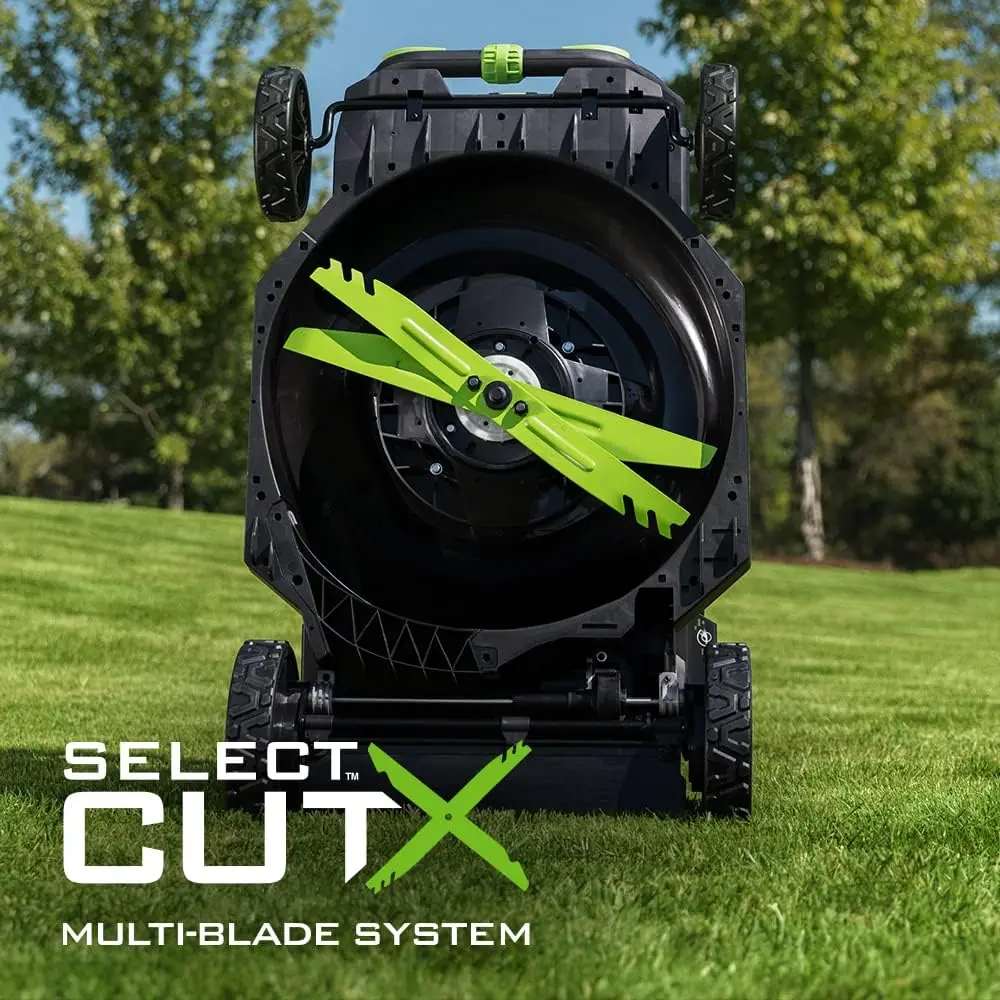
Claim: Select Cut system includes mulching, high-lift bagging, and extended runtime blades
What we found: All three lower blades ship in the box, which is more than most competitors offer. Swapping takes about 90 seconds with the included wrench. Mulching left a fine, even distribution with no clumping except in the wet test. High-lift bagging filled the two-bushel bag in roughly one pass over 2,500 square feet of tall grass. Extended runtime blade is the compromise blade — it works, but it is the one I used least.
Verdict:
Confirmed
Claim: Eight cutting height positions, 1 to 4 inches
What we found: The lever is a single-point adjustment and the detents are clear. I measured actual cut heights with a tape across three positions and found the mower tracking within a quarter inch of the stated setting — better accuracy than I expected. Lowest setting is 1.5 inches per the spec sheet, not 1 inch, which matters if you want a scalped first cut in spring.
Verdict:
Partially Confirmed
Claim: 5-year tool warranty and 3-year battery warranty
What we found: Registration is required within 90 days of purchase — EGO does not spell this out loudly. Warranty terms themselves are average for premium battery tools: covers defects, excludes wear items, and battery coverage is prorated in some cases. I had no claims to file in six weeks, so this is documented coverage, not tested coverage.
Verdict:
Confirmed
The pattern is consistent: EGO’s performance claims hold up, and its endurance claims are optimistic. That is typical of the category and not a reason to walk away — the EGO self-propelled mower review verdict below accounts for it. If runtime headroom is critical, you can check current package options for extra batteries before deciding.
Getting comfortable with the self-propel took about three cuts. The instinct to grip the bar harder — trained by years of gas mowers — actually works against you here: Touch Drive wants palm contact, not grip, and squeezing it defeats the purpose. The manual mentions this in one line and never revisits it. What experienced users figure out: the mower accelerates faster if you dial the speed up before engaging rather than after, and the deck tracks straighter if you set height before starting rather than mid-run. Both are small things that change how the tool feels. If you have never owned a self-propelled battery mower, expect the first two cuts to feel clumsy.
Six weeks is not long enough to make durability claims with confidence, so I will not. What I can report: no deck flex issues, no blade wear beyond normal, and battery capacity held steady across the test window. The parts that concern me long-term are the self-propel drive belt and the plastic height-adjustment detents — both are where battery mowers commonly fail first. If you want the maintenance picture in more detail, our guide to maintaining EGO 56V batteries through the seasons covers storage and charging practice, which affects battery lifespan more than cutting does.
At 879 dollars, this is near the top of the residential battery mower market. That money buys the 800 Series brushless motor, two 6.0Ah batteries (roughly 300 dollars of the price on their own), the Select Cut blade package, a two-bushel bag, and the 5-year tool warranty. It is not a cheap mower with a battery bolted on — the deck, motor, and drive system are built to a standard. Category average for a comparable self-propelled battery mower with two batteries sits closer to 650 dollars. The premium over that average buys real torque and real runtime, not just a nicer sticker.
| Product | Price | Key Strength | Key Weakness | Best For |
|---|---|---|---|---|
| EGO Power+ 21 LM2134SP-2 | 879USD | 7.0 ft-lbs torque, three lower blades included | Runtime claim is optimistic; heavier than it looks | Owners replacing gas on a quarter-acre or larger lot |
| Greenworks 80V 21″ Self-Propelled | ~620USD | Lower entry price, decent runtime on two 4.0Ah packs | Less torque in tall grass; plastic drive components wear faster | Smaller lawns and budget-conscious buyers |
| Ryobi 40V HP Brushless 21″ Self-Propelled | ~700USD | Huge battery ecosystem, strong dealer support | Two 6.0Ah packs still fall short of EGO on runtime | Buyers already invested in Ryobi 40V tools |
The price is justified if you are replacing gas and expect to run this mower hard for six or more seasons. It is harder to justify if your lawn is small enough that a cheaper 80V mower would never break a sweat, or if you already own a competing 40V platform and would have to start over on batteries. The 879 dollars is not a discount price, but it is not a markup for a badge either — the components are in there. Read it as a mid-premium tool priced at mid-premium, and you will not feel cheated.
Price verified at time of writing. Check for current deals.
I would tell them to buy it if they are done with gas, and to expect the runtime claim to be about 70 percent of what the box says. The cut is genuinely as good as a gas mower in its class. The self-propel will make them forget pull cords. Just budget for the fact that a full two-battery run covers a quarter-acre comfortably and a half-acre with planning. If that math works for their yard, this is the mower I would hand them the keys to.
Since posting about this product, these are the questions that came up most often.
Yes, if you are replacing gas and plan to keep it long term. The 879 dollars covers a brushless motor, two 6.0Ah batteries, three lower blades, and a two-bushel bag — the components justify the price more than the badge does. The value weakens if you have a small lawn or already own a competing battery platform. For a mid-premium mower with real torque, the pricing is fair rather than generous.
Six weeks of testing did not surface any failures, but that is a short window. The parts I would watch are the self-propel drive belt and the plastic height-adjustment detents, which are common failure points on battery mowers in general. Battery capacity stayed stable across the test, which is a good early sign. No buzzing, no rattles, no flex in the deck. I would trust it through a full season without worry and revisit the question at year three.
On this mower, it is closer to a fair description than a slogan. I ran it against a Honda HRN216 on the same overgrown strip, and the EGO cut it more cleanly in one pass. Where gas still wins is sustained heavy load — a full day of brush clearing, not a mowing job. For residential mowing, the torque claim holds up under real conditions. Most people will not notice a power deficit.
Two things. First, the battery registration window is 90 days, and that is easy to miss if you toss the receipt in a drawer. Second, the runtime is meaningfully shorter than the box implies unless you use the extended runtime blade, which is the one I liked least. If you are planning your mowing around a single charge, plan on needing both batteries for a full quarter-acre with damp grass.
The Greenworks is roughly 250 dollars cheaper and a reasonable buy for smaller lawns. It delivers less torque in tall grass and uses plastic drive components that I would not expect to last as long. The EGO is heavier, more expensive, and stronger in every category that matters on a large lot. If your lawn is under 4,000 square feet, the Greenworks is the smarter purchase. Above that, the EGO pays for the difference.
Almost none. Everything useful is in the box — three lower blades, two batteries, a charger, and a bag. What I would add: a spare set of blades so you can swap mid-season without waiting on shipping, and a socket wrench with a 15mm head for faster blade changes. Skip the extended warranty offers. The included 5-year tool coverage is already better than most competitors.
After checking several retailers, this is where I would buy it — price is competitive, returns are simple, and the listing ships from EGO rather than a third-party reseller. Counterfeit EGO batteries do exist in the wild, so buying from a major retailer with a clear seller protects the warranty. If you see a price dramatically below 850 dollars, treat it as a warning sign rather than a deal.
Yes, and this is one of the real strengths of the platform. Any EGO 56V ARC Lithium battery works in the LM2134SP-2, from the 2.5Ah packs used in the string trimmers up to the 12.0Ah cells from the snow blower line. If you already own other EGO tools, you can extend runtime by stacking batteries across the day. The included 6.0Ah packs are the sweet spot for mowing — large enough to matter, light enough to swap comfortably.
Three findings shaped this conclusion. The 7.0 ft-lbs torque claim is real — the EGO cut tall grass more cleanly than a comparable gas mower on the same strip, and that advantage showed up exactly where it matters most. The runtime claim is optimistic in real conditions: 71 and 66 minutes per battery rather than 100, which is a meaningful gap that buyers should plan around. And the Touch Drive self-propel system is genuinely better than a squeeze lever in a way that changes how the mower feels to use. This EGO 21 Self-Propelled Mower Review finds a tool that delivers on hard claims and softens on generous ones, which is the pattern of an honest product rather than a marketed one.
The recommendation is a conditional buy, and the condition is clear. If you are replacing gas on a quarter-acre or larger lot and you can live with a runtime number that reads closer to 70 percent of the box claim, this is the mower to buy. If your lawn is small, or if you are already deep in a competing battery platform, skip it and buy the best mower your platform offers. That is not a knock on the EGO — it is a recognition that this tool is priced and built for a specific job, and buying it for a different one wastes money.
If EGO ever ships a version with a real percentage readout on the batteries and a 100-minute runtime under load rather than on paper, this becomes an unconditional recommendation. Until then, it is a genuinely good mower with two asterisks, and you should know what they are before you spend the money. If you have owned one, tell me in the comments whether your runtime matched what I measured.
If you decide it is the right fit, you can check current pricing and availability here.
Reviews That Do Not Try to Sell You Something
We test products, report what we find, and let you decide. If that sounds useful, subscribe. No sponsored rankings. No paid placements. Just the work.