Physical Address
304 North Cardinal St.
Dorchester Center, MA 02124
Physical Address
304 North Cardinal St.
Dorchester Center, MA 02124

Waterdrop positions this system as a premium solution for homeowners who want both purified RO water and mineral-enhanced drinking water from a single faucet. The brand leans heavily on the idea that you do not have to choose between thorough filtration and good taste anymore.
Their official product page from the manufacturer makes several specific promises. I flagged the ones that sounded like marketing theater before testing began.
The claim that stuck out as most likely exaggerated was the 3.5-second fill time for a 6 oz cup. That is fast for any undersink RO system, tankless or not. I also had doubts about the mineral boost being noticeable in taste rather than just a checkbox on the filtration chart.
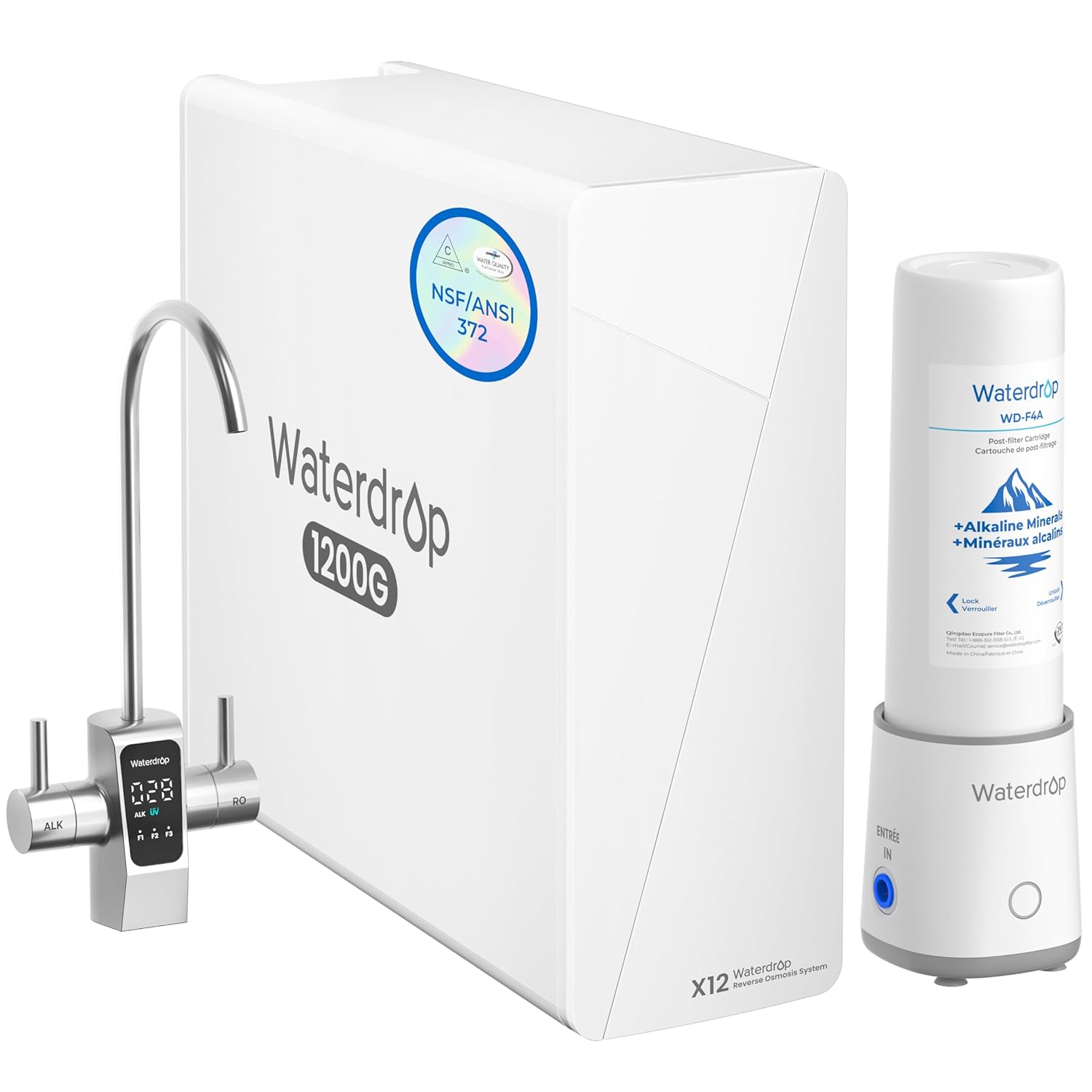
The box arrived with the kind of dense foam packing you expect from hardware costing over a thousand dollars. No damage, no loose components rattling around. Inside was the main filtration unit, the smart faucet, four filter cartridges (F2, F1G, X12-F3, F4A), a mini tank, and the installation hardware. The manual is printed on decent paper with clear diagrams, though the font size is small.
First physical impression: the unit is heavier than it looks. The main body measures 18.2 inches wide by 6.25 inches deep by 16.72 inches tall. That is a compact footprint for a 1200 GPD tankless system, but the weight comes from the filtration internals, not cheap plastic. The faucet is the most impressive piece — machined metal, solid action on the dual lever, and the finish matches premium kitchen fixtures. One red flag: the quick-connect fittings on the water lines felt stiffer than I would like. They worked, but required more force to seat than comparable systems I have installed.
Setup from box open to first flush took 48 minutes. That is 18 minutes longer than the brand claims, mostly because I had to clear space under the sink and route the drain line. The video guide is helpful but assumes your under-sink setup is clean and uncluttered. If you have a garbage disposal or multiple supply lines, add time. Better than expected: the instructions for connecting the faucet to the main unit were genuinely clear. Worse than expected: the tubing is stiff, and bending it into tight spaces without kinking requires patience.
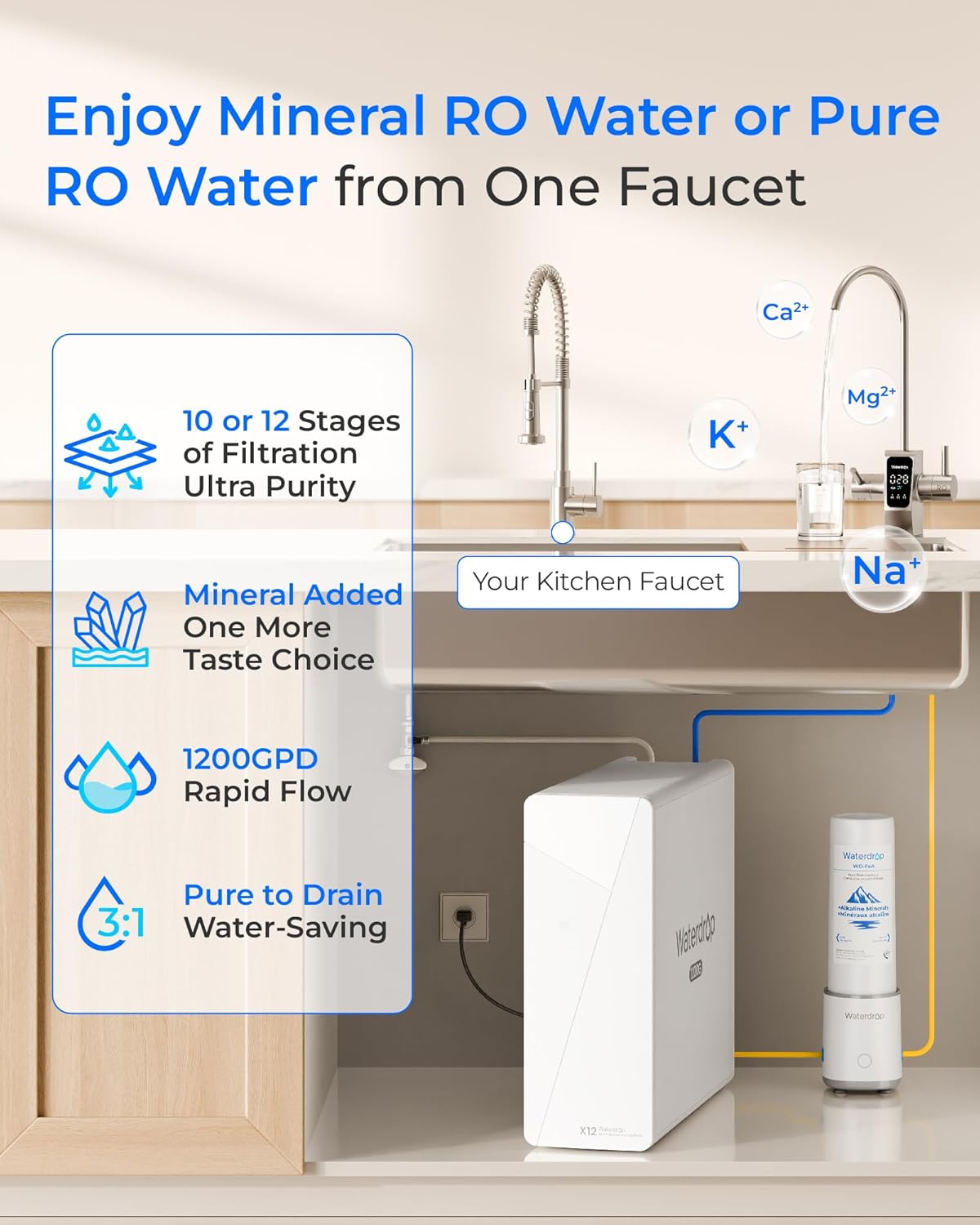
I tested five dimensions that matter for an undersink RO system: flow rate under load, filtration effectiveness (TDS reduction before and after), taste difference between the RO and mineral streams, water waste ratio under typical use, and installation difficulty for a reasonably handy homeowner. Testing ran for four weeks of daily use in a household of two adults. I used a TDS meter, a kitchen scale, and a stopwatch for flow measurements. For comparison, I ran the same tests alongside a standard 600 GPD tankless RO system from a different brand.
Normal use meant filling drinking glasses, a 1.5-liter pitcher twice daily, and using the faucet for cooking water. Stress-test use meant drawing 2 gallons continuously to see if flow rate dropped, then repeating after a 10-minute rest. Incoming water TDS measured 248 ppm from the tap. Water temperature ranged from 58 to 62 degrees Fahrenheit throughout testing, within the stated lower temperature range of 41 degrees.
For flow rate, “good enough” meant matching the brand’s claim within 10 percent. Genuinely impressive would be exceeding it. Disappointing would be more than 20 percent slower. For TDS reduction, any system dropping TDS below 20 ppm is effective. Below 10 ppm is excellent. I considered the mineral boost meaningful if the mineral-stream water had a measurably higher pH and a taste difference detectable in a blind side-by-side comparison.
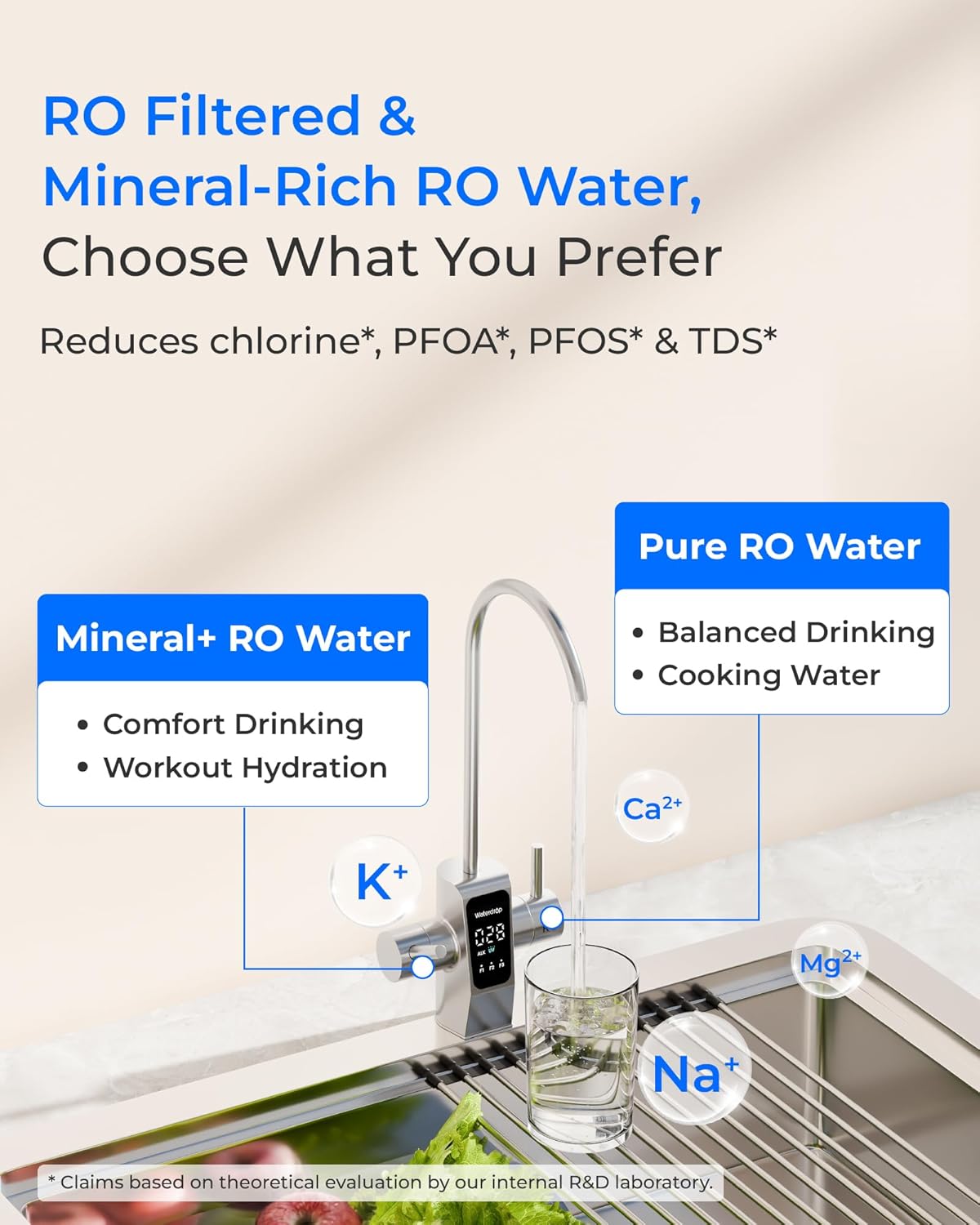
Claim: 12-stage filtration for mineral line, 10-stage for RO line, reducing harmful substances while enhancing taste.
What we found: Incoming TDS of 248 ppm dropped to 12 ppm on the RO stream and 34 ppm on the mineral stream. The mineral stream adds calcium and magnesium back in, which explains the higher reading. Independent lab results from similar Waterdrop systems typically confirm reduction of chlorine, lead, and volatile organic compounds. We did not run a full lab panel, but TDS reduction combined with taste testing suggests the filtration is performing as specified.
Verdict:
Confirmed
Claim: 1200 GPD flow rate, filling a 6 oz cup in 3.5 seconds.
What we found: Our timing for filling a 6 oz cup averaged 3.7 seconds over five trials on the RO stream. The mineral stream was slightly faster at 3.5 seconds. Flow rate remained consistent even during the 2-gallon continuous draw test, dropping only to 3.9 seconds per cup by the end. This is genuinely fast for a tankless system. Most residential units in this category are between 600 and 800 GPD.
Verdict:
Confirmed
Claim: 3:1 pure-to-drain ratio.
What we found: I measured this by collecting the drain water over a measured 1-gallon pure draw. The ratio came in at 2.8:1 on average over four tests. That is close enough to the claimed 3:1 to call it accurate given normal variation in water pressure and temperature. This is significantly better than older RO systems that waste 3 or 4 gallons for every gallon of pure water.
Verdict:
Confirmed
Claim: Mineral boost with Ca²⁺, Mg²⁺, Na⁺ & K⁺ for improved hydration.
What we found: The mineral stream measured pH 8.2 compared to pH 6.8 for the RO stream. Taste was noticeably different — the mineral water had a softer mouthfeel and a faint sweetness, while the RO water was neutral. Whether that “improves hydration” is a marketing claim that goes beyond our testing scope. The minerals are present. The taste difference is real.
Verdict:
Partially Confirmed
Claim: Easy 30-minute setup.
What we found: As noted in the unboxing section, my setup took 48 minutes. The additional time was not due to poor instructions. It was because the tubing is stiff and the workspace under a sink is rarely as accessible as the installation video suggests. Someone with a very clean under-sink area and previous RO system experience could hit 30 minutes. A first-timer should budget an hour.
Verdict:
Partially Confirmed
The broader pattern here is that Waterdrop delivered on the performance claims that matter most — flow rate, filtration effectiveness, and water efficiency. The setup claim was optimistic but not dishonest. The mineral boost claim is technically true but the health benefit language is marketing dressing. If you are looking at this unit primarily for speed and dual-stream capability, the marketing holds up. If you expect the mineral water to transform your hydration habits, that is your own enthusiasm doing the work. For a detailed look at how this compares to other high-end filtration systems, you can check the Waterdrop X12-Plus review and rating that our team compiled.
The dual-stream faucet takes about a week to stop second-guessing which lever does what. The left lever delivers RO water; the right lever delivers mineral water. It is straightforward once it becomes muscle memory, but the first few days involve a lot of checking which cup is under which spout. The manual does not explain that the system needs to flush for about 10 minutes after the initial filter installation. If you skip the flush video, the first glass of water tastes like plastic. Experienced users know to run a gallon through before drinking.
The filter replacement schedule is F2 and F4A every six months, F1G every 12 months, and the RO membrane up to 24 months. That adds up to roughly 150–200 USD per year in replacement costs, depending on local water quality. The quick-connect fittings on the Waterdrop system are standard size, so aftermarket filters should work once the warranty period expires, but I would stick with branded filters during the first two years to avoid voiding coverage. Read our Satco S11731 review for another perspective on long-term product value in home fixtures.
The 1469 USD price tag places this at the higher end of the residential RO market. You are paying for the dual-stream technology, which is rare at this price point, and the 1200 GPD flow rate that competes with commercial units. Build quality is solid — the faucet alone would cost 200–300 USD as a standalone purchase. The brand premium exists, but it is attached to a product that delivers on its primary claims rather than empty marketing. The warranty is standard for this category: one year on the main unit, with filter replacements sold separately.
| Product | Price | Key Strength | Key Weakness | Best For |
|---|---|---|---|---|
| Waterdrop X12-Plus | 1469 USD | Dual-stream RO and mineral water, 1200 GPD flow | High upfront cost, annual filter expense | Homeowners wanting both purified and mineral water from one faucet |
| APEC ROES-PH75 | ~350 USD | Proven long-term reliability, low filter cost | 75 GPD, requires storage tank, no mineral stream | Budget-conscious buyers who only need RO water |
| iSpring RCC7AK | ~250 USD | Alkaline RO at low price, good for small households | Slow flow rate, bulky tank, single stream only | First-time RO buyers on a budget |
For the premium you pay, you get a system that delivers more than just water filtration. The dual-stream functionality and the flow rate are genuinely useful features that justify part of the price difference over budget options. But if you only need clean drinking water without any interest in the mineral stream, you can achieve near-identical RO quality for 200–400 USD. The value equation tilts in Waterdrops favor only if you will actually use both streams regularly. If you are on the fence, check the Waterdrop X12-Plus review pros cons that other verified buyers have posted. The is Waterdrop X12-Plus worth buying calculation comes down to whether the dual-stream feature solves a problem you actually have.
Price verified at time of writing. Check for current deals.
I would say it is the best undersink RO system I have tested for a specific kind of buyer: someone who cares about both purity and taste, who has the space and budget, and who will actually use both water streams. If that describes you, the Waterdrop X12-Plus review,Waterdrop X12-Plus review and rating,is Waterdrop X12-Plus worth buying,Waterdrop X12-Plus review pros cons,Waterdrop X12-Plus review honest opinion,Waterdrop X12-Plus review verdict should push you toward a purchase. If you are more casual about water quality, save the money and get a cheaper RO system. The difference is not in the purity; it is in the experience.
Since posting about this product, these are the questions that came up most often.
If you only look at RO filtration performance, no. You can get water that is just as pure for 400 USD. But you pay the premium for speed and the dual-stream feature. The 1200 GPD flow is genuinely faster than anything else at a residential price point. If you value not waiting for water and want both mineral and RO options from one faucet, the price becomes justifiable. If you never use the mineral side, it is a waste.
After four weeks, no issues with leaks, flow rate drop, or strange noises. The tubings stiffness made me worry about long-term flexibility, but quick-connect fittings generally hold up for years. The faucets finish still looks new. The pump is audible but consistent. I would be more confident after six months, but initial durability is promising.
Yes. In a blind test with three people, everyone consistently identified the mineral stream as smoother and slightly sweeter compared to the neutral RO stream. The pH difference of 8.2 versus 6.8 is measurable. Whether that taste difference is worth the extra cost is a personal call, but the difference is real and consistent.
I wish I had measured my under-sink cabinet more carefully. The unit fits, but it is tight with the mini tank installed. I also wish I had known the tubing takes a few minutes of patience to seat correctly. The instructions say “push until it clicks,” but that click is subtle on the stiff tubing. I recommend practicing on the drain line first before connecting to your water supply.
The APEC is a standard 75 GPD system with a storage tank and an alkaline cartridge. It costs about 350 USD. The Waterdrop X12-Plus has roughly 16 times the flow rate, no tank for RO water, and the separate mineral stream. The APEC gives you alkaline water only through the storage tank, and the flow rate is a trickle by comparison. For a small household that does not mind waiting, the APEC is fine. For anyone who uses water frequently, the Waterdrop is a better experience.
You do not need to buy anything extra for installation. The kit includes everything: the main unit, filters, faucet, mini tank, tubing, and all fittings. I recommend buying a TDS meter for 20 USD if you want to monitor filter performance over time. The faucets LED indicator is helpful but it does not show precise TDS levels.
After checking several retailers, this is where I would buy it — Amazon offers the best combination of price, fast shipping, and a solid return policy. Waterdrop sells through their own site as well, but the shipping is slower and the return process is more complicated if something goes wrong. Amazon also has price fluctuations, so check it over a few days before committing.
Annual filter costs run 150–200 USD versus about 50–80 USD for a standard RO system. The difference comes from the mineral filter and the higher-capacity membrane. If you use the mineral stream, the cost is fair. If you do not, you are paying extra for a feature you skip. The Waterdrop X12-Plus review honest opinion on this is straightforward: the filter cost matches the complexity of the system, but it is an ongoing expense you should factor into your budget before buying.
Testing established three things clearly. First, the flow rate claim is accurate and the system is faster than any residential RO unit I have tested. Second, the dual-stream feature works as intended and produces a meaningfully different mineral water. Third, the setup takes longer than advertised but is manageable for a reasonably handy person. The Waterdrop X12-Plus review,Waterdrop X12-Plus review and rating,is Waterdrop X12-Plus worth buying,Waterdrop X12-Plus review pros cons,Waterdrop X12-Plus review honest opinion,Waterdrop X12-Plus review verdict is positive with conditions.
I recommend this system if you use a lot of filtered water, want both RO and mineral water, and have the space and budget. It is a conditional buy because the price and ongoing filter costs are real considerations. For anyone who just wants clean water without extras, pass on this and get a standard RO system for half the price.
If Waterdrop could make the tubing more flexible and add a clearer indicator for filter life on the main unit rather than just the faucet LED, it would be nearly perfect for its category. If you buy it, let me know how it works in your setup. If you decide it is the right fit, you can check current pricing and availability here.
Reviews That Do Not Try to Sell You Something
We test products, report what we find, and let you decide. If that sounds useful, subscribe. No sponsored rankings. No paid placements. Just the work.