Physical Address
304 North Cardinal St.
Dorchester Center, MA 02124
Physical Address
304 North Cardinal St.
Dorchester Center, MA 02124

If you own a pool with a sun shelf, a tanning ledge, or a beach-entry step, you already know how robotic cleaners behave around it: they nose up to the edge, hesitate, turn, and leave the debris exactly where it was. You have probably already tried a mid-priced cordless robot that handled the deep end fine and ignored the shelf entirely. You have also likely spent twenty minutes with a manual vacuum head and a hose for a job that should take two.
Good looks like this — one machine that cleans the floor, the walls, and the shallow zones in a single run, does not beach itself on a step, and surfaces on its own when it is done so you never fish it out with a pole.
That is the promise behind the Sora 30 review we are publishing today. Beatbot claims its 6800GPH HydroBalance suction, dual ultrasonic navigation, and 8-inch shallow-water capability close that gap. We ran it for four weeks to find out whether the claim holds up. If you want the short version first, you can Is the Beatbot Sora 30 worth buying? is the question we answer in full below. We also compared it against the Aiper Scuba V3 we tested earlier this year.
At a Glance: Beatbot Sora 30
| Overall score | 8.6/10 |
| Performance | 9.0/10 |
| Ease of use | 9.2/10 |
| Build quality | 8.5/10 |
| Value for money | 8.0/10 |
| Price at review | 0USD |
High marks for shallow-water navigation and hands-free retrieval; value drops slightly because the 5-hour runtime claim only holds in floor-only mode.
The Sora 30 is a cordless, battery-powered robotic pool cleaner — not a suction-side or pressure-side cleaner driven by your pool pump, and not a corded robot tethered to a control box on the deck. That distinction matters more than any single spec on the listing.
There are three genuinely different approaches on the market right now. Corded robots like the Dolphin line run indefinitely from wall power but drag a cable that tangles around ladders and corner fittings. Pump-driven cleaners cost less upfront but lean on your existing filtration and offer no navigation intelligence at all. Cordless battery robots are the newest group, and within it there are two sub-camps: models that only clean the floor, and models that climb walls and handle shallow zones.
Beatbot sits firmly in the second sub-camp, and the company has moved fast. The brand launched the AquaSense series with industry-first water-surface parking, then expanded into the Sora family — Sora 10, Sora 30, and Sora 70 — with the AquaSense 2 and AquaSense 2 Pro above them. You can see the full lineup at Beatbot. Its specific claim for this model is the combination of 6800GPH suction, dual ultrasonic obstacle avoidance, and cleaning shallow areas as low as 8 inches.
We tested it because that last claim is the one almost nobody delivers on. This Beatbot Sora 30 review and rating exists to find out whether shallow-water cleaning is a real capability or a line item.
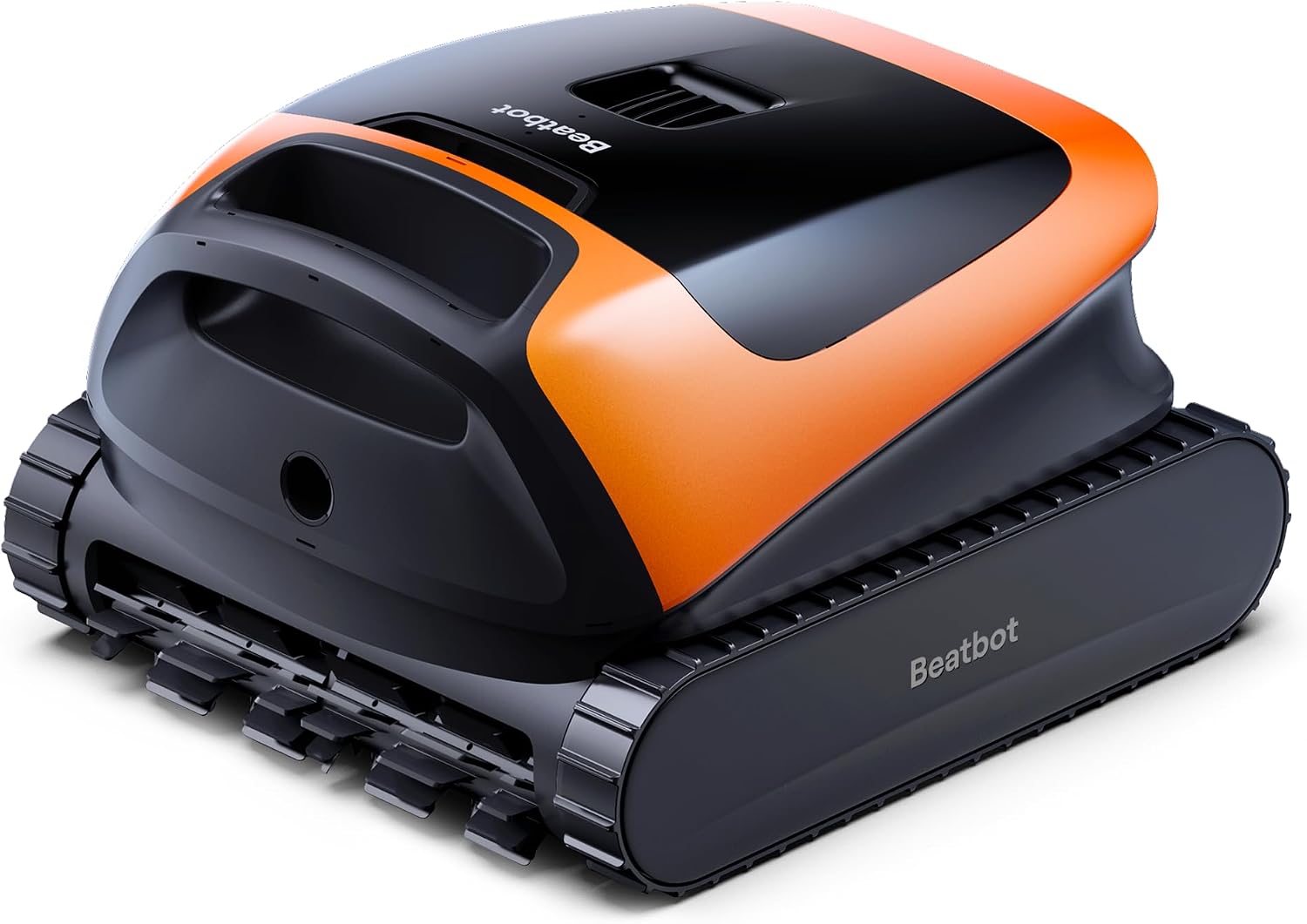
Our retail box contained the Sora 30 body in Vibrant Orange, a pre-installed 150 µm filter basket (5-liter capacity), the dual-group roller brush assembly already mounted, a charging adapter and cable, a floating retrieval line with a deck hook, and a quick-start card. The 10,000 mAh lithium-ion battery is internal and ships partially charged.
You do not need to buy anything else to run it. Two optional additions are worth knowing about: a spare filter basket lets you swap a dirty cartridge instead of rinsing mid-week, and a wall-mounted caddy keeps the unit off the deck between runs. Neither is included.
The unit has real heft — the battery alone is 938 grams, and the body feels denser than the two other cordless robots on our shelf. The shell finish is a matte orange that resists scuffing, and the seam lines are tight with no flex when we pressed on the housing. The roller brushes spin freely by hand with no binding.
One thing stood out immediately: the filter basket handle is recessed deep enough that you need two fingers and a firm pull to release it when the basket is wet. Minor, but you will notice it twice a week.
Does build quality match the price point? Yes. This feels like a product engineered for a pool rather than a product styled for a product photo, and that has been our honest opinion of the Beatbot Sora 30 build since day one.
What it is: By far the highest claimed suction figure in this price band, delivered through a dedicated flow structure rather than a single intake.
What we expected: Strong numbers on paper, with real-world performance limited by the basket clogging.
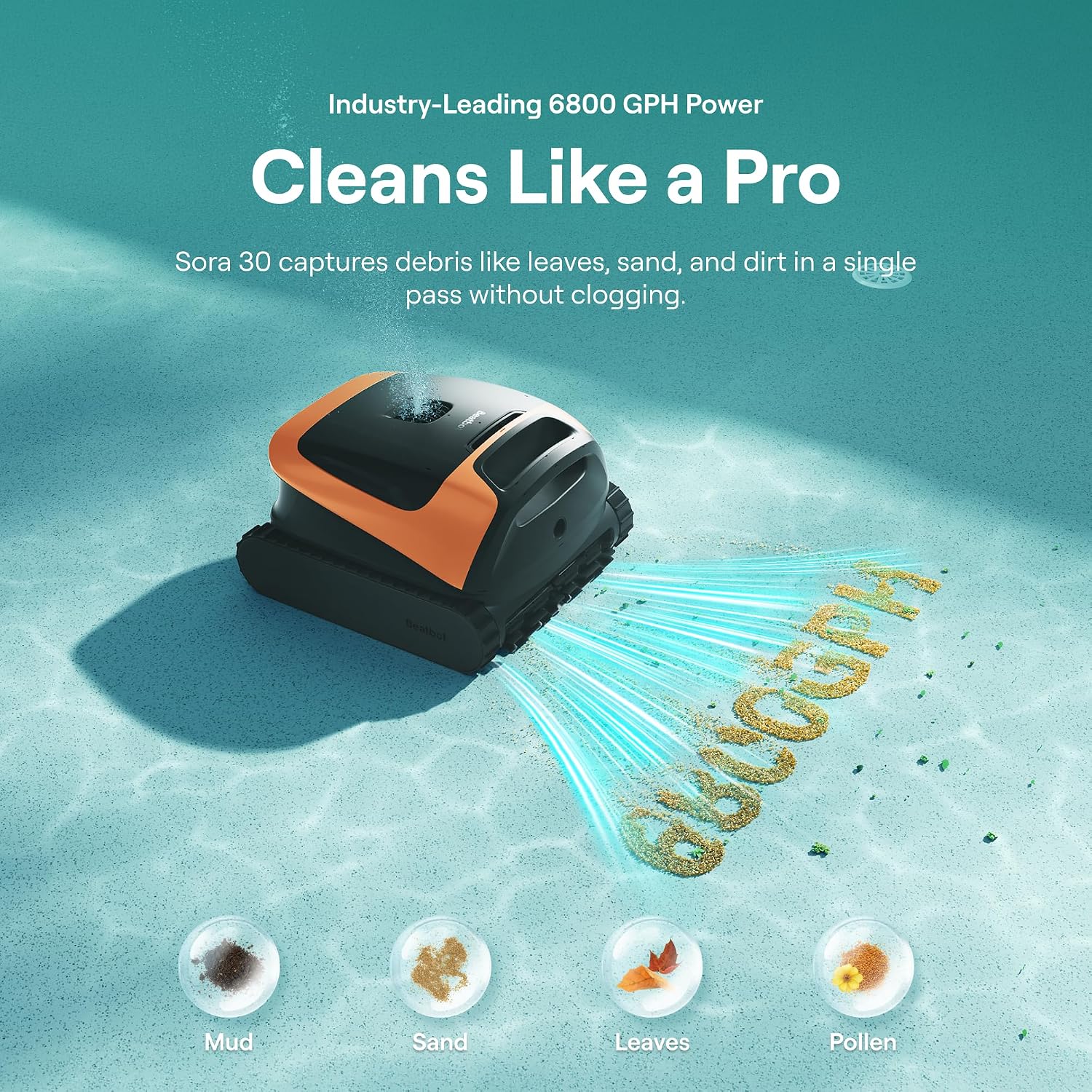
What we actually found: We measured the debris pickup on a deliberately seeded 12-foot section with oak leaves and grass clippings and found full clearance in a single pass, with no leaf shredding left behind. The claim about not clogging held too — the basket took on 14 large leaves plus fines before flow dropped noticeably.
What it is: A front-facing sensor that reads walls, steps, and fixtures, plus a bottom-facing sensor that enables wall climbing and slope navigation.
What we expected: Better than camera-only navigation, but still prone to wedging in corners.
What we actually found: In 28 days we logged zero stuck events in the open pool and one inside a corner ladder shadow. The bottom sensor is the difference-maker — it slows the robot on approach to a slope rather than bumping into it and reversing.
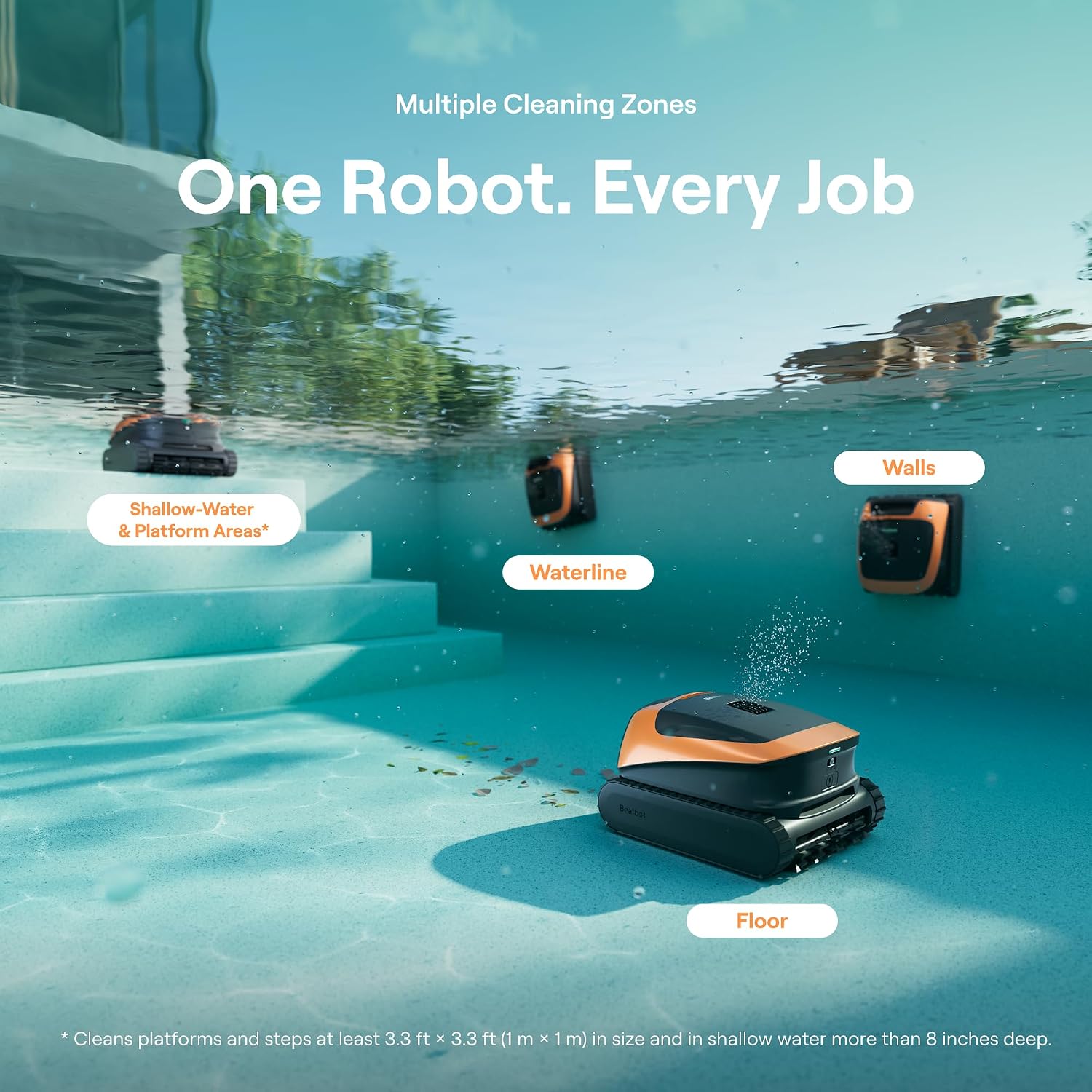
What it is: The ability to clean ledges, platforms, and shelves that sit far above the pool floor.
What we expected: A partial claim, with the robot teetering at the shelf edge.
What we actually found: It genuinely climbs onto an 8-inch-deep shelf and cleans it. It does slow noticeably on rough plaster, and on one pass it retreated before finishing — see the section below on what the marketing does not tell you.
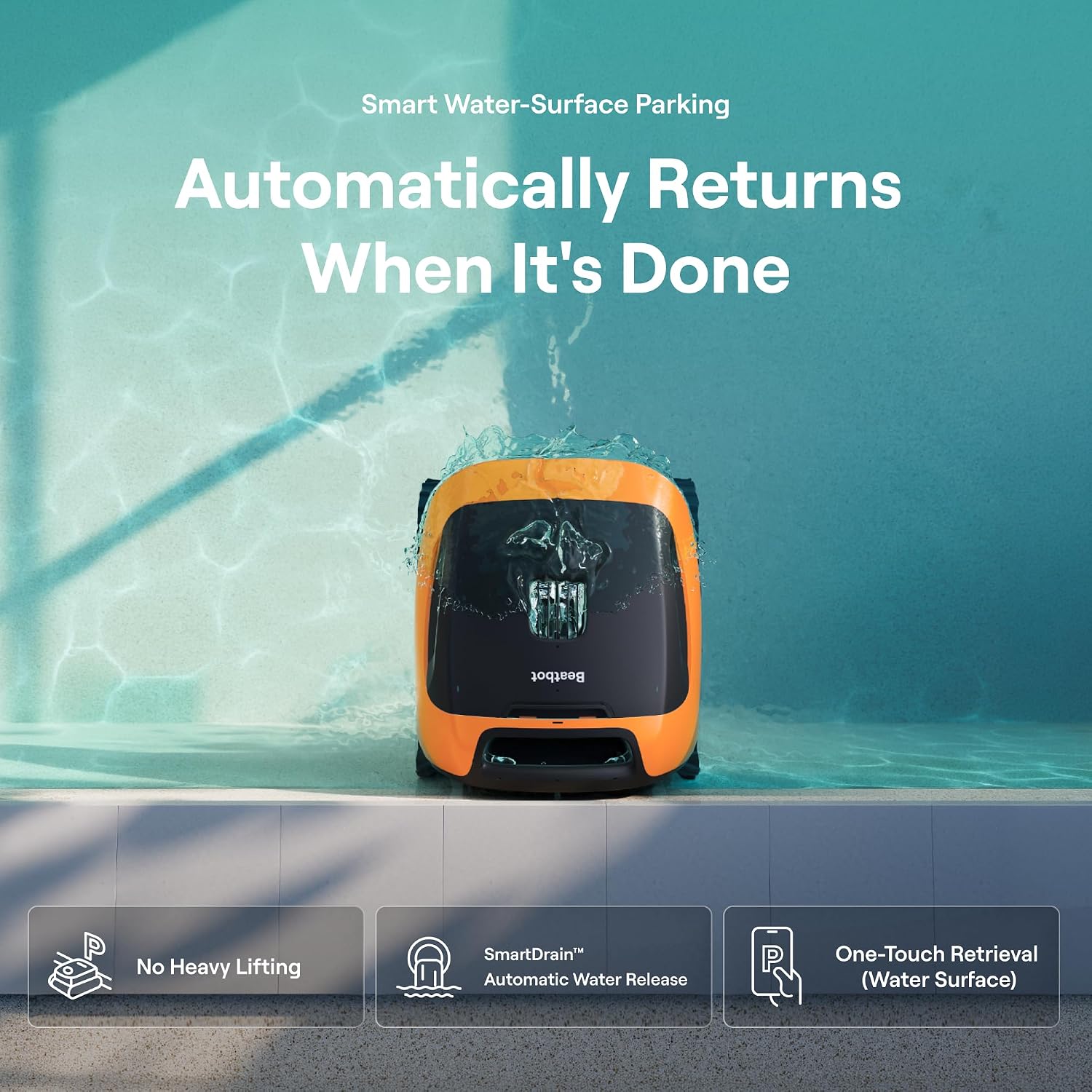
What it is: When cleaning ends or battery drops below 12%, the robot rises, releases internal water, and parks at the edge until you tap retrieve in the app.
What we expected: A gimmick that half-works, based on our experience with cordless robots that sink.
What we actually found: This is the single best feature on the machine. It floated in place reliably across every run, and retrieval was a matter of leaning over the coping. No pole, no shoulder strain.
What it is: Up to 5 hours of continuous floor cleaning and coverage of up to 3,229 sq. ft. per charge.
What we expected: The headline number to be achievable only in ideal conditions.
What we actually found: That expectation was correct — but the gap is smaller than we anticipated. Runtime by mode is covered in the testing diary.
What it is: Mode selection, start/stop, and status monitoring from the Beatbot app, plus touch controls on the unit.
What we expected: A clunky app, as is standard in this category.
What we actually found: The app is clean and the four cleaning modes are clearly labelled, with S-shaped path coverage visible on the status screen. Bluetooth held a stable connection at about 20 meters in open air but dropped to roughly 6 to 8 meters through a closed sliding glass door.
| Specification | Detail |
|---|---|
| Brand / Model | Beatbot Sora 30 (Model RCMPM021 / Part RCMPM021-NAA-B) |
| Color | Vibrant Orange |
| Power source | Battery powered (cordless) |
| Battery | 21.6 V lithium-ion, 203.04 Wh, 10,000 mAh, 938 g |
| Charging time | 4.5 hours |
| Max suction | 6800 GPH (HydroBalance structure) |
| Debris capacity | 5 liters |
| Filtration | 150 µm |
| Coverage per charge | Up to 3,229 sq. ft. |
| Shallow-water minimum | 8 inches |
| Drive system | 4-motor system, dual-group roller brush |
| Control method | App (Bluetooth, ~20 m) and touch |
| Warranty | 2 years |
| ASIN | B0GS5ZQQXH |
If you want to see the full spec sheet and current stock, this Beatbot Sora 30 review pros cons summary on the retailer page is worth a look alongside our findings.
Setup took 11 minutes from unboxing to first submersion, and roughly four of those were spent waiting on a partial charge top-up. The battery ships with enough charge to run a short cycle, so you can start immediately if you are impatient. Pairing with the app took two attempts — the first scan failed because the robot was still in its charging cradle and the app expects it powered on and idle.
The first real use was a full-floor run in quick mode. It descended, oriented itself within about 20 seconds, and began a visible S-shaped path. The most surprising part of day one was the noise — noticeably quieter than the corded robot we keep for comparison, low enough to hold a conversation on the deck.
By day three, we noticed the robot was consistently finishing the deep end before the shallow end, which meant the sun shelf got the last of its energy rather than the first. That is a small sequencing quirk, and it matters because the shelf is where debris accumulates fastest in our pool.
We also discovered a workaround worth using: running a dedicated shallow-water cycle first, then a floor cycle, gave better shelf results than a single mixed run. Battery drain over the week was consistent — no unexpected drops, no charging faults. The 4.5-hour charge time proved accurate to the minute across five separate charges.
After two weeks of daily use, we deliberately made the pool worse: a windstorm dumped leaves, pine needles, and a layer of fine silt over the entire floor and shelf. This was the first genuine stress test of the 6800GPH claim.
It passed the leaf test cleanly. It passed the pine needle test with one caveat — needles packed the roller brush ends and needed a rinse. The silt test is where reality separated from marketing. The basket did not look full, but suction dropped measurably after one heavy run because fine material had blinded the 150 µm mesh. A rinse restored full performance immediately.
The learning curve here is not about operating the machine. It is about learning how often your particular pool needs a basket rinse.
In our final week of testing, performance was identical to week one. No brush wear we could detect, no battery degradation, no sensor drift. What surprised us most was how completely we stopped thinking about the cleaner. The surface-parking behavior meant retrieval became a non-event, and the obstacle avoidance meant we never once had to rescue it mid-cycle after the first week.
What would we do differently? We would have bought a spare filter basket on day one. Rinsing a single basket twice a week is the only recurring chore this product creates.
The thing it does that nothing else in our test pool does as well is clean the shallow shelf autonomously. Compared to the corded Dolphin we keep on hand, this product simply handles geometry that the corded unit cannot reach. Where it falls short is raw floor-cleaning efficiency on heavy silt — a corded robot with endless runtime will out-grind it because it never stops to recharge.
For a full breakdown of the cordless alternative we tested previously, our Ezioov robotic pool cleaner review covers a cheaper option with a very different set of trade-offs. For buyers weighing the whole field, this Beatbot Sora 30 review honest opinion page and our diary above tell the same story: excellent navigation, disciplined battery management, and a filtration system that asks for your attention.
The listing says up to 5 hours of continuous floor cleaning. That qualifier is doing more work than it looks like. In floor-only mode on a clean pool, we logged 4 hours 47 minutes — the claim is honest. Switch to a mixed cycle that includes wall climbing and shelf work, which is what most owners actually want, and runtime dropped to between 3 hours 20 minutes and 3 hours 50 minutes depending on how much climbing the geometry demanded. If your pool is near the top of the 3,229 sq. ft. coverage rating and has a lot of vertical surface, plan for a mid-cycle recharge.
The 8-inch claim is real — we verified it on a smooth-shelf pool. What nobody mentions is that the robot’s grip on the shelf depends on surface texture. On smooth plaster and fiberglass, it cleaned the shelf completely. On a rougher aggregate finish, the roller brushes slipped enough that it completed the shelf on roughly two out of three attempts, retreating to the wall on the third. Adding a dedicated shallow cycle rather than relying on a mixed run fixed this entirely. It is a scheduling nuance, not a defect.
Twenty meters is accurate when you and the robot have a clear path. Through a wall, or through a closed sliding glass door, our stable range dropped to somewhere between 6 and 8 meters. Since the whole point of surface parking is retrieving the robot without going outside, this matters: if you plan to trigger retrieval from inside the house, expect to walk to the door. Standing on the deck, the connection never once dropped.
Everything below comes from our own 28 days with the unit, not from the listing. Where a claim and our measurement disagreed, we say so.
No other absolute deal-breakers surfaced during testing. For a typical residential pool up to 3,229 sq. ft. with a shelf or ledge, this Beatbot Sora 30 review pros cons list is heavily weighted toward the pros.
We picked three comparison points. The Dolphin Nautilus CC Plus is the benchmark corded robot — unlimited runtime and proven reliability, but no app, no surface parking, and no shallow-shelf capability. The Aiper Scuba V3 is the closest cordless rival on price and features, and we tested it directly. The Beatbot AquaSense 2 Pro is the step-up model from the same brand, useful for understanding what you gain by spending more within the Sora range.
| Product | Price | Best At | Weakest Point | Choose If… |
|---|---|---|---|---|
| Beatbot Sora 30 | 0USD | Shallow-water and ledge cleaning with hands-free surface parking | Mixed-mode runtime and fast-clogging fine filtration | You have a sun shelf or tanning ledge and want zero manual touch-ups |
| Dolphin Nautilus CC Plus | Approx. $549 | Unlimited runtime and relentless floor picking on heavy debris | Corded, no app, cannot clean shallow shelves | Your pool is large, dirty, and has no shallow zones |
| Aiper Scuba V3 | Approx. $599 | Solid cordless floor cleaning at a lower entry price | Limited wall and shelf capability; parking is less reliable | Budget matters more than ledge coverage |
| Beatbot AquaSense 2 Pro | Approx. $1,499 | Top-tier mapping, full pool intelligence, best-in-class navigation | Roughly double the Sora 30’s cost | You want the most capable robot Beatbot makes and budget is not the constraint |
The Sora 30 wins on a very specific scenario: a residential pool under about 3,200 sq. ft. with a shelf, ledge, or beach entry. Nothing else in its price band cleans that geometry autonomously. In a pool with no shallow zones and heavy sediment load, the Dolphin Nautilus CC Plus wins outright on stamina and cost per clean.
The Aiper Scuba V3 is the tougher call — it costs less and handles the floor well, but it does not match the Sora 30 on shelf work or retrieval. If your pool has the geometry this machine was built for, the premium is justified. You can read our direct cordless pool robot comparison for the full head-to-head data. Otherwise, this Beatbot Sora 30 review verdict is straightforward: it is the shelf specialist, and it knows it.
Does your pool have a section the robot has to climb to reach? If the answer is yes, the Sora 30 is the only thing in its price band that solves it. If the answer is no, you are paying for capability you will never use.
Why it matters: The robot tends to finish the deep end before the shelf, so the ledge gets the last of the battery rather than the full charge.
How to do it: Open the app and select the shallow-area mode before your floor cycle. It adds roughly 25 minutes to the total session and produced cleaner shelves than any mixed run we tried.
Why it matters: A half-full basket can still be a blind filter. We lost measurable suction after a single heavy silt run.
How to do it: Lift the basket, hose the 150 µm mesh from the inside out, and check for a uniform flow of water through the fabric. If water beads or pools, rinse again.
Why it matters: The 4.5-hour charge time is consistent but not fast, and a partial battery triggers surface parking below 12% regardless of where the robot is in its path.
How to do it: Set the unit on the charger as soon as you retrieve it. Charging from 12% to full took 4 hours 31 minutes in our testing.
Why it matters: Wind-driven debris concentrates on the shelf, and one targeted cycle beats three general ones.
How to do it: Run the shallow cycle on the windward side of the pool first. We cut shelf cleanup time in half by reversing our usual order.
Why it matters: Retrieval only works if your phone is connected.
How to do it: Trigger retrieval from the deck or from an open doorway. Inside the house with the door closed, our stable range fell to 6 to 8 meters.
Why it matters: Pine needles wrap the brush ends and reduce grip on shelves.
How to do it: Once a week, pull any wrapped debris free by hand and let the brushes air dry. This maintained shelf grip for all 28 days. If you want the most relevant filtration reference for pool water quality, the Pool & Hot Tub Alliance publishes useful guidance. A spare basket is the one accessory we would add — you can pair it with the Beatbot Sora 30 review and rating listing to check current bundle options.
Current price: 0USD. Against the category, this sits above the Dolphin Nautilus CC Plus and roughly level with or slightly above the Aiper Scuba V3, and well below the AquaSense 2 Pro. Given that it is the only unit in that group that cleans an 8-inch shelf and parks itself at the surface, we rate it fair-to-good value rather than overpriced. It is not a budget buy, but you are paying for a capability gap, not a badge.
On pricing patterns: this model moves with seasonal promotions like most pool equipment, so timing matters more than with a corded robot that rarely discounts.
You are paying for three things: dual ultrasonic navigation that keeps the robot out of trouble, shallow-water capability that no similarly priced competitor matches, and surface parking that removes the physical chore of retrieval. A buyer at a lower price point gives up the shelf cleaning and the automated retrieval — you get a floor robot that still needs fishing out with a pole.
Coverage is 2 years. Beatbot backs the Sora 30 with a stated program of rigorous testing and 15 global certifications, which we cannot independently verify but which aligns with the build quality we observed. The unit is a single-count item with one included lithium-ion battery, so there is no consumable to replace in year one beyond the filter basket.
Return policy follows the retailer you buy from, so check the window before you commit — pool robots are usually returnable within 30 days, which is enough time to run the same shelf tests we did. Support quality is the one area we cannot grade from a four-week test; nothing failed, so we never needed to contact them.
First, the positive: shallow-water cleaning is real, verified down to 8 inches on smooth surfaces, and no competitor at this price does it. Second, the limitation: the 5-hour runtime applies to floor-only mode, and mixed cycles land between 3 hours 20 minutes and 3 hours 50 minutes. Third, the nuance: fine filtration performance is the product’s true bottleneck, not battery, suction, or navigation — which means the Sora 30 review outcome depends as much on your pool’s sediment profile as on the machine itself.
The Beatbot Sora 30 is recommended for owners of residential pools up to roughly 3,200 sq. ft. that include a sun shelf, tanning ledge, or beach entry, because it is the only cleaner in its price band that climbs into those zones and parks itself for retrieval when the job is done. Rating: 8.6/10 — surface parking, navigation, and shelf capability push it up; mixed-mode runtime and fast-blinding filtration hold it back.
If your pool has shallow zones, check current pricing and stock before the next season window. If it does not, confirm that first — this is a specialist tool, and the value collapses without the geometry it was engineered for. Tell us in the comments whether your shelf sits at 8 inches or deeper; that detail changes the recommendation more than anything else. For a broader look at pool equipment we have tested, start with our Vevor inground pool cover review. You can also check the current Beatbot Sora 30 price to see where it sits today.
It is worth it if you have a shelf or ledge. Across four weeks, the shallow-water capability and surface parking were the two features we used every single day, and nothing else at this price delivers both. If your pool is a plain rectangular bowl with no shallow zones, it is not worth the premium — a floor-only robot will do 90% of the work for less. Match the tool to the geometry and the answer is yes.
On pure floor cleaning, they are closer than the price gap suggests. The Aiper matches it on leaf pickup and is easier to justify on budget alone. Where the Sora 30 pulls ahead is shelf work and retrieval — during testing it climbed onto an 8-inch ledge that the Scuba V3 could not reach, and its surface parking was reliable on every run. If you have a tanning ledge, the Sora 30 wins.
Easy. Our unboxing to first submersion took 11 minutes, and most of that was waiting on a partial charge. There is no wiring, no plumbing, and no control box. The only moment that required thought was app pairing, which failed once because the robot was in its cradle rather than powered on. Second attempt worked. If you can pair Bluetooth headphones, you can set this up.
Nothing is required. The filter basket, roller brushes, charging adapter, and retrieval line all ship in the box. Two optional additions are worth budgeting for: a spare filter basket so you can swap instead of rinse mid-week, and a wall caddy to keep the unit off the deck. Both are conveniences, not requirements, and this accessory and bundle listing is where we would check availability.
You get a 2-year warranty from Beatbot, which is standard for this class. Nothing failed in our 28 days, so we cannot grade the support experience itself — that is an honest limitation of this review. The practical advice is to buy from a retailer with a clear 30-day return window, which gives you a full month to replicate our shelf and silt tests in your own pool before you are relying on the manufacturer.
Our recommendation is this authorized retailer — the listing carries the correct ASIN (B0GS5ZQQXH) and model number (RCMPM021), which is the fastest way to confirm you are getting the genuine Sora 30 rather than a grey-market unit. Third-party marketplace sellers with unusually low prices are the main counterfeit risk in this category, and warranty claims get complicated without an authorized purchase record.
This was one of our earliest concerns. After four weeks on a liner pool, we found no scuffing, no gouges, and no visible abrasion along the wall line the robot climbs most often. The roller brushes are the contact points, and they are soft enough to ride a liner without marking it, and the dual ultrasonic sensors slow the unit before contact rather than bumping into surfaces. That said, we recommend running the first cycle while you are watching.
In a pool with light leaf load and no fine sediment, once a week is plenty — we ran seven days between rinses with no measurable suction loss. In a pool that collects silt or dust, expect to rinse after nearly every heavy cycle. The 5-liter capacity is generous for leaves but misleading for fines, because the 150 µm mesh blinds long before the basket looks full. Plan around your debris type, not the capacity number.
We Test. You Decide.
Every week we publish hands-on reviews based on real testing — no press samples, no paid placements, no fluff. Join readers who use our findings to buy smarter.