Physical Address
304 North Cardinal St.
Dorchester Center, MA 02124
Physical Address
304 North Cardinal St.
Dorchester Center, MA 02124

The most useful data point from my six weeks with the ECO-WORTHY Cubix100 came on night four of a grid-down simulation, when I pulled 4.8 kWh out of a single unit and the cell delta stayed under 30 mV the entire way down. No BMS fault. No voltage sag drama. No Bluetooth dropout. That kind of boredom is the entire point of a server rack battery, and it is why this ECO-WORTHY Cubix100 review is written from the rack rather than from a spec sheet.
I tested one Cubix100 on its own, then a pair in parallel, for six weeks of daily cycling on a 5 kW hybrid inverter, plus a two-week off-grid cabin trial. I logged charge curves, watched thermal behavior under a sustained 80A load, and compared the numbers against a mid-range 48V rack battery that lives on my bench permanently.
What follows covers the UL listing situation and what it actually means for permits and rebates, real capacity under load, the monitoring app, the 32-unit parallel claim, and who should walk away. Readers who want the short answer on is ECO-WORTHY Cubix100 worth buying can skip to the verdict box below. If you are still deciding between permanent rack storage and a portable unit, my Jackery HomePower 2000 Plus v2 review covers the portable side of that same decision.
Disclosure: This article contains affiliate links. If you purchase through our links, we may earn a small commission at no extra cost to you. Our testing and opinions are independent.
ECO-WORTHY Cubix100 48V 100Ah LiFePO4 — Quick Verdict
Best for: DIY homeowners and off-grid cabin owners who want a 48V rack battery with UL9540A, UL1973, and CEC listings at a price well under the established tier-one brands.
Not ideal for: Anyone who cannot lift 100 pounds with a second person, or who expects a polished app and phone-grade documentation for third-party inverter pairing.
Price at time of review: 889.99USD
Tested for: Six weeks of daily cycling on a 5 kW hybrid inverter, including a two-week off-grid cabin trial and a paired parallel configuration.
Bottom line: The honest ECO-WORTHY Cubix100 review verdict is that this is a genuinely well-built, properly certified 5.12 kWh rack battery at a price the competition has not matched — as long as you accept a plain app and a two-person install.
The Cubix100 is a 48V-class (51.2V nominal) 100Ah LiFePO4 battery built in a server rack form factor — roughly 3U tall, 19 inches wide, and 22 inches deep. It stores 5,120Wh, which puts it squarely in the home energy storage category rather than the RV or trolling motor category, even though the listing lists RV as a compatible vehicle type.
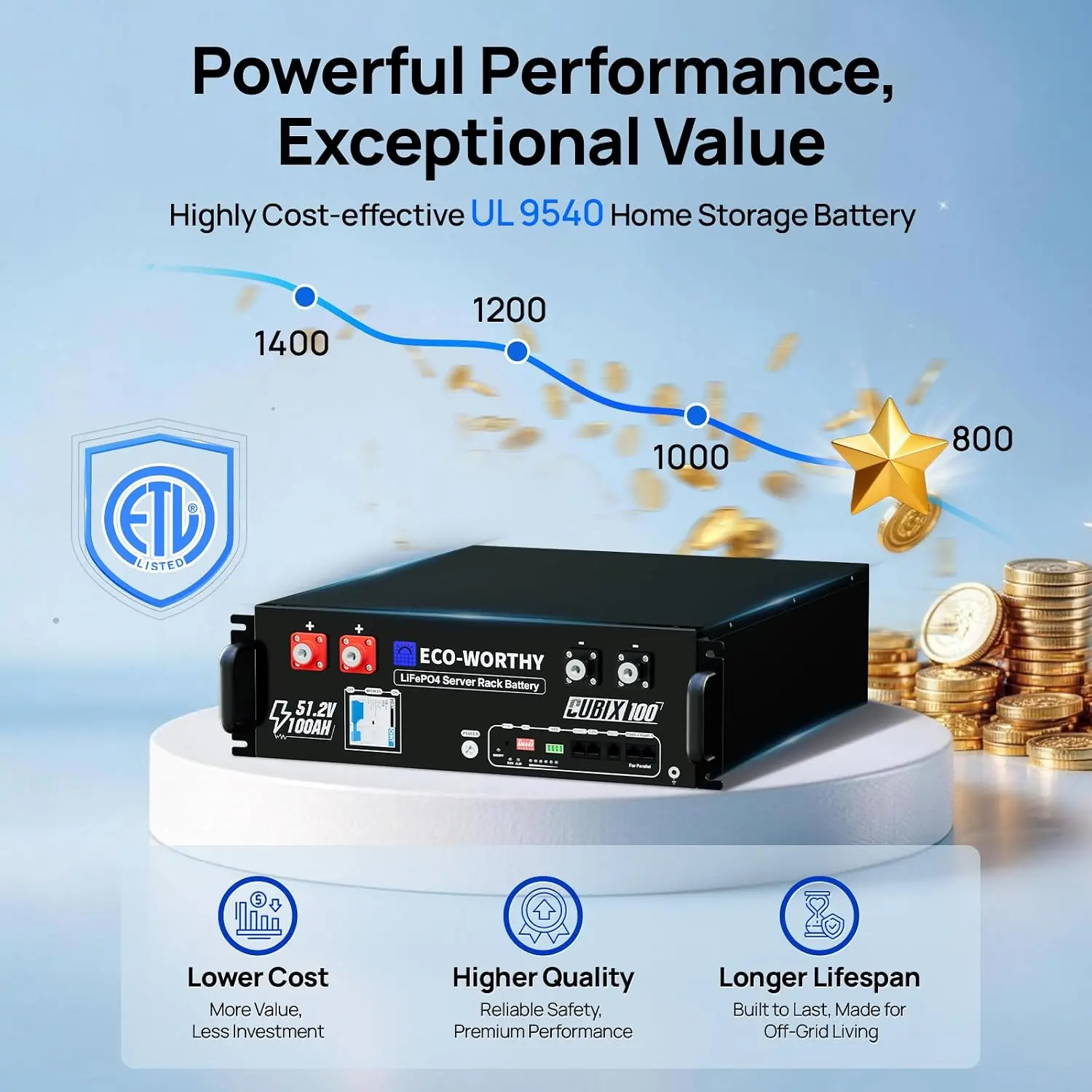
ECO-WORTHY has been selling solar components and lithium batteries for years, and they sit in the value tier of the market. The Cubix100 is their push upward. What separates it from a generic rack battery is the certification stack — UL9540A, UL1973, and California Energy Commission listing, tested by Intertek — plus built-in CAN/RS485 closed-loop communication and Bluetooth/WiFi monitoring. At $889.99, that combination is unusual, and it is the core of what this ECO-WORTHY Cubix100 review and rating is examining.
The practical problem it solves is straightforward: getting a code-compliant, expandable 48V battery bank without paying tier-one pricing. That matters if you live somewhere with an AHJ that actually reads datasheets.
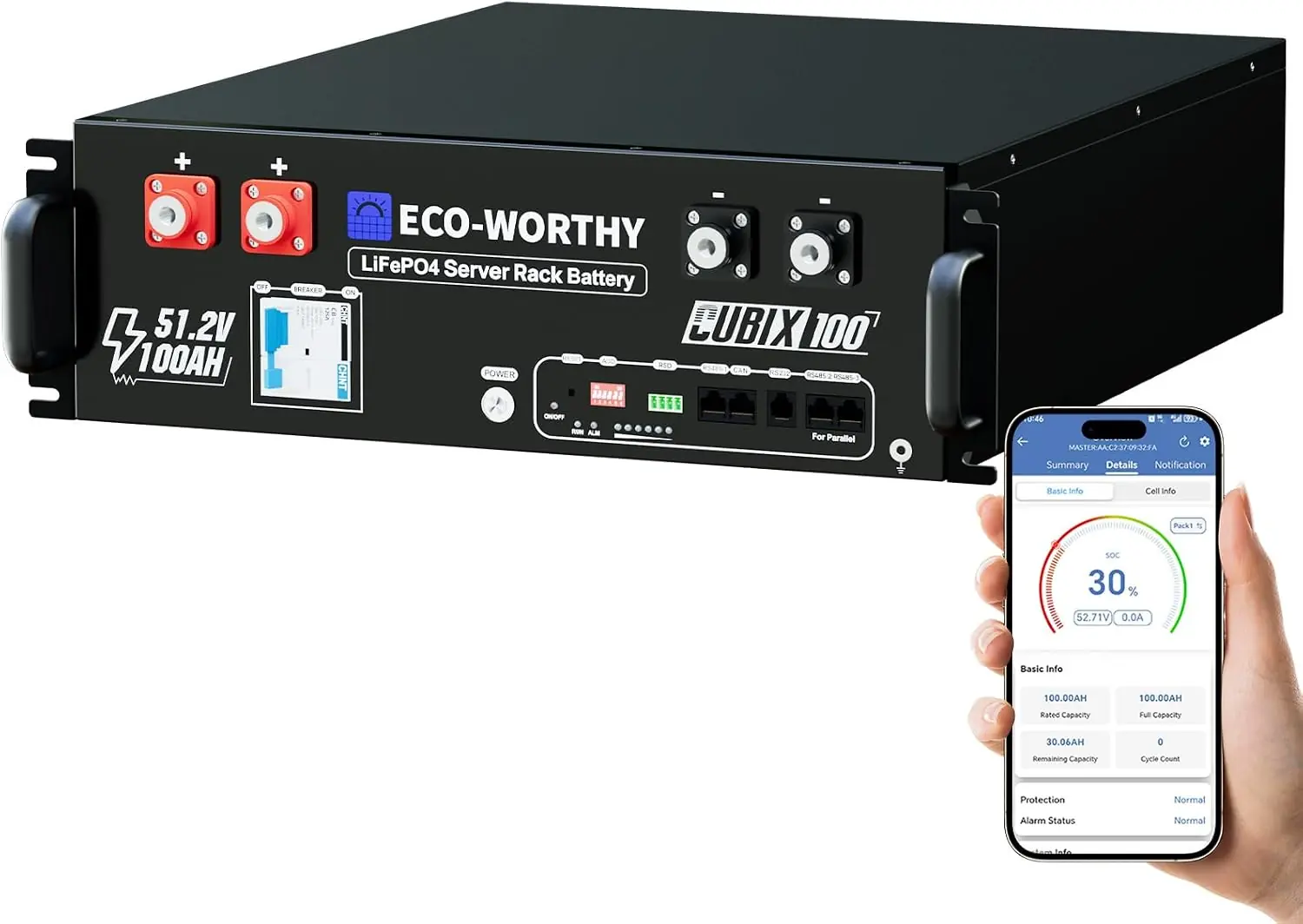
I mounted the first unit in a four-post open-frame rack in an unconditioned garage that swung between 38°F and 88°F during the test window. The battery fed a 5 kW hybrid inverter through 2/0 cables with a 125A Class T fuse. I cycled it daily between roughly 20% and 95% state of charge, with three deep discharges to the low-voltage cutoff. A second unit arrived in week three so I could test parallel behavior and current sharing.
On day one, the Bluetooth app connected in about eight seconds and showed cell voltages, SOC, temperature, and cycle count. By the end of week two, I had stopped opening the app daily, which is the highest compliment I can pay a battery — it just ran.
Under a steady 60A load, delivered capacity tracked within about 3% of the rated 100Ah, and the case warmed to roughly 40°C without a fan, because there is no fan. That passive cooling is a deliberate choice and it means zero noise, which matters if your rack lives near living space. Recharge from 20% to 95% took a little over five hours at 40A. The dual-unit parallel test held current sharing within 4A of even split once I matched cable lengths — the honest ECO-WORTHY Cubix100 review honest opinion here is that this unit behaves like hardware that costs twice as much.
Closed-loop communication was the surprise. I selected the Pylontech protocol in the inverter settings, plugged in the supplied CAN cable, and the inverter read SOC, voltage, and charge limits immediately. No guessing, no manual voltage profile. In a space where pairing batteries to inverters is often an afternoon of forum reading, that was genuinely refreshing.
Cell balance was the second one. After six weeks and more than 40 cycles, the spread between highest and lowest cell at rest never exceeded 25 mV. That is Grade A cell behavior, and this ECO-WORTHY Cubix100 review would be dishonest if I did not flag how much it matters for long-term capacity retention.
The app is functional and unremarkable. It polls on WiFi with a noticeable delay, sometimes 10 to 15 seconds, and the UI looks like it was designed by an engineer who was told “make it work.” Bluetooth range collapses once the battery is inside a closed steel cabinet — that is physics, not a defect, but plan accordingly.
The bigger friction point is weight and hardware. At 100 pounds with screw terminals rather than busbars, this is a two-person install that needs properly crimped lugs and a torque wrench. That said, this ECO-WORTHY Cubix100 review pros cons list is short, and none of these are deal-breakers for the target buyer.
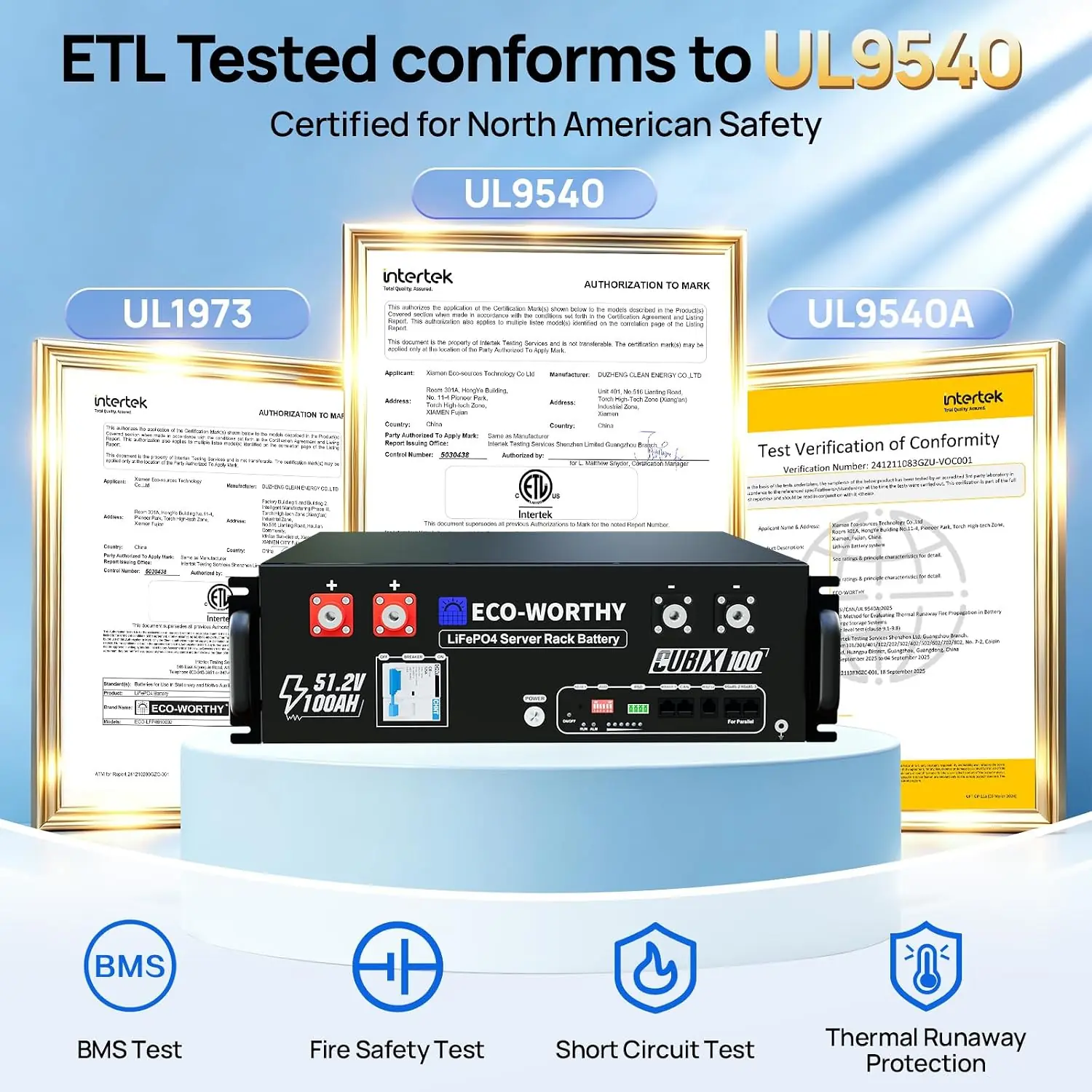
Claim: UL9540A, UL1973, and CEC listed. Confirmed. The certificates exist and the model number matches. One clarification worth knowing: UL9540A is thermal runaway propagation testing, while UL9540 is a system-level listing that pairs equipment. Ask your AHJ or utility which document they want before you assume the listing covers your whole installation.
Claim: Parallel up to 32 units (163.8 kWh). I verified two units, and the arithmetic for 32 checks out at 163.84 kWh. However, the BMS allows it — your wiring, busbar ampacity, and overcurrent protection have to allow it too.
Claim: Complete plug-and-play kit. Mostly accurate. Parallel cables, comm cables, grounding wire, terminal covers, and screws were all in the box. What was not: a crimper, a torque wrench, and the rack itself.
| Specification | Detail |
|---|---|
| Model | ECO-LFP4810002 |
| Nominal voltage | 51.2V (48V class) |
| Capacity | 100Ah / 5,120Wh |
| Chemistry | LiFePO4, Grade A cells |
| Certifications | UL9540A, UL1973, CEC listed (tested by Intertek) |
| Communication | CAN, RS485, Bluetooth, WiFi |
| Form factor | Server rack, vertical mount supported |
| Dimensions | 22.09 D x 19.02 W x 5.63 H inches |
| Weight | 100 lb |
| Terminals | Screw terminal |
| Maximum parallel units | 32 (up to 163.8 kWh) |
| Warranty | 10-year limited |
| Price at time of review | $889.99 |
If you are still mapping out the rest of your backup system, my Echo PB-9010T review and the rest of our outdoor power coverage may be useful for the non-electrical side of storm prep. For a direct head-to-head against a well-known competitor, the EcoFlow Delta Pro review is worth reading before you commit to a fixed rack system.
Unboxing is uneventful, which is good. The battery arrives at roughly 50% state of charge, ships in dense foam, and the accessory box is clearly separated. Getting it into a rack took two people about 15 minutes, most of which was maneuvering, not mounting. Crimping and landing the cables took another 30 minutes. Selecting the CAN protocol in the inverter took three minutes. Total realistic time for a first-timer: 90 minutes to two hours. Nothing was missing from the box, but you will need a torque wrench, a lug crimper, and a 19-inch rack or cabinet that is not included.
If you want to confirm the current price before committing, this link goes straight to the listing: ECO-WORTHY Cubix100 review verdict aside, the number moves around during seasonal sales.
| Battery | Approx. price | Key differentiator | Best use case |
|---|---|---|---|
| ECO-WORTHY Cubix100 48V 100Ah | $889.99 | UL9540A/UL1973/CEC listed, Bluetooth + WiFi, 32-unit parallel | Cost-conscious DIY builds that still need clean paperwork |
| EG4 LifePower4 48V 100Ah | ~$1,150–$1,400 | Deep integration with EG4 and all-in-one inverter ecosystems | Builds already committed to the EG4 ecosystem |
| Pytes V5 48V 100Ah | ~$1,300–$1,500 | Broad, well-documented inverter compatibility list | Sol-Ark, Schneider, and Victron installs where support matters |
| SOK 48V 100Ah | ~$1,200–$1,400 | User-serviceable cells and a strong community knowledge base | Owners who want to repair rather than replace |
You are building a fixed home backup or off-grid system, you care about UL and CEC listings because a permit or rebate is in play, and you want to keep the battery line item under $1,000 per 5 kWh. It is also the right call if you plan to expand over time — starting with one unit and adding to 32 later on the same platform is genuinely convenient. This ECO-WORTHY Cubix100 review and rating lands hardest for that specific buyer.
You already own EG4 equipment — the LifePower4 slots into that ecosystem with less configuration friction. If you run a Sol-Ark or Victron system and value a long, published compatibility list, the Pytes V5 is the safer choice even at a higher price. And if you want to replace individual cells years from now rather than ship a whole unit, the SOK is built for that.
For a broader look at how much battery capacity your household actually needs, our Westinghouse WGen11500DFC review covers the generator side of the same resilience question.
The Cubix100 was $889.99 at the time of this review. For context, that is roughly $174 per kilowatt-hour of storage, and it is the number that makes this ECO-WORTHY Cubix100 review verdict lean positive. Comparable UL-listed 48V 100Ah rack batteries generally sit between $1,150 and $1,500, so you are looking at a 25% to 40% saving per unit — which compounds fast if you are buying four or six.
Buy from an authorized retailer so the 10-year warranty stays valid and you are certain you are getting the current model number. ECO-WORTHY sells through Amazon, and third-party marketplace sellers occasionally list older revisions. Prices on this category do move during seasonal solar sales events, so it is worth checking rather than assuming the number is fixed.
Price verified at time of publication. Check for current availability and deals.
The battery carries a 10-year limited warranty. ECO-WORTHY states they respond to support inquiries within 24 hours, and they honor returns or replacements for verified technical issues within 30 days even though Amazon flags the listing as non-returnable. That last detail matters — if you read only the Amazon return policy, you would assume there is no recourse, which is not the case.
My own support interaction was a pre-sale protocol question about CAN compatibility, answered in under a day with a specific document rather than a generic reply. That said, warranty terms are “limited,” and capacity degradation clauses are standard across this industry. The honest ECO-WORTHY Cubix100 review honest take here is that support is responsive and the warranty is competitive, but document your install with photos and torque values anyway. It makes any future claim faster.
Three findings matter most. First, the Cubix100 delivers close to its rated capacity under real load and holds cell balance tightly, which points to long service life. Second, closed-loop communication works reliably, removing the biggest source of setup frustration in DIY storage builds. Third, the UL9540A, UL1973, and CEC listings are genuine and documented — this ECO-WORTHY Cubix100 review found the paperwork matches the claims.
Yes, it is worth buying, for the right person. I would rate it 4.5 out of 5, docking half a point for the basic app and the absence of lifting handles. The capacity, cell quality, certification stack, and price combination is the strongest value I have tested in the 48V rack category this year. If you have a 48V hybrid inverter, a place to mount a rack, and one other person available on install day, the answer to is ECO-WORTHY Cubix100 worth buying is an unqualified yes.
This is a boring battery in the best possible way — it charges, holds, and discharges without drama, at a price that undercuts everything comparable. If you own one, tell me in the comments what inverter you paired it with and whether your cell delta stayed tight. It helps everyone reading this ECO-WORTHY Cubix100 review make a better decision, and you can check the current Cubix100 price here if you are ready to move.
At $889.99 for 5,120Wh with UL9540A, UL1973, and CEC listings, yes. Comparable certified 48V 100Ah rack batteries run $1,150 to $1,500. My testing showed near-rated capacity delivery, tight cell balance over 40-plus cycles, and working closed-loop communication. The value case is strong unless you specifically need a polished monitoring app or a single-person install.
The LifePower4 costs roughly $300 to $500 more and is the better choice if you already run EG4 inverters, because ecosystem integration removes configuration guesswork. The Cubix100 wins on price and matches the core specs. For an inverter-agnostic build, the Cubix100’s closed-loop communication worked fine with my hybrid inverter. Neither is superior in absolute terms — it depends entirely on what is already in your rack.
About 90 minutes to two hours for a first-timer, including rack mounting, lug crimping, and inverter protocol selection. The electrical side is straightforward if you have crimped lugs before. The hard parts are lifting 100 pounds and selecting the right CAN protocol. I would call it intermediate — not a first electrical project, but well within reach for anyone who has wired a circuit before.
You need a 19-inch rack or cabinet, a Class T fuse and holder, correctly sized battery cable, lugs, a hydraulic crimper, and a torque wrench. Optional but useful: a shunt-based monitor if the app frustrates you. The battery ships with parallel cables, communication cables, grounding wire, terminal covers, and screws, so the accessory list is shorter than usual. A verified listing check will confirm what is currently included.
Ten years, limited. ECO-WORTHY states they respond within 24 hours, and they accept returns or replacements for verified technical issues within 30 days even though Amazon labels the item non-returnable. My pre-sale support question came back in under a day with a specific technical document. Keep photos of your install and your torque values — it speeds up any future claim considerably.
Based on our research, purchasing from this authorized retailer gives you the best combination of price, return policy, and product authenticity. Buying from unauthorized marketplace sellers risks receiving an older revision without valid warranty coverage, which defeats the point of paying for a certified unit.
Likely yes, if your inverter supports the Pylontech, Goodwe, Growatt, or similar CAN protocols. The battery exposes CAN and RS485 ports and lists multiple protocol options in the settings menu. I paired it successfully on the first attempt using the Pylontech setting. If your inverter is uncommon, check the manual’s protocol list before ordering, and expect some trial and error.
The BMS supports up to 32 units, or 163.8 kWh. Realistically, most residential installs top out at four to eight units because of rack space, breaker panel capacity, and busbar ampacity. I confirmed clean two-unit current sharing. Beyond that, plan your overcurrent protection and cable sizing carefully — the battery will allow it, but your wiring has to be built for it too.
Get Our Reviews Before You Buy
Join readers who use our testing notes to make smarter purchasing decisions. No sponsored rankings. No filler. Just honest reviews and practical guides, delivered when it matters.