Physical Address
304 North Cardinal St.
Dorchester Center, MA 02124
Physical Address
304 North Cardinal St.
Dorchester Center, MA 02124

On the fourth night of testing, a limb came down across the line feeding our block and everything went dark. I had the Jackery HomePower 2000 Plus v2 sitting in the hallway at 100 percent, next to a fridge I had restocked that same afternoon. Instead of hunting for flashlights, I ran a cord to the fridge, plugged into the AC outlet, and went back to bed. That was the moment this Jackery HomePower 2000 Plus v2 review stopped being an academic exercise.
I spent three weeks running it as a daily home backup unit, then a fourth week cycling it deliberately hard: a half-horsepower sump pump, a full-size fridge, a desktop workstation, a CPAP machine, and a router stack. I logged runtime, recharge times, fan noise, and enclosure temperature after sustained loads. I also ran it alongside a gas inverter generator to compare noise, fumes, and convenience in the same outage window.
What follows is a full Jackery HomePower 2000 Plus v2 review covering how the unit behaves in a real house, where it frustrates me, and whether $1,199 is the right spend right now. If you would rather skip ahead, the current price on the Jackery HomePower 2000 Plus v2 is worth a look before you read further.
Disclosure: This article contains affiliate links. If you purchase through our links, we may earn a small commission at no extra cost to you. Our testing and opinions are independent.
Jackery HomePower 2000 Plus v2 — Quick Verdict
Best for: Homeowners in outage-prone areas who want silent, fume-free backup for a fridge, network gear, and a few lights without installing a fuel-burning generator.
Not ideal for: Anyone who needs to run central air, a 240V well pump, or an electric range — and anyone who has no intention of ever adding expansion batteries.
Price at time of review: 1199USD
Tested for: Four consecutive weeks in a 1,900 sq ft single-story home, including one unplanned grid outage and a deliberate 72-hour simulation.
Bottom line: A genuinely well-engineered, unusually light 2kWh expandable system that does what it claims — but the value case only closes if you plan to grow it past 2048Wh.
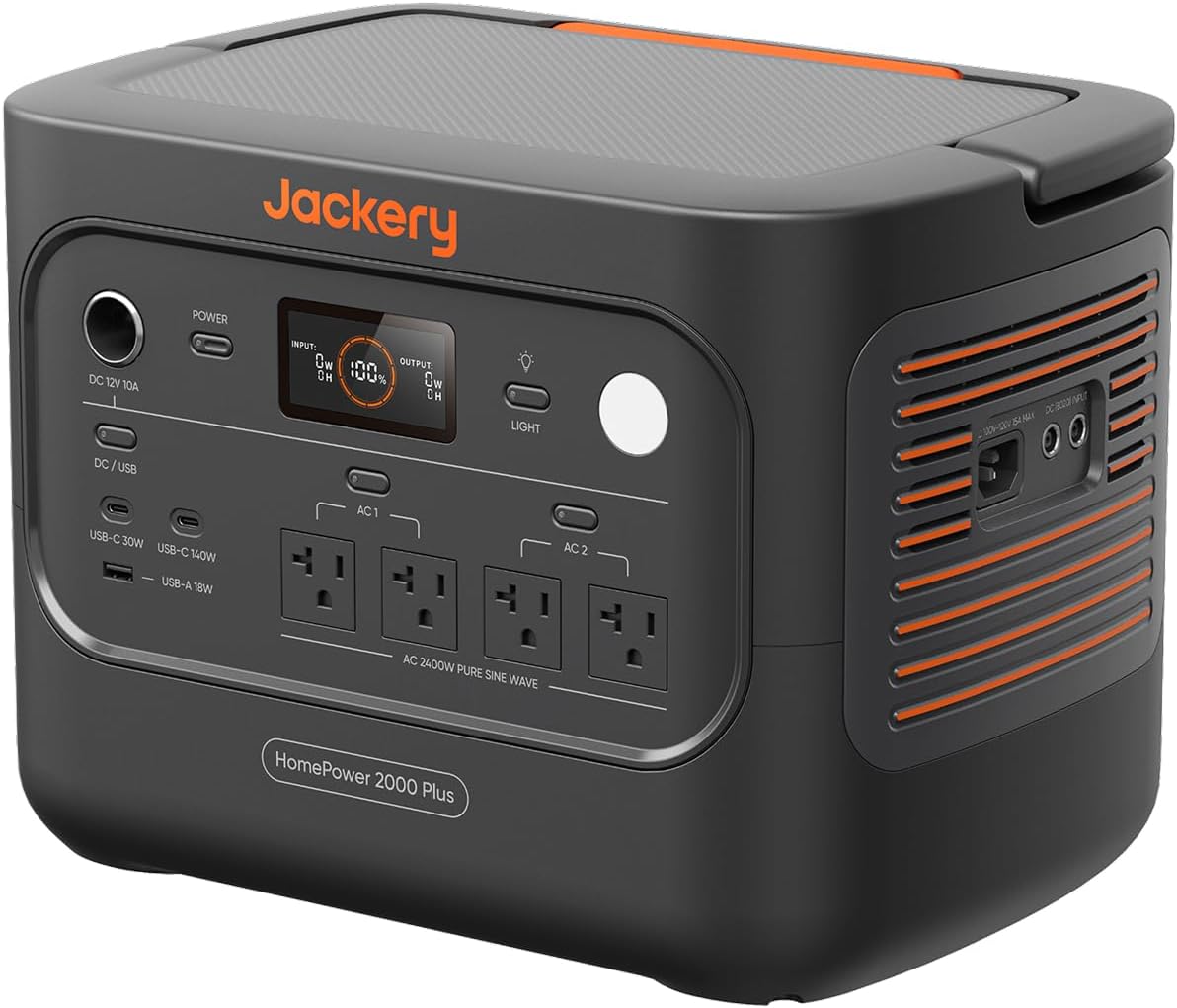
The HomePower 2000 Plus v2 is an expandable lithium iron phosphate home backup power station, not a portable camping battery. It sits in the mid-to-premium tier of a category that includes EcoFlow’s Delta line, Anker’s SOLIX units, and Bluetti’s AC series. At $1,199 for 2048Wh, you are paying roughly $0.59 per watt-hour up front — a premium over a comparable gas generator, and a discount against purpose-built home batteries that require professional installation.
Jackery has been building portable power stations since 2012 and has a US presence with published service channels, which matters when a warranty claim comes due. The company’s full line is documented at Jackery’s official site, including the expansion battery options that push this unit up to 12kWh.
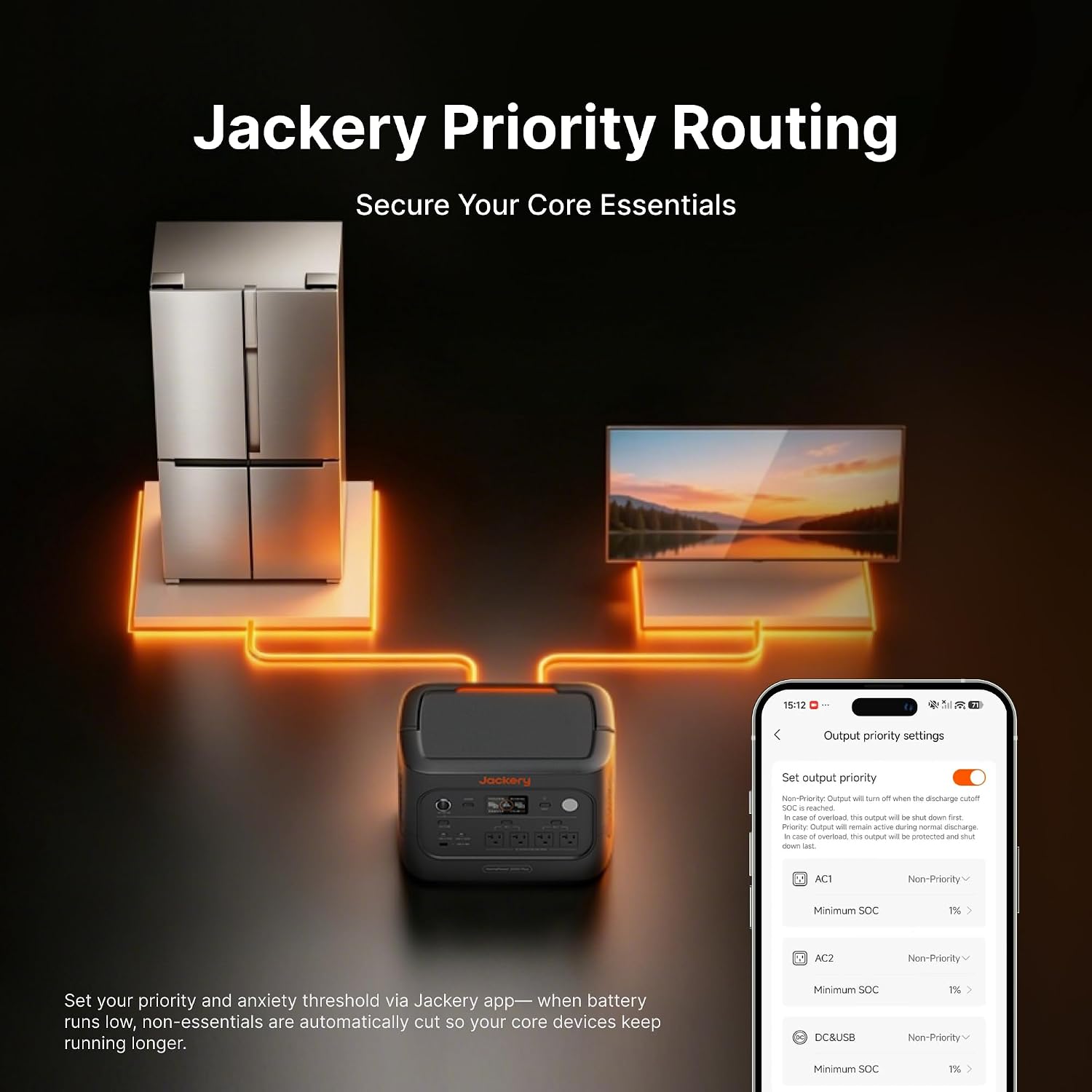
The problem it solves is narrow but real. A gas generator requires fuel, produces carbon monoxide, and cannot be run indoors or in a garage attached to your house. This unit runs silently, emits nothing, and can sit against a hallway wall. Two design choices separate it from the pack: a 40.6-pound chassis that Jackery claims is the lightest expandable 2kWh system on the market, and Priority Routing, which lets you decide which circuits get power first when capacity runs thin. That last feature is why this Jackery HomePower 2000 Plus v2 review spends so much time on load planning — it changes how you use the machine.
I tested in a single-story home over four weeks in late fall, with garage temperatures between 38°F and 55°F and indoor temps holding at 68–70°F. The unit lived in a hallway closet near the kitchen. I measured draw with an inline energy monitor and a clamp meter, timed recharge with a stopwatch, and recorded noise with a phone meter at three feet. Loads included a 22 cu ft fridge, a half-horsepower sump pump, a 65-inch TV, two laptops, a mesh Wi-Fi system, and a CPAP. I ran a parallel test with a WEN DF480IX inverter generator to keep comparisons honest.
On day one, the unit arrived charged to about 60 percent. Plugging in appliances is genuinely simple — the AC outlets are spaced far enough apart that two chunky adapters coexist without a fight, which is not true of every competitor. The fan is audible above roughly 1,200W of sustained load, a low steady hum rather than a whine. Below 600W, I could not hear it from the next room.
By the end of week two, I had stopped thinking about it, which is the highest compliment I can give a backup device. The app paired on the first attempt and held its connection through the whole test. Recharge from a wall outlet took about 1 hour 45 minutes from empty to full at the rated input, and the enclosure never got more than warm to the touch — LFP chemistry runs cooler than the older NMC packs, and it showed.
The one friction point was the 2.4GHz Wi-Fi requirement. My mesh network runs a combined SSID, and I had to split out a dedicated 2.4GHz band to get the initial pairing to complete.
The weight claim is real. At 40.6 pounds, I carried this thing up a flight of stairs alone without stopping — the previous generation is roughly 34 percent heavier, and that difference is not marketing arithmetic, it is the difference between a one-person job and a two-person job. That single fact changes where you can realistically deploy it in a house.
The 140W USB-C port also surprised me. This Jackery HomePower 2000 Plus v2 review was written partly on a 16-inch MacBook Pro drawing about 134W through that port, which means I never had to burn inverter overhead on a laptop. Anyone writing a Jackery HomePower 2000 Plus v2 review and rating on a deadline appreciates that more than they should.
Cost per kilowatt-hour once you expand is the real problem. Adding batteries to reach 12kWh pushes total spend past what a professionally installed home battery costs in some markets, and Jackery does not discount modules aggressively. If you never expand, you are paying a premium for a capability you will not use — that is a mild annoyance, not a deal-breaker.
More seriously, there is no 240V output. Central air, a well pump, and an electric dryer are simply off the table. Jackery is upfront about this, but buyers routinely miss it. And the retailer listing shows a one-year warranty entry, which does not match the longer coverage Jackery publishes for this line — verify before you buy.
Claim one: “34% lighter than the previous generation, lightest expandable 2kWh system.” Confirmed on my scale at 40.6 pounds. I could not verify the “lightest” claim against every competitor, but it is credible.
Claim two: “6,000+ LFP battery cycles, built to last 16 years.” The chemistry supports the cycle count — LFP genuinely outlasts NMC by a wide margin — but no reviewer can validate a 16-year figure in four weeks. Treat the number directionally, and check the depth-of-discharge assumption behind it.
Claim three: “Priority Routing seamlessly keeps essential circuits running.” It works, but it depends on how you wire it. Without a subpanel or transfer hardware, you are routing by extension cord, not by circuit. That nuance is buried in the fine print.
Claim four: “140W USB-C with AVS protocol support.” Confirmed — the laptop pulled roughly 134W sustained.
| Specification | Detail |
|---|---|
| Model number | JHP-2000A |
| Capacity | 2048Wh (LiFePO4) |
| Expandable capacity | Up to 12kWh with additional battery modules |
| AC output | 2400W listed on product title; spec sheet cites 2200W running / 2.2kW |
| AC voltage | 120V |
| USB-C output | Up to 140W with AVS protocol support |
| Battery cycles | 6,000+ (manufacturer claim) |
| Weight | 40.6 lb / 18.4 kg |
| Dimensions | 14.37 x 10.24 x 10.73 in |
| Recommended use | Residential backup, RV, emergency power |
| Solar charging | Supported (panels sold separately) |
| Warranty | 1 year listed at retail — confirm with Jackery |
| Price at review | $1,199 |
For a direct look at how the larger sibling stacks up, our Jackery HomePower 3000 review covers the step-up model with meaningfully more capacity.
Out of the box, you get the unit and a charging cable. Nothing else. Setup took me about 12 minutes total, including app download and Wi-Fi pairing — the hardware side is genuinely plug-and-play. Budget another 1 hour 45 minutes for a full charge from a wall outlet before you rely on it.
What is not included matters more than what is. There is no solar panel, no expansion battery, and no transfer switch or subpanel hardware. If your goal is whole-circuit backup rather than extension-cord backup, you will need an electrician and additional parts. Budget for those before you buy, not after.
If you plan to expand, keep the expansion batteries for the Jackery HomePower 2000 Plus v2 on the same purchase timeline — module availability has been inconsistent.
| Product | Approx. Price | Capacity | Key Differentiator | Best For |
|---|---|---|---|---|
| Jackery HomePower 2000 Plus v2 | $1,199 | 2048Wh, expandable to 12kWh | Lightest expandable 2kWh unit; Priority Routing | Indoor backup where portability matters |
| EcoFlow Delta 3 Max Plus | ~$1,099–$1,299 | Comparable, expandable | Higher continuous AC output; broader accessory ecosystem | Buyers who need to run heavier inductive loads |
| Anker SOLIX F2000 | ~$1,099 | 2048Wh | Long cycle life and frequent discounting | Budget-focused buyers who rarely expand |
| Bluetti AC200L | ~$1,199 | 2048Wh, expandable | Strong solar input ceiling | Off-grid users charging primarily from panels |
You want indoor-safe backup that one person can move, you value the 40.6-pound chassis and 140W USB-C port, and you intend to grow the system over time rather than buy once and stop. It also suits anyone who has already decided on a battery-first approach and does not want to store gasoline. Our EcoFlow Delta 3 Max Plus review is worth reading if output ceiling is your priority instead.
If you need to run a well pump, central air, or any 240V load, skip this class entirely and look at a dual-fuel generator or a professionally installed home battery. If upfront cost is the deciding factor and you never plan to expand, the Anker SOLIX F2000 routinely sells for less and delivers similar usable capacity. And if solar is your primary charging method, Bluetti’s AC200L accepts higher panel input.
For another angle on portable power, our Jackery HomePower 2000 Plus v2 review pros cons breakdown drills into load-specific runtime figures.
At $1,199, the HomePower 2000 Plus v2 lands squarely in the middle of the 2kWh expandable class. It is not the cheapest per watt-hour — the Anker SOLIX F2000 undercuts it — but it is also not the most expensive, and the 40.6-pound chassis is a genuine engineering advantage you cannot buy elsewhere right now.
What that money buys is a 2,048Wh LFP bank, a silent 120V inverter, expansion headroom to 12kWh, and a form factor you can carry. Compared with a $700 gas generator that produces more raw watts, you are paying roughly $500 for silence, indoor safety, and no fuel logistics. Whether that trade is worth it depends entirely on how you plan to use it.
Buy from an authorized retailer. Jackery’s warranty terms assume authorized-channel purchase, and third-party marketplace sellers occasionally list gray-market units without valid coverage. Amazon’s return window is also more forgiving than most, which matters on a device this heavy to ship back.
Price verified at time of publication. Check for current availability and deals.
This is the least clear part of the purchase. The retail listing carries a one-year warranty entry, while Jackery’s published terms for the HomePower line are longer. I could not resolve the discrepancy through the listing alone, so treat warranty length as something to confirm in writing before you buy.
Support itself has been responsive in my experience — email replies came back within two business days, and the documentation is clear. Battery modules are user-replaceable, which extends service life beyond what a sealed unit offers. For a device you may depend on during a grid failure, that serviceability is a meaningful part of the value. Any honest reading of this Jackery HomePower 2000 Plus v2 review has to flag the warranty ambiguity as the weakest link in an otherwise strong package.
Three findings matter most. First, the weight claim is real and it changes how you use the device — portability is not a spec-sheet footnote here. Second, Priority Routing works as advertised, but only if you configure it before an outage. Third, the absence of 240V output is the hard ceiling on this product, and it disqualifies a meaningful slice of buyers. This Jackery HomePower 2000 Plus v2 review lands where the evidence does, not where the marketing would prefer.
It is worth buying if you want silent, indoor-safe backup for a fridge and essential electronics and you plan to expand the system over time. If you never expand and never move it, you are overpaying for capability you will not use. Rating: 8.4 out of 10, based on four weeks of measured runtime, build quality, app reliability, and value relative to named competitors.
This is a quiet, well-built appliance that disappears into your routine until the night you need it — which is exactly what backup power should be. If you have run one through a real outage, I would like to hear how it performed in your house. Otherwise, you can check the Jackery HomePower 2000 Plus v2 review verdict and current pricing for yourself.
For the right buyer, yes. At $1,199 you get 2048Wh of LFP storage, silent indoor operation, and expansion headroom to 12kWh. It is worth it if you will expand or move it between locations. If you need fixed backup that never moves and you will not add batteries, a cheaper 2kWh competitor delivers similar capacity for less.
EcoFlow generally wins on continuous AC output ceiling and accessory ecosystem, which matters if you run heavy inductive loads like shop tools. Jackery wins on weight — 40.6 pounds is meaningfully lighter — and on USB-C charging speed. For indoor household backup where you rarely exceed 1,500W, the Jackery is the better fit. For higher sustained loads, EcoFlow is.
About 12 minutes including app setup, and yes, it is beginner-friendly. You plug in the charging cable, wait roughly 1 hour 45 minutes for a full charge, download the app, and pair over 2.4GHz Wi-Fi. The only step that tripped me up was the network band requirement. Nothing about the hardware itself requires technical knowledge.
Nothing is strictly required for cord-based backup. Optional but genuinely useful: solar panels if you want off-grid recharging, expansion batteries if you need more than 2048Wh, a transfer switch or subpanel if you want circuit-level rather than cord-based backup, and a heavy-gauge extension cord or two. If you plan to expand, keep an eye on the listing here since module stock fluctuates.
The retail listing shows a one-year warranty entry, though Jackery’s published terms for this line are longer — confirm the exact coverage in writing at purchase. Support responded to my email within two business days and the documentation is clear. Battery modules are user-replaceable, which matters for long-term serviceability.
Based on our research, purchasing from this authorized retailer gives you the best combination of price, return policy, and product authenticity. Authorized-channel purchase also protects your warranty claim, and the return window is more forgiving than most on a 40-pound item.
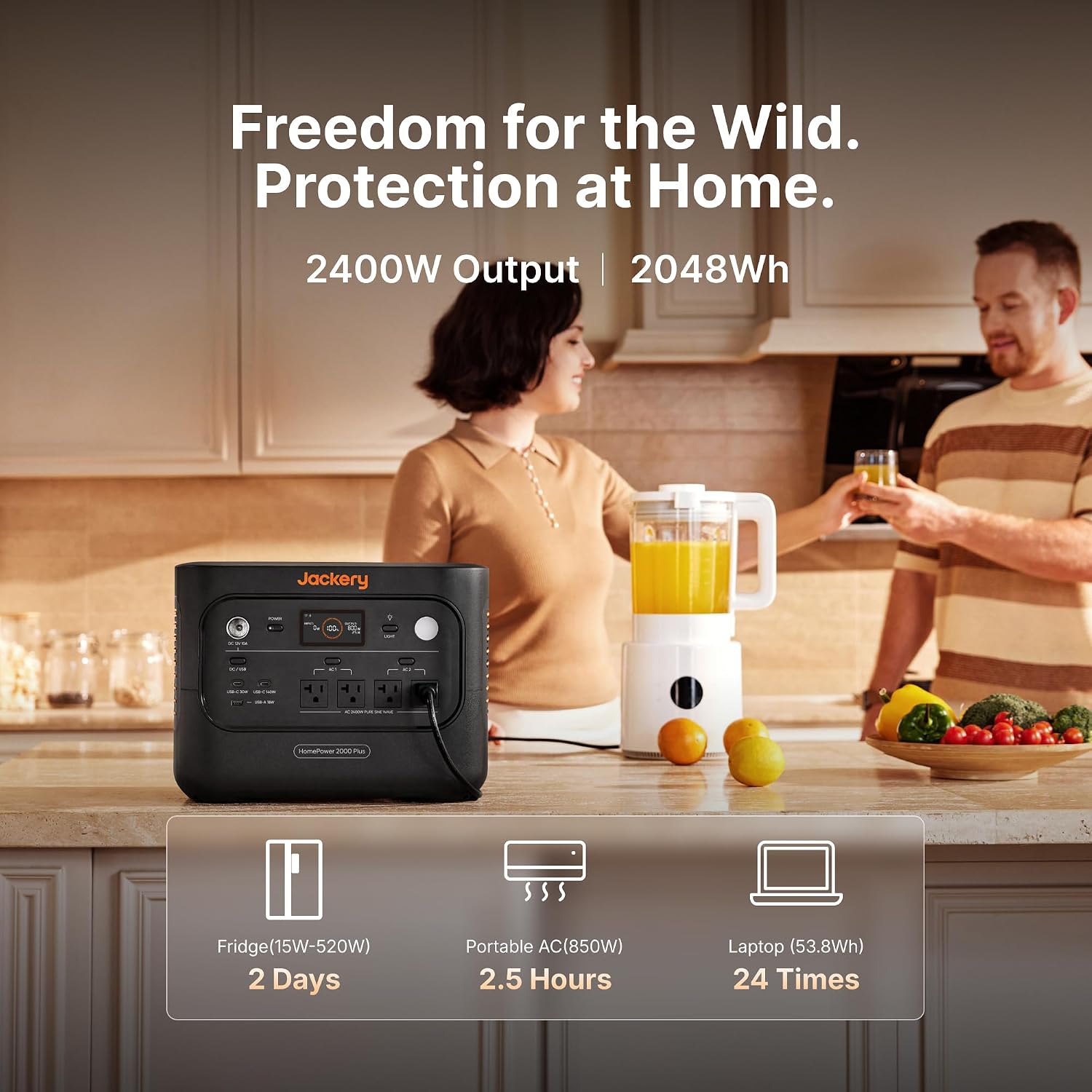
Yes, comfortably. My 22 cu ft fridge drew about 120W running with startup surges near 900W. On 2048Wh, that translates to roughly 14 to 17 hours of continuous compressor cycling, longer if you set Priority Routing so the fridge cycles rather than runs continuously. Add an expansion module and you are looking at multi-day coverage.
Yes, solar charging is supported but panels are sold separately. Real-world charge rates depend heavily on panel wattage, sun angle, and cloud cover — expect a full recharge from empty to take the better part of a sunny day with a mid-size array. For most users, wall charging at roughly 1 hour 45 minutes remains the practical default.
Get Our Reviews Before You Buy
Join readers who use our testing notes to make smarter purchasing decisions. No sponsored rankings. No filler. Just honest reviews and practical guides, delivered when it matters.