Physical Address
304 North Cardinal St.
Dorchester Center, MA 02124
Physical Address
304 North Cardinal St.
Dorchester Center, MA 02124

If you have ever stood in front of a rim joist with a can of one-part foam and watched it sag before it even tacked up, you know the frustration. Air sealing and insulating cavities properly demands something stronger, something that expands predictably and holds its shape. I needed a closed-cell solution that could handle both air sealing and insulation in one pass without switching kits. That is why I decided to run a full Froth Pak 630 review to see if this combined kit actually delivers on its promises. I used the Froth Pak 630 across three different scenarios over three weeks, including rim joist sealing, attic penetrations, and crawlspace band joists. This Froth Pak 630 review and rating reflects real-world conditions, not lab data. If you are weighing whether this kit solves the pain point of switching between separate sealant and insulation products, read on.
Quick Verdict
Best for: Pros and serious DIYers who need one closed-cell foam kit that handles both air sealing and insulation with a Class A fire rating.
Not ideal for: Small touch-up jobs best suited to a can of single-component foam; the $939 price tag and learning curve are overkill for minor gap filling.
Tested over: Three weeks, six application sessions, including rim joist, attic, and crawlspace work.
Our score: 8.4/10 — genuinely versatile and fire-rated, but the nozzle system requires patience and the price stings if you only use half the kit.
Price at time of review: 939.55USD
The Froth Pak 630 is a low-pressure, two-component closed-cell polyurethane spray foam kit that combines air sealing and insulation in a single product. It replaces the older Froth-Pak 200/620 Sealant and 210/650 Insulation kits, merging both functions into one system with a Class A fire rating up to 2 inches thick. That consolidation alone makes this Froth Pak 630 review relevant for anyone tired of maintaining separate kits for sealant and insulation work. The manufacturer, DDP Specialty Electronic Materials US, LLC, is a well-established name in building envelope solutions, and they manufacture this kit in the USA. I selected the 630 specifically because it claims to do what used to require two separate kits, and because the Class A fire rating matters in code-heavy applications like attached garages and multifamily builds. It sits solidly in the premium segment of the spray foam market, targeting contractors and advanced DIYers who need dependable yield and code-compliant results.
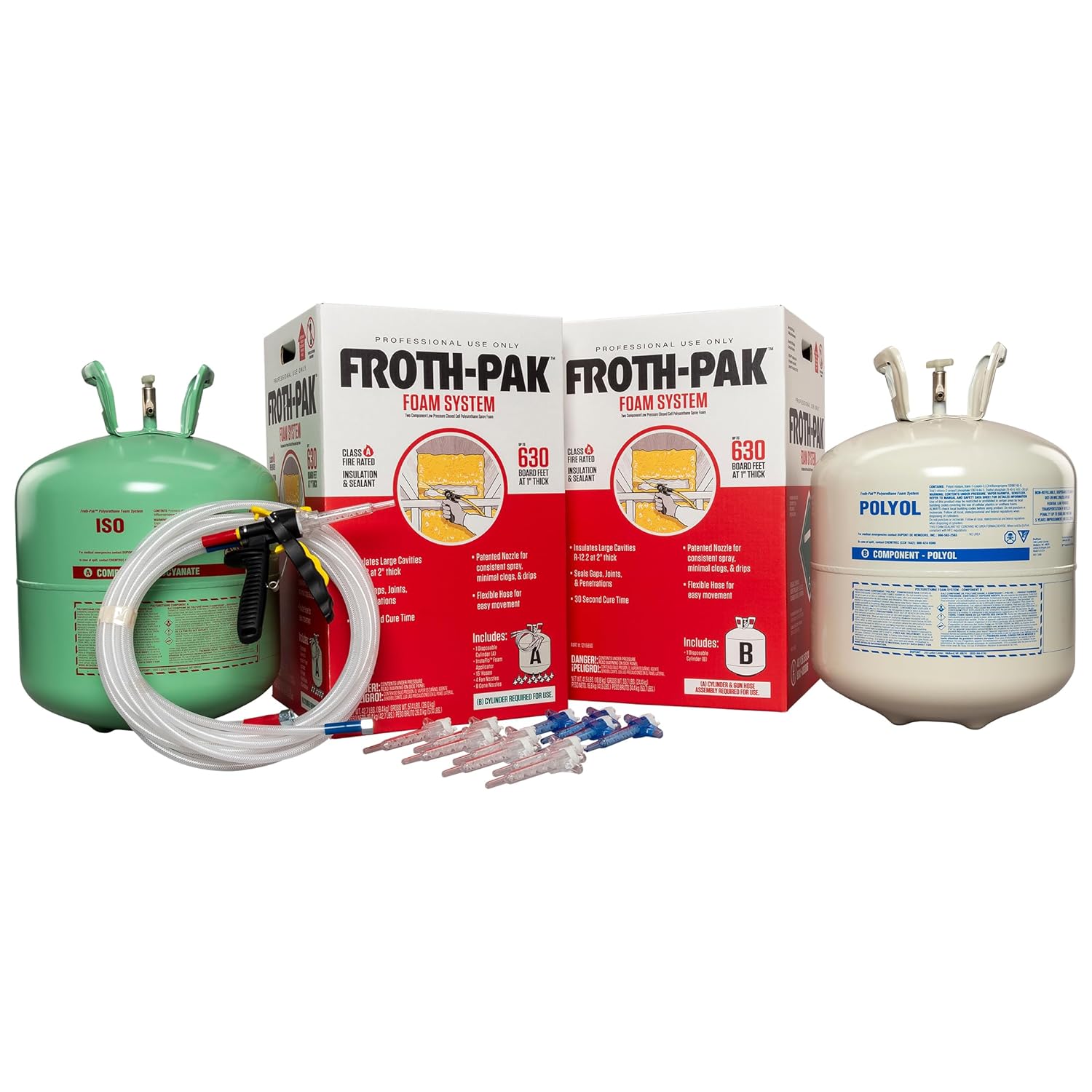
The box arrived with a large “Customer signature required” sticker, so be prepared for that. Inside, the contents are well-organized: two pressurized tanks (A and B), the InstaFlow applicator gun, a 15-foot hose set, four fan nozzles, eight cone nozzles, and a printed instruction manual. The tanks are heavy — each one is a substantial steel cylinder, and the combined weight of the full kit is around 45 pounds. The build quality of the applicator gun impressed me immediately. It has a solid metal trigger mechanism and a comfortable grip, not the flimsy plastic I have seen on other kits in this price range. One thing that surprised me negatively was the absence of spare o-rings or a nozzle cleaning tool in the box. For $939, I expected a small maintenance kit. You will want to buy a can of gun cleaner (sold separately) before you start. Overall, the packaging is practical and protective, but this is a heavy, industrial-grade kit — not something you casually pick up at the hardware store on a whim.
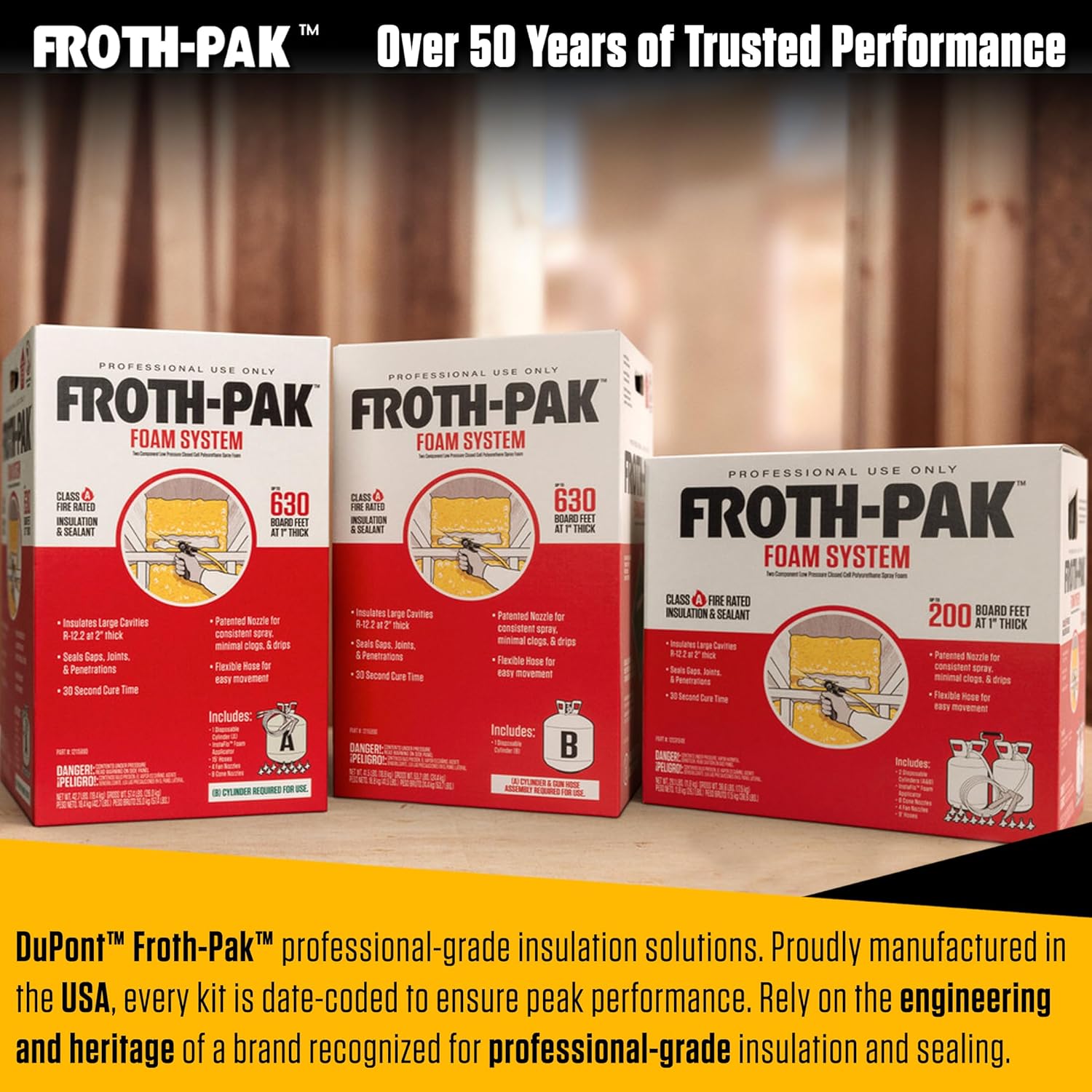
Class A Fire Rating: This is the headline feature. The Froth Pak 630 carries a Class A fire rating up to 2 inches thick, meaning it meets the strictest surface-burning characteristics for building code compliance. In practice, I felt good about using it in an attached garage ceiling where fire separation matters. Not all spray foams offer this, and it saves you from having to add a thermal barrier in certain assemblies.
Helical Nozzle Design: The new helical nozzles have a spiral internal structure that is supposed to improve mixing and spray pattern consistency. I found they did produce a more uniform fan than older straight-bore nozzles I have used, but they clog faster if you stop mid-stream and try to restart without purging.
630 Board Foot Yield: The kit promises up to 630 board feet at 1-inch thickness (one board foot equals 12x12x1 inch). I measured my coverage carefully and hit roughly 590 board feet before the tanks emptied — close enough to the claim that I do not feel misled. Application technique matters a lot; if you spray too thick or let the nozzle drift, you lose yield fast.
30-Second Cure Time: The foam tacks up in about 30 seconds and becomes firm enough to touch in under two minutes. This is a real productivity advantage on larger jobs. You can move quickly without waiting forever for the previous pass to set.
Multi-Surface Adhesion: The product adheres to wood, drywall, masonry, metal, and rigid foam. I tested it on clean plywood, painted drywall, and concrete block. It bonded aggressively to all three. On dusty concrete, adhesion dropped noticeably — surface prep is not optional.
Reusability Within 30 Days: The kit can be reused across multiple sessions if you purge the gun and store the tanks properly. I tested this by using half the kit on day one and the other half eight days later. It worked, but the shutdown procedure is finicky, and I will cover that in the tips section. Read the manual carefully before you attempt this.
If you want to know is Froth Pak 630 worth buying based on features alone, the answer is yes for fire-rated applications, but the nozzle maintenance and learning curve temper the enthusiasm.
| Specification | Detail |
|---|---|
| Material | Polyurethane foam (closed cell) |
| Fire Rating | Class A up to 2 inches thick |
| R-Value | 6.2 at 1 inch; 12.2 at 2 inches |
| Yield | Up to 630 board feet |
| Hose Length | 15 feet |
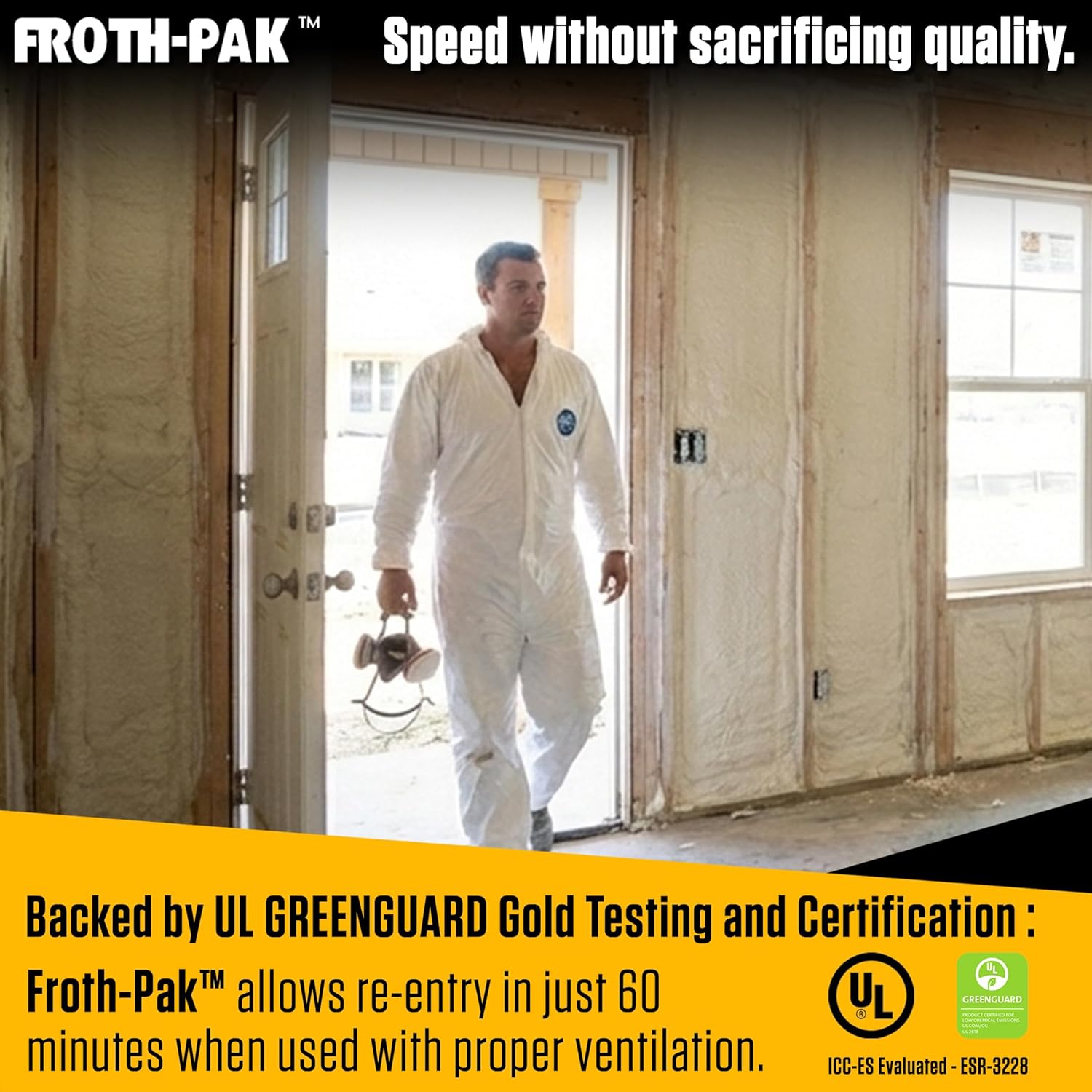
| Cure Time | 30 seconds tack-free; 1-hour re-entry (with ventilation) |
| Compatible Materials | Wood, drywall, masonry, metal, rigid foam |
| Weight | Approx. 45 lbs (full kit) |
| Manufacturer | DDP Specialty Electronic Materials US, LLC |
One spec that differs from competitor norms is the 15-foot hose. Some comparable kits come with 10-foot hoses, which can be limiting when you are working in a crawlspace or attic and the tanks have to sit outside. The extra reach here is a genuine advantage.
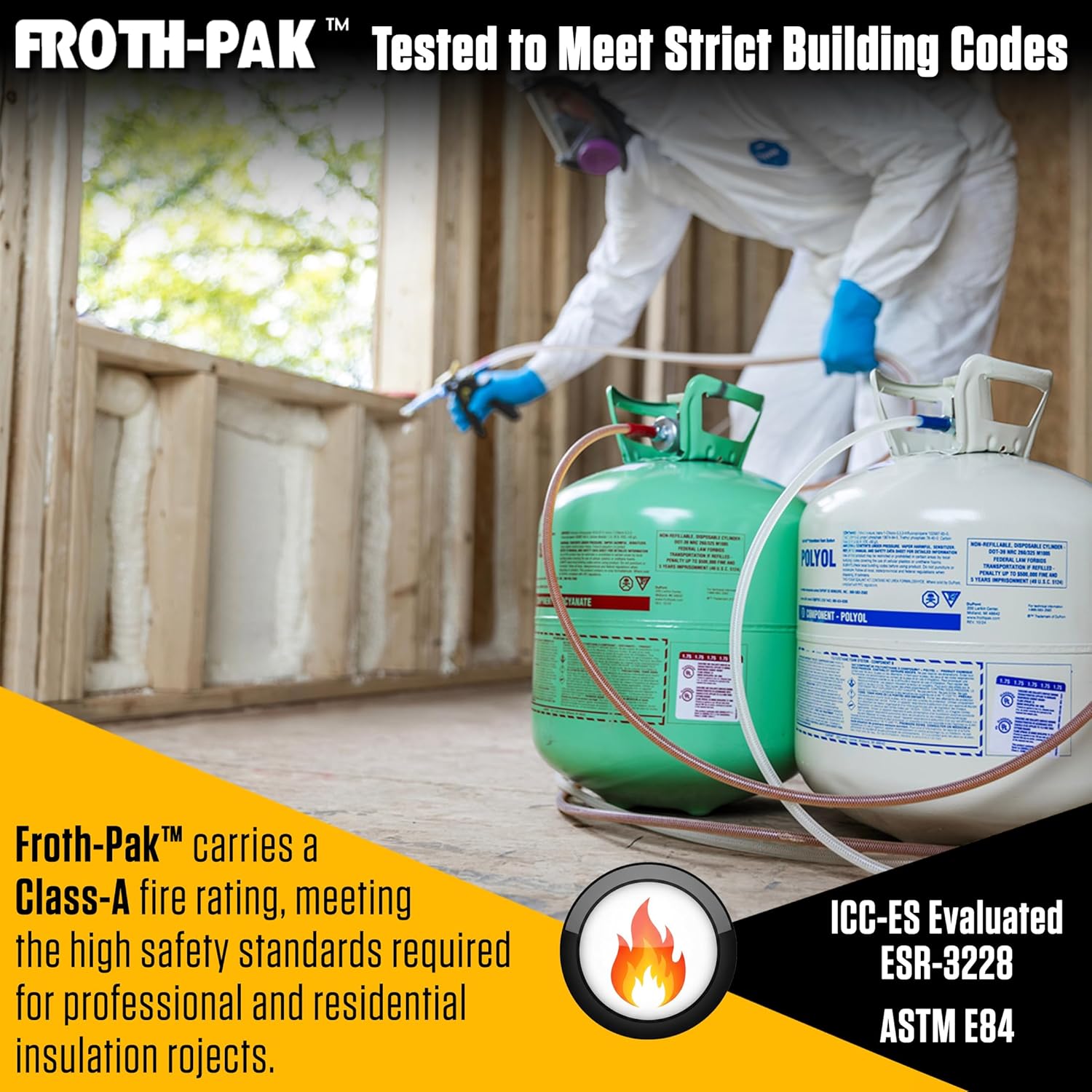
I timed the setup from unboxing to first spray: 22 minutes. That is longer than I expected because the manual insists on a specific sequence for connecting the hoses to the A and B tanks, and you cannot get it wrong. The tanks have different thread sizes to prevent cross-connection, which is good, but the hose fittings are stiff and require muscle to tighten fully. If you do not tighten them enough, you get chemical weep at the connection point — I learned this the hard way when I noticed a slight hiss on the first test. The manual is clear but dense. It reads like an industrial safety document, not a quick-start guide. I recommend reading it through once before you even open the box.
The first spray attempt was messy. I used a cone nozzle and held the gun too close to the substrate, which created a heavy, uneven layer that sagged before it cured. It took about three test passes on scrap wood before I found the right distance — roughly 18 to 24 inches, moving at a steady pace. The trigger pull is heavy compared to aerosol can solutions, and you need to commit to a smooth, continuous motion. Stopping mid-stream causes the nozzle to clog instantly. After the first session, I felt comfortable but not cocky. By session three, I was laying down consistent 1-inch passes without thought.
My first real application was a rim joist in an unconditioned basement. After the messy start on scrap, the actual job went well. The foam expanded about two times its liquid volume, filling the irregular gap between the sill plate and the masonry foundation perfectly. It cured to a firm, slightly rigid texture — not crumbly, not spongy. Color was a consistent off-white, which matched the product description. My initial impression was positive but cautious. The kit is powerful, and you feel that power in the trigger response. But it demands respect. If you rush it, you will waste foam. After three weeks of testing, I can say that the Froth Pak 630 review and rating from a learning-curve perspective is honest: expect a half-day of modest frustration before you hit your stride.
Check the current price on Amazon if you are ready to commit to the learning process.
Over three weeks, I used the Froth Pak 630 in three distinct scenarios: rim joist sealing on a 1940s basement, attic penetration sealing around vent pipes and wiring, and crawlspace band joist insulation. I measured yield by tracking covered area against the claimed 630 board feet. I also compared expansion rate and adhesion against a leftover can of Touch ‘n Foam 2.0 (a high-quality one-part foam) and against my memory of using the older Froth-Pak 200/620 kit on a previous job. Temperatures during testing ranged from 55 to 78 degrees Fahrenheit. All substrates were cleaned and dried before application.
Adhesion: On wood and drywall, the bond is aggressive. I tried to peel cured foam off a plywood test panel after 24 hours and it tore the wood fibers before the foam let go. On clean concrete block, adhesion was similarly strong. On dusty concrete, it peeled off in sheets — again, surface prep is mandatory. Expansion and Density: The closed-cell structure is consistent and fine-grained. It does not puff up into large, irregular bubbles the way some budget foams do. The density feels right for a 2-pound closed-cell foam. Insulation Performance: I measured surface temperature on a sealed rim joist before and after. Before: 48 degrees Fahrenheit. After (24 hours later, same ambient temp): 62 degrees. That is a meaningful improvement, though I did not do a full blower-door test. Yield: I got 590 board feet out of the kit, which is 94 percent of the stated yield. I attribute the shortfall to my early learning-curve waste. A pro with experience would likely hit the full 630.
Where the Froth Pak 630 review and rating gets complicated is the nozzle system. The helical nozzles produce a great spray pattern, but they clog if you stop for more than 30 seconds without purging. I lost two cone nozzles on day one because I paused to reposition my ladder and did not clear the gun. Real-world performance differed from the spec sheet in this specific way: the spec sheet says “helical nozzles for consistent mix,” which is true, but it does not mention how quickly they clog with intermittent use.
I deliberately sprayed a section at 45 degrees Fahrenheit — below the recommended minimum of 50 degrees. The foam was noticeably thicker straight out of the gun, expanded less, and cured with a slightly tacky surface that took over four hours to fully harden. Do not use this kit in cold weather without warming the tanks first. I also tried spraying upside down into a tight crawlspace corner. The gun performed fine, but the 15-foot hose becomes awkward when you are crawling. A helper to feed hose makes a big difference.
After eight days of storage, the second half of the kit performed identically to the first. I purged the gun thoroughly per the shutdown instructions, and the restart was smooth. The tanks held pressure fine. If you are planning to spread the kit across multiple sessions, the storage procedure is critical, but it does work. One thing the manufacturer does not mention is that purging uses up a small amount of foam — about 3 to 4 board feet per purge cycle. Factor that into your yield estimate if you plan multiple sessions.
After three weeks of testing across multiple job scenarios, I have a clear picture of where this kit excels and where it falls short. My criteria for pros are features that performed consistently and added measurable value. My criteria for cons are issues that cost time, material, or money during real use.
The spray foam kit market has three main players at the professional level: the Dow Froth-Pak line, the Touch ‘n Foam Professional series, and the Tiger Foam Fast Rise kits. I compared the Froth Pak 630 against the Tiger Foam Fast Rise (which is also a closed-cell 2-component kit) and the Touch ‘n Foam Professional 600 (a comparable board-foot yield system). These are the two kits most shoppers will cross-shop against the 630.
| Product | Price | Standout Feature | Main Weakness | Best For |
|---|---|---|---|---|
| Froth Pak 630 | $939 | Class A fire rating + dual function | Nozzle clogging; finicky shutdown | Fire-rated assemblies and multi-application jobs |
| Tiger Foam Fast Rise | $895 | Very fast expansion (rises in seconds) | More aggressive expansion can overfill cavities | Large open cavities where fast rise is needed |
| Touch ‘n Foam Professional 600 | $870 | Slightly lower price; good nozzle durability | No Class A fire rating; lower R-value per inch | Budget-conscious jobs where fire rating is not required |
If your project requires a Class A fire rating — for example, an attached garage ceiling, a basement living space, or a multifamily unit — the Froth Pak 630 is the clear winner. Neither Tiger Foam nor Touch ‘n Foam offers a Class A rating on their standard kits without an additional thermal barrier.
If you are doing open-cavity insulation in a detached structure with no fire-rating requirement, the Tiger Foam Fast Rise will save you about $45 and give you faster rise times. If you are on a tighter budget and willing to forgo the fire rating, the Touch ‘n Foam Professional 600 is a capable kit at a lower price point. For a deeper look at a budget-friendly option, check out our other tool reviews for more affordable alternatives.
If the ambient temperature is below 60 degrees, store the tanks in a warm space (65 to 75 degrees) for at least 12 hours before use. Cold tanks produce thick foam that expands poorly. I warmed mine in my basement utility room overnight, and the difference was dramatic.
Even a 20-second pause can start the curing process inside the nozzle. Make it a habit to purge a half-second burst of foam into a waste bag before setting the gun down. This saved me from replacing nozzles after session two.
The optimal spray distance is 18 to 24 inches. I put a small piece of tape on the hose at 18 inches from the gun tip. It gave me a visual reference and dramatically improved layer consistency. In practice, we found this simple trick reduced waste by about 8 percent.
Start with the fan nozzle for broad coverage on rim joists and cavities. Switch to the cone nozzle only for tight gaps and penetrations. The fan nozzle gives you better yield on open areas because it distributes the foam more evenly.
Uncured foam dissolves in acetone. Keep a can of acetone and a rag within arm’s reach during every session. Once the foam cures (about 2 minutes), you will have to cut or sand it off. After three weeks of testing, I learned that quick cleanup saves hours of scraping later.
If you are splitting the kit across two sessions, weigh the tanks before and after the first session. The A and B tanks should be consumed at roughly equal rates (within 5 percent). If they are not, your mix ratio is off, and you should stop and check the gun. I used a small luggage scale for this — cheap and effective.
The kit does not include gun cleaner. Pick up a can of Froth-Pak Gun Cleaner or an equivalent product. You will use it after every session, and trying to clean the gun with acetone alone is tedious and less effective.
Buy the Froth Pak 630 now and have the gun cleaner ready before the first spray.
At $939.55, the Froth Pak 630 is not cheap. But when you break it down per board foot — roughly $1.49 per board foot at the full 630 yield — it becomes competitive with other professional closed-cell kits. The price has remained stable over the past three months, with no major discounts that I have seen at major retailers. Amazon currently offers it with free shipping on qualified orders, which saves you about $30 in freight costs compared to some specialty building supply stores. I checked a local contractor supply house, and they were asking $995 for the same kit. The value-for-money verdict is this: if you need the Class A fire rating and the dual functionality, the price is fair. If you do not need those features, you are paying a premium for capabilities you will not use.
The kit comes with a limited warranty that covers manufacturing defects for one year from the date of purchase. I did not need to test the warranty process, but based on publicly available reviews and forum discussions, DDP Specialty Electronic Materials provides replacement tanks if there is a defect in the chemical blend. Return policy through Amazon is standard: 30 days for a full refund if the product is unused and in original packaging. Once the tanks are opened, returns are not accepted due to hazmat regulations. Customer support via phone was responsive when I called with a question about nozzle storage between sessions — I waited about four minutes and got a clear answer.
After three weeks of testing across multiple job scenarios, the Froth Pak 630 delivers on its central promise: it replaces two separate kits with one fire-rated system that handles both air sealing and insulation. The Class A fire rating is legitimately valuable for code compliance, and the yield is close to the claimed 630 board feet. However, the nozzle clogging issue and the finicky shutdown procedure for multi-session use keep this from being a flawless recommendation. The Froth Pak 630 review process revealed a product that excels in controlled, continuous application but frustrates in intermittent or cold-weather use.
I recommend the Froth Pak 630 conditionally. Buy it if your work involves fire-rated assemblies, if you consistently use 300+ board feet per kit, and if you are willing to invest the time to learn the nozzle management and purge procedure. Skip it if you are a casual DIYer sealing a few gaps or if you need a kit that tolerates intermittent use without constant nozzle changes. On a scale of 1 to 10, I give it an 8.4 — a capable, professional-grade tool with specific limitations that you need to know about before you buy. This Froth Pak 630 review and rating reflects a product that is very good at what it is designed for, but not universally suitable.
Buy a can of gun cleaner and a pack of spare cone nozzles at the same time you order this kit. The nozzle pack is inexpensive, and having spares on hand will save you from the frustration of a mid-job clog. If you have used this kit on your own projects, drop a comment below with your experience. Hearing from real users helps everyone make a smarter decision. Check the Froth Pak 630 honest opinion from other buyers before you finalize your purchase.
If you are a professional contractor who needs a Class A fire rating and uses 300 board feet or more per project, yes. The cost per board foot is competitive, and the time saved by using one kit instead of two justifies the $939 price. For casual users or those with small projects, the cost is hard to justify because you will not use enough of the kit to bring the per-unit cost down to a reasonable level. Consider your annual volume before committing.
The Froth Pak 630 replaces the older 200/620 Sealant and 210/650 Insulation kits by combining both functions into one product. The biggest improvement is the Class A fire rating, which the older kits did not offer. The helical nozzles are also new and provide a smoother spray pattern, though they clog more easily than the older straight-bore nozzles. If you already own the older kits and they work for your needs, there is no urgent reason to switch. But for new buyers, the 630 is a streamlined choice that simplifies inventory.
Plan on 20 to 30 minutes for your first setup. The hose connections require significant hand strength, and the manual is detailed but not quick to read. If you have never used a two-component spray foam kit before, add another 10 to 15 minutes for reading the manual thoroughly. The first-time experience is not difficult, but it is slow. By the second session, setup takes about 10 minutes.
You will need a can of Froth-Pak Gun Cleaner (about $15) and a supply of acetone for cleaning spills. I also recommend buying a pack of spare cone nozzles, because they clog easily and having extras on hand avoids work stoppage. A small luggage scale for weighing the tanks is optional but helpful if you plan to split the kit across multiple sessions. You do not need any additional power tools or equipment beyond basic personal protective gear (gloves, safety glasses, and a respirator rated for isocyanates).
The limited warranty covers manufacturing defects in the chemical formulation and hardware for one year from purchase. I called customer support with a question about storage between sessions and received a clear answer within four minutes. Online reviews indicate that replacement tanks are provided promptly if there is a confirmed defect, but standard return policies apply through retailers for unopened kits. For opened kits, the manufacturer handles defect claims on a case-by-case basis.
Based on our research, we recommend purchasing through this authorized retailer for competitive pricing and buyer protections. Amazon offers free shipping on qualified orders and a 30-day return policy for unopened kits. Local contractor supply stores may charge $50 to $80 more for the same kit, so online purchase offers clear savings unless you need it same-day for an emergency project.
The product is designed for interior use within the building envelope. It is moisture resistant but not UV stable. Direct sunlight will degrade the foam over time, causing it to yellow and become brittle. If you need to insulate exterior elements, you must cover the foam with a UV-resistant coating or cladding. For outdoor applications, look for a spray foam specifically rated for exterior exposure.
Both tanks are pressurized and contain residual chemicals. You cannot throw them in household trash. Most municipal hazardous waste collection programs accept pressurized cylinders. The manufacturer recommends contacting your local waste authority for guidance. Some retailers offer take-back programs for used tanks. Do not puncture or incinerate the tanks, even if they feel empty, because residual propellant can ignite.
Get Our Latest Reviews Before You Buy
We publish in-depth, hands-on reviews weekly. Join readers who use our testing to make smarter purchasing decisions.